

Ecosystem partnerships are a powerful growth strategy for developer tool companies. By leveraging integrations, marketplace listings, and co-marketing efforts, businesses can reduce customer acquisition costs, improve retention, and expand their reach. Here's why it works:
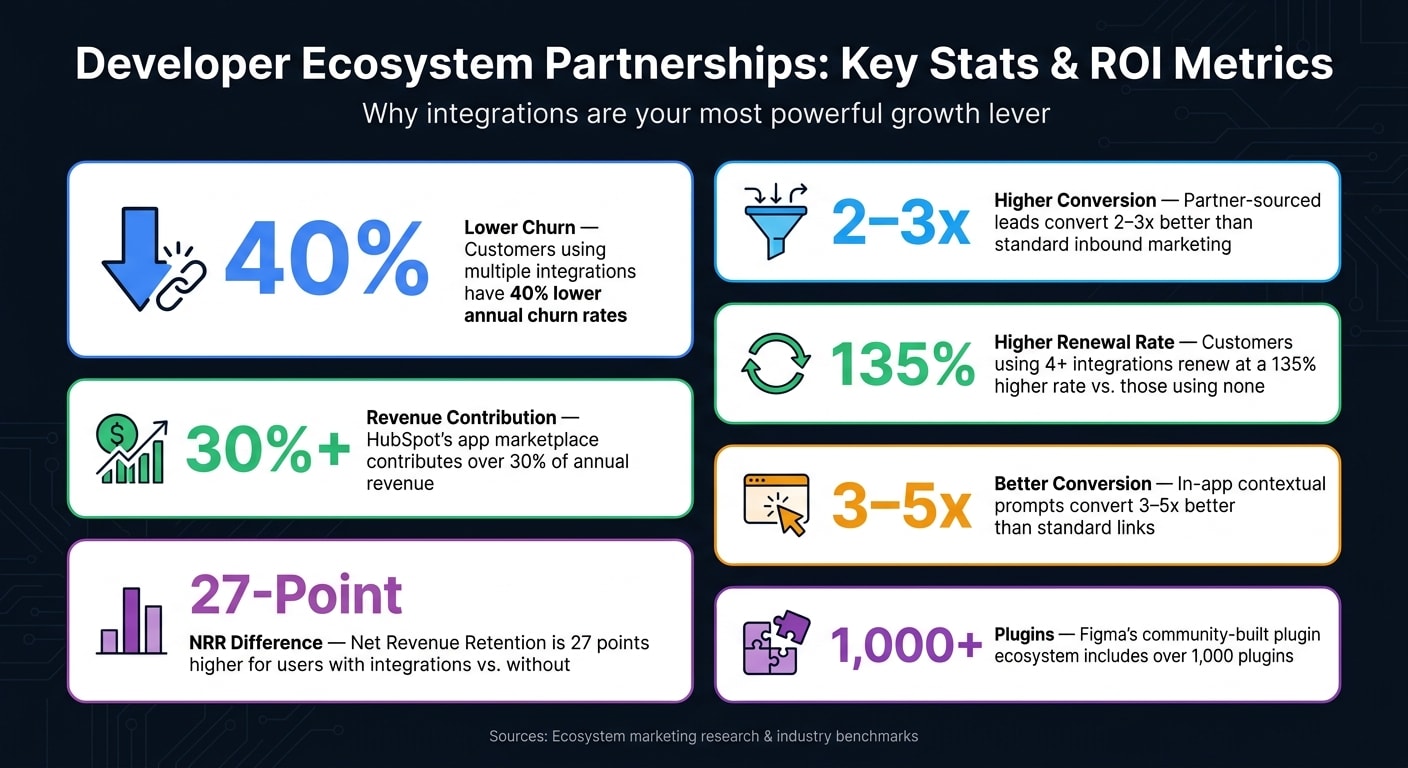
- Lower Churn: Customers using multiple integrations are less likely to leave - churn rates drop by 40%.
- Higher ROI: Leads from partnerships convert 2–3x better than standard inbound marketing.
- Revenue Impact: Ecosystems drive significant growth - HubSpot’s app marketplace contributes over 30% of its annual revenue.
This guide explains how to transform your product into a platform by building integrations, optimizing marketplace visibility, and creating targeted content for developers. The takeaway: Ecosystem marketing isn’t just an add-on; it’s a scalable way to grow your business while boosting customer loyalty.
Core Types of Developer Ecosystem Partnerships
Not all ecosystem partnerships operate the same way. Each model serves a distinct purpose, engages with different audience touchpoints, and delivers unique results. Knowing which type aligns with your goals is the first step to crafting a strategy that drives meaningful progress.
Marketplace Listings and App Store Presence
Placing your product on platforms like AWS, GitHub, or VS Code stores puts it in front of developers actively seeking solutions. The real benefit goes beyond visibility - it’s the trust these platforms establish. They handle critical aspects like billing, security reviews, and compliance checks, which can dramatically shorten enterprise sales cycles by eliminating the need for separate vendor assessments.
Platforms such as AWS use AI-powered recommendations based on metadata, past performance, and specialization indicators. This means the quality of your listing is crucial to ensuring it reaches the right audience . From here, the next step is embedding your product into developers' daily workflows through technology integrations.
Technology and Integration Partnerships
Integration partnerships focus on connecting your product with tools developers already rely on - using APIs, SDKs, plugins, or CI/CD hooks. The aim? To weave your product into their workflows, making it harder for them to switch to alternatives.
The importance of this approach is backed by data. As Kenny Browne explains:
"Whether or not it works with their existing tech stack is a top three buying consideration."
This is why companies like HashiCorp invest in creating extensive libraries of Terraform providers and why Figma’s plugin ecosystem, which includes over 1,000 community-built plugins, has become a major competitive advantage. Each integration strengthens product loyalty and retention.
To scale these efforts, you’ll need to offer a robust developer portal. This should include API credentials, clear documentation, sample code, and sandbox environments . Beyond technical integrations, co-marketing initiatives can amplify your product’s credibility and expand its reach.
Co-Marketing and Platform Partnerships
Co-marketing partnerships - such as joint webinars, co-branded solution pages, and shared launch campaigns - are a powerful way to build credibility and extend your reach. Partnering with a well-known platform immediately enhances your brand’s reputation.
Platform partnerships, like AWS’s ISV Accelerate program, take this further by offering prioritized placement within a larger provider’s sales network. These programs often require passing a Foundational Technical Review (FTR), which signals to the provider’s sales team that your product meets enterprise-grade standards . The "Better Together" narrative - showcasing how your solution complements a partner’s platform to solve unique problems - resonates strongly with technical buyers who value compatibility across their tech stack.
| Partnership Type | Primary Goal | Key Success Metric |
|---|---|---|
| Marketplace Listings | Procurement & Trust | Conversion rate (view to install) |
| Technology Integrations | Retention & Stickiness | Monthly active integrations |
| Co-Marketing & Platform | Reach & Validation | Partner-influenced revenue |
Optimizing Your Marketplace Presence
Once you've chosen your partnership types, it's time to make sure developers can easily find your product. If your listing isn't discoverable, it won't succeed as a distribution channel. To stand out, you need to optimize your listing with strategies that improve visibility.
Ranking Factors in Developer Marketplaces
Developer marketplaces rank listings based on factors like recent activity and quality. Key signals include recent installs, the volume of reviews, and how fresh those reviews are. A strong launch effort can help you climb the rankings faster than relying on gradual, organic growth. One effective approach is automating review requests as part of your integration's success flow. For example, trigger a request about 14 days after activation - this timing hits a sweet spot when users have seen the value of your product but haven't yet moved on to other priorities .
By focusing on these ranking signals, you lay the groundwork for creating a listing that not only attracts attention but also converts visitors into users.
Building Effective Marketplace Listings
When crafting your marketplace listing, avoid leading with a laundry list of features. Instead, highlight the outcomes developers can achieve. For instance, a statement like "Monitor Kubernetes costs in real time inside your existing AWS console" speaks directly to a developer's goals, making it far more compelling than a generic list of specs.
A winning listing typically includes a clear value proposition, a concise explanation of how the integration works, step-by-step setup instructions, and visuals that show the product in action. When it comes to keyword targeting, focus on long-tail phrases such as "Connect [Your Product] with [Partner Tool]" or "[Partner Tool] integration for [Your Product]." These phrases attract developers who are already searching for specific workflows . Pair a well-optimized listing with external campaigns to boost your marketplace ranking even further.
Driving Installs Through External Channels
Consistent installs are key to improving your marketplace ranking, and external marketing can directly impact this. In-app cross-promotion stands out as one of the most effective tactics - contextual prompts shown at the right moment convert 3–5 times better than standard links . If you're working with a partner, aim for mutual in-app placements instead of settling for a simple logo feature.
For paid strategies, platforms like daily.dev Ads let you target developers who are already part of your ecosystem. For example, you can reach developers using your partner's product and deliver a tailored message about your native integration. This focused approach is often more efficient than broad awareness campaigns. Together, these external efforts and your integration partnerships create a solid foundation for sustainable growth.
"The partner ecosystem is the ultimate multiplier for growth. You can 10X your resources without 10Xing your cost." - Carlos Roman, Global Head of Partner Marketing, Databricks
Integration-Driven Content Marketing
Using integration-driven content marketing turns every technical partnership into an opportunity for growth. Each integration should be treated as its own content campaign, complete with landing pages, documentation, and a clear distribution strategy.
Creating Integration Landing Pages
Every integration deserves its own landing page. Why? Because developers often search for specific solutions, using queries like "connect Datadog with PagerDuty" or "GitHub integration for Jira." A dedicated page helps capture this long-tail search traffic.
The structure of these pages is crucial. Start by highlighting the joint value - what users can achieve by combining the tools - rather than overwhelming them with technical specs. Include a simple diagram showing how data flows between the tools, a few practical use cases, and a straightforward setup guide. This approach answers the key question developers have: "Will this work for me?"
From an SEO perspective, focus on optimizing for product pair names, such as "Datadog + PagerDuty." Use these terms in your HTML <title> tag and H1 heading. Over time, these small optimizations can drive meaningful organic traffic.
Once you've captured attention with a compelling landing page, detailed documentation becomes the next step in ensuring adoption.
Building Integration Documentation
Integration documentation should prioritize getting users to their first successful result quickly. A quickstart guide is essential. As Riley Carr from G2 explains:
"Quickstarts and walkthroughs minimize time to first API call."
Beyond the quickstart, include sample code in two or three popular programming languages, provide a sandbox environment for safe testing, and offer a troubleshooting section. The goal? Developers should be able to register, grab API credentials, and start testing without needing to contact support.
Organize documentation consistently across all integrations. Each should include sections like an overview, prerequisites, step-by-step setup, configuration examples, and a troubleshooting FAQ. This consistency reduces the cognitive load for developers who might use multiple integrations. And the benefits are clear: customers using four or more integrations renew at a 135% higher rate than those using none .
Once your documentation is in place, the next step is promoting your integration content effectively.
Promoting Integration Content
Promotion starts within your product. Adding an "Integrations" tab to your main app navigation makes it easy for users to discover new connections while they’re already engaged with your platform. This approach often leads to higher install rates compared to external campaigns . Complement this with deep links in email campaigns that take users directly to the integration setup page inside their account, eliminating unnecessary steps.
To reach developers outside your existing user base, platforms like daily.dev Ads allow you to target by specific tools and tech stacks. For example, you can promote your Terraform integration directly to developers already using Terraform. This precise targeting ensures your content reaches the right audience, making your efforts more effective than broad awareness campaigns.
| Promotion Channel | Primary Benefit | Key Metric |
|---|---|---|
| In-App Marketplace | High adoption among existing users | Integration install rate |
| Integration Directory | Organic discovery via SEO | Search ranking for "[Tool A] + [Tool B]" |
| Developer Ads | Precise targeting by tech stack | Cost per qualified lead |
| Co-Marketing | Shared authority and lead pool | Joint registrations/downloads |
| Documentation Portals | Self-service adoption | Time to first API call |
Measuring the ROI of Ecosystem Marketing
Once you've launched integrations and established promotion channels, the next big step is proving the ROI. Ecosystem marketing doesn’t just expand your audience - it delivers measurable results. When done right, the insights you gather can be incredibly persuasive.
Key Metrics for Ecosystem Success
A critical metric to monitor is your integration attach rate - the percentage of customers using at least one integration. Why does this matter? Customers who adopt multiple integrations see a 40% lower annual churn rate. Additionally, when you segment Net Revenue Retention (NRR) by integration depth, there's a striking 27-point difference between users with integrations and those without . These numbers make a strong case for ecosystem investment, especially when presenting to company leadership.
| Metric Category | Key Metrics | Why It Matters |
|---|---|---|
| Discovery | Impressions, CTR, Unique Visitors | Tracks top-of-funnel visibility |
| Engagement | Monthly Active Integrations, Time on Page | Shows how sticky and engaging your product is |
| Conversion | Install Rate, Trial Starts, Demo Requests | Measures lead generation and user interest |
| Retention/ROI | Attach Rate, Partner-Sourced Pipeline, NRR | Links ecosystem efforts to revenue and growth |
| Technical | API Error Rates, Documentation Views | Evaluates the developer experience and usability |
Attribution Across Partner Channels
To make the most of these metrics, you need to accurately attribute revenue to the right sources. This can be tricky in ecosystem marketing. For example, a developer might first find your tool through a search engine, later join a co-marketing webinar with a partner, and finally sign up through a marketplace listing.
A practical way to handle this is by separating partner-sourced revenue (deals originating directly from a partner channel) from partner-influenced revenue (deals where a partner or integration played a role at some point in the customer journey). Tools like Crossbeam can help you map overlaps between your CRM and partner databases, ensuring that influenced accounts are properly tagged. Why does this matter? Partner-sourced leads convert at rates 2–3x higher than those from inbound marketing .
Using daily.dev Ads to Amplify Results
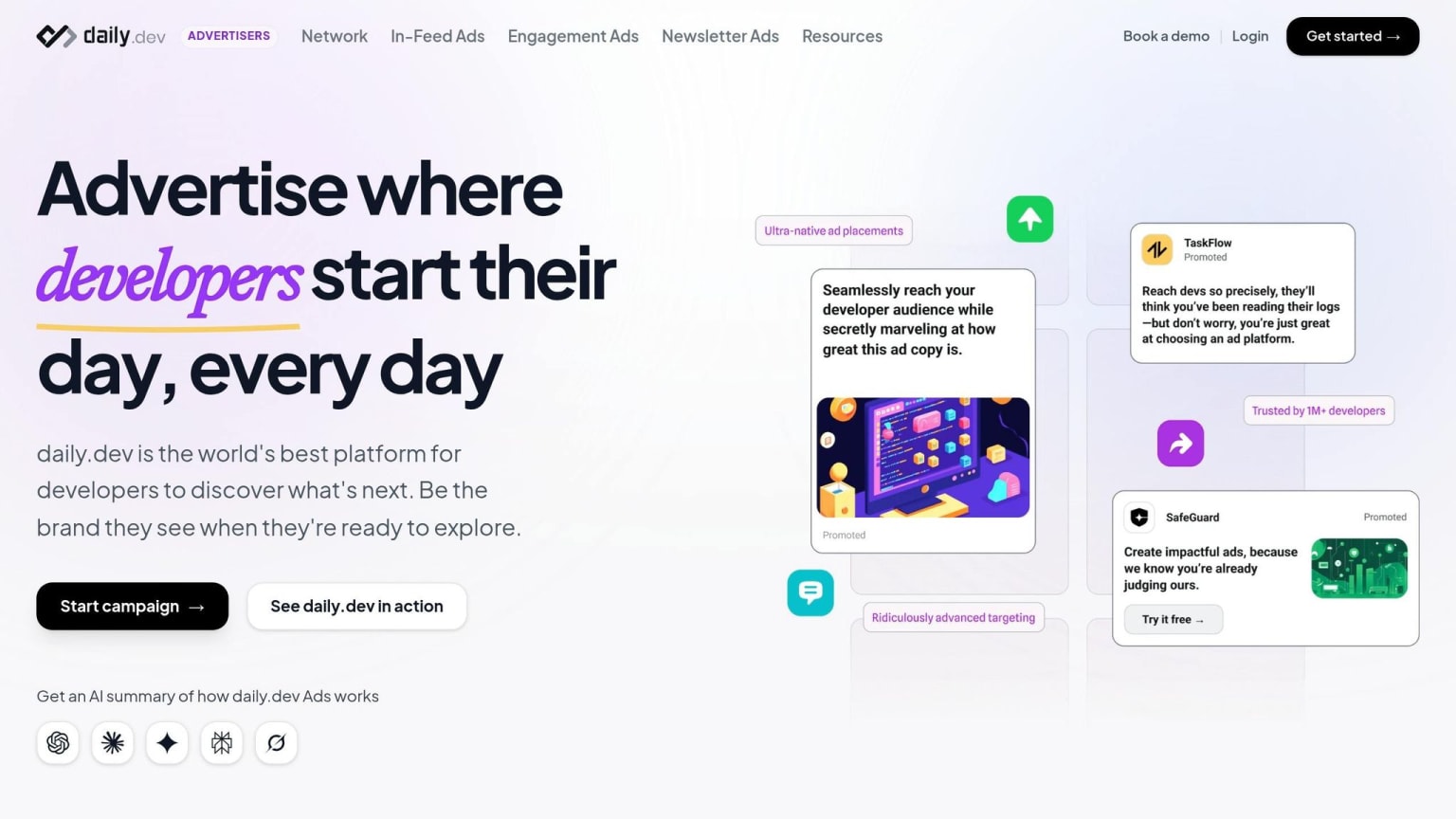
Ecosystem marketing creates organic growth, but paid advertising can speed things up - especially when you’re launching a new integration or targeting a specific tech audience. Platforms like daily.dev Ads let you reach developers based on the tools they use. For instance, you could promote a Terraform integration directly to Terraform users or highlight your GitHub Marketplace listing to developers working on CI/CD workflows.
With its built-in real-time performance tracking, daily.dev Ads allows you to link ad impressions and clicks directly to marketplace installs or visits to your integration pages. This feedback loop helps you decide where to double down on your ecosystem partnerships for the best results.
Conclusion: Scaling Developer Ecosystem Marketing
Here’s the key takeaway: Integrations are a game-changer for distribution. Developers consistently rank stack compatibility as one of their top buying considerations. That’s why the most successful developer tool companies don’t treat their ecosystems as an afterthought - they treat them as critical assets. And it pays off: companies with multiple integrations see higher renewal rates, making ecosystem investments an easy sell to leadership.
To scale effectively, transition from one-off integrations to a self-service platform with automated workflows. This might include developer portals, submission workflows, or in-app marketplaces that grow without derailing your product roadmap. A great example is Slack, which initially built a handful of integrations in-house before opening its APIs to third-party developers. That controlled-to-open strategy has been a cornerstone of its ongoing success .
Once your ecosystem expands, measuring its impact is essential. Track metrics like integration attach rates, renewal uplift, and partner-influenced pipeline. Define clear milestones and don’t hesitate to cut partnerships that fail to deliver results.
With solid performance tracking in place, focus on amplifying your reach. Organic growth can be slow, so to speed up adoption or target specific developer groups, tools like daily.dev Ads can help you reach the right audience with precision - whether by seniority, programming language, or tech stack. By combining automation with targeted outreach, you can turn your ecosystem into a sustained growth engine.
FAQs
Which integrations should we build first?
Begin by taking a closer look at your ecosystem to spot key patterns. These could include existing integrations, connections built by partners, or frequent customer requests. Pay extra attention to integrations that cater to high-intent user needs - buyers often choose tools based on how well they fit into their existing tech stack.
When prioritizing, focus on gaps that directly affect revenue generation or customer retention. Before diving into co-marketing efforts, make sure the integration is fully functional and actively used by shared customers. Once ready, showcase it in a centralized, SEO-optimized marketplace. This approach can significantly enhance visibility and increase adoption rates.
How can we improve marketplace ranking quickly?
To improve your marketplace ranking quickly, prioritize SEO and user engagement. Start by creating SEO-friendly landing pages for each integration. These pages should highlight clear value propositions, include well-crafted metadata, provide straightforward installation instructions, and feature screenshots to help users understand the offering.
Centralize all your listings in a searchable marketplace to make navigation easier for users. Use in-app placements strategically to encourage activation and drive user interaction.
For an additional boost, consider running co-marketing campaigns. Collaborate on joint webinars or create co-branded content to increase traffic and foster engagement. These efforts can help attract more users while strengthening partnerships.
How do we attribute partner-influenced revenue?
To effectively track partner-influenced revenue, it's crucial to centralize your ecosystem into a single system. This allows you to monitor key factors like integration-related pipeline, product adoption tied to specific integrations, and marketplace transactions. Some essential metrics to keep an eye on include:
- Monthly active integrations: Gauge how often integrations are being used.
- View-to-install conversion rates: Measure the percentage of users who move from viewing an integration to installing it.
- Revenue from partner-sourced leads: Track how much revenue is directly tied to leads generated by your partners.
For enterprise hyperscaler partnerships, the focus should shift to mutual customer wins. Make sure to link opportunities directly to specific accounts and marketplace transactions. Avoid relying on vanity metrics or generic leads that don't provide actionable insights.