

Developers are hard to reach with traditional marketing tactics like ads and cold outreach. Growth loops offer a better alternative. Unlike funnels, which rely on constant spending, growth loops create self-sustaining cycles where each user action brings in more users. This approach is perfect for developer tools, as it aligns with how developers discover and adopt products - through peer recommendations, documentation, and integrations.
Key insights:
- What are growth loops? Self-contained systems where user actions generate visibility or value, feeding back into the loop.
- Why they work: Developers prefer organic discovery methods, like open source contributions, SEO-friendly documentation, and integrations.
- Examples: Tools like Snyk, Supabase, and Vercel use growth loops to scale without heavy ad spending.
- Metrics to track: Viral coefficient (>0.2), doc-to-trial rate (3–8%), and PQL-to-paid conversion (15–30%).
This guide covers five main growth loops (open source, documentation-SEO, integrations, community content, and advocacy) and explains how to layer paid ads strategically for amplification. If you're ready to scale, you can advertise with daily.dev to reach a highly targeted developer audience. Growth loops are a sustainable way to scale developer tools while reducing reliance on paid acquisition.
The Core Growth Loops for Developer Products
Different growth loops align with various stages of a product's development. Below, we'll dive into three highly effective loops for developer tools. Each one builds momentum in its own way, offering a clear path to kickstart and scale growth.
The Open Source Contribution Loop
A smart open source strategy doesn't just offer a stripped-down version of your product. Instead, it provides a tool that solves a specific workflow problem, earning developers' trust before they even look at your pricing page. Think of it like a Trojan horse: the free tool draws developers in, and when their needs expand, they naturally upgrade to the paid version .
Take Vercel as an example. By open-sourcing Next.js, they positioned their hosting platform as the go-to solution for teams ready to deploy. Similarly, Supabase created an open, developer-first platform where the community could contribute, extend, and advocate. The result? Enterprise adoption that's 45% faster compared to proprietary alternatives . Both approaches demonstrate how open source can build trust and familiarity, speeding up the transition to paid tiers.
To make this loop work, treat your GitHub README like a landing page. Include clear descriptions, GIFs showcasing the tool in action, and "good first issue" labels to make it easier for newcomers to contribute. Each contribution improves the product, attracting more users and creating a self-reinforcing cycle . This sets the foundation for engagement across other growth loops.
The Documentation-SEO Loop
Beyond open source, great documentation is another essential pillar of developer-led growth.
"Documentation is your single highest-ROI marketing channel." - SaasOpportunities
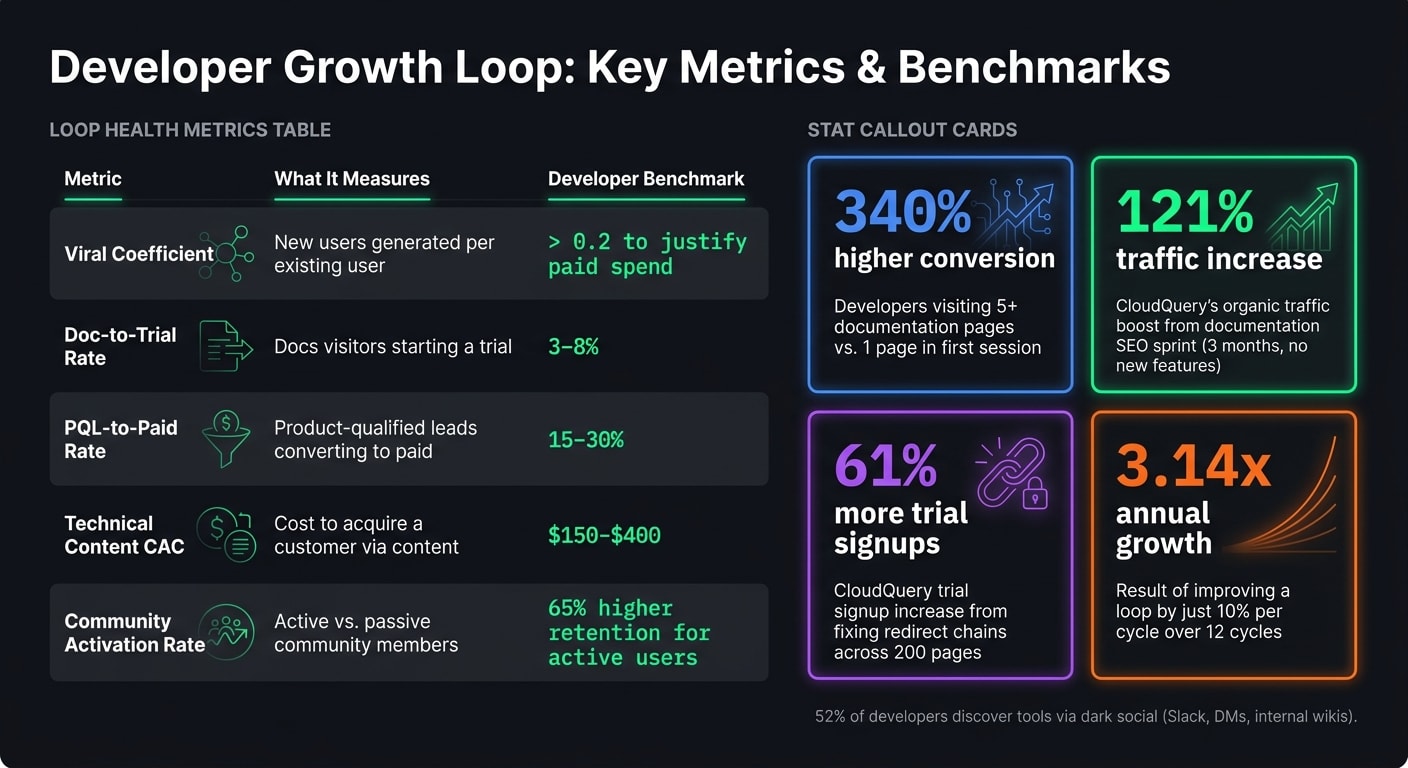
The best docs don’t just explain your product - they address the problem developers are trying to solve. For instance, a guide titled "How to Handle Webhook Retries in Python" meets developers exactly when they're stuck. And here's the kicker: developers who interact with five or more unique documentation pages during their first session convert at a 340% higher rate than those who only visit one page .
Case in point: In early 2026, Joe Karlsson of CloudQuery ran a three-month sprint focused on SEO and technical content updates. The results? A 121% boost in estimated daily organic traffic, 426 keywords breaking into the top 10 rankings, and a 61% increase in trial signups - all without launching new features or spending on ads .
There's also a newer angle to consider: Generative Engine Optimization (GEO). Tools like Cursor and Claude Code use structured documentation to generate code suggestions. As Joe Karlsson explained:
"Your README, your examples directory, your API reference, and your SDK docs are your LLM marketing." - Joe Karlsson, Developer Advocate, CloudQuery
In other words, high-quality documentation doesn't just rank on Google - it gets surfaced by AI tools, introducing your product to developers who may not even be actively searching for it.
The Integration and Marketplace Loop
Integrations open up entirely new acquisition channels. Listing your tool in places like the VS Code Extension Marketplace, GitHub Marketplace, or Vercel Integrations puts it in front of developers actively seeking workflow solutions. These users are already primed to take action, making them a far more targeted audience than general advertising .
This loop compounds over time because integrations naturally embed your tool into developers' workflows. For example, Snyk's GitHub integration scans repositories and opens fix Pull Requests, making the tool visible to every collaborator on that project - without any outbound effort . Even mid-tier integration directories can generate between 500 and 2,000 impressions per month, and unlike paid search (where developer-related keywords can cost $5–$15 per click), marketplace traffic brings built-in intent .
When writing marketplace listings, focus on the problem your tool solves rather than just listing features. Developers browsing these directories are looking for solutions, not product names. Integrations not only expand your reach but also amplify the impact of your open source and content strategies, creating a powerful compounding effect.
How to Layer Paid Ads onto Organic Growth Loops
When to Add Paid Advertising
Paid advertising works best when it enhances growth loops that are already effective. Don’t jump into ad spending until your loop is producing second-order effects, like developers recommending your tool on Discord or community members engaging on their own. A growth expert from restruggle.com put it perfectly:
"The day we turned off paid marketing, growth flatlined. We'd built a leaky bucket with an expensive hose, not a sustainable growth engine." - Author, restruggle.com
The right time to add ads is when your loop’s viral coefficient exceeds 0.2, and the main bottleneck is awareness or reach - not issues with product-market fit. Once your loops are validated, paid ads can amplify their success, rather than trying to patch holes in a weak system.
Using daily.dev Ads to Speed Up Existing Loops
With a validated loop in place, paid ads should enhance your organic pull, not disrupt it with irrelevant promotions. Developers are naturally skeptical of generic ads, so focus on delivering content that’s genuinely useful - like technical guides, open-source tools, or announcements about integrations.
This is where daily.dev Ads shine. They’re designed to promote high-performing content, such as technical tutorials, marketplace integrations, or key product milestones. With precise targeting options - like seniority level, programming language, and specific tools - you can reach the developers who are most likely to engage with your loop .
"Growth for developer tools is not about noise. It's about alignment between product quality and visibility structure." - Sunil Joshi, Co-Founder, Shadcn Space
The key is to identify which loop entry point has the highest organic conversion rate. Then, use paid campaigns to drive more traffic to that entry point. The goal isn’t to replace the loop but to scale its effectiveness.
Measuring How Paid Ads Affect Loop Performance
Once you’ve scaled your loop entry points with paid ads, it’s important to measure how they’re impacting overall loop performance. Instead of focusing on raw clicks, track metrics that are specific to your loop’s success:
| Metric | What It Measures | Developer Benchmark |
|---|---|---|
| Viral Coefficient | New users generated per existing user | > 0.2 to justify paid spend |
| Doc-to-Trial Rate | Percentage of docs visitors starting a trial | 3–8% |
| PQL-to-Paid Rate | Product-qualified leads converting to paid users | 15–30% |
| Technical Content CAC | Cost to acquire a customer via content | $150–$400 |
| Community Activation Rate | Active community members vs. passive users | 65% higher retention for active users |
Interestingly, 52% of developers discover tools through “dark social” channels like private Slack groups, internal wikis, or DMs . To uncover how your paid campaigns might be driving word-of-mouth, consider adding a simple “How did you hear about us?” question during onboarding.
The ultimate indicator of success is when your loop-specific conversion rates stay steady - or even improve - as paid traffic increases. If your doc-to-trial rate drops with more paid traffic, it’s a sign that your targeting might need adjustment, not necessarily that the loop itself is failing.
How to Measure and Fix Your Developer Growth Loops
Key Metrics for Tracking Loop Health
Measuring the health of your growth loops boils down to three critical signals: loop multiplier (viral coefficient), cycle time, and points of friction. The loop multiplier reveals how many new users each existing user brings in. For context, an organic viral coefficient above 0.2 is considered a baseline - anything below that suggests the loop isn't generating enough natural momentum to justify scaling .
Cycle time tracks how quickly a user completes a loop action. Here's a handy rule of thumb: if a motivated user can't invite a teammate or share content in under 30 seconds, friction is likely slowing the loop down .
To further evaluate, compare cohorts. Users who actively engage in behaviors like sharing content, inviting teammates, or answering community questions tend to show 65% higher retention rates and 40% more usage expansion . These differences highlight the loop's business potential. By focusing on these metrics, you can pinpoint areas for improvement, which ties directly into diagnosing and fixing stalled loops.
How to Diagnose and Fix a Stalled Loop
The metrics above can help you determine whether friction or misalignment is holding back your loop's effectiveness. Typically, stalled loops result from one of two issues: friction or a disconnect between the loop mechanic and the product's core value. If users engage with the behavior but at low volumes, friction is the likely culprit. If they avoid the behavior entirely, the loop mechanic may not align with your product's value proposition .
"The best growth loops are deeply integrated into core product value. If your product isn't naturally shareable, collaboration-oriented, or content-driven, bolting on referral features rarely works." - restruggle.com
A practical approach is to directly ask ten users to refer a colleague or share a resource. If they hesitate even with a personal nudge, automation won't solve the problem. Regular manual validation should be part of your diagnostic process, not a one-time task .
For Documentation-SEO loops, technical debt often lurks as a hidden issue. Redirect chains and orphan pages can stall organic growth, even when your content is solid. Joe Karlsson, a Developer Advocate at CloudQuery, demonstrated this during a three-month sprint ending in May 2026. By cleaning up redirect chains across 200 pages, he achieved a 121% increase in estimated daily organic traffic and a 61% boost in trial signups - all without publishing new content .
Iterating on Loop Performance Over Time
Once you've identified and resolved loop issues, continuous iteration is key to sustaining and compounding growth.
"Growth loops are product features that happen to drive acquisition. They need the same ownership, measurement, and optimisation as any core product feature." - restruggle.com
To maintain momentum, assign a dedicated growth team - typically including a PM, an engineer, and an analyst - to monitor loop performance regularly. As your user base expands, the ownership model should evolve: founders can handle manual validation for fewer than 10,000 users, a PM should take over between 10,000 and 100,000 users, and a specialized growth team should focus on optimization once the user base exceeds 100,000 .
The payoff for consistency is impressive. A loop that improves by just 10% per cycle can deliver 3.14x annual growth over 12 cycles - all without increasing spending per cycle .
Conclusion: Building a Growth Engine That Compounds Over Time
Key Takeaways
Growth loops have an edge over funnels because they build momentum over time. Each user action feeds back into the system, reducing acquisition costs and driving continuous growth. When multiple loops work together, they amplify this effect even further. Keeping a close eye on performance metrics and refining your approach ensures that the engine keeps running smoothly.
Remember, hitting benchmarks like a viral coefficient above 0.2 and cycle times under 30 seconds is crucial. Take Supabase as an example: their open-source approach helped grow a Discord community of over 200,000 members, playing a key role in their journey to a $500M+ valuation . Similarly, Vercel's focus on Next.js created a loyal ecosystem of advocates, reducing the need for heavy spending on paid acquisition early on .
Paid channels work best once your loops are validated. This ensures scalability without disrupting the organic momentum you've built.
Next Steps for Developer Marketing Leaders
To put these insights into action, developer marketing leaders can follow these steps to activate and scale their most effective loops:
- Identify your strongest loop: Find the areas where users naturally share, contribute, or engage with others.
- Validate manually before automating: If users aren’t willing to recommend your product when asked directly, no referral program will fix that.
- Check loop health: Ensure your viral coefficient is above 0.2, and key actions can be completed in under 30 seconds.
- Introduce paid advertising strategically: Use paid ads to amplify what’s already working. For example, platforms like daily.dev Ads allow you to showcase high-performing content or tools to over 1 million developers. Targeted promotions here often result in community-join rates of 15–25%, compared to 3–5% for generic sign-up ads .
- Reallocate budgets as loops mature: Focus on building the loop early on. Once the community becomes self-sustaining, shift resources toward amplifying its reach.
FAQs
How do I choose the best growth loop for my developer product?
To find the right growth loop, make sure it aligns with your product's main value, the behavior of your target users, and how people naturally discover your product. For instance, collaboration loops are a great fit for tools designed for multiple users, while content or SEO loops work best for products that rely on search traffic. If you're in the early stages of building your company, content or collaboration loops can often be the most effective starting points.
Keep an eye on organic metrics like viral coefficients to evaluate how well your loop is working. This data will help you fine-tune the loop for long-term, scalable growth.
What’s the fastest way to improve doc-to-trial conversion?
To improve the chances of converting documentation readers into trial users, focus on making your documentation as clear and practical as possible. Address developers' exact needs by including runnable examples and detailed, step-by-step guides that help them accomplish tasks quickly - like successfully making an API call.
Take it a step further by personalizing your follow-ups. For instance, send targeted emails featuring tutorials or resources that match the user's interests or challenges. This keeps them engaged and increases the likelihood they'll explore your product further.
Lastly, don’t underestimate the power of technical SEO. By optimizing your documentation for search engines, you can attract highly qualified traffic. Over time, this organic growth can bring in trial users who are already interested in what you offer.
When should I start using daily.dev Ads to scale a loop?
Once your growth loops are already gaining traction with strong cycle times and multipliers, it's the perfect moment to start using daily.dev Ads. Think of ads as a way to boost the success you’re already seeing, rather than relying on them as the main source of growth.