

Developers don’t buy tools the same way traditional B2B customers do. Instead of focusing on ROI or executive approval, developers prioritize solving immediate technical problems. This shifts the focus of your Ideal Customer Profile (ICP) from decision-makers to individual contributors. A well-defined developer ICP zeroes in on:
- Key Attributes: Tech stack, programming languages, IDEs, and daily pain points.
- Buying Triggers: Problems like performance lags or scaling issues.
- Discovery Channels: GitHub, Reddit, peer communities, and documentation - not LinkedIn or webinars.
Developers follow a 4-stage adoption process: discovery, team adoption, manager evaluation, and procurement. Your ICP must address these stages, focusing on developers early in the cycle. To build an effective ICP, prioritize specific behaviors like GitHub activity, learning habits, and seniority over generic company demographics. Tailor your campaigns to align with each role’s priorities, from individual contributors to engineering managers, ensuring consistent messaging across all levels.
The goal? Understand developers’ challenges, meet them where they are, and offer solutions that fit into their workflows. This approach ensures you’re reaching the right developers at the right time.
How Developers Actually Buy
The developer buying process doesn’t kick off with a sales pitch or a request for proposals (RFP). It begins when a developer encounters a problem - maybe it’s a slow query, a broken pipeline, or a scaling issue - and starts looking for a solution. That search often leads them to a GitHub repository, a blog post, or a Hacker News thread. They’ll test the tool, and if it works, they’ll keep using it. No forms to fill out, no demos to schedule, and no managerial sign-offs required.
Unlike the traditional enterprise buying process, acquiring developers as users starts with an individual contributor (IC), not someone holding the budget. In fact, a 2023 Stack Overflow survey revealed that over 75% of developers either directly use or influence the purchase of tools and services - even if they don’t control the budget.
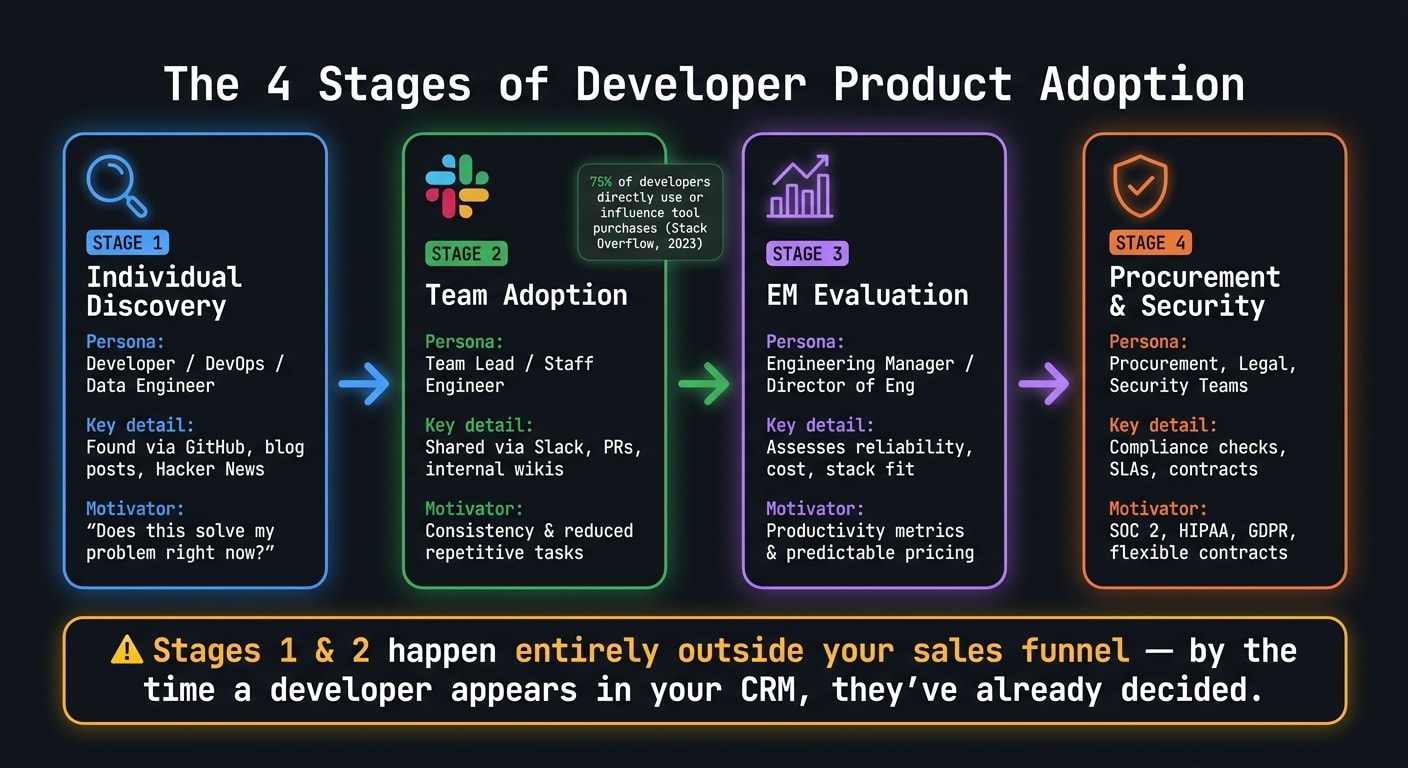
This organic, ground-up process unfolds in four distinct stages.
The 4 Stages of Developer Product Adoption
The journey typically progresses through these four stages:
- Individual discovery: A developer stumbles upon the tool through content, community, or a colleague’s recommendation. They try it out - often through a free tier or open-source version - asking themselves one simple question: “Does this solve my problem right now?”
- Team adoption: If the tool proves useful, the developer shares it with their team, perhaps through a Slack message, a pull request comment, or an internal wiki. Gradually, teammates begin using it in live projects, creating informal adoption within the team.
- Engineering manager evaluation: At this point, an engineering manager (EM) or a senior engineer notices the tool’s growing use. They evaluate it for broader adoption, focusing on reliability, cost, and how well it integrates with the existing tech stack.
- Procurement and security review: Finally, procurement and security teams step in to formalize the purchase. This involves compliance checks, cost assessments, and contract negotiations.
Here’s the key takeaway: The first two stages happen entirely outside your sales funnel. By the time a developer shows up in your CRM, they’ve already made their decision.
Who Influences the Decision at Each Stage
Different roles drive decisions at each stage, and their priorities evolve as they move through the process:
| Stage | Primary Persona | What They Care About |
|---|---|---|
| Individual discovery | Developer / DevOps / Data Engineer | Quick setup, clear documentation, stack compatibility, no forced sales interaction |
| Team adoption | Team lead / Staff engineer | Collaboration tools, consistency, reducing repetitive tasks |
| EM evaluation | Engineering manager / Director of Eng | Productivity metrics, vendor reliability, predictable pricing |
| Procurement/security | Procurement, legal, security teams | SOC 2 compliance, SLAs, data security, flexible contracts |
The challenge? The person championing your tool is rarely the one signing the contract. The developer who loved your product from day one has to navigate three additional layers before a deal is finalized. However, their endorsement carries weight throughout the process. That’s why it’s crucial to connect with individual contributors early - before they settle on another solution. Understanding these adoption stages will help you design an ideal customer profile (ICP) that accounts for both individual and team dynamics.
How to Define Your Developer ICP
Once you've outlined the buying process, the next step is creating an ICP (Ideal Customer Profile) that aligns with the technical needs and habits of developers.
Many developer ICPs miss the mark because they rely on generic B2B templates. Job titles and company size alone don't tell the full story. For instance, a "software engineer at a 500-person SaaS company" could range from a junior frontend developer to a senior-level engineer. Each of these roles requires a unique approach in terms of messaging, outreach, and timing.
The Core Attributes of a Developer ICP
A strong developer ICP focuses on technical context and behavior rather than just company demographics. Here's a breakdown of key attributes to consider:
| Attribute | What to Define | Why It Matters |
|---|---|---|
| Role | Developer, DevOps, Data Engineer, Platform Engineer | Identifies the specific challenges they tackle daily |
| Seniority | Junior (0–3 yrs), Mid-level (3–7 yrs), Senior (7+ yrs) | Influences decision-making power and their perspective on build vs. buy decisions |
| Tech stack | Languages, frameworks, cloud providers, CI/CD tools | Determines compatibility and evaluation criteria |
| Learning habits | Docs-first, community-driven, video tutorials, newsletters | Shows where to reach them before they start actively searching |
| Community involvement | GitHub activity, Discord participation, conference speaking | Indicates their influence within their team and the broader developer network |
| Build vs. buy bias | Preference for building, pragmatic approach, or buying-first | Shapes how you position your product's value |
Seniority is particularly important. According to data from the daily.dev network, mid-level developers (3–7 years of experience) make up about 45% of the active developer pool, with seniors accounting for 30% and juniors around 25% . Mid-level developers often discover and advocate for tools internally. They have the experience to assess quality but may not hold final budget approval.
Building Developer Personas That Reflect Actual Behavior
The difference between an effective developer persona and a generic one lies in how well it captures specific behaviors. Instead of relying on vague labels, focus on observable actions - like monitoring changelogs, contributing to GitHub projects, or tracking performance benchmarks.
It's also crucial to consider the technical environment. Are they working in a monorepo with dedicated platform support, or are they a full-stack generalist at a startup juggling multiple tasks? These details affect their expectations for setup complexity, documentation quality, and pricing models. One group might demand enterprise-grade reliability, while the other needs tools that deliver immediate productivity.
Don't forget to map their awareness stage. A developer who hasn't yet identified a problem will need educational content to highlight potential pain points. On the other hand, a developer actively comparing solutions will look for evidence like benchmarks, case studies, and detailed integration guides. Aligning your persona with their awareness stage helps refine both targeting and content strategies.
Developer ICP Worksheet Template
Here’s a worksheet to help you get started. Use it as a foundation and refine it as you gather more data from campaigns and user feedback.
Company Profile
- Industry vertical: (e.g., fintech, developer tools, e-commerce infrastructure)
- Company size: (headcount range and engineering team size)
- Growth stage: (seed, Series A–C, growth, enterprise)
- Infrastructure maturity: (greenfield startup, legacy migration, cloud-native)
Team Profile
- Team size: (number of engineers on the target team)
- Team type: (product engineering, platform/infra, data, security)
- Current tooling: (languages, frameworks, cloud providers in use)
- Known pain points: (what’s slowing them down right now)
Developer Persona
- Primary role: (e.g., backend engineer, ML engineer, DevOps)
- Seniority level: (junior / mid-level / senior / staff)
- Build vs. buy tendency: (strong builder / pragmatic / buy-first)
- Decision-making role: (individual user / internal champion / evaluator)
Technical Environment
- Primary language(s): (e.g., Python, Go, TypeScript)
- Key integrations required: (e.g., Kubernetes, AWS, GitHub Actions)
- Deployment environment: (cloud, on-prem, hybrid)
- Compliance requirements: (SOC 2, HIPAA, GDPR)
Behavior Signals
- Where they learn: (daily.dev, Hacker News, subreddits, YouTube, newsletters)
- Community participation: (GitHub contributions, Discord servers, conferences)
- Content preferences: (technical tutorials, quick-start guides, benchmarks, changelogs)
- Awareness stage: (unaware / problem-aware / solution-aware / product-aware / ready to adopt)
This worksheet isn’t a one-and-done tool. The best ICPs evolve over time. Start with your assumptions and refine them as you gather insights from campaigns and real-world developer behavior.
Turning Your Developer ICP into Targetable Signals
An ICP worksheet is only as good as its ability to turn attributes into actionable signals. The tricky part? Translating those traits - like role, tech stack, seniority, and learning habits - into measurable behaviors you can actually track and target.
Mapping ICP Attributes to Developer Signals
Take, for instance, a developer’s tech stack. You can often spot this in their GitHub activity. Learning habits? These show up in the content they consume, whether it’s deep-dive technical posts on daily.dev, discussions on subreddits like r/devops or r/dataengineering, or interactions in niche Discord communities. Seniority often reveals itself in the complexity of the questions they ask publicly or the depth of the content they engage with.
| ICP Attribute | Observable Signal / Proxy | Where to Find It |
|---|---|---|
| Tech stack | Languages in public repos, tags followed | GitHub, daily.dev tag follows |
| Role | Job title in profiles, content topics engaged | LinkedIn, developer communities |
| Seniority | Depth of content consumed, PR review patterns | GitHub activity, content engagement data |
| Learning habits | Regularly read sources, newsletter subscriptions | daily.dev feed behavior, email open data |
| Community involvement | Stars, forks, Discord activity, conference talks | GitHub, Discord, event registrations |
| Build vs. buy bias | Interest in "how to build X" vs. "best tools for X" | Content topic engagement |
The key is to move from assumptions to observable behaviors. For example, instead of guessing what content developers prefer, track their actual engagement.
Also, focus on activation events - like a developer’s first successful API call - rather than just sign-ups. These events are stronger indicators of alignment with your ICP. Training ad platform algorithms on these activation events can help you zero in on higher-quality audiences.
Next, let’s look at how to validate these signals and refine your developer ICP.
How to Validate Your Developer ICP
Starting with assumptions is fine, but validation turns your ICP from a rough draft into a reliable tool.
Cohort analysis is one of the best ways to validate. Group your users by ICP attributes - like seniority, stack, or role - and compare their activation rates, retention, and revenue growth. For instance, if mid-level Python engineers using AWS activate faster and stick around longer than other groups, that’s a clear ICP signal.
Combine this data-driven approach with qualitative developer interviews. Talk to 8–10 developers who fit your ICP. Ask them how they found your product, what almost stopped them from trying it, and what they were reading the week before they signed up. These conversations often uncover insights you won’t find in your analytics - like discovering your best users all follow a specific GitHub organization or subscribe to a particular changelog newsletter.
Finally, analyze content engagement by segment. If developers engaging with your benchmarking content convert three times more often than those reading your onboarding tutorials, that tells you something critical about their awareness and evaluation process. Content engagement offers a direct line to understanding where a developer is in their journey - and it’s a signal you can use to fine-tune both your ICP and your targeting strategy.
Putting Your Developer ICP to Work in Campaigns
Once you've validated and mapped your Ideal Customer Profile (ICP), the next step is to turn those insights into action. This means shaping your campaigns around who you target, what you say, and where you say it - all tailored to the ICP segments you've defined.
Targeting and Messaging by ICP Segment
A one-size-fits-all approach just doesn't cut it. For instance, a senior backend engineer evaluating a database tool has completely different priorities compared to a junior frontend developer checking out a new framework. Your targeting and messaging need to reflect those differences.
Start by focusing on key factors like tech stack, role, and seniority. These will guide how you craft messages that actually resonate. For example:
- Individual contributors are focused on code quality, developer experience, and performance. They want to dive into documentation, explore code snippets, and test things out in a sandbox. The best call-to-action (CTA) for this group? Something like "Try it now" or "See the docs." They're not interested in booking a demo.
- Engineering managers, however, think about team velocity, hiring challenges, and whether a tool will solve problems or create new ones. They respond better to case studies, ROI data, and performance benchmarks.
Here’s a quick breakdown of how to align messaging with each segment:
| Target Segment | Primary Messaging Focus | Preferred Content / CTAs | Key Channels |
|---|---|---|---|
| Individual Contributor | Technical how-to, performance, code quality | Docs, GitHub, sandboxes, "Try Now" | daily.dev, Reddit, Stack Overflow |
| Engineering Manager | Team velocity, ROI, security, hiring | Case studies, ROI calculators, "Book a Demo" | LinkedIn, newsletters |
Pro Tip: LinkedIn thought leader ads can be a cost-effective way to reach technical audiences. In fact, they cost 77% less per click than standard sponsored posts and often perform better . For example, if an engineering manager at a target account follows a respected DevOps expert, a post from that person will carry far more weight than a generic banner ad from a brand they don’t recognize.
Reaching Multiple Buyer Roles at Once
Developer tool purchases rarely involve just one person. Typically, you’re dealing with a mix of stakeholders - developers, engineering managers, and senior leaders like VPs or CTOs. If your campaigns only focus on one role, you risk leaving critical gaps that can slow down or derail deals.
The solution? A layered Account-Based Marketing (ABM) strategy. Here’s how it works:
- For developers, focus on bottom-up awareness and encourage product adoption with hands-on content like docs and sandboxes.
- For engineering managers, highlight team-level outcomes with case studies and ROI-focused content.
- For VPs/CTOs, emphasize strategic benefits like security, architecture, and budget alignment - topics that matter in boardroom discussions.
Here’s a handy guide to match messaging with each buyer role:
| Buyer Role | Primary Focus | Preferred Content | Best Platform |
|---|---|---|---|
| Individual Contributor (IC) | Code quality, DX, performance | Docs, code snippets, sandboxes | daily.dev, GitHub, Hacker News |
| Engineering Manager (EM) | Team velocity, hiring, OKRs | Case studies, ROI data, benchmarks | LinkedIn, newsletters |
| VP of Engineering / CTO | Strategy, security, budget | Industry reports, high-level architecture | LinkedIn, events |
The trick is ensuring all these tracks are aligned. For instance, if your developer-facing content promises full flexibility but your VP-focused messaging emphasizes centralized control, you're setting yourself up for confusion during the evaluation stage. The key is to tailor the angle of each message to the specific audience while keeping your core value proposition consistent across all levels.
How daily.dev for Business Maps to Your Developer ICP
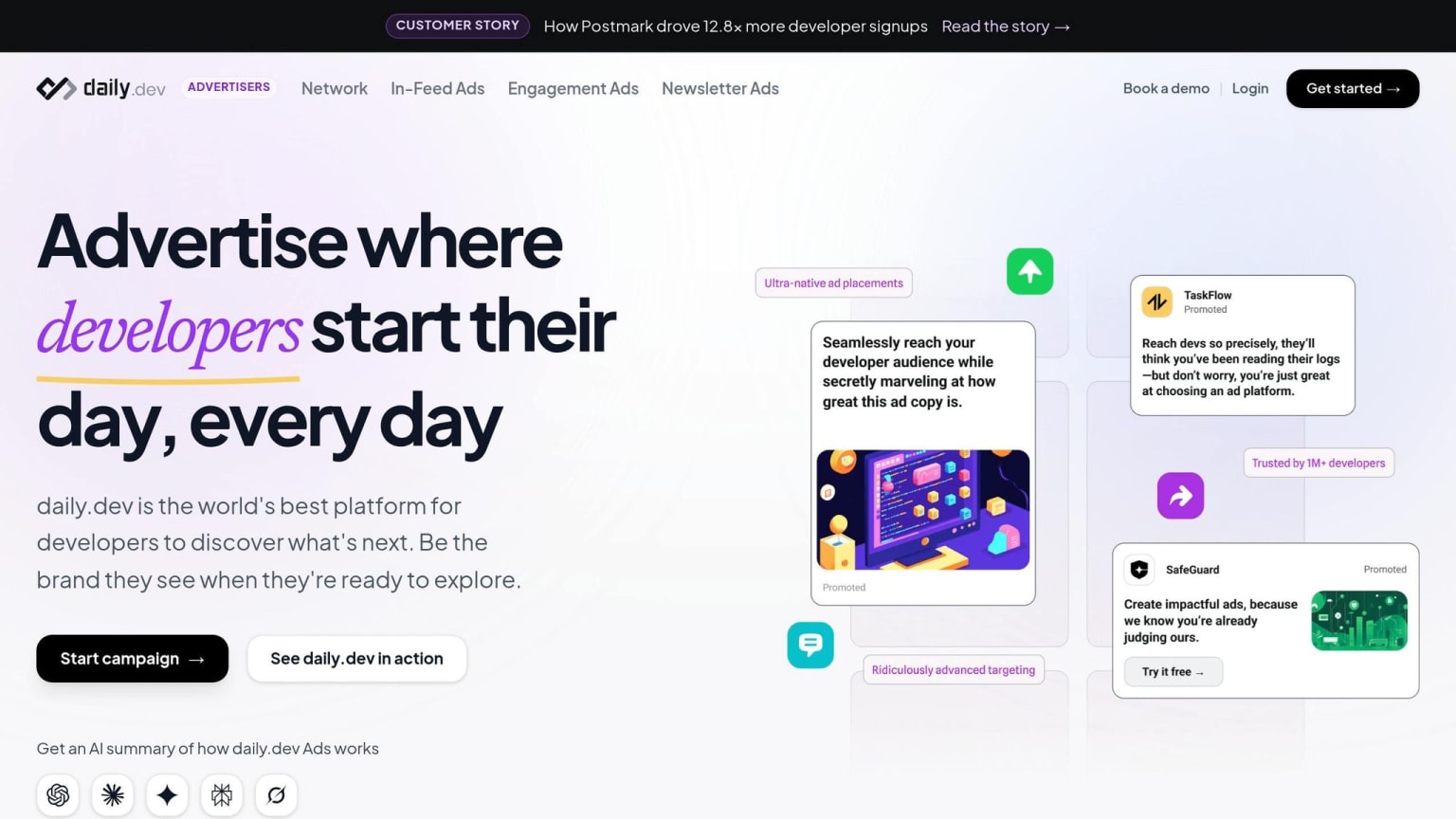
Daily.dev for Business takes your Ideal Customer Profile (ICP) insights and turns them into actionable strategies. While mapping your ICP is important, the real value lies in putting it to work. This platform does just that by using real-time, first-party behavioral signals from over 1 million active developers. Instead of relying on outdated profiles or broad demographic guesses, it gives you access to developers exactly when they're searching for solutions. This live data allows for precise and timely targeting.
daily.dev Targeting Dimensions That Match Your ICP
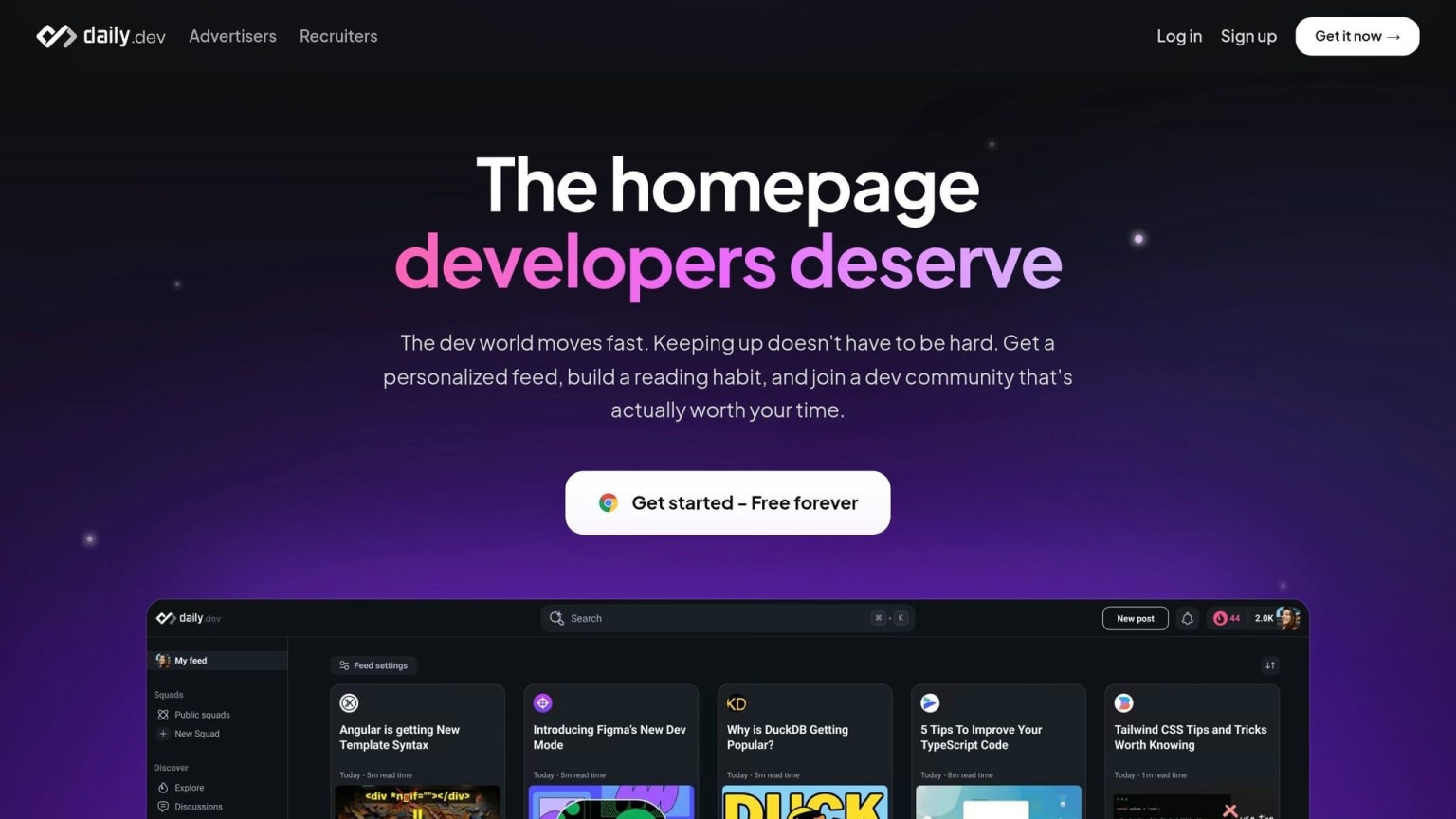
The targeting options on daily.dev go beyond generic ad categories - they're built to reflect the attributes of your ICP.
Take seniority, for example. The audience on daily.dev is broken down into clear segments: 25% Junior (0–3 years), 45% Mid-Level (3–7 years), and 30% Senior (7+ years) . This segmentation enables you to focus on developers with the right level of experience based on their actual engagement.
Skill domain targeting is another powerful tool. Around 42% of users engage with Web/React content, 35% with Backend/Systems topics, and 24% with DevOps/Cloud content . Additionally, interest in AI/ML content has skyrocketed, with a 156% increase in engagement, making it the fastest-growing area on the platform .
"Developers do not click on ads. They click on solutions to their problems." - daily.dev
This approach to targeting ensures you're reaching developers while they're actively exploring tools and technologies - not while they're distracted by unrelated content. These tailored dimensions make setting up campaigns both straightforward and effective.
Running Campaigns on daily.dev Against Your Developer ICP
Daily.dev's interface allows you to directly apply your ICP data to campaigns. You can set parameters like seniority, skill domains, and topic tags to deliver ultra-relevant ads that naturally integrate into a developer's feed . For instance, a developer researching Kubernetes or Rust might see a sponsored post that feels like a continuation of their reading.
The goal is to engage activated developers - those who take meaningful actions like making their first API call or using your product in a significant way. This metric aligns more closely with long-term retention and revenue than simply tracking sign-ups .
Conclusion: From ICP Definition to Developer Reach
A well-defined developer ICP lays the groundwork for every campaign decision. When you pinpoint exactly which developer you're aiming to reach - their role, tech stack, seniority, and learning habits - everything else becomes sharper: your messaging, channel selection, creative approach, and targeting. Using tools like the ICP worksheet template, you can identify the key attributes that shape how and where to engage.
Go beyond simple job titles. Include behavioral signals such as preferred programming languages, tags, and trusted communities, and map these to observable actions. Then, activate this understanding through campaigns that seamlessly integrate into the spaces developers already trust. This structured approach ties ICP definition to practical strategies for reaching your audience.
Developers are naturally skeptical of marketing. To earn their attention, you need to show up in the right context and offer something genuinely helpful. As daily.dev highlights, developers only engage when solutions address their real-world challenges . Your ICP research is what makes this possible - it guides you to the right problems and the best places to address them.
By following the mapping process, your ICP enables tailored messaging for every stage of adoption. For developers in the discovery phase, who may not yet recognize their problem, visibility in familiar feeds and trusted communities builds awareness. For those actively evaluating tools, specific and relevant messaging helps close the gap.
The priority isn’t about reaching more developers - it’s about connecting with the right ones at the right time.
FAQs
What’s the fastest way to build a developer ICP from scratch?
The fastest way to build a developer ICP is by leveraging first-party behavioral data instead of relying on outdated profiles. Begin by pinpointing the tools, programming languages, and frameworks your product integrates with. Platforms like daily.dev Ads can help you segment audiences based on their technical skills and interests. Focus on high-value prospects using firmographic data, and refine your ICP by combining qualitative interviews, engagement signals, and cohort analysis. This ensures your ICP aligns with developers' actual workflows and preferences.
How do I turn a dev tool ICP into targetable signals?
To create actionable signals from a developer ICP, focus on three key areas: technographic, firmographic, and behavioral attributes. Start by defining your ICP based on roles, seniority levels, and the technologies they use, such as programming languages and frameworks (e.g., Node.js).
Leverage first-party engagement data, like tech tags, to identify their seniority and content consumption habits. Take it a step further by layering additional signals, such as the libraries they rely on, the growth stage of their company, or the specific phase of their projects. Finally, tailor your messaging to align with their objectives and where they are in the development lifecycle.
How can I validate my developer ICP is correct?
To fine-tune your Ideal Customer Profile (ICP) for developers, start by using cohort analysis. This helps you monitor how different groups interact with your product over time. Pair this with developer interviews to gather qualitative insights that reveal their needs, preferences, and pain points.
Next, analyze content engagement signals to confirm that your messaging resonates with their specific roles and tech stacks. Are you speaking their language? Are you addressing the tools and technologies they care about? These signals can guide adjustments to ensure your content hits the mark.
With tools like daily.dev for Business, you can take this a step further. Map first-party data - such as tags, programming languages, and seniority levels - directly to your ICP attributes. This ensures your profile is grounded in actual developer behavior instead of relying on outdated assumptions or overly broad metrics.