

Want to engage developers effectively? Focus your budget on what they value most: great documentation, active DevRel teams, and meaningful community engagement. Traditional tactics like cold emails and broad ads often fail because developers prefer hands-on testing and peer recommendations. Here's a quick breakdown of how to allocate your marketing spend based on your company's stage:
- Seed Stage ($50K budget): Prioritize SEO, strong documentation, and niche newsletter sponsorships. Avoid hiring full-time marketers; work with fractional experts or agencies instead.
- Series A ($200K budget): Expand into content, SEO, and community-building. DevRel becomes essential for creating tutorials and engaging directly with developers.
- Series B+ ($1M+ budget): Balance spending across paid ads, content, and events. Focus on retention and expansion, with flexible monthly budget adjustments.
Key Insights:
- Developers block ads (60%+) and avoid cold outreach, so focus on trust-building through technical content and active community participation.
- High-quality documentation is your best-performing asset for driving signups.
- Free-tier users incur hidden costs; allocate resources to support them effectively.
- Avoid overcommitting to conferences early; prioritize proven channels like SEO and community sponsorships.
To succeed, track metrics like "Time-to-first-API-call" and documentation engagement, and balance short-term ROI with long-term investments in trust and credibility.
Budget Structure by Company Stage
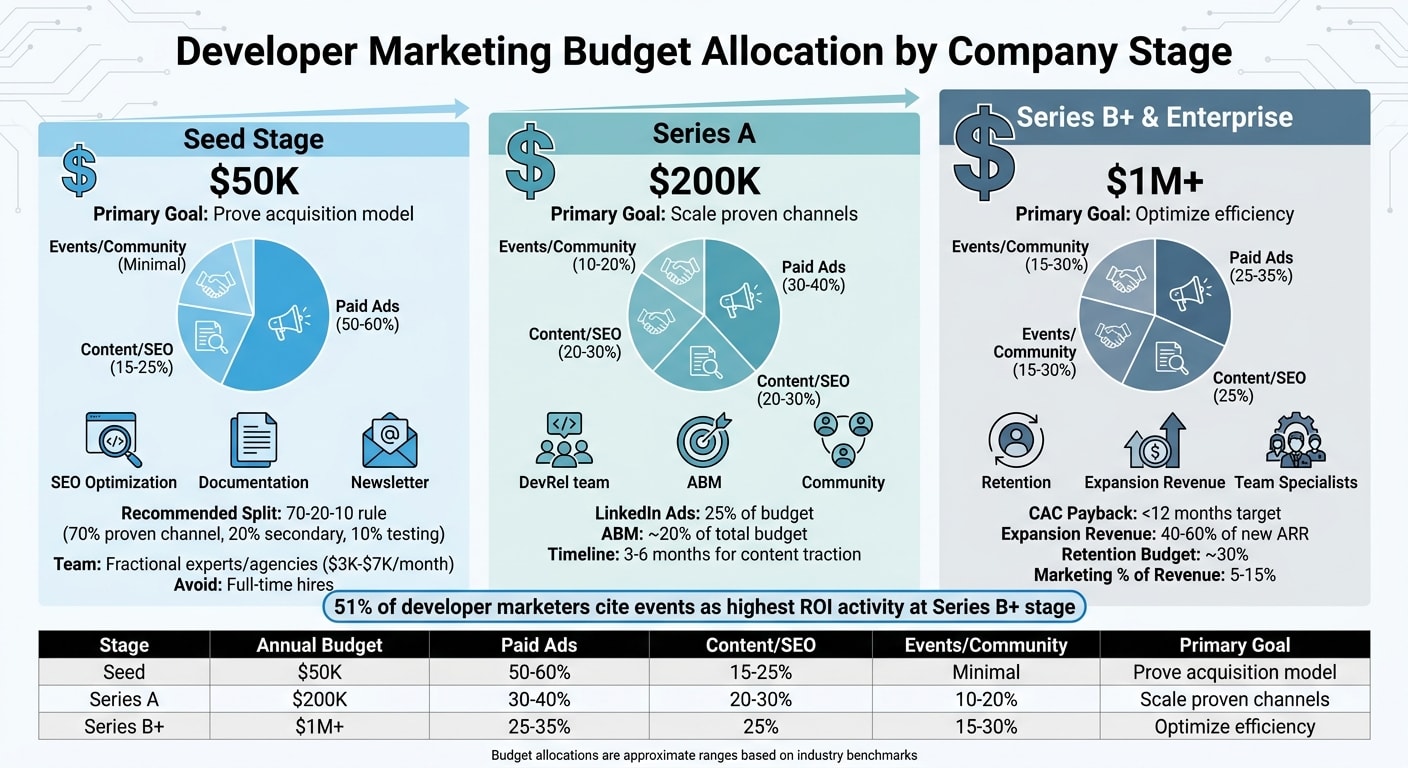
As your company grows, your budget priorities evolve to match new challenges and goals. What works in the early days - like founder-led content and small-scale community engagement - won't cut it when you're aiming for larger revenue targets. Here’s a breakdown of how to allocate your marketing budget at different stages.
Seed Stage: $50K Annual Budget
At the seed stage, your primary objective is to validate your customer acquisition model, not to focus on brand awareness . Every dollar should contribute to long-term growth. That means prioritizing SEO, clear documentation, and high-intent paid search over splashy brand campaigns or expensive conferences.
A 70-20-10 split works well here: spend 70% on your most reliable channel (often SEO or Google Ads targeting competitor keywords), 20% on a secondary channel like niche newsletter sponsorships, and 10% on testing new approaches .
Start by investing $5,000–$10,000 in tools for measurement and tracking, like GA4, CRM systems, and attribution dashboards . Strong documentation is key - well-written guides with runnable code examples can drive more signups than traditional paid channels .
"Seed-stage budgets prove customer acquisition, not brand awareness."
- Waqas Khokhar, Founder, ScalixAI
Avoid hiring a full-time marketer at this point. A $50,000–$60,000 salary would eat up your entire budget . Instead, work with fractional experts or agencies charging $3,000–$7,000 per month . Affordable tools like Ahrefs ($99–$129/month) and ConvertKit ($29–$79/month) can cover your basic needs without overspending .
Focus on bottom-of-funnel content, such as comparison pages ("YourProduct vs. Competitor") and technical guides. Save broader, top-of-funnel content like industry trend pieces for later stages . For paid channels, niche newsletter sponsorships (e.g., Techpresso at around $3,500 for 550K subscribers) often deliver better customer acquisition costs (CAC) than LinkedIn or Google Display .
These focused efforts lay the groundwork for scaling as your company grows.
Series A: $200K Annual Budget
With a $200K budget, you can expand on what worked during the seed stage while introducing new strategies like Account-Based Marketing (ABM) and developer relations (DevRel) . Paid ads should take up 30–40% of your budget, down from 50–60% during the seed stage . The freed-up funds can go toward content, SEO, and community-building efforts.
Allocate 20–30% of your budget to content and SEO . Since content takes time to deliver results - 3–6 months for traffic and up to 18 months for lead generation - early investment is critical. Another 10–20% should go to events and community sponsorships , including hackathons, meetups, and developer conferences.
DevRel becomes a game-changer at this stage. Instead of traditional sales outreach, which developers often ignore, a DevRel team can create tutorials, answer questions on Stack Overflow, and build sample projects . This approach pays off: SEO leads convert at 14.6%, compared to just 1.7% for outbound methods .
For paid ads, increase your LinkedIn Ads allocation to 25%, focusing on decision-makers at your target companies . ABM campaigns also become viable, with about 20% of your total budget allocated to targeting high-value accounts .
A real-world example: Delve, an AI compliance platform, partnered with ScalixAI before their Series A to overhaul their Google Ads and LinkedIn campaigns. Within six months, they influenced $7M in pipeline and closed $1.2M in revenue, helping secure $32M in Series A funding led by Insight Partners .
These strategies help you scale your marketing efforts while preparing for more complex initiatives in later stages.
Series B+ and Enterprise: $1M+ Annual Budget
With over $1M to spend annually, your focus shifts to optimizing efficiency and diversifying your channels . Your CAC payback period should aim for under 12 months , and you can now afford high-impact activities like major conferences, large-scale hackathons, and advanced SEO campaigns.
Budget allocation becomes more balanced: approximately 25–35% for paid ads, 25% for content and SEO, and 15–30% for events and community sponsorships . Events take on greater importance, supported by data showing that 51% of developer marketers cite them as their highest ROI activity .
Retention and expansion revenue take center stage. Expansion efforts can account for 40–60% of new ARR , so allocate around 30% of your budget to initiatives like email nurture campaigns, in-product education, and customer success content . Marketing spend as a percentage of revenue typically drops to 5–15%, even as absolute spending increases .
Team structure also evolves at this stage. Over 50% of your budget will likely go to hiring specialists for SEO, paid media, content, DevRel, and ABM roles . This allows you to scale initiatives that were previously handled by generalists or agencies.
The key difference at this stage is flexibility. Instead of sticking to a rigid annual plan, reallocate funds monthly based on real-time performance data . For example, if LinkedIn ABM campaigns are delivering qualified opportunities at $2,000–$7,000 per CPQO , shift more budget there. If a conference sponsorship underperforms, redirect those funds to newsletter sponsorships or other high-ROI activities.
| Stage | Annual Budget | Paid Ads | Content/SEO | Events/Community | Primary Goal |
|---|---|---|---|---|---|
| Seed | $50K | 50–60% | 15–25% | Minimal | Prove acquisition model |
| Series A | $200K | 30–40% | 20–30% | 10–20% | Scale proven channels |
| Series B+ | $1M+ | 25–35% | 25% | 15–30% | Optimize efficiency |
Channel-by-Channel Cost Benchmarks
When planning your developer marketing budget, understanding the costs of different channels is key to making smart decisions. Each channel has its own pricing dynamics, and knowing these can help you allocate resources to strategies that resonate with developers. Unlike traditional B2B marketing, developer marketing requires a unique approach since developers tend to avoid conventional ads . Here’s a breakdown of what to expect across the most effective channels.
Content Marketing Costs
Content marketing takes up the largest share of developer marketing budgets - 25–30% by 2026 . This budget is usually divided into creation (15–20%) and distribution (20–25%) . For many teams, outsourcing content creation is the norm, with 85% relying on external vendors .
On the distribution side, newsletter sponsorships often deliver the best value. For example, in April 2026, DigitalOcean ran a campaign on Techpresso, achieving over 1,000,000 impressions at just $1.70 per click . A primary ad on Techpresso costs roughly $3,500 and typically generates 400–1,000 clicks . In contrast, LinkedIn ads targeting bottom-of-funnel leads can cost anywhere from $350 to $800 per lead .
"For devtools, documentation is the highest-converting marketing asset. Clear docs with runnable examples produce more signups than any ad."
- Louis Corneloup, Founder at Dupple and Techpresso
Content marketing requires patience. Organic results often take 3–6 months to gain traction, and SEO-driven leads may take up to 18–24 months to fully compound . However, once established, the ongoing traffic comes at no additional cost .
Now, let’s dive into how paid ads on developer-focused platforms can complement your content strategy.
Paid Ads on Developer Platforms
Developers are not fans of traditional display ads, but native ads embedded in developer content feeds tend to perform well. Platforms like daily.dev for Business integrate ads seamlessly into developers' browsing experiences, avoiding the intrusive feel of banners.
These platforms typically charge $1.70–$3.00 per click for newsletter and native placements , far less than LinkedIn’s $150–$250 per lead for top-of-funnel campaigns . Ads placed within trusted technical content often convert better than generic B2B ads.
B2B SaaS costs continue to rise, with technical campaigns averaging $371 per lead compared to $201 for organic leads . The overall average cost per lead for B2B SaaS now stands at $237 .
"Some long-term creator partnerships cut our cost per lead by 30-40% compared to ads on Meta and Google."
- Kyle Denhoff, Senior Director of Marketing, HubSpot
To ensure your technical content gets seen, allocate 20–25% of your budget to paid content distribution . This approach bridges the gap while your organic reach develops.
Let’s also look at how community sponsorships and events can drive meaningful engagement.
Community Sponsorships and Developer Events
Events and community engagement are priorities for 60% of developer marketers, with 51% identifying them as the highest ROI channel . Budget allocation for events grows with company size: Series B companies ($10M–$30M ARR) typically spend 10–15%, while Series C+ companies ($30M+ ARR) increase this to 15% .
For small to mid-sized enterprises with budgets between $25,000 and $100,000, 25–30% should go toward impactful events like hackathons or networking sessions . This translates to $6,250–$30,000 annually. Larger enterprises with budgets exceeding $100,000 might allocate $25,000–$300,000+ for events . Additionally, 15–20% of the budget should support online activities like developer quests and webinars .
These investments pay off. For instance:
- Hedera’s "learn & earn" campaign brought in over 5,000 developers and led to the creation of seven promising projects .
- Circle’s Bounty Challenge engaged 2,600 developers, resulting in over 15,000 API calls and 2,000 on-chain transactions .
- Ethereum’s Devcon VI attracted 60,000 participants through a mix of virtual and in-person options .
"Events like Hackathons or Networking typically require a larger budget due to prize money, promotion, and logistics, but they can deliver substantial ROI through product adoption, community growth, and potential partnerships."
- Mia Le, Marketing, AngelHack
As in-person events make a comeback in 2026 after years of virtual-first strategies , investing in these initiatives can build trust and long-term loyalty. Additionally, communities like Slack groups and forums offer a cost-effective way to maintain engagement, creating a lasting connection with developers .
Brand Awareness vs. Demand Generation Allocation
Figuring out how to split your budget between brand awareness and demand generation is a real challenge in developer marketing. Unlike traditional B2B strategies, where aggressive demand capture often delivers results, developers are a tough audience. They block ads (over 60% use ad blockers) and steer clear of cold outreach . Because of this, traditional performance marketing doesn’t get far. Instead, you need a mix of trust-building initiatives and targeted demand capture - and how you balance those depends a lot on your company’s stage of growth.
The 40-60% Split
For developer-focused companies in the scaling phase, a 40% brand awareness and 60% demand generation split tends to work well . Why? Because about 95% of buyers aren’t actively looking to purchase . If you focus solely on capturing the 5% who are, you’ll quickly hit a wall in terms of returns.
For early-stage companies (seed to Series A), it’s a different story. Here, 80-90% of the budget should go toward demand generation to establish product-market fit . Once you’ve proven the model, you can shift to a more balanced allocation. By Series B and beyond, increasing brand investment to 40-50% helps build trust and category awareness . In fact, in mature markets, some leaders reverse the ratio entirely, dedicating 60% to brand and 40% to demand.
When it comes to brand awareness in developer marketing, the breakdown often looks like this:
- 30-40% for content marketing
- 25-30% for community building
- 10-25% for selective paid distribution
These efforts take time to pay off. For example, SEO-driven content and community engagement typically need 12-36 months to show results, but they deliver steady, high-ROI outcomes that paid ads simply can’t match .
"Never let paid exceed 50% of your marketing budget - if you do, your pipeline disappears the moment you cut ad spend."
- Alexander Chua, Co-Founder, Growigami
This kind of thoughtful allocation helps build the trust that’s so essential for engaging developers.
Building Trust with Developers
A balanced budget is just the start - trust is the foundation for all brand efforts. Developers are naturally skeptical of overhyped marketing. Words like “enterprise-grade” or “revolutionary” often trigger doubt . What they do trust, however, is technical credibility. In fact, the top factor driving product adoption among developers is a recommendation from an industry peer, which ranks at 25.8% .
To build this trust, focus on delivering real value. For example, invest in documentation that helps developers quickly get to a working "Hello World" within five minutes of interaction . Pair strong documentation with DevRel teams active on platforms like Stack Overflow and Discord, which tend to outperform traditional sales outreach .
Another effective strategy is sponsoring newsletters like those on daily.dev for Business. These native placements integrate seamlessly into developers’ routines, costing around $1.70-$3.00 per click . They reach developers in spaces where they’re already consuming technical content.
To amplify your efforts, allocate 20-25% of your content budget specifically for scaling successful messaging . Start by testing your content in organic channels. Once you see what resonates, use paid distribution to expand its reach. This creates a trust-driven funnel where your brand awareness efforts naturally lead to demand generation.
Measuring Channel Performance
Measuring the success of your developer marketing channels can feel like solving a puzzle. The "dark funnel" makes it tricky - developers often discover tools through places like Discord, Slack, or simply by word-of-mouth, leaving you with little visibility into these interactions . Add to that long sales cycles (often stretching beyond 90 days), and it’s easy to misattribute conversions to the wrong channel . This means you need alternative ways to track performance.
CAC by Channel and Attribution Challenges
Customer Acquisition Cost (CAC) differs significantly depending on the channel. Here’s a breakdown:
- Referrals: Around $150
- Organic SEO: $200–$290
- Paid Search: $230–$350
- Paid Social: $300–$500
- Outbound Sales: $400–$1,980
But here’s the catch: attribution lag can mess with your calculations. In fact, 52% of marketing budget failures happen because teams overlook this lag, leading to over-crediting last-touch channels . For example, a developer might read a blog in January, join your Discord in February, and finally convert in April - but analytics might only credit the final step .
This kind of oversight is costly. Around 68% of failed marketing plans end up over-investing in low-intent channels due to this “last-touch blindness” . To combat this, techniques like incrementality testing (using geographic or time-based holdouts) can help you figure out whether a channel is truly driving conversions or just coincidentally tied to them .
Hidden costs can further inflate your CAC. For example:
- Agency markups: Add 8–15%
- Overlapping MarTech tools: Add 5–12%
- Untracked community management labor: Adds 3–8%
To keep things sustainable, aim for a CAC that’s less than one-third of your customer lifetime value (LTV) and a payback period under 12 months .
"A channel with a $50 CPL and 2% close rate costs you $2,500 per customer. A channel with a $200 CPL and 25% close rate costs you $800 per customer. The 'expensive' channel is 3x more efficient."
- Alexander Chua, Co-Founder, Growigami
When traditional attribution models fall short, alternative metrics can give you a better sense of long-term performance.
Alternative Metrics for Developer Marketing
With long conversion cycles and indirect touchpoints, you’ll need proxy metrics to assess your pipeline’s future health . For example, tracking documentation page views can be a strong indicator - developers who spend time in your docs are more likely to take your tool seriously . Similarly, measuring the "Time-to-first-successful-API-call" can show whether you’re reaching the right technical audience .
For freemium or open-source products, other metrics can reveal top-of-funnel activity, such as:
- GitHub stars
- Weekly NPM installs
- Package downloads
In community-focused channels, look beyond raw member counts. Metrics like the rate at which users invite teammates to your product can predict paid conversions . Engagement quality matters too - track meaningful interactions, like questions answered in Discord or Slack, instead of just tallying participants .
Content marketing offers another bright spot. SEO-driven content achieves a 2.10% visitor-to-lead conversion rate, compared to just 0.70% for PPC . Email nurturing is also effective, converting leads to marketing-qualified leads at rates between 36% and 41% . These benchmarks can guide your expectations and planning.
Finally, don’t underestimate the power of community and events - 51% of developer marketing teams report these as their highest ROI channels .
Budget Mistakes to Avoid
Even experienced leaders can fall into common pitfalls when managing developer marketing budgets. For more developer marketing insights, explore our latest resources. One of the biggest missteps? Falling into the "uniform allocation trap" - splitting funds equally across all channels. For example, dividing your budget into equal parts for content, ads, events, and social media might seem fair, but it often leads to every channel underperforming .
"When you spread your budget too thin, everything sucks equally." - Anastasiya Khvin, Marketing Manager, Aimers
Another common mistake is treating community-building efforts like short-term performance marketing. This approach prioritizes immediate ROI but can stifle long-term growth . While 60% of developer marketers dedicate large portions of their budgets to events , many underestimate the high logistical costs and limited follow-up that conferences often entail . At the same time, 76% of marketers report content marketing as their most effective channel , yet teams frequently underfund the technical infrastructure - like SEO and documentation - that ensures content gets discovered .
Overspending on Conferences
Conference sponsorships are expensive and notoriously difficult to measure in terms of ROI, making them an easy target for budget cuts during lean times . However, the real issue isn’t hosting or attending events - it’s overcommitting to them before your demand generation strategy is proven . A great example comes from Dropbox. Between 2008 and 2010, they found that Google AdWords campaigns cost $233–$388 per customer for a $99 product. Instead of doubling down on events, they pivoted to a viral referral program, which grew their user base from 100,000 to 4 million in just 15 months .
When it comes to conferences, choose wisely. Focus on those with strong technical networking opportunities and active community participation . Use the 70/20/10 budget rule: allocate 70% to proven channels, 20% to promising experiments, and 10% to niche or experimental events .
Underspending on Content and Community
Despite clear evidence of its effectiveness, many teams neglect the technical elements that make content marketing successful. Organic leads, for instance, convert at a rate of 14.6%, compared to just 1.7% for outbound channels . Additionally, 70% of marketers agree that SEO delivers better ROI than paid ads .
"For devtools, documentation is the highest-converting marketing asset. Clear docs with runnable examples produce more signups than any ad." - Louis Corneloup, Founder, Dupple
Mailmodo is a great case study: they reached $100K ARR in just five months by prioritizing organic channels over costly ads .
To make the most of your content budget, allocate 15–20% to technical guides, code samples, and educational materials . Avoid using gated content, as developers often distrust lengthy forms . Invest in Developer Relations (DevRel) resources to support forums, platforms like Stack Overflow, and communities on Discord, where peer recommendations drive nearly 26% of product adoption decisions .
Undervaluing Free Tier Support
Free-tier users often come with hidden costs, such as the need for engineering resources, in-product analytics, and customer support. These demands can drain your operational budget if you don’t plan for them upfront . Successful SaaS companies suggest setting aside an extra 15–25% of your budget to cover these costs, including tools for marketing automation, analytics, and dedicated team time .
Tracking metrics like "Time-to-first-successful-API-call" can help measure user activation . DevRel resources are also essential for offering personalized support through platforms like Discord or Stack Overflow, which can encourage free-tier users to eventually convert into paying customers . For instance, in 2024, Circle launched a "Bounty Challenge" that engaged over 2,600 developers to build programmable wallets. This initiative resulted in 15,000 API calls and 2,000 on-chain transactions . Such engagement requires a solid support infrastructure.
Aim to allocate 60–70% of your budget to activities with a 90-day return and 30–40% to long-term initiatives like SEO, branding, and community-building . If you need to make cuts, start with events and leave content untouched - content’s compounding benefits are difficult to recover once lost .
| Mistake | Impact | Solution |
|---|---|---|
| Overspending on Conferences | High logistics costs with limited follow-up; superficial engagement . | Be selective with events; focus on those with strong community and technical networking . |
| Underspending on Content | Higher customer acquisition costs (CAC) due to reliance on ads; lower trust among developers . | Invest 15–20% in technical guides, code samples, and educational content . |
| Undervaluing Free Tier Support | Hidden costs from unplanned support and infrastructure demands . | Track activation metrics and allocate DevRel resources to support free-tier users . |
Conclusion
Planning a developer marketing budget calls for a specialized strategy. Based on cost benchmarks and channel performance data, consider allocating 70% of your budget to channels with a track record of consistent ROI, 20% to emerging opportunities showing potential, and 10% to experimental initiatives .
Conduct quarterly audits to adjust spending in response to real-time CAC (Customer Acquisition Cost) data. Companies that regularly reassess their budgets tend to outperform those sticking to rigid annual plans . Track monthly CAC by channel closely - if a channel’s CAC exceeds a 12-month payback period, reduce its budget by 50% and redirect funds to better-performing channels .
Balancing immediate results with long-term growth is key. Allocate 60–80% of your budget to direct response and demand generation efforts. At the same time, invest in channels like content, SEO, and community building, which take 12–18 months to mature but eventually yield leads at almost no marginal cost .
Keep in mind that developers are often skeptical of paid channels - over 60% actively block ads . To address this, prioritize investments in technical documentation, open-source contributions, and community engagement alongside paid acquisition. Platforms like daily.dev for Business provide a smart solution by integrating native ads into developers’ daily workflows, avoiding the pitfalls of traditional ad blockers.
FAQs
How do I choose the 70% 'proven' channel for my developer marketing budget?
To make the most of 70% of your developer marketing budget, focus on channels that consistently deliver solid ROI and generate predictable revenue. These typically include content marketing, SEO, and community-driven initiatives. To identify which channels are worth the investment, rely on past performance data and industry benchmarks. Keep a close eye on metrics like Customer Acquisition Cost (CAC) and engagement rates to ensure you're putting your money where it counts.
It's also important to prioritize channels that resonate with developers. Developers tend to value authenticity and trust, so choose strategies that align with their preferences. And don’t forget to stay flexible - adjust your spending as you monitor performance and spot trends.
What should I track to prove ROI when attribution is unclear?
Tracking customer lifetime value (CLV), engagement metrics such as API calls and GitHub activity, product usage (like SDK implementation rates), and community growth indicators is key. To measure impact effectively, consider using proxy metrics and experimenting with first-party data alongside outcome-focused analytics.
When is it worth increasing spend on paid developer ads?
When a paid developer ad channel shows strong results - like better engagement, lower customer acquisition costs (CAC), or more accurate attribution - it’s a good idea to increase your spending there. Just make sure the channel fits well with your audience’s habits and preferences to get the most out of your investment.