
Podcast advertising for developers is a high-impact way to reach technical audiences like CTOs, engineers, and software architects. Why? Podcast ads build trust through host recommendations, with a 4.2x return on ad spend - outperforming social media and search ads. Here's what you need to know:
- Ad Costs: Expect $25–$65 CPM for host-read mid-roll ads on technical podcasts. Smaller shows may charge flat fees starting at $200 per episode.
- Top Podcasts: Shows like The Changelog and Software Engineering Daily attract engaged developer audiences, with rates ranging from $1,200 to $3,000 per episode.
- Ad Types: Mid-roll ads perform best with low skip rates (8–12%), while host-read ads deliver 3–5x better conversions than programmatic ads.
- Tracking ROI: Use promo codes, vanity URLs, and tools like Podsights to measure impact. Podcast ads also boost branded search volume and amplify other marketing channels by up to 40%.
- Effective Ads: Focus on technical language, specific use cases, and clear calls to action like promo codes or URLs.
Want results? Combine podcast sponsorships with other developer-focused channels like newsletters for maximum reach and engagement.
The Developer Podcast Landscape
Podcasts targeting developers have become an effective advertising channel, offering a range of content from broad engineering discussions to highly specialized tech topics. For instance, The Changelog Network connects with over 650,000 monthly listeners across its various shows. Similarly, podcasts like Software Engineering Daily and Syntax attract large, engaged audiences . Research backs up the value of this medium: 81% of podcast listeners actively pay attention to ads, and with 67% of developers using ad-blockers, traditional display ads often fall short . Below, we’ll explore some top developer podcasts and their advertising costs.
Top Developer Podcasts by Audience Size
The Changelog is a leading podcast for software professionals and open-source enthusiasts, drawing between 40,000 and 80,000 weekly listeners . For those in the AI space, Practical AI caters to machine learning engineers and practitioners, with an audience of 35,000 to 45,000 weekly listeners . Changelog News, which provides quick industry updates, reaches 20,000 to 30,000 listeners weekly. On the niche side, Fallthrough serves Go developers and systems engineers, attracting 1,000 to 2,000 weekly listeners .
Advertising rates align with audience size and engagement. For example:
- The Changelog charges $3,000 weekly for two episodes, requiring a four-week minimum, which delivers an estimated reach of 200,000 to 280,000 listeners .
- Practical AI sponsorships cost $1,200 per episode .
- Fallthrough offers a more affordable option at $200 per episode .
Other noteworthy podcasts outside The Changelog Network include Lenny's Podcast, which focuses on product and growth insights, and The All-In Podcast, which dives into venture capital and startup trends . These metrics provide a clear picture of the potential reach and costs involved in advertising on developer-focused podcasts.
What Developer Listeners Expect
While audience size and pricing matter, understanding developer behavior is key to crafting effective ads. Developers interact with podcast ads differently than general audiences. They often form "parasocial trust" with hosts, meaning they feel a strong connection after spending hours listening. This trust makes host-read ads far more effective than programmatic alternatives .
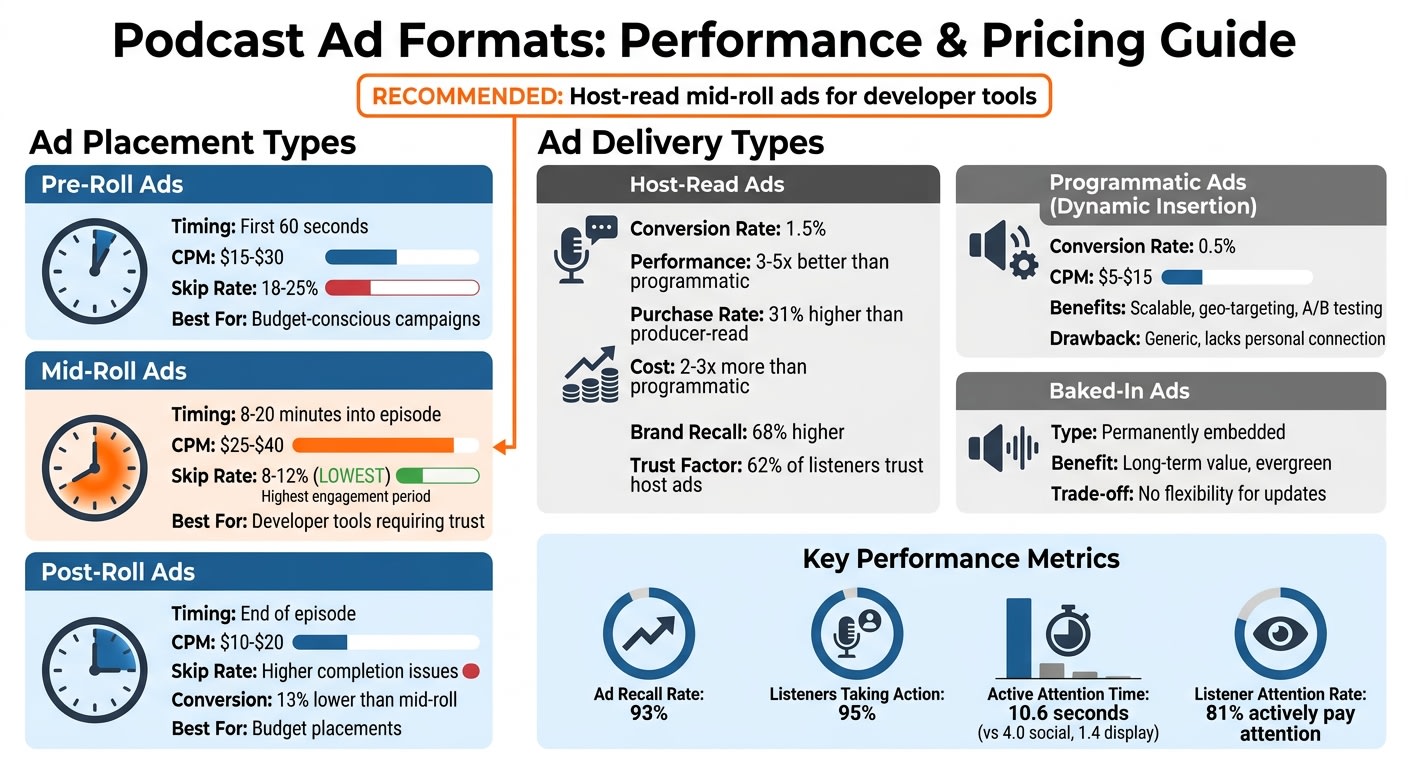
That said, developers are also a tough crowd. As Idlen notes, "Developers are skeptical, ad-averse, and quick to dismiss anything that feels like marketing fluff" . They value technical depth, specific use cases, and honest messaging over generic corporate pitches. This skepticism means ad placement is critical. Mid-roll ads, for instance, have lower skip rates (8% to 12%) compared to pre-roll slots (18% to 25%) . With a 93% ad recall rate and 95% of listeners taking action after hearing an ad , podcasts are an effective way to reach decision-makers like CTOs and engineering leads.
Podcast Sponsorship Formats Explained
Developer podcasts offer a variety of sponsorship formats, each tailored to different goals and budgets. Choosing the right option ensures your campaign aligns with your objectives and resonates with your audience.
Pre-Roll, Mid-Roll, and Host-Read Ads
Pre-roll ads run within the first 60 seconds of a podcast episode. These ads typically cost between $15–$30 CPM and come with skip rates of 18%–25% .
Mid-roll ads are placed 8–20 minutes into the episode when listeners are most engaged. With CPM rates of $25–$40, mid-rolls boast lower skip rates - around 8%–12% - making them ideal for promoting developer tools where trust and focus matter .
Post-roll ads, airing at the end of an episode, are a budget-friendly option at $10–$20 CPM. However, they often see lower completion rates and convert about 13% less effectively than mid-roll placements .
Host-read ads stand out as particularly effective, outperforming producer-read ads by 31% in purchase rates . When a trusted host recommends a developer tool, it feels like advice from a peer - critical for technical products, where credibility carries extra weight.
Next, let’s break down the differences between dynamic programmatic ads and the more personal touch of host-read endorsements.
Programmatic vs. Host-Read Sponsorships
Programmatic ads leverage dynamic ad insertion (DAI) to slot pre-recorded commercials into podcast episodes. These ads are scalable and cost-efficient, priced at $5–$15 CPM, and allow for geo-targeting or seasonal updates . However, they often come across as generic, lacking the personal connection that developer audiences value.
Host-read ads deliver 3–5 times better conversion rates than programmatic spots but cost 2–3 times more . For technical audiences, the added expense is justified, as these ads provide the authentic, trust-based recommendations that resonate deeply.
Baked-in ads, permanently embedded into the audio file, offer long-term value as new listeners discover older episodes. While dynamic ad insertion allows for flexibility and A/B testing, baked-in ads maintain the evergreen quality of a host’s endorsement .
For campaigns targeting developers, host-read mid-roll ads strike the best balance. They combine high engagement, low skip rates, and the credibility needed for technical products. Starting with host-read ads helps validate your messaging, while programmatic placements can later expand your reach and retarget key audiences .
Understanding these formats is crucial for aligning your sponsorship strategy with developer expectations. This sets the stage for establishing clear cost benchmarks and tracking ROI effectively in the next steps.
Developer Podcast Sponsorship Costs
When planning your advertising strategy, having a clear understanding of sponsorship costs is crucial. Developer podcasts often command higher rates due to their targeted reach, connecting with high-income professionals and decision-makers in the tech world. These pricing structures play a big role in determining the potential return on investment for your campaigns.
CPM Rates and Flat Fee Pricing
CPM pricing varies depending on ad placement and the podcast's audience size. For developer podcasts in 2026, you can expect to pay $25–$50 CPM for host-read mid-roll ads, with technology-specific podcasts often charging $45–$65 CPM . Pre-roll ads are typically less expensive, costing $18–$25 CPM, while post-roll ads fall in the range of $10–$20 CPM .
On the other hand, flat-rate pricing offers a straightforward option for budgeting, especially for niche podcasts. For instance:
- The Changelog charges $3,000 per week for two episodes, reaching 40,000–80,000 developers weekly.
- Practical AI asks $1,200 per episode, reaching 35,000–45,000 listeners.
- Smaller shows like Fallthrough, which caters to the Go programming community with 1,000–2,000 weekly listeners, charge just $200 per episode .
Most podcast networks set minimum spends of $2,500–$5,000 to account for operational costs, making multi-episode campaigns a practical choice for advertisers .
Season Packages and Bulk Deals
Longer-term commitments can lead to significant cost savings. Season packages in 2026 often include discounts of 10% for 3-month commitments, 15% for 6-month commitments, and 20% for annual agreements . For example, a mid-tier tech podcast with 10,000–50,000 downloads might charge $8,000–$30,000 for 4–8 episodes, often bundling perks like newsletter mentions and social media shoutouts .
Bulk deals also lock in CPM rates even as the audience grows, offering additional value . When negotiating, it’s worth requesting category exclusivity to prevent competitors from advertising during your campaign window. Most developer-focused podcasts structure their ad commitments in 4-week, 8-week, or 13-week runs, with a 4-week minimum being the standard .
Writing Podcast Ads That Developers Won't Skip
Developers are quick to spot marketing fluff. The best way to engage them? Keep your ad copy authentic. Ads that resonate sound less like legal jargon and more like a trusted colleague recommending a tool they genuinely use. When your message connects with a technical audience, it enhances the effectiveness of host-read sponsorships. Beyond podcasts, you can also reach developers at scale through targeted ecosystem campaigns.
Using Technical Language and Specific Use Cases
Generic pitches won’t cut it. Developers respond to precise, category-specific language. For example, instead of calling your product a "sales tool", refer to it as a "RevOps platform" if that’s what it is.
"A host who has used your product will mention a real detail. Real details convert. Generic endorsements don't." – MillionPodcasts
To make this happen, let hosts experience your product firsthand by offering free trials or demos. This allows them to highlight specific features and workflows. For instance, sharing how teams using your tool close deals 30% faster provides concrete value that resonates.
When providing talking points, aim for 3–5 concise, impactful details. Cover the essentials: what the product does in one sentence, who it’s for (e.g., "developers managing infrastructure for small teams"), the main problem it solves, and a key proof point. If your product name is technical, include a phonetic guide to help the host pronounce it correctly - credibility matters.
Clear CTAs: Promo Codes and Vanity URLs
Make it simple for developers to take action. Use podcast-specific promo codes - like CHANGELOG or SYNTAX - that tie directly to the show’s name. This not only tracks performance by show but also makes the offer feel exclusive. Ask the host to mention the code at least twice during the read: once mid-read and again at the end.
To make the code meaningful, pair it with real value: an extended trial, a discount, or free feature unlocks. Codes without a clear benefit rarely drive conversions. Also, include a vanity URL (e.g., "yoursite.com/practicalai") for those who prefer navigating directly instead of dealing with codes. Before the episode goes live, double-check that both the code and URL work - broken links can derail your campaign.
Since not every listener will use the promo code, consider adding a post-purchase survey with a simple question like, "How did you hear about us?" This helps capture the broader impact of your podcast ads, beyond just the tracked code usage.
Next, we’ll dive into strategies for tracking podcast advertising ROI, ensuring your efforts lead to measurable success.
Tracking Podcast Advertising ROI
Measuring the return on investment (ROI) for podcast ads can be tricky because listeners often don’t act immediately after hearing an ad. To get a clear picture, you’ll need to combine three key tracking methods: promo codes and vanity URLs for direct attribution, pixel-based tools to capture indirect effects, and post-purchase surveys to fill in the gaps .
Conversion Tracking Methods
Start by using show-specific promo codes and vanity URLs. These tools provide direct attribution, but don’t be discouraged if many listeners don’t use the promo code right away. It’s common for people to research your brand later before converting. To track those delayed actions, pixel-based tools like Podsights, Chartable, ArtsAI, or Podscribe are invaluable. By embedding tracking pixels on your website, these tools link listener activity to site visits, offering accuracy rates between 70% and 85% . This layered approach is especially critical for developer tools, where purchase decisions often take longer.
Another important metric is branded search volume. A strong campaign should boost branded search queries by at least 20% . You can monitor this using Google Search Console or your analytics platform during and after the campaign. Additionally, include a simple post-purchase survey at checkout with a question like, “How did you hear about us?” While not as precise, this method helps capture conversions that promo codes and pixels might miss .
Host-read ads often outperform programmatic ones, converting 3 to 5 times better. On average, host-read ads achieve a 1.5% conversion rate, compared to just 0.5% for programmatic ads on the same show . Podcast ads also deliver 10.6 seconds of active attention on average, far surpassing social media ads (4.0 seconds) and display ads (1.4 seconds) . Together, these methods create a strong system for measuring podcast ad performance, even when conversions don’t happen right away.
Dealing with Attribution Gaps
For developer tools, purchase cycles can stretch beyond 60 days. Instead of relying on 7-day data, evaluate performance at 30 and 60 days . Keep in mind that attribution gaps are common: attributed ROAS (Return on Ad Spend) often appears 30% to 50% lower than the actual ROI because listeners may convert weeks later or on different devices, making them harder to track .
To maximize results, plan for 6 to 8 weeks of consistent ad placements. For more expert insights on developer marketing, consider how these campaigns fit into your broader strategy. Shorter campaigns (like 2 weeks) usually don’t generate enough frequency to make a noticeable impact . For developer tools, aim for a cost per trial under $30 (good) or under $15 (great), with a trial-to-paid conversion rate above 15% . Podcast ads also amplify the effectiveness of your other marketing channels by up to 40%, thanks to the trust and awareness they build .
How to Choose the Right Podcasts
Choosing the right podcasts is key to ensuring strong ROI and cost efficiency, as mentioned earlier. The focus should be on connecting with engaged audiences rather than chasing sheer download numbers. A smaller, niche podcast with 5,000 dedicated listeners can often deliver better results than a larger one with 20,000 less engaged followers.
Matching Audience Demographics
Start by asking for media kits from the podcasts you're considering. These should provide detailed listener insights, including job roles (like CTOs, Senior Engineers, or Founders), company stages (from Seed to Series C), and industries (such as SaaS, Fintech, AI, or Cybersecurity) . If the media kit lacks this kind of depth, reach out to the producer directly - this lack of detail could be a red flag .
Geographic data is another important factor. Some leading developer podcasts have 40% to 50% of their audience based in the U.S., with the rest spread globally . If you're targeting North American developers, make sure the podcast's audience aligns with this focus.
Beyond demographics, look for engagement metrics. Strong signals include episode completion rates (64% is a solid benchmark for B2B podcasts), Apple Podcasts reviews, and social media buzz around new episodes . Also, match your product to the right podcast category. As MillionPodcasts explains, "Picking the right category usually has more effect on results than picking the biggest show" . For instance, indie hacker podcasts are ideal for dev tools and PLG SaaS, while analytics platforms perform better on product and growth-focused shows .
Before committing to large networks, test your messaging on three to five smaller niche podcasts. For example, if you're promoting a Go-related tool, try a podcast specifically about Go programming to see how your creative resonates . And don’t overlook the importance of the host’s expertise and presentation style - they can make or break the effectiveness of your sponsorship.
Topic Fit and Host Reputation
When it comes to podcasts, the host's credibility often outweighs audience size. Developers tend to trust hosts who come across as peers - people who understand technical details and clean code . Listen to two or three full episodes to assess how the host presents sponsor messages. Do they sound natural and invested, or does it feel like they’re just reading a script? Host-read ads are particularly effective, offering a 68% higher brand recall rate compared to pre-recorded spots, with 62% of listeners trusting ads delivered by their favorite hosts .
To ensure authenticity, give the host direct access to your product so they can provide a genuine endorsement. A personal anecdote or specific detail from their own experience will resonate far more than a generic pitch . This taps into the "parasocial trust" that listeners develop after spending hours with their favorite hosts .
Finally, limit sponsorships to two or three per episode. Overloading an episode with ads can dilute your message and reduce its impact . These criteria align perfectly with broader strategies aimed at maximizing podcast ad performance and audience engagement.
Combining Podcast Ads with Other Developer Channels
Podcast sponsorships are most effective when they’re part of a broader, multi-channel strategy rather than being used in isolation. Developers engage with content in diverse ways - some enjoy listening to podcasts during their commute, others prefer reading newsletters while at their desks, and many scroll through feeds during short breaks. By addressing these varied preferences, you can create a cohesive presence that reinforces your message across multiple touchpoints without overwhelming your audience. This kind of integration not only widens your reach but also strengthens the impact of each individual channel.
By combining podcast sponsorships with other channels, you can build on the trust that podcasts naturally foster. For instance, a host-read ad establishes credibility through the relationship listeners have with the host, while a follow-up ad in a newsletter or digest reinforces the message with clear, actionable steps.
Many developer-focused networks now offer bundled packages that include both podcast and newsletter placements. Take Changelog News as an example: they charge $1,500 per week for a sponsorship package that reaches about 25,000 podcast listeners and 22,000 newsletter subscribers . These packages are designed to connect with developers across their preferred content formats while keeping the messaging consistent. Additionally, using coordinated tracking methods can provide better insights into campaign performance.
Advanced tracking across multiple channels can help you understand the broader impact of your podcast ads. Instead of relying solely on promo codes, layered tracking techniques can reveal how podcast impressions contribute to conversions, even when there’s a delay between listening and taking action.
For example, BenchPrep ran a full-funnel campaign that combined podcast sponsorships with social media and direct outreach. Within 90 days, they saw a 40% boost in target account awareness, a 12% increase in active buying intent, and three qualified enterprise opportunities . This case highlights how podcasts can play a pivotal role in driving results when integrated into a well-rounded marketing strategy.
FAQs
How many episodes should I sponsor to see results?
When it comes to seeing results from podcast sponsorships, the number of episodes you should commit to depends on your goals and the audience of the podcast. A common recommendation is to sponsor for at least 4 weeks. For bi-weekly shows, this typically means around 8 episodes. This time frame allows you to build brand awareness, maintain a steady presence, and gather enough data to assess how well the sponsorship is working.
What should I ask for in a podcast media kit?
When you're considering sponsoring a podcast, a media kit is your go-to resource for evaluating the opportunity. Here’s what you should request to make an informed decision:
- Audience Insights: Check for details like listener size, geographic distribution, and professional background. This helps you understand who you'll be reaching.
- Download Data: Look for metrics such as average listens per episode and total downloads to gauge the podcast's reach and popularity.
- Ad Format Options: Ask about available formats, such as pre-roll, mid-roll, and host-read ads, to see what fits your strategy.
- Pricing Information: Request specifics like CPM (cost per thousand impressions) ranges to ensure the sponsorship aligns with your budget.
- Campaign Results: Inquire about past sponsorship performance to assess how effective their ads have been for other brands.
- Sponsorship Flexibility: Explore options like exclusivity or custom content integration to see how you can tailor the partnership to your goals.
By gathering these details, you can ensure the podcast aligns with your marketing objectives and gives you the best chance to see a strong return on investment.
How do I estimate ROI without perfect attribution?
To get a sense of ROI in developer podcast advertising - even without perfect attribution - you can lean on proxy metrics like vanity URLs, promo codes, and branded search lift. For example, assign unique promo codes or URLs to your campaign to track direct conversions. Additionally, watch for spikes in branded search volume or website traffic during the campaign period. While these methods aren't exact, they provide a practical way to link ad activity to measurable results.