

Software engineers are challenging to reach with ads, but precision targeting can deliver results far above industry averages. For example, Linear achieved a 4.2% click-through rate (CTR) and a 28% demo sign-up rate by focusing on developers skilled in React and TypeScript. The key is understanding their behavior: 88% use ad blockers, and 65% skip sponsored content, making traditional methods ineffective. Instead, engineers trust platforms like GitHub, Hacker News, and recommendations from peers.
To succeed, you need to:
- Target individual contributors (ICs) for awareness and managers for budget approvals.
- Use firmographic data (company size, funding stage), technographic insights (tech stacks like React or Kubernetes), and behavioral targeting (online habits).
- Focus on platforms engineers already use, like daily.dev, LinkedIn, and Google Ads.
Key strategies include:
- daily.dev Ads: Target ICs by interests (e.g., Node.js, Docker) with high CTRs (4–6%) and low costs ($5–10 CPM).
- LinkedIn: Layer job titles, skills, and exclusions to target ICs, avoiding wasted impressions on managers.
- Google Ads: Target high-intent queries like error messages or documentation searches for better conversions.
Ad creative should include technical details like code snippets, benchmarks, and diagrams. Landing pages should offer direct access to documentation, sandboxes, or GitHub links - avoiding "Request a Demo" forms. Allocate budgets strategically: 60–70% for IC awareness and the rest for manager conversions. By refining targeting and messaging, you can cut wasted spend by up to 50% and improve campaign performance.
Understanding the Software Engineer Audience
Casting too wide a net in targeting often leads to ineffective campaigns. Grouping software engineers with other technical roles results in generic messages that fail to connect. For instance, lumping software engineers, DevOps engineers, data engineers, and engineering managers together can dilute the message's relevance.
Take this example: a LinkedIn campaign promoting an API tool spent $10,000 but only achieved a 0.3% click-through rate (CTR). Why? DevOps engineers overlooked app-focused creatives that didn’t address their infrastructure needs. However, when the campaign narrowed its focus to "software engineers" with skills like "Node.js" on daily.dev, the CTR shot up to 2.1%, generating 500 trials. The lesson? precision targeting matters. Let’s dive into what sets these roles apart.
Software Engineers, DevOps, Data Engineers, and Managers: Key Differences
According to Stack Overflow's 2024 Developer Survey, software developers make up around 55-60% of the developer workforce, while DevOps engineers account for 15-20%, and data engineers comprise 10-15% .
- Software Engineers (ICs): They value code quality, performance, and developer experience. Ads featuring code snippets or technical benchmarks resonate with them. Spending 60-70% of their time in IDEs like VS Code solving bugs, they respond to content that directly addresses their coding challenges .
- DevOps Engineers: Their focus is on CI/CD pipelines, Kubernetes, and infrastructure as code. Campaigns that align with their priorities, like "Kubernetes troubleshooting", see better engagement. For example, a logging tool campaign tailored to this need achieved a 1.2% CTR - three times higher than generic developer ads .
- Data Engineers: Building ETL pipelines with tools like Airflow and Snowflake, they prioritize data quality over app features. One advertiser shifted from targeting broad "developer" keywords to "data pipeline" keywords, resulting in a 40% increase in conversions by aligning with their specific needs .
- Engineering Managers: They focus on leadership, hiring, OKRs, and budgets. Unlike ICs, they consume content on LinkedIn about organizational design rather than technical repositories. A JetBrains survey revealed 68% of software engineers prefer technical content, while 82% of engineering managers favor business metrics and ROI data . Ads promoting "boost velocity 20%" often fail to engage ICs, who are more interested in solutions for "fix memory leak." In fact, 70% of ICs skip manager-focused ads entirely .
IC Engineers vs. Managers: Who to Target and Why
Understanding the roles and influence of IC engineers and managers is crucial for effective targeting.
IC engineers drive 80% of tool adoption through bottom-up usage. They trial tools, influencing 85% of technical evaluations. However, managers hold the reins when it comes to budgets, controlling 92% of final approvals, according to Gartner's 2023 research . This creates a clear strategy:
- Target ICs for awareness and top-of-funnel campaigns. Their grassroots adoption drives 60% of SaaS growth.
- Target managers for bottom-funnel conversions when budget approval is required.
For example, a CI tool gained 15,000 users through IC-focused daily.dev ads before securing manager sign-offs, showcasing the power of building grassroots support first . This balance between IC and manager targeting ensures better budget allocation and campaign impact.
3 Targeting Strategies for Software Engineers
Once you grasp the key differences between IC engineers and managers, three strategies - firmographic, technographic, and behavioral targeting - can help you zero in on the right audience. Each strategy focuses on a unique aspect: company-level attributes, the tools engineers use, or their online behavior. Together, they provide a well-rounded approach to targeting software engineers effectively.
Firmographic Targeting: Leveraging Company Data
Firmographic targeting uses company-specific details like industry, size, and funding stage to identify high-value prospects. Instead of focusing on total employee count, it’s smarter to filter by departmental headcount. For instance, a 5,000-employee manufacturing company with only 10 engineers isn’t a great target for a DevOps tool. On the other hand, a 200-person SaaS startup might have a much larger engineering team, making it a better fit. The key is to prioritize companies based on the size of their buying teams, not their overall workforce.
Growth signals also play a huge role. Companies that recently raised Series B–D funding are often ready to invest in new tools. In fact, teams using Ideal Customer Profile (ICP)-based scoring report win rates that are 40–60% higher compared to those spreading their efforts evenly . Additionally, industry-specific insights can sharpen your approach. For example, healthcare engineers often focus on HIPAA compliance, while fintech developers prioritize solutions for high-concurrency systems .
It’s worth noting that firmographic data isn’t static - it decays at a rate of 22.5% to 30% annually. This means targeting lists older than 90 days risk becoming outdated and less effective .
While firmographics provide a strong foundation, understanding the tools engineers use adds another layer of precision.
Technographic Targeting: Focusing on the Tech Stack
Technographic targeting digs into the programming languages, frameworks, and tools that engineers rely on daily. This approach answers the question, “What’s in their tech stack?” rather than just looking at company size. For example, identifying engineers actively using tools like React or TypeScript can help you tailor your outreach.
When you combine technographic data with firmographic insights - like recent funding rounds or large engineering teams - you can significantly reduce wasted ad spend. This method has been shown to deliver a 138% ROI on lead generation efforts . It’s a targeted way to ensure your message reaches engineers who are likely to benefit from your product.
Behavioral Targeting: Tracking Online Engagement
Behavioral targeting focuses on engineers’ online habits, revealing their current interests and intent. Unlike firmographic and technographic approaches - which tell you who they are or what tools they use - behavioral data captures what they care about right now. For example, engineers consuming articles on "Rust performance optimization" have very different priorities compared to those exploring project management tips.
Platforms like daily.dev can provide valuable insights through interactions such as saved articles, followed topics, and time spent on specific content. Additionally, participation in forums or searches through documentation can highlight immediate challenges they’re trying to solve. Personalized outreach based on these behaviors can yield an 18% response rate, compared to just 2% for generic messages .
Platform-Specific Targeting for Software Engineers
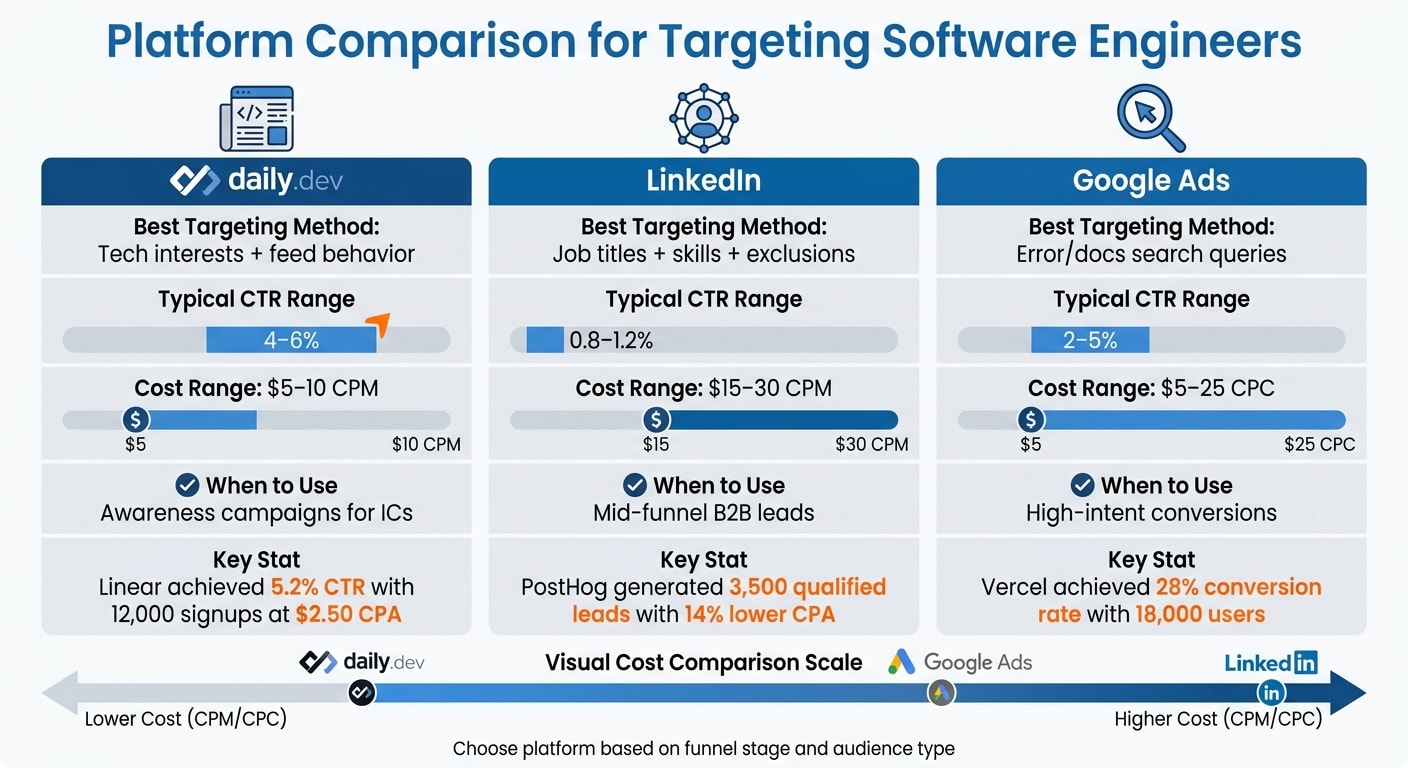
When targeting software engineers, it's essential to focus on platforms they naturally engage with - places where they solve problems, stay updated on tech trends, and dive into documentation. By combining firmographic, technographic, and behavioral insights, you can strategically place ads where they'll have the most impact.
Reaching Engineers on daily.dev Ads
daily.dev is a highly personalized news feed for developers, boasting over 1 million monthly active users, primarily individual contributors. The platform's ability to track what developers read allows advertisers to target based on interests in specific programming languages and frameworks. For instance, if your product integrates with Node.js, you could target developers consuming Node.js-related content.
Campaigns on daily.dev use interest-based targeting and feed behavior. For example, in Q4 2024, Linear ran ads aimed at developers interested in React and TypeScript. This strategy delivered a 5.2% click-through rate (CTR), resulting in 12,000 signups at just $2.50 per acquisition - far lower than the $8 CPA they experienced on LinkedIn . This platform works particularly well for engineers seeking practical, implementation-focused content.
To optimize campaigns, select 3–5 relevant tech tags (e.g., "Rust" or "WebAssembly" for niche audiences) and avoid manager-heavy topics like "leadership." Limit ad frequency to three impressions per day to prevent ad fatigue. A CI/CD tool that targeted "Go" and "Docker" audiences successfully generated 500 qualified signups at an $8 CPA .
Once you've established a presence on daily.dev, consider refining your targeting strategies on professional networks like LinkedIn.
LinkedIn: Using Job Titles and Skills for Precision
LinkedIn excels at leveraging professional data, but achieving efficiency requires layering multiple filters. Start by targeting job titles such as "Software Engineer", "Senior Software Developer", or "Backend Engineer." To avoid wasting budget, exclude managerial titles like "Manager", "Director", or "VP." Adding specific technical skills - such as "Python", "React", "AWS Lambda", or "Microservices" - helps ensure you're reaching hands-on practitioners rather than decision-makers.
A successful example: In the first half of 2025, PostHog targeted "Python" and "Software Engineer" (excluding managers), generating 3,500 qualified leads at a 14% lower CPA . This approach combines job function, seniority, and technical skills to pinpoint individual contributors. For audience size, aim for a range of 200,000 to 500,000 users in the U.S. Start with a $10–15 CPM bid, test headlines like "Benchmark your app in 5 lines," and retarget engineers who visit your documentation pages to maximize return on ad spend.
For engineers actively searching for solutions, Google Ads offers a direct way to capture intent.
Google Ads: Capturing Engineers Through Search Intent
Google Ads connects with engineers at critical moments - when they're debugging, researching tools, or looking up documentation. Focus on search queries that reflect these needs, such as error messages ("TypeError: Cannot read property 'map' of undefined"), documentation searches ("React useEffect cleanup"), or comparison keywords ("best PostgreSQL ORM 2026").
In February 2025, Vercel targeted queries like "Next.js deployment error", achieving a 28% conversion rate for free-tier signups. This campaign brought in 18,000 users and $1.2 million in pipeline, outperforming generic "web framework" ads by a factor of three . Engineers searching for solutions like "log4j vulnerability fix" are often addressing urgent production challenges, making this a high-intent audience.
To refine targeting, use broad match modifiers (e.g., +react +hook +error) or exact match keywords for specific issues (e.g., "npm install fails on M1"). A logging tool that bid on "ELK stack alternative" captured 10,000 monthly searches with a 12% CTR and a $15 CPA. For additional precision, layer in Google's "In-market: Software Development Tools" audience and exclude terms like "manager", "team", or "hire" to filter out irrelevant traffic.
| Platform | Best Targeting Method | Typical CTR | Cost Range | When to Use |
|---|---|---|---|---|
| daily.dev | Tech interests + feed behavior | 4–6% | $5–10 CPM | Awareness campaigns for ICs |
| Job titles + skills + exclusions | 0.8–1.2% | $15–30 CPM | Mid-funnel B2B leads | |
| Google Ads | Error/docs search queries | 2–5% | $5–25 CPC | High-intent conversions |
Creating Ad Creative That Resonates with Software Engineers
To grab the attention of software engineers, your ad creative needs to go deeper than surface-level promises. Engineers are drawn to how your product works - the technical details that demonstrate its real-world application. A successful ad hinges on offering substance that appeals to their analytical mindset.
Use Code Examples and Technical Diagrams
Engineers respond best to ads that showcase actual implementation. Including a code snippet that demonstrates your API in action or a system architecture diagram can be far more engaging than vague claims like "10x productivity." As Sarah Java Beans, a software engineer, aptly put:
"If you're the type of engineer that doesn't care about the 'what' so much as the 'how', or you nerd out over algorithms and performance optimizations the ad server will be fun for you" .
This quote highlights that technical audiences care deeply about understanding the mechanics behind a product, not just its end results.
So, your creative should focus on answering: "How does this actually work?" For example, if you're advertising a database tool, include a brief code example that demonstrates query optimization. If it's a monitoring service, a simplified diagram showing data flow can make a big impact. These elements establish credibility by showcasing your technical expertise. Once you've captured their interest, reinforce it with clear, honest metrics.
Show Honest Benchmarks and Transparent Metrics
In addition to technical visuals, providing real data is key to building trust. Engineers are skeptical of vague marketing claims - they want hard numbers like latency (ms), throughput (requests/sec), or memory usage. Carbon Ads, a company specializing in developer-focused advertising, explains:
"Our technical audience values transparency and authenticity" .
For example, if your product shortens build times, share a specific comparison like: "Reduced CI/CD pipeline from 12 minutes to 3.5 minutes (measured across 1,000 builds)." If you're promoting an API, include actual response times under load. Engineers respect honest metrics that acknowledge both the strengths and limitations of your product. A claim like "99.9% uptime (with transparent incident reports)" resonates far more than a generic "always available." This kind of transparency shows that you understand their priorities and respect their technical expertise.
Landing Page Optimization for Software Engineers
Once your ad grabs attention, the landing page needs to deliver on its promise immediately. Just as precise targeting ensures the ad reaches the right audience, a well-crafted landing page turns curiosity into meaningful engagement. Software engineers, in particular, prefer to explore products independently, steering clear of anything that feels like a sales pitch.
Include Documentation, Sandboxes, and GitHub Links
Engineers thrive on hands-on evaluation, so your landing page should provide direct access to technical resources that allow them to test your product right away. This could include links to detailed documentation, an interactive sandbox or demo environment, and GitHub repositories when applicable.
Instead of vague calls-to-action (CTAs) like "Learn More", use specific, action-oriented options such as "Project Dashboard", "Interactive Demo", or "View API Docs" . These CTAs show you value their time and expertise. For example, if your product is a database tool, let them run actual queries in a sandbox - no account required. If it's a development framework, link directly to your GitHub repo, complete with easy-to-use code samples.
"Landing page optimization is about creating the most effective path between what your visitors want and what your business needs" .
What engineers want is immediate proof that your product works. If your ad highlights a feature like "sub-10ms latency", link visitors directly to detailed performance metrics - not a general help page.
Also, keep this in mind: 53% of visitors will leave if a page takes more than 3 seconds to load . Engineers, who value performance, will judge your product by the responsiveness of your landing page. Optimize for Core Web Vitals like Largest Contentful Paint (LCP) and Interaction to Next Paint (INP). A slow page can ruin credibility before they even start exploring.
Avoid Friction: Skip 'Request a Demo' Forms
Forms that say "Request a Demo" are a major turnoff for software engineers.
"Psychology is used to optimize the impact of ads. This creates a very fine line between providing users with relevant marketing vs. manipulation. The problem here is one of education - marketers become experts in human behavior... but the users themselves are unaware/uneducated about this" .
Engineers are naturally skeptical of marketing tactics that feel pushy, and gating access behind a form only amplifies that skepticism. They're also privacy-conscious and hesitant to share personal details without understanding how that information will be used. Instead of forcing them into a demo request, use CTAs like "Start for Free", "Try Now", or "Explore Templates" . These options let them dive into your product without feeling pressured.
Prioritize direct conversions over indirect signals. Engineers prefer actions like installing an app or signing up for a free account rather than filling out contact forms . If you absolutely need to collect information, keep it minimal - only ask for what’s absolutely necessary. Reducing form friction can significantly improve conversion rates, and even a one-second delay in page load time can hurt conversions .
The goal is to let engineers experience your platform's benefits immediately, whether that’s through documentation, a sandbox, or a free trial. This approach not only builds trust but also aligns with their preference for self-directed exploration.
Measuring Campaign Success and Budget Allocation
To make the most of your creative strategies and landing page efforts, it's essential to measure campaign success accurately and allocate your budget wisely. Standard metrics often fall short when it comes to distinguishing between the engagement of IC engineers and the conversions driven by managers. This distinction is crucial since IC engineers often research, test, and recommend tools, while managers typically make the final purchasing decisions.
Measuring Reach Among ICs vs. Managers
When assessing reach, go beyond traditional metrics. Focus on alternative engagement indicators that reveal IC engineer interest. For example, track actions like visits to technical documentation, GitHub stars, sandbox sign-ups, and API key generations. These behaviors show genuine interest and intent, even if they don’t immediately result in paid accounts. Platforms like daily.dev can provide additional insights by monitoring clicks on specific technical content, such as frameworks or programming languages, which signal areas of interest.
You can also validate your audience through surveys. Add simple, optional questions during sign-up, such as "What’s your role?" or "Did you hear about us from a colleague?" This feedback helps confirm whether IC engineers are discovering your product independently or if managers are the primary point of contact. These insights are invaluable for refining your strategy and budget allocation.
Allocating Budget for IC Awareness and Manager Conversion
Focusing solely on bottom-funnel conversions can backfire. While targeting managers might yield quicker results, neglecting IC engineers can weaken your top-of-funnel efforts. IC engineers need to understand your product first, as their internal recommendations often pave the way for managers to evaluate and eventually adopt the tool .
For engineering tools with longer sales cycles - spanning 12 months or more - consider splitting your budget strategically. Allocate about 30% to awareness campaigns aimed at IC engineers. The remaining 70% can focus on conversion-driven campaigns targeting managers and other decision-makers. This balance ensures you’re building grassroots support among engineers while also addressing the needs of decision-makers. For example, on daily.dev, dedicating 30% of your budget to interest-based targeting helps build sustained awareness that compounds over time.
Conclusion
To execute and measure precise targeting campaigns effectively, it’s essential to move away from broad developer-focused strategies and instead zero in on specific segments. For example, software engineers, DevOps professionals, data engineers, and managers each have their own unique needs and behaviors. Combining firmographic, technographic, and behavioral approaches can cut wasted spending by up to 50% while ensuring you’re reaching engineers who are actively coding.
Choosing the right platforms is a critical step. Platforms like daily.dev allow you to target engineers based on the frameworks they follow, LinkedIn helps refine your outreach using job titles and skills, and Google Ads captures high-intent queries. Each platform serves a distinct purpose in your marketing funnel, so understanding their roles can make or break your strategy.
When it comes to execution, your messaging and visuals need to resonate with engineers. Use elements like code snippets, architecture diagrams, and clear benchmarks to grab their attention. Replace generic "Request a Demo" forms with direct access to resources engineers value most - documentation, sandboxes, and GitHub links. This approach aligns with how engineers evaluate tools and can increase trial sign-ups by as much as 50%.
Once your creatives and landing pages are optimized, focus on balancing your budget across the funnel. Early on, allocate 60–70% of your spend to awareness campaigns targeting individual contributors (ICs). As your pipeline matures, shift efforts toward converting managers. To measure success, track proxy metrics such as GitHub stars, sandbox usage, and visits to technical documentation. As Patricio Robles, CMO of daily.dev, highlighted during the 2025 Dev Marketing Summit:
"Engineers don't buy; they build. Target their daily pain points, not org charts."
A great way to start is by launching a $1,000 pilot campaign on platforms like daily.dev or LinkedIn. Monitor engagement among ICs, iterate on your approach weekly, and scale what works. For more detailed insights, explore our guide to advertising to developers and our behavioral targeting strategies. By aligning your campaigns with the priorities of engineers, you can achieve measurable growth that lasts.
FAQs
How do I target IC software engineers without paying for manager impressions?
To effectively reach individual contributor (IC) software engineers while avoiding wasted ad spend on manager impressions, focus on behavioral and platform-specific targeting. Leverage insights such as their coding habits, preferred tools, and programming language interests to fine-tune your approach. Platforms like daily.dev are excellent for targeting based on developer behaviors, while LinkedIn and Google provide options like job titles, technical skills, and search queries tied to specific tasks. These strategies help ensure your message resonates with IC engineers specifically.
What signals best identify engineers who will actually try my tool?
The most effective signals are behavioral and interest-based data. This includes things like coding habits, the tools developers frequently use, and how they engage with technical content. Pay attention to actions such as reading about particular programming languages, interacting with tutorials or documentation, or checking out tools that are similar to yours. These insights can help you connect with developers who are actively searching for solutions, making it more likely they’ll give your tool a try.
What should I send engineers to after they click - docs, sandbox, or signup?
When engineers show interest, guide them to documentation, a sandbox environment, or GitHub repositories instead of pushing them toward a demo request form. These options cater to their technical mindset, offering instant access to the tools and information they value most, which increases the chances of meaningful engagement.