

If I’m spending more than 25% of my week on marketing, my pipeline is flat for 90 days, and my message only works when I explain it myself, it’s time to hire my first developer marketer.
Here’s the short version:
- I should hire when founder-led growth stops producing steady pipeline
- I should wait if I still don’t know which channel works or if product-market fit is still shaky
- The first hire should own messaging, content, channels, docs input, and measurement
- The handoff works best with a 30-60-90 day plan
- By month six, I should expect things like 3:1 pipeline coverage and 50% of new pipeline tied to marketing work
A simple way to think about it: founder-led growth gets the first users; marketing-led growth helps make demand less dependent on the founder’s time.
A few signs stand out fast:
- I’m the bottleneck for campaigns, content, demos, or landing pages
- More than half of marketing projects stall before launch or measurement
- Developers outside my network don’t get the product fast
- Paid tests are running, but no one is learning from them
- I have at least 50+ paying customers and some channel signal worth pushing
Quick comparison
| Hire now if... | Wait if... |
|---|---|
| I spend >25% of my week on marketing | I haven’t done the marketing work myself yet |
| Pipeline has been flat for a full quarter | I still don’t know what channel works |
| Messaging confusion slows deals | Product-market fit is still unclear |
| I have 50+ paying customers | I don’t have enough customer signal yet |
| I can fund the hire with 12+ months of runway | Runway is under 12 months |
Bottom line: I shouldn’t make this hire to “try marketing.” I should make it when I already have signal, clear problems, and a job that one person can own from end to end.
Signs that founder-led growth has hit a ceiling
One slow month is just noise. But when the same pattern sticks around for a full quarter, it's a ceiling, not a rough patch. That's the point where a founder needs to stop winging it and start handing off the work. Watch the trend for one quarter, or 90 days, before calling it a system-level problem .
Stalled pipeline and founder overload
The first sign usually shows up in the pipeline. It stops growing even while the founder puts in more hours. Qualified opportunities swing up and down, and conversion rates across the funnel start to weaken. Why? Because the founder is still closing a high share of a small pipeline instead of creating more volume at the top . At that stage, the problem isn't effort anymore. It's ownership.
Then founder overload kicks in. And that time has to come from somewhere: product decisions, hiring, and strategy usually take the hit.
"The biggest signal that you should hire one is when the founder becomes the bottleneck for marketing throughput." - WithAgility
Inconsistent campaigns and unclear developer positioning
When campaigns aren't measured, the company learns nothing. It just keeps making the same guesses. If more than half of marketing projects from the past six months stalled before launch or before measurement, founder-led growth isn't working .
If the pipeline is flat, the next place to look is the message. Maybe current users get it. But if technical developers outside the founder's network can't quickly tell why the product matters, the issue is positioning .
"The product is good, engineers who find it like it, and yet nobody can explain - in one sentence - what it does and who it's not for. So growth is whatever happens to leak out of the founder's Twitter." - Daria Dovzhikova, GTM strategist
Paid acquisition opportunities the founder cannot manage alone
Once organic founder-led motion stops bringing in enough volume, advertisement campaigns for developers often become the fastest way to learn what works on a repeat basis. That's when growth can no longer depend on founder bandwidth alone. Paid channels need someone who owns them.
Paid acquisition takes structured targeting, steady creative testing, and clear measurement. If a founder is running scattered experiments without the time to improve them, they're spending money without building a learning loop the company can use again.
Founder-led growth is volatile. Marketing-led growth is repeatable, measurable, and easier to scale.
What the first developer marketer should own
This role owns positioning, content, channels, and measurement across the funnel. It’s not just about shipping blog posts or sending emails.
When the founder becomes the bottleneck, it’s time to give one person ownership of repeatable growth work.
Right now, that work usually sits with the founder, gets split across engineering, or just doesn’t happen. Here’s what the handoff looks like:
| Responsibility | Currently Handled By | Moves To |
|---|---|---|
| Positioning & messaging | Founder (intuition) | Marketer (systematized) |
| Blog & SEO content | Founder / Engineering | Marketer |
| Email & newsletters | No one / Founder | Marketer |
| Analytics & dashboards | Engineering / No one | Marketer |
| Docs & developer experience | Engineering | Marketer (collaboration) |
| Trial experience / PLG | Engineering | Marketer (growth/UX focus) |
Each line in that table ties back to the same warning signs from the last section: a stalled pipeline and a founder who’s stretched too thin. This is the fix on the ground.
Start with the message. Then move into distribution.
Messaging, positioning, and developer ICP fit
Begin with positioning. Define the ideal developer, what they care about, and the product’s technical value. Then write it down. The ICP, value proposition, and the story told across docs and landing pages should line up .
Docs need extra attention here.
"Docs are the highest-intent marketing surface you have. Your quickstart converts harder than any campaign." - Daria Dovzhikova, GTM Labs
That line gets right to the point. If the documentation is confusing, thin, or out of sync with how the product works, the marketer should help fix it with engineering. Not from the sidelines, but side by side.
Channel strategy, campaigns, and execution
Once positioning is in place, the marketer takes over the channels.
That means picking channels that lead to signups, product usage, community response, and docs traffic. Not gated PDFs. Not vanity MQLs that look nice in a slide deck but go nowhere .
Marketing-led growth works best when each campaign has:
- one owner
- one deadline
- one metric
Simple beats messy here.
Measurement, feedback loops, and pipeline visibility
Then comes the feedback loop. Put one shared dashboard in place and use it often.
Track 5–7 metrics: weekly unique visitors, signups, activations, signup-to-activation rate, and revenue. That gives the team a clear view of what’s working and where users get stuck, before friction turns into churn .
How to move from founder-led to marketing-led growth
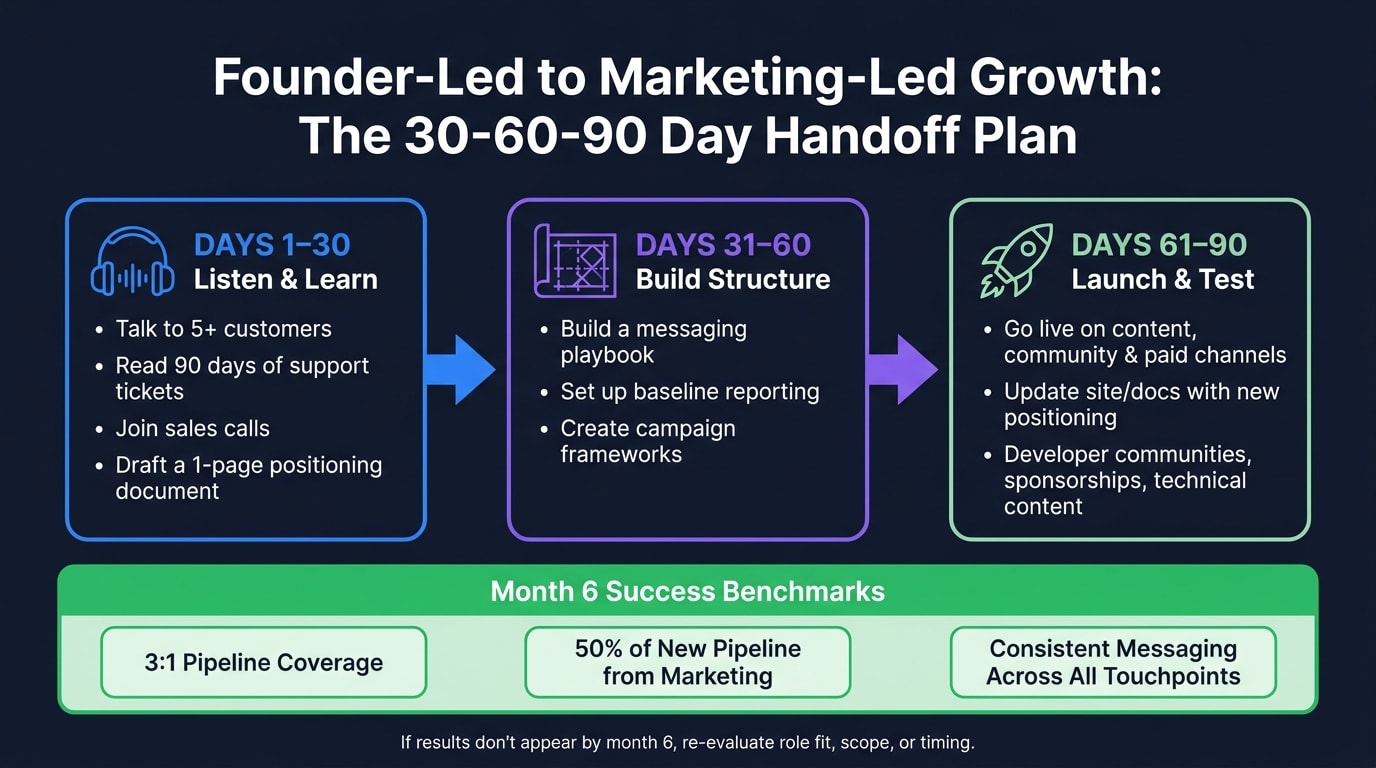
This handoff does not mean the founder disappears. It means the founder shifts focus to product vision, customer insight, and sign-off on high-stakes calls, while the developer marketer takes over repeatable execution . That shift needs to be spelled out in plain terms: who owns what, when they own it, and which channels they run.
Before the handoff starts, record recent sales calls, pull out the phrases customers keep using, and save them in a shared brief. That gives the marketer a starting point based on evidence instead of tribal knowledge .
Skills to look for in the first hire
Your first hire should be a hands-on operator who can do the work themselves for 6 to 9 months and then build a team . You’re looking for someone with technical fluency, strong product marketing judgment, hands-on campaign experience, and a testing mindset.
They also need to get how developers think and what they tend to distrust. That matters more than it sounds. If they can’t translate what the founder knows into clear docs, repeatable systems, and day-to-day execution, the handoff usually gets messy.
A 30-60-90 day handoff plan
The first 30 days should focus on listening. Talk to five or more customers, read 90 days of support tickets, join sales calls, and draft a one-page positioning document .
Days 31–60 are about putting structure in place :
- Build a messaging playbook
- Set up baseline reporting
- Create campaign frameworks
By day 90, tests should be live across content, community, and paid developer channels. That includes developer communities, sponsorships, technical content, and daily.dev placements. At the same time, the site or docs should reflect the new positioning .
If this handoff falls apart, the cause is usually simple: the hire is wrong, or the role is trying to cover too much.
Success metrics for the first six months
A healthy first six months usually looks like this:
- 3:1 pipeline coverage
- Developer-facing messaging that is documented and consistent across touchpoints
- At least 50% of new pipeline tied to specific marketing activities by month six
If those numbers don’t show up, the issue is usually fit, scope, or timing.
Common hiring mistakes and a simple decision framework
Mistakes that hold back the first developer marketer
Once you’ve defined the role, the next risk is simple: hiring the wrong person or expecting them to fix too much too fast.
The biggest mistake is bringing in a generic growth marketer or content writer instead of a developer marketer who can shape ICP, messaging, and go-to-market. Those are often the exact gaps behind a stalled pipeline and weak positioning in the first place .
The next failure mode is founder abdication. The hire starts, and then the founder steps away too early. That cuts off the customer context the marketer needs during the handoff, which makes it much harder for them to do the job well .
A third mistake is boxing the role into content or paid ads only. That narrows the job too much. The hire should have room to own work across developer communities, sponsorships, and daily.dev Ads .
Set clear goals from day one. For example:
- Increase trial-to-paid conversion by 20%
- Publish four posts per month
A yes-no hiring checklist for founders
Use this checklist before you hire.
| Hire now if… | Wait or fix first if… |
|---|---|
| Founder is spending >25% of their week on marketing tasks | Founder hasn't personally tried the marketing work yet |
| 50+ paying customers provide clear usage signal | Fewer than 50 customers; not enough signal to amplify |
| 1–2 acquisition channels are producing predictable results | No channel has proven to work consistently |
| Messaging confusion is actively slowing deals | Product-market fit hasn't been identified yet |
| You can complete this sentence: "In 90 days, this will be physically different, and this specific person will have done it" | Runway is under 12 months |
If you can check at least four signals in the left column, the hire makes sense. If not, you’re still paying for discovery, not scale.
FAQs
How do I know if I’m hiring too early?
You’re probably hiring too early if you don’t have enough signal yet, can’t point to the exact marketing bottleneck, or haven’t found content or go-to-market motions that are ready to scale.
It’s also too early if you want someone to “figure out marketing” before PMF, expect them to own all of marketing, or pay them to run tests the founder should still be running.
Should my first developer marketer be strategic or hands-on?
Your first developer marketer should be hands-on. Not a strategist trying to manage a team that doesn’t exist yet.
At an early-stage startup, you need a generalist who can do the work directly: write content, run campaigns, build landing pages, and set up your marketing systems from scratch.
A strategist or VP-level hire who expects to delegate is usually the wrong fit. Early on, this role calls for someone who’s comfortable in the weeds and able to build your first marketing playbook piece by piece.
What if my product-market fit still feels uncertain?
If product-market fit still feels shaky, you probably shouldn’t hire a marketer yet. Bringing someone in to “figure it out” is a common and expensive mistake. A marketer can’t manufacture demand or invent signal that doesn’t exist.
For now, keep leading marketing yourself. Put your time into channels that get you closer to users, help you sharpen your view of the user persona and core problem, and improve onboarding until you find a clear, repeatable way to acquire customers.