

Hacker News (HN) is a go-to platform for developers, founders, and researchers, with over 10 million monthly readers. It’s a powerful channel for launching developer tools, but success requires understanding its unique dynamics. Here’s what you need to know:
- Show HN Posts: These posts can generate 5,000–50,000+ visitors in 48 hours, with 1.4 GitHub stars per upvote for open-source tools. A strong title and transparent engagement are critical.
- Timing: Post during Tuesday–Thursday, 9 AM–12 PM ET for maximum visibility. For niche projects, Sunday 7 PM ET works well.
- Engagement: Respond to comments actively within the first 60 minutes. Thoughtful replies to critiques build trust and sustain momentum.
- Algorithm Factors: Early upvotes, comment quality, and account credibility matter more than sheer numbers. Avoid gaming the system - HN penalizes coordinated upvotes and promotional tactics.
- Post-Launch Strategy: Follow up with technical deep dives or updates within weeks to maintain visibility. Use feedback to improve your product and demonstrate progress.
HN’s audience values technical depth, transparency, and meaningful discussions. A well-executed launch can drive traffic, GitHub stars, and leads while providing long-term SEO benefits.
How Hacker News Ranking Works in 2026
If you're looking to make an impact on Hacker News (HN) in 2026, understanding how its ranking system works is essential. This isn't just about getting upvotes; it's about timing, engagement, and authenticity.
Hacker News Scoring: Votes, Time Decay, and Flags
The HN ranking algorithm considers several factors: early upvote momentum, time decay, flags, anti-abuse filters, and the credibility of the account posting.
The first 30–60 minutes after posting are absolutely critical. To have a shot at the front page, a post typically needs 30–50 upvotes within the first hour . Timing is everything here - 10 upvotes in 30 minutes carry far more weight than the same number spread out over three hours .
Engagement in the comments section also plays a big role. Threads with active, meaningful conversations tend to rank higher. It's not just about the number of upvotes; the algorithm values the depth and quality of discussions .
To put things in perspective:
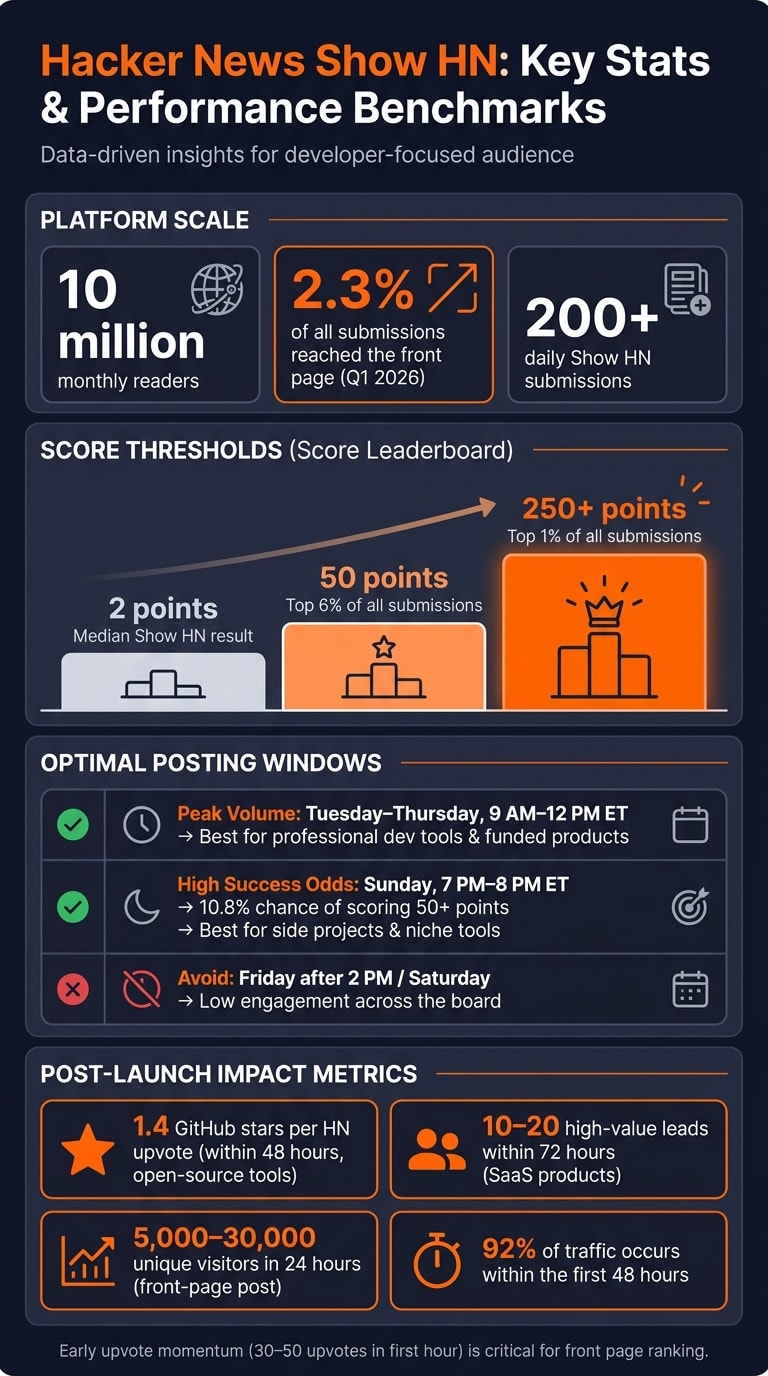
- Only 2.3% of all submissions made it to the front page in the first quarter of 2026 .
- The median Show HN post scores just 2 points, while hitting 50 points puts you in the top 6% of submissions .
| Score Threshold | What It Means |
|---|---|
| 2 points | Median Show HN result |
| 50 points | Top 6% of all submissions |
| 250+ points | Top 1% of all submissions |
Show HN posts do have a slight advantage. They appear in a dedicated /shownew queue and get a grace period where downvotes are disabled, giving them time to gain traction before the broader community weighs in .
These dynamics highlight why trying to "game" the system is a bad idea - it doesn't work and can even backfire.
Why Gaming Hacker News Backfires
HN's anti-abuse system is sharp. It can detect and penalize tactics like vote manipulation, coordinated upvote campaigns, and fake accounts . Asking your Slack team or Twitter followers to upvote your post might seem harmless, but it can result in your post being shadowbanned or outright removed. In fact, votes from brand-new accounts or accounts with zero karma are heavily discounted and may even trigger fraud detection .
For example, in April 2026, a solo founder's Show HN was automatically removed within minutes because the account had no karma - a clear reminder to build account credibility before posting .
"HN generally rewards clear, plain, descriptive framing. A lot of bad HN advice starts from 'how do I make my post stand out?' The official answer is almost the opposite: do not decorate it." - Alcazar Security
The community itself acts as an additional layer of moderation. Regular users are quick to flag posts that seem artificial or overly promotional. Once a post starts getting flagged, the algorithm can impose an "overheating penalty", capping its rank no matter how many upvotes it gets . The best approach? Build karma through genuine participation and post from a personal account.
Beyond gaming tactics, how you handle criticism and engagement can also affect your post's performance.
How Negative Engagement Hurts Post Performance
Flags are a direct negative signal in HN's ranking formula . If a post attracts heavy criticism and the author responds poorly - especially with dismissive or defensive replies - it can quickly spiral into a toxic thread. This invites more flags, which in turn lower the post's rank .
"One dismissive reply and the thread turns toxic. HN users will pile on. Stay calm, even if criticized." - The Growth Terminal
Overly promotional language can make things worse. Titles that use buzzwords like "revolutionary" or "game-changing" often trigger immediate downvotes before anyone even reads the post . Additionally, the 2026 HN guidelines explicitly ban AI-generated or AI-edited comments, reinforcing the platform's focus on authentic, human-driven conversations .
In short, authenticity isn't just encouraged - it's built into how the platform operates.
How to Build a Strong Show HN for Developer Tools
Writing Show HN Titles That Work
Your title needs to grab attention fast - like, within three seconds. If it's too vague or overly dramatic, you'll lose potential clicks before anyone even glances at your product.
A simple and effective formula for your title is: Show HN: [Product Name] – [One-sentence technical description]. The key is to highlight what makes your project stand out technically. For instance, AFFiNE nailed it with "Show HN: AFFiNE – an open-source Notion alternative with local-first storage." The phrase "local-first storage" immediately showcased the technical value, drawing in curious developers. That post alone led to thousands of GitHub stars .
Stick to titles that are 8 to 12 words long and under 80 characters. Posts in this range tend to perform 40% better on average . Avoid exclamation marks, flashy adjectives, or anything that feels like a press release.
"The differentiator in your title should be the technically interesting part - the architecture choice, the open source angle, the local-first approach, the specific problem you solved." - Iris, Ex-CoFounder of AFFiNE
What to Link to and Why It Matters
Always link to something developers can immediately interact with - a live demo, functional product, or public GitHub repository. Hacker News readers love to dive in, explore the code, or test the tool directly. Linking to a marketing page with a waitlist form? That's a quick way to lose their trust .
Your link also needs to handle a sudden surge in traffic. A front-page Show HN post can bring in anywhere from 5,000 to 30,000 unique visitors in just 24 hours . To prepare, ensure your page or demo is backed by a CDN and aggressively cached.
Right after you post, follow up with a maker comment as your first reply. Use this space to explain your project, why you built it, the tech stack, and one honest limitation. Acknowledging what your tool can't do yet shows you're serious and transparent. As Nova Yu, Founder of CrossMind, put it: "A Show HN post works when it reads like a genuine experiment report, not a launch announcement."
When to Post and What to Check Before You Do
Timing plays a big role in your post's success. The best window for maximum visibility is Tuesday–Thursday, 9:00 AM–12:00 PM ET. This timeframe captures US East Coast developers starting their day and European engineers in their afternoon . If you're working on a niche or side project and want less competition, consider posting on Sunday at 7:00 PM ET (Monday 00:00 UTC). This slot has a 10.8% chance of scoring 50+ points, thanks to fewer competing posts .
| Posting Window | Time (ET) | Best For |
|---|---|---|
| Peak Volume | Tue–Thu, 9 AM–12 PM | Professional dev tools, funded products |
| High Success Odds | Sun, 7 PM–8 PM | Side projects, niche tools |
| Avoid | Fri after 2 PM / Sat | Low engagement across the board |
Before hitting "post", double-check that your product is live, your infrastructure can handle traffic, your maker comment is ready, and you're available to engage for the next 2–4 hours. Active participation during the first few hours is essential to maintaining momentum.
With all these elements in place, you're ready to move on to the next phase: executing post-launch strategies effectively.
What to Do in the First 60 Minutes After Posting
Minute-by-Minute Priorities
The first hour after publishing your Show HN post is crucial. If you don’t hit the early upvote threshold, the algorithm will move on quickly.
As soon as your post goes live, start by adding a maker comment. This should include details about what you built, why you built it, the key technical decisions, and at least one limitation. Next, reach out to a small group of 10–30 trusted technical contacts - people like colleagues, advisors, or early users. Ask them for honest feedback, not upvotes. Hacker News has sophisticated systems to detect coordinated voting, so the focus should always be on engagement, not gaming the system .
From minute 15 onward, keep an eye on your thread and respond to every meaningful comment within 15 minutes. The pace of comments plays a big role in the Hacker News ranking algorithm - active discussions help keep your post visible longer .
"A well-managed comment section can sustain a front page post for 18–24 hours. A post where the founder disappears after submitting typically fades in 4–6 hours." - Iris, Ex-CoFounder & COO of AFFiNE
Throughout, stay composed and professional in your responses as the discussion evolves.
How to Respond to Feedback Without Getting Defensive
Hacker News readers are often technical, skeptical, and blunt. You’ll encounter critiques that are sharp, some that are inaccurate, and others that hit uncomfortably close to home. How you respond to these will shape the tone of your thread.
For valid technical critiques, acknowledge the point and explain your reasoning. A response like, "That's a fair point - we chose X because of Y, but Z is a real limitation we're addressing", shows you’re thoughtful and open. When correcting factual inaccuracies, stay calm and provide specifics - link to code, benchmarks, or design decisions to back up your point. Always aim for clarity and keep the conversation fact-based rather than confrontational.
If someone points out broken links or bugs, fix them right away. Once resolved, reply to the commenter to let them know. This kind of responsiveness demonstrates you’re serious about your work, not just trying to promote a landing page.
Handling a Traffic Surge
While engaging with the thread is critical, you also need to ensure your infrastructure can handle the traffic spike. A front-page Show HN post can drive anywhere from 5,000 to 30,000 unique visitors in 24 hours . If your product or site can’t handle the load, it could backfire - slow load times or broken links often lead to downvotes, which can quickly derail your momentum .
Before posting, double-check that your CDN is active and your landing page is properly cached. Have a static fallback page ready in case your demo struggles under heavy traffic. If something goes wrong, don’t go silent - update the thread immediately. A message like "We're seeing higher traffic than expected and are scaling up - back in ~15 minutes" is far better than leaving users in the dark. Being transparent under pressure earns respect on Hacker News.
Plan to dedicate the first 2–4 hours after launch to actively managing the thread. This is your chance to control the narrative, and how you handle both the technical and conversational aspects during this critical window will set the tone for what comes next.
Post-Mortem Playbook: Turning HN Results Into Long-Term Gains
Key Numbers to Track After a Show HN
After posting on Hacker News (HN), it's not just about the traffic spike - it’s about understanding how that traffic translates into meaningful outcomes.
For open-source tools, you can expect 1.4 GitHub stars per HN upvote within 48 hours . For SaaS products, the focus shifts to trial signups and quality leads. A strong launch typically generates 10–20 high-value leads within 72 hours . Another key metric is the number of comments - posts with over 200 comments often achieve an average score of 487, a clear indicator of deep community engagement . And don’t forget the SEO benefits: with HN’s Domain Rating of 91, a front-page post can provide backlinks that boost your domain authority over time .
These metrics offer more than just a performance snapshot - they help you refine your approach and make the most of community feedback.
How to Use Comment Feedback Productively
The numbers matter, but the qualitative insights from comments can be even more transformative.
"HN gives you something harder to measure - engineers who actually read what you built, file specific bug reports, and sometimes email you at midnight with architectural critiques better than anything your own team had raised." - Iris, Ex-CoFounder & COO, AFFiNE
To make the most of this feedback, categorize comments into buckets: bugs, UX issues, feature requests, or dismissals. This structured approach helps you create a transparent public roadmap, showing the community that their input is valued. For example, when AFFiNE launched on HN, one commenter provided a detailed 600-word critique of their CRDT implementation. The team found this feedback more insightful than their internal reviews and incorporated it into their architecture .
You’ll also encounter the classic "Why not just use [X]?" comment. Instead of brushing it off, use these critiques to refine your competitive positioning. Explain your trade-offs in simple, clear terms. If a bug is flagged, aim to fix it within 48 hours and respond directly to the commenter - this kind of responsiveness builds trust and goodwill with the technical audience you’re trying to reach .
Keeping Momentum After the Spike Fades
A Show HN post generates a short-lived but intense burst of attention. The impact fades quickly - 92% of the traffic typically occurs within the first 48 hours .
To keep the momentum going, follow up with a technical deep dive two to four weeks after your launch. Publish a detailed post about your build and submit it to HN. This serves two purposes: it re-engages users who missed the original post and gives the HN algorithm a reason to resurface your work . Your original HN thread also acts as a long-term resource, functioning as an indexable Q&A that can attract high-intent search traffic for up to a year .
For sustained visibility, consider tools like daily.dev for Business. This platform allows you to place native ads directly in a feed read by over 1 million developers daily. While HN provides a high-intensity, short-term boost, daily.dev offers ongoing exposure, targeted by programming language, user seniority, and the tools your audience already uses.
Building a Lasting Presence on Hacker News
Building Founder and Employee Accounts That People Trust
Using Hacker News (HN) as a megaphone for your brand is a quick way to lose credibility. The platform’s algorithm is designed to downrank overt marketing, and seasoned users can sniff out insincere tactics almost immediately .
The solution? Ditch the company accounts and go personal. Create individual profiles for founders or employees and spend weeks - or better yet, months - engaging thoughtfully in discussions that genuinely interest you. This isn't about gaming the system; it's about respecting how the community operates. Founders who participate authentically and avoid marketing jargon often see 2–3x more engagement than those who don’t .
"Hacker News does not care about your brand. It cares about what you built, why you built it, and whether you are being honest about it." - RankInPublic
Honesty goes a long way here. Share behind-the-scenes details about your tech stack, the challenges you faced, and the trade-offs you made. This kind of transparency builds trust and sets the stage for deeper conversations about your technical insights.
Writing Technical Deep Dives That Resonate on HN
Posting a generic product launch on HN? Don’t expect much traction - it’ll likely get lost among the 200+ daily "Show HN" submissions . What grabs attention is content with real technical depth - something that teaches readers and sparks curiosity.
Effective posts dive into architecture decisions, share lessons from failures, and back up claims with specific benchmarks. For example, instead of vague statements, include concrete metrics like "processing 100K events/sec on a 2-core instance" . Linking to live repositories or providing actionable data makes your post even stronger. These kinds of deep dives help sustain interest long after the initial traffic surge.
Your post title matters too. A title like "I replaced our Postgres queue with a custom scheduler - here's what broke" is far more engaging than one stuffed with buzzwords like "revolutionary" or "game-changing." HN users tend to be skeptical of hype, so keep it straightforward. Titles with 8–12 words perform 40% better on average, so aim for that sweet spot .
Using Ask HN to Start Real Conversations
Beyond technical posts, engaging the community through "Ask HN" threads is another powerful way to build credibility. But here’s the catch: only use it when you’re genuinely seeking input, not as a sneaky way to promote your product.
For example, ask questions like, "Ask HN: What's the best architecture for handling X at scale?" before your product launches. This approach not only helps you gather valuable feedback but also shows that you’re thoughtful and open to learning. Specific questions about things like onboarding flows, pricing models, or API design can boost engagement by 30–50% .
"Write something smart. Say plainly what it is. Follow the rules. Show up like a human. That still beats timing tricks." - Alcazar Security
HN users and moderators are quick to spot sockpuppet accounts or overly promotional handles. By showing up consistently as a genuine participant - curious, transparent, and unafraid to admit what you don’t know - you’ll earn the trust that can make all the difference for your launch .
The Second Launch Pattern and When Not to Post on HN
How to Re-emerge on HN Every 12 to 18 Months
One Show HN post isn’t a long-term growth plan - it’s just a momentary spotlight. As data scientist Daniel King explains:
"The Show HN launch is not a growth strategy. It's a pulse. You get one day of intense attention, and then it's over."
For established companies, returning to Hacker News every 12 to 18 months is possible, but only if you have a standout update to share. The Hacker News community has a long memory, and a weak follow-up can harm your reputation.
The best second launches showcase clear, measurable progress - like a major architectural overhaul, an open-source release, or a transparent retrospective that includes raw data and lessons learned. Take AFFiNE as an example: their first Show HN post generated 6,000 GitHub stars in just a week. A year later, they returned to the front page with an in-depth technical discussion about their CRDT implementation and demonstrated strong product–market fit .
A well-crafted title, such as "Show HN: [Product] – rebuilt X based on your feedback," shows that you’ve listened to the community. On the other hand, presenting your second launch as just another version of an existing tool - like "Another AI copilot" or "Another Postgres tool" - without a clear technical edge can damage your credibility . If your first launch didn’t perform well, it’s better to wait 3–6 months before trying again to avoid being flagged as spam .
Your second launch should build on the trust and presence you’ve already established on Hacker News. Think of it as part of a broader strategy to maintain credibility and momentum. But knowing what not to do is just as critical.
Posts and Products That Tend to Fail on HN
When planning your next launch, it’s important to steer clear of common mistakes that often lead to failure on Hacker News. Even with a solid strategy, certain missteps can derail your efforts.
The biggest red flag? An unprepared product. Hacker News users will click your link within minutes of posting. If your onboarding process is clunky, the demo doesn’t work, or all you have is a waitlist page, early negative feedback can stick - and it’s tough to recover from a poor first impression when traffic is high.
Avoid flashy buzzwords like "revolutionary" or "disruptive" in your title. Hacker News readers prefer straightforward, technically grounded language. Similarly, coordinated social media campaigns and overly polished launch videos can come across as inauthentic.
Products without a real technical edge - like consumer apps, basic UI tweaks for existing tools, or simple wrappers for APIs - are unlikely to gain traction. What Hacker News users care about is the how: your architecture choices, the trade-offs you made, and the challenges you faced.
Lastly, don’t use "Ask HN" as a sneaky way to pitch your product. The community views this as disingenuous, and the resulting discussion rarely leads to anything meaningful .
Conclusion: Making Hacker News Work for the Long Run
Hacker News has the power to turn relatively unknown developer tools into major hits - if you approach it the right way.
"Hacker News does not care about your brand. It cares about what you built, why you built it, and whether you are being honest about it." – RankInPublic
At its core, Hacker News values technical honesty. Founders who focus on authentic participation - sharing real insights and genuine experiences - often see 2–3× higher engagement compared to those who rely on polished marketing speak . This approach isn’t just ethical; it’s smart.
Landing on the front page of Hacker News can bring a rush of visitors, but this spike is temporary. What happens afterward is just as important. To make the most of your moment in the spotlight, focus on follow-up engagement. Answer community questions, dive deeper into technical topics, and use feedback to refine your product. These strategies help ensure that the initial buzz translates into long-term impact. Keep your Hacker News submission URL handy - it can remain relevant for months, as journalists and investors often revisit high-scoring threads .
For sustained visibility, consider expanding your reach beyond Hacker News. Tools like daily.dev for Business allow you to run targeted ad campaigns aimed at developers based on their programming language, seniority, and tools. With access to over 1 million developers, this platform can help turn a short-lived traffic surge into weeks of meaningful exposure.
Companies like Tailscale and AFFiNE demonstrate how combining an honest launch with consistent, technically focused engagement can transform a one-day spike into lasting success. By staying active and grounded in the developer community, you can keep the momentum going long after your initial Hacker News debut.
FAQs
How much traffic does a Show HN usually drive?
A successful Show HN post featured on the front page can attract anywhere from 5,000 to 30,000 visitors within just 24 hours. For posts that go viral, that number can soar past 100,000 visitors. Open-source tools shared on Show HN often experience a surge in interest, gaining 500 to 2,000 GitHub stars during this period.
However, it's important to note that traffic from Show HN peaks fast, with a half-life of about 24 hours. This makes it an excellent way to generate a short-term burst of high-quality attention, though it’s not ideal for long-term growth strategies.
How do I avoid getting flagged or penalized on HN?
To stay in good standing on Hacker News and avoid penalties, it's important to prioritize genuine engagement and adhere to the platform's rules. Never request upvotes or organize voting efforts, as these actions can result in shadowbans. Use a personal account rather than a brand account, which may face stricter scrutiny. Make sure your project is fully operational before sharing it - unfinished or non-functional projects can hurt your credibility. Avoid using marketing jargon or making inflated claims, and when responding to criticism, remain open and transparent. Stay focused on honest discussion without becoming defensive or overly promotional.
What should I do in the first hour after posting?
The first hour can make or break your post's performance on Hacker News. Why? Because the algorithm heavily weighs early engagement. Your goal is to gather 30–50 upvotes in that critical window.
- Post your first comment fast: Within 5 minutes of publishing, drop a pre-written comment. Keep it technical and straightforward - no fluff.
- Engage with comments: Respond quickly to every comment, even the critical ones. If someone points out a bug, fix it ASAP and acknowledge their input.
- Share strategically: Send the link to trusted peers, but avoid directly asking for upvotes. Stay online and active for at least 2 hours to keep the momentum going.
This hands-on approach can significantly boost your post's visibility early on.