

Want to connect with developers worldwide? Start by understanding their unique needs.
Here’s what you need to know:
- The global developer population reached 47.2 million by 2025, with 20.8 million professionals. India leads growth at 14% annually.
- Developers in different regions have distinct preferences, job conditions, and platform habits. For example:
- North America/Western Europe: Established markets with high enterprise developer density.
- South Asia: Rapid growth, with 7.5 million developers.
- China: Local platforms dominate, like Segmentfault.com.
- Localization is key. It’s not just about translating words but tailoring the entire user experience, including visuals, tone, and formats.
- Challenges include text overflow, hardcoded strings, and cultural missteps. Solutions like AI-assisted workflows and Over-the-Air updates can help.
- Paid ads? Geo-targeting and regional budgets matter. CPCs vary: $0.20–$0.80 in APAC, $1.50–$3.00 in EMEA.
Takeaway: Localized content and regional strategies aren’t optional - they’re essential to engaging developers effectively. Platforms like daily.dev Ads can help you reach over 1 million developers with precise targeting.
The Global Developer Landscape
Developer Populations by Region
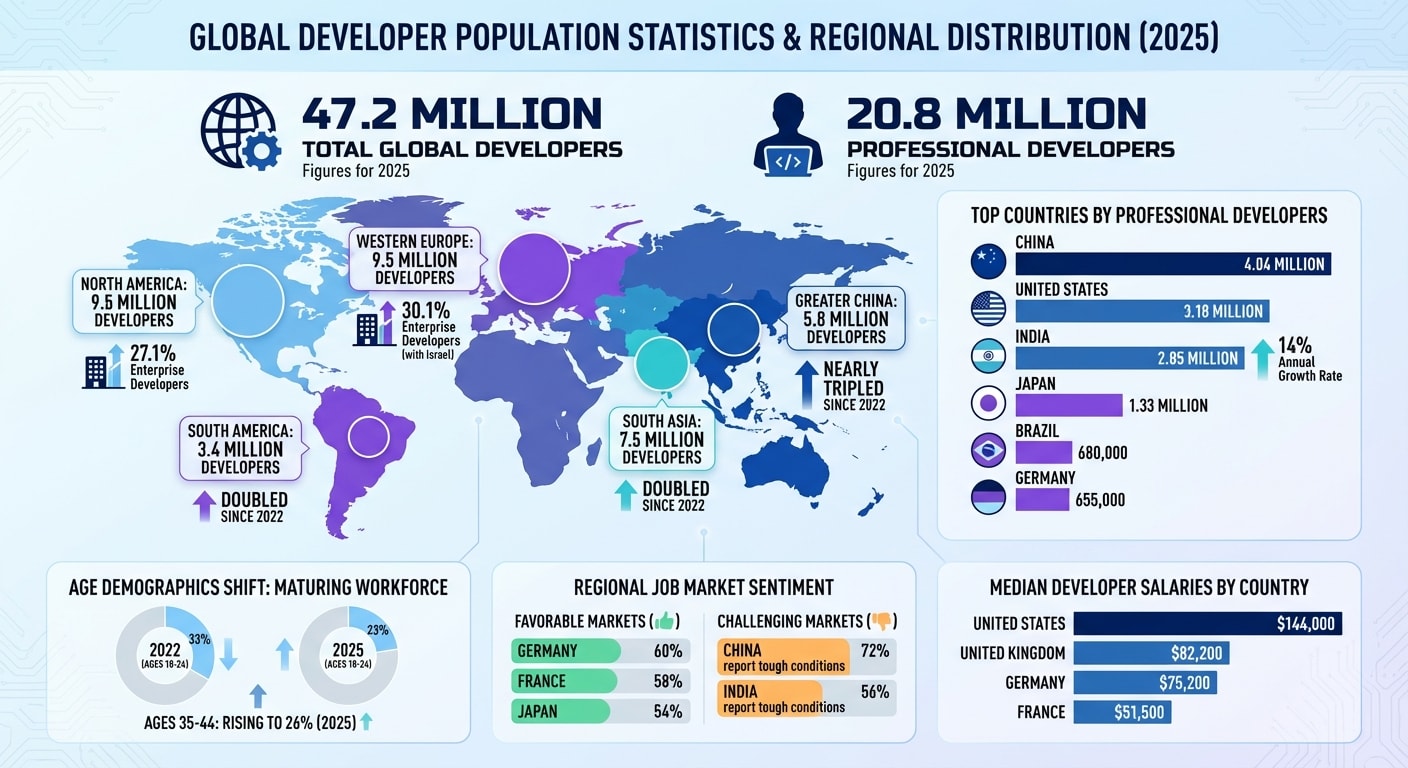
Developers are not evenly spread across the globe, and knowing where they're concentrated is key to crafting effective international marketing strategies. By early 2025, the global developer population reached a staggering 47.2 million, with 20.8 million identified as professionals .
North America and Western Europe stand out as the most established markets, each home to about 9.5 million developers . These regions also have the highest density of enterprise developers, with Western Europe and Israel making up 30.1%, while North America accounts for 27.1% . On the other hand, South Asia has seen explosive growth, with its developer community doubling to 7.5 million since 2022. Greater China has experienced even faster growth, nearly tripling its numbers to 5.8 million during the same period . South America also doubled its developer population, reaching 3.4 million .
When zooming in on individual countries, China leads the pack with 4.04 million professional developers, followed closely by the United States at 3.18 million and India at 2.85 million . India, in particular, is growing rapidly, with its developer workforce expanding at 14% annually, fueled by a thriving IT sector and robust STEM education . Other notable markets include Japan (1.33 million), Brazil (680,000), and Germany (655,000) .
The developer workforce is also undergoing a demographic shift. The percentage of developers aged 18–24 dropped from 33% in 2022 to 23% in 2025, while those aged 35–44 rose to 26% . This trend suggests a maturing workforce, which means marketing efforts need to cater more to experienced professionals rather than just newcomers.
These demographic and regional differences shape the technology preferences and market dynamics that vary across the globe.
How Developer Preferences Vary by Geography
Beyond population statistics, developers in different regions have distinct preferences, job conditions, and platform habits that influence how they respond to marketing efforts. This diversity also affects regional market opportunities.
Job market conditions reveal sharp contrasts. In Germany, 60% of developers view the job market as favorable, with France at 58% and Japan at 54% . On the flip side, 72% of developers in China and 56% in India report tough job markets . These differences impact messaging: developers in tighter job markets might gravitate toward content focused on skill-building and career advancement, while those in stronger markets may prioritize tools that enhance productivity and efficiency.
Salary differences also play a big role in shaping priorities. The median developer salary in the United States is an impressive $144,000, compared to $82,200 in the United Kingdom, $75,200 in Germany, and $51,500 in France . These disparities affect how developers perceive pricing and value propositions in tools and services.
Technology preferences differ by region too. Globally, JavaScript remains the most popular programming language, with nearly 60% adoption, while Python is the go-to for AI and machine learning projects, boasting 75.3% adoption . In cloud infrastructure, AWS leads globally with 46% market share, whereas Alibaba Cloud holds 11%, dominating in APAC .
Enterprise developers are increasingly focused on cutting-edge technologies. For example, 56.5% are involved in Augmented Reality projects, and 32.7% are engaged in Industrial IoT . Western Europe and North America are at the forefront of these innovations, showcasing their dominance in enterprise technology development.
Localization vs. Translation in Developer Marketing
Translation focuses on converting words, while localization adapts the entire experience. This includes elements like cultural nuances, date and number formats, imagery, tone, and even user interfaces. For developer marketing, localization is especially important. Why? Because 76% of consumers prefer buying products with information in their own language, and 40% won’t purchase from websites in other languages .
The challenges of localization go beyond swapping words. For instance, German text can be up to 30% longer than English, while Finnish might expand by 30% to 40% . A button label that fits perfectly in English might overflow in these languages. Right-to-left scripts, like Arabic and Hebrew, add another layer of complexity, requiring mirrored user interfaces instead of simple text translations. Even pluralization can get tricky - English has just singular and plural forms, but Polish has three forms, and Arabic has six.
The business case for localization is clear. Companies that support 20 or more languages see international revenue make up 52% of their total income. Compare that to just 8% for English-only products. Additionally, localization budgets saw an average 47% year-over-year increase in 2025 .
"Localization is not a cost - it is leverage." - Eray Gündoğmuş, better-i18n
To keep up with demand, many developer teams are turning to AI-assisted workflows. In fact, 73% now use LLM-based translation tools, and 39% rely on a hybrid approach - using AI for initial drafts and human experts for review. This combination is especially effective for technical documentation .
Regional Messaging Strategies for APAC, LATAM, and EMEA
Localization fundamentals lay the groundwork, but regional messaging strategies take it a step further by tailoring content to specific markets.
In APAC, cultural sensitivity is key. Formality and visual symbolism matter. For example, direct calls-to-action like "Get Started for Free" may feel too abrupt in places like Japan, Korea, or Singapore. Even colors can send different messages - white, which symbolizes purity in the West, can represent death in parts of Asia. Similarly, certain imagery, like owls, might carry negative meanings . For China, regulations like ICP licensing dictate how content is structured and hosted.
LATAM audiences respond well to warm, friendly tones, but treating Spanish as one language is a misstep. Spanish speakers in Mexico, Argentina, and Spain use different vocabulary, currency formats, and levels of formality. Brazil, on the other hand, requires Portuguese content and compliance with LGPD regulations, which have unique requirements compared to GDPR .
EMEA presents its own challenges, demanding support for multiple languages and strict regulatory compliance. For example, Arabic and Hebrew require right-to-left layouts, which involve mirroring navigation, icons, and progress bars - not just flipping text. GDPR compliance is also a must, and planning for text expansion is crucial since German text can grow 10% to 35% longer than English .
Common Localization Problems and How to Fix Them
Localization often brings technical hurdles, but many of these issues can be addressed with proactive planning and modern tools.
Text Overflow: This is a widespread issue, with 67% of developers experiencing truncation problems . To prevent this, design UI components to handle up to 40% text expansion. Use CSS logical properties like
margin-inline-startinstead ofmargin-leftto accommodate both left-to-right and right-to-left layouts .Hardcoded Strings: A headache for 73% of developers, hardcoded strings add unnecessary technical debt. The fix? Externalize all user-facing text into locale files (e.g., JSON or YAML) using internationalization (i18n) libraries. This approach decouples localization from the development cycle .
Concatenation Issues: Building sentences by joining fragments (e.g., "You have " + count + " items") often breaks translations. Instead, use full sentence templates with placeholders. This is critical for languages with complex grammar rules, where word order or gender can vary .
Cultural Missteps: Nearly 42% of translation errors stem from cultural inappropriateness. To avoid this, involve native speakers in in-market reviews to catch awkward phrasing or cultural insensitivity. Don’t forget to localize metadata, like
<title>tags, to boost regional SEO .Inefficient Workflows: Delayed releases due to translation bottlenecks affect 78% of teams. A solution gaining popularity - especially among mobile teams (68%) - is Over-the-Air (OTA) updates. These allow translation fixes or content updates without requiring a full code release .
Addressing these challenges ensures smoother localization processes, helping you engage developers effectively across the globe.
Where Developers Engage by Region
Developer engagement shifts dramatically depending on the region. While platforms like Stack Overflow dominate in Western markets, their reach is limited in other parts of the world - only 19% of developers in Greater China and 36% in Japan use it. This leaves a large portion of the global developer community connecting through alternative platforms and channels . These differences highlight the importance of understanding local preferences when engaging developers globally.
Top Developer Platforms by Region
In China, regional platforms take center stage. Developers turn to Segmentfault.com for Q&A, Zhihu for sharing knowledge, and platforms like BiliBili and MaiMai for social interactions . Meanwhile, in Japan, Teratail.com leads in Q&A, while Codezine and IT Media provide popular technical content. Notably, 59% of Japanese developers have over 16 years of experience, making technical depth a priority for communication .
India stands out as the fastest-growing developer market, with a 14% annual growth rate. Indian developers are highly active on global platforms such as Stack Overflow and GitHub, with GitHub usage reaching 9.75 million users in 2022 . In Brazil, developers prefer Portuguese-language versions of these platforms, emphasizing the need for localized content . Eastern Europe showcases a mix of global and local engagement, with countries like Poland, Ukraine, and Romania relying on both international platforms and state-supported innovation hubs. Examples include Bulgaria's Sofia Tech Park and Moldova's Innovation Technology Park, which hosts over 2,370 enterprises .
Using Regional Developer Communities
Beyond major platforms, smaller regional groups play a critical role in fostering engagement. In Latin America, developers often gather in tech parks and "smart cities", especially in Brazil and Argentina, where fintech and agritech innovation thrive. The region’s alignment with North American time zones also boosts collaboration opportunities .
Specialized communities are gaining traction as well. For instance, Poland and Ukraine are seeing increased activity in cybersecurity circles, fueled by Poland's planned $1 billion cybersecurity budget increase in 2025. Similarly, Vietnam’s 1.26 million developers are active in regional tech meetups and innovation hubs .
"A fifth of the global developer population is located in either the Greater China region or the rest of East Asia." – Brayton Noll, Analysis, Developer Nation
These regional strategies are further supported by significant investments. For example, in June 2025, blockchain company Tether committed $25 million to Georgia's tech ecosystem to support local startups. Meanwhile, Oracle plans to invest $100 million in new data centers in Argentina by early 2026, strengthening the country’s growing tech workforce .
English-First vs. Localized Content: Which to Choose
Deciding between English-only and localized content depends on factors like where your developers are based, your budget, and how much localization can boost your competitive edge . The decision isn’t all-or-nothing - many companies opt for a tiered strategy that balances cost with potential impact.
When English Content Works
An English-first approach is effective in regions with high English proficiency or when budget constraints are a concern. Countries like the Netherlands, Sweden, and Singapore are examples of markets where developers often prefer English technical content. If your traffic data shows strong engagement from English-speaking users, focusing on English content can be a smart move .
For startups spending around $28,000 annually, prioritizing English content often makes more sense compared to enterprises that invest approximately $680,000 . If you're just starting to expand globally, refining your English content could yield better results than attempting to cover multiple languages at once. While this strategy may meet short-term goals, it’s worth evaluating the long-term benefits of localization.
Why Localized Content Performs Better
Localization goes beyond simple translation - it’s about connecting with your audience in a way that feels tailored to their needs. For example, developers in Japan, where 59% have over 16 years of experience, expect technical materials in formal Japanese . In Brazil, Portuguese-language versions of platforms resonate more strongly with developers . A one-size-fits-all Spanish translation won’t effectively serve audiences in Mexico, Argentina, and Spain, as each market has unique linguistic nuances .
Localized content builds trust and drives engagement, especially for developer tools and SaaS products. Users who onboard in their native language tend to stick around longer and adopt features more quickly. In fact, companies that invest in localization report positive ROI 71% of the time, with returns ranging from 1.5× to over 3× .
"Localization is not a cost - it is leverage." – Eray Gündoğmuş, Better i18n
To maximize your budget, consider a tiered quality model. For high-impact content like marketing pages, pricing, and onboarding flows, invest in professional translation with native-language review. Blog posts and help documentation can benefit from professional translation without intensive review. Meanwhile, low-priority content like error logs or internal documentation can rely on machine translation with light editing . This approach ensures you’re allocating resources effectively while maintaining broad content coverage.
How Culture Affects Developer Marketing
Cultural differences play a big role in how developers respond to marketing, trust platforms, and engage with products. Overlooking these differences can have immediate consequences. Developers may abandon tools or platforms if the information feels out of place or unreliable. Poor localization is often a culprit, leading to confusion and support issues. For instance, ambiguous date formats like 03/04/2024 or unfamiliar currency displays can frustrate users . As Coders Stop aptly put it:
"Nothing says 'we don't care about your market' like badly formatted local data" .
Adapting Messages for Different Regions
The tone and level of formality in your messaging can vary significantly by region. In North America, a direct call-to-action like "Get Started for Free" often works well. But in regions such as Japan, Korea, and Germany, this approach might come across as too casual or unprofessional. These markets often expect a more formal tone . Simply translating the words doesn’t cut it - you need to adapt to the professional norms of the audience. For example, in Japan, where 59% of developers have over 16 years of experience , your messaging should reflect their expertise and high standards.
Cultural differences also extend to platform preferences. Developers in China and Japan are far less likely to use Stack Overflow compared to their peers in other parts of the world . Instead, they rely on local platforms like segmentfault.com in China and teratail.com in Japan . Ignoring these preferences can mean missing out on key engagement opportunities.
Educational backgrounds further shape how developers evaluate tools. In Greater China, 50% of developers acquire their coding skills through undergraduate degrees, compared to the global average of 41-42% . Meanwhile, in Indonesia, many developers turn to online courses and bootcamps for their education . These differences highlight the importance of tailoring your marketing to diverse learning paths.
Cultural Mistakes to Avoid
Getting local data formats right is non-negotiable. Missteps like using U.S. conventions in European markets - such as $1,234.56 instead of 1.234,56 € - can confuse users and lead to drop-offs .
Steer clear of idioms and metaphors that don’t translate well. Phrases like "knock it out of the park" or "boil the ocean" are deeply rooted in specific cultures and often lose their meaning in translation . Keeping your content straightforward and technical ensures it resonates globally.
Be mindful of regional data privacy laws. Regulations like the GDPR in Europe, PDPA in Thailand, and CCPA in California differ by region . Ignoring these rules can result in legal trouble and damage your credibility in local markets.
Assuming global platforms work the same everywhere is another common mistake. In regions where developers favor local alternatives, relying solely on global platforms can mean missing large segments of your audience.
Regional Cultural Preferences and Developer Experience
| Region | Communication Style | Key Platform | Experience Level |
|---|---|---|---|
| Japan | Formal, technical | Teratail.com | 59% with 16+ years |
| Greater China | Professional, credential-focused | Segmentfault.com | 4% with 16+ years |
Understanding these cultural nuances not only helps fine-tune your messaging but also guides how you allocate resources for international campaigns. By aligning your approach with regional preferences, you’re more likely to make a lasting impression on developers worldwide.
International Paid Advertising for Developers
When creating international paid advertising campaigns, it's crucial to adapt strategies to fit local conditions. This means considering differences in advertising costs, platform preferences, and performance metrics across regions. Success hinges on tailoring your approach to these regional variations.
How to Use Geo-Targeting for Developer Campaigns
Geo-targeting allows you to deliver ads to developers in specific locations - countries, regions, or even cities - by using IP addresses and device location data . Start broad, targeting larger regions, and fine-tune your approach based on performance data like click-through rates (CTR) and conversion rates. For instance, you might initially target the entire APAC region but then narrow your focus to countries like India or Singapore if CTR exceeds 2% and conversion rates surpass 5%.
Different platforms offer varying levels of geo-targeting precision. Google Ads, for example, supports city-level targeting, making it ideal for reaching developers in tech hubs like Bangalore or São Paulo . On the other hand, LinkedIn Ads works well for targeting B2B developer tools in established markets, thanks to its filters for job titles, company sizes, and skills. Keep in mind that platform popularity varies by region, so adjust your media mix accordingly.
To maintain consistency and reduce errors, use standardized templates for campaign setups . Additionally, tapping into local expertise can help refine your targeting by accounting for regional trends and seasonal nuances.
Regional CPC Benchmarks for Developer Keywords (2023)
| Region | Average CPC | Competition Level | Recommended Budget % |
|---|---|---|---|
| APAC | $0.20‑$0.80 | Medium | 35% |
| LATAM | $0.30‑$1.00 | Low | 25% |
| EMEA | $1.50‑$3.00 | High | 40% |
Once you've set precise geolocation parameters, the next step is to allocate your budget effectively to maximize returns.
How to Allocate Budget Across Regions
After setting up targeted ads, your budget allocation should reflect where your audience is most concentrated - not just where advertising costs are lower. For instance, mature markets like North America and Western Europe tend to have higher CPCs ($2.00‑$5.00) due to heavy competition, while regions like APAC and LATAM often offer lower CPCs ($0.50‑$2.00) and access to larger audiences . If your product focuses on fintech developers in Brazil, allocating a larger share of your budget to LATAM could yield better results than spreading resources thinly across multiple regions.
Regularly monitor performance metrics like conversion rates, cost-per-acquisition (CPA), click-through rates (CTR), and return on ad spend (ROAS) for each region to spot underperforming markets. For example, if your APAC campaigns generate a lot of clicks but few conversions, the issue might lie in your messaging or localization strategy.
Budgets should also be flexible, adapting to regional events and seasonal trends. Developer conferences, hackathons, and hiring cycles vary around the world. European developers, for instance, often take vacations in August, while hiring peaks in Asia may occur at different times. Plan to boost spending 2‑4 weeks before major regional events or product launches to maximize visibility among your target audience .
Currency fluctuations can also impact your campaigns. A stronger U.S. dollar can make advertising in other regions more expensive, while a weaker dollar might reduce costs. Keep an eye on exchange rates and adjust budgets accordingly to maintain consistency . Additionally, consider local economic conditions. For example, during economic slowdowns, reduced developer hiring in some regions might lower the ROI of your ad spend.
Reaching Global Developers with daily.dev Ads
Once your regional budget strategies are in place, the next step is finding a platform that can effectively connect you with developers worldwide. That’s where daily.dev Ads comes in. With access to over 1 million developers across 150+ countries, this platform combines precise technical segmentation with native ad placements to make international campaigns more effective.
daily.dev Ads Features
daily.dev Ads offers more than just basic demographic targeting. It allows you to segment your audience based on seniority levels (aspiring, entry-level, mid-level, senior), programming languages (like JavaScript, Python, Java, Swift, or Go), and even specific tools developers rely on (such as Docker, Kubernetes, Jenkins, Jupyter Notebook, or Visual Studio Code) . This targeting is powered by behavioral data from real coding activity, achieving over 90% accuracy while cutting acquisition costs by 50% compared to job-title targeting .
The platform’s global reach is also well-distributed. Key regions include APAC (30% of users, with hubs like India and China), EMEA (25%, including Germany and the UK), and LATAM (15%, with countries like Brazil and Mexico) . To enhance engagement, daily.dev supports more than 10 languages for ad copy. Ads can be automatically adapted to match users’ language preferences, and A/B tests comparing English to localized versions have shown a 25–35% increase in engagement in non-English-speaking markets .
Native ad placements, such as in-feed and post-page ads, outperform traditional banners, delivering 2–3× higher click-through rates (CTR) . On average, global campaigns see CTRs of 1.5–2.5%, with localized creatives driving up engagement by 40% . The platform’s desktop-first design aligns with developers’ habits, as they often evaluate APIs and tools on desktop devices .
To help you track and optimize performance, daily.dev Ads provides real-time dashboards. Key metrics include impressions, clicks, CTR, cost-per-click (CPC), and engagement by tech stack. You can also analyze ROI by region and integrate with tools like Google Analytics or Mixpanel for deeper insights .
Campaign Examples Using daily.dev Ads
The platform’s advanced features have already delivered impressive results for global campaigns:
Vercel, a cloud provider, used daily.dev Ads in 2024 to target JavaScript developers in India and Southeast Asia. By focusing on mid-to-senior developers and using in-feed ads to promote edge functions, the campaign achieved 250,000 impressions, a 4.2% CTR, and a 15% conversion rate for sign-ups .
Nubank, a fintech company, ran a campaign aimed at senior backend developers in Brazil and Mexico. Ads highlighting Kubernetes and Node.js were placed post-page, generating 180,000 impressions, a 3.8% CTR, and a 12% lead conversion rate. This success was fueled by daily.dev’s access to over 100,000 LATAM developers, ensuring cost-effective reach .
For budget planning, experts suggest allocating 40% to high-volume regions like APAC, 30% to EMEA, 20% to LATAM, and 10% to smaller markets. CPCs typically range from $0.50 to $1.50 per click. Start with geo-fenced tests to identify top-performing regions, then reallocate budgets dynamically to scale successful campaigns .
Conclusion
Reaching developers in global markets involves much more than simply translating content into different languages. True localization tailors cultural references, date formats, and messaging to make your product feel like it was built specifically for that audience. As Eray Gündoğmuş puts it, "Content localization is one of the highest-leverage investments a growing product company can make. Done well, it turns existing content into a compounding asset" .
The numbers back this up. 76% of consumers prefer to buy products with information in their own language, and 40% won’t purchase from websites that don’t support their native language . With the global developer population projected to hit 20.8 million by 2025 , localization is no longer optional - it’s essential for driving engagement and revenue. Markets around the world are expanding, and localized content is key to connecting with these audiences.
To get started, focus on markets with strong traffic or growth potential instead of trying to localize everything at once . Invest in professional translation for high-priority pages like pricing and onboarding, while using machine translation for less critical content. Writing with localization in mind helps too - stick to active voice, avoid cultural idioms, and maintain a glossary of terms to ensure consistency . This kind of thoughtful strategy sets the stage for successful global outreach.
daily.dev Ads simplifies the process with native ad placements and access to a global developer community. Use these strategies to create international campaigns that deliver real results with daily.dev Ads.
FAQs
Which regions should I localize for first?
Focusing on regions with the largest and fastest-growing developer communities is a smart move. Start with the United States, China, and India - these three countries dominate globally in terms of developer numbers. After that, shift your attention to regions like Europe, Southeast Asia, and Latin America, where developer communities are not only growing but also becoming increasingly diverse. By prioritizing these areas, you can tap into global trends while boosting engagement with content tailored to local needs.
How do I know translation isn’t enough?
Translation by itself often misses the mark in international developer marketing because it overlooks the cultural and contextual nuances that influence how messages are perceived. Developers tend to value content that feels genuine and can quickly sense when something seems out of place or disconnected. To connect effectively, localization needs to go further - adjusting tone, metaphors, and references to align with the audience’s cultural background. This approach builds trust and keeps developers engaged by ensuring the messaging aligns with local values and professional expectations.
What should my international ad budget split be?
When planning your international developer marketing budget, set aside 40-50% for paid ads. This allocation should reflect factors like regional developer demographics, preferred channels, and local preferences. It's not just about running ads - it’s about understanding where and how to reach developers effectively.
Strive for a balance between English-first content and localized materials. While English may serve as a global standard, localized content resonates more deeply with specific audiences. Additionally, focus on platforms that are popular in particular regions to ensure your efforts align with local habits.
For geo-targeting and budget distribution, consider developer engagement patterns. Emerging hubs like South Asia and Greater China present exciting growth opportunities, while established markets in North America and Europe remain crucial. Adapting your approach to each region’s unique dynamics is essential for maximizing impact.