

Platform engineers are pivotal in shaping how modern software organizations operate. They manage Internal Developer Platforms (IDPs) to streamline developer workflows, reduce cognitive load, and ensure compliance. Unlike DevOps or SRE teams, platform engineers treat the IDP as a product, influencing tool selection and organization-wide processes.
Why this matters:
By 2026, 80% of large software organizations are expected to have platform engineering teams. These teams focus on metrics like onboarding efficiency, golden path adoption, and cloud cost management. Their decisions ripple across entire engineering departments, making them a key audience for infrastructure and developer tool marketers.
How to connect with them:
- Tailor messaging to their priorities: productivity, integration, and measurable outcomes (e.g., DORA metrics).
- Provide technical content: migration stories, Architecture Decision Records (ADRs), and build-vs-buy analyses resonate more than generic marketing.
- Engage in their spaces: Use channels like GitHub, CNCF events, and technical newsletters. Avoid traditional ads; focus on ungated, actionable content.
Key takeaway:
Platform engineers value tools that simplify processes, integrate seamlessly, and improve developer efficiency. Position your solution as a problem-solver for their specific challenges, backed by data and technical depth.
Understanding Platform Engineers and Their Priorities
Core Goals and Success Metrics
Platform engineers focus on improving developer productivity, which is often measured by metrics like how quickly new hires become effective, how frequently teams adopt "golden paths", and how well cloud costs are managed. These tangible measures help platform teams gauge their success. For instance:
- Onboarding efficiency: How fast new engineers ramp up.
- Golden path adoption: The rate at which teams use predefined, standardized solutions instead of building custom ones.
- Cloud cost management: Keeping infrastructure expenses under control.
In organizations with less mature platforms, developers can spend up to 40% of their time dealing with infrastructure and tooling tasks instead of coding new features . However, mature platform teams can significantly reduce this burden, cutting unnecessary tasks by 30–40% . This efficiency also leads to 40% fewer support tickets directed to platform teams and 28% faster median time from commit to production .
"Platform engineering should not be positioned as an infrastructure overhead - it should be quantified as a multiplier on every product team's capacity." - iCentric Insights
These metrics guide how platform teams assess tools and strategies, ensuring their efforts directly enhance productivity.
Technical Criteria for Tool Selection
When choosing tools, platform teams prioritize compatibility with their existing internal developer platform (IDP). Key considerations include:
- Seamless integration: Tools must work smoothly with frameworks like Backstage, Crossplane, or Kratix.
- Open standards: Avoiding proprietary lock-in is essential for long-term flexibility.
- Built-in compliance and security: Tools should embed guardrails directly into the platform, making secure practices the default.
A great example of this approach is NatWest. In 2026, Chris Plank, Lead Enterprise Architect at NatWest, used the Kratix framework to transform their provisioning process. What once took months was reduced to minutes for thousands of developers. This was achieved with organizational policies built into "LEGO-like" building blocks, ensuring compliance was automatic .
"NatWest is using Kratix to simplify everything... we reduce the toil and cognitive load developers face, helping them be productive from day one." - Chris Plank, Lead Enterprise Architect, NatWest
This focus on technical compatibility ensures that new tools enhance, rather than hinder, platform operations.
The Developer Experience Mindset
Platform engineers treat their IDP as a product designed for their internal customers - developers. They approach it with the mindset of a product manager, conducting user research, maintaining roadmaps, and monitoring adoption rates. If golden paths see low usage, it’s seen as a platform shortcoming, not a developer failure.
For marketers, this means focusing on outcomes rather than just features. For example, instead of listing capabilities, highlight results like:
- American Express consolidating tools from over 10 to a single unified IDP .
- Stripe achieving environment provisioning in under 15 minutes through automated self-service .
This outcome-driven approach resonates with platform engineers, who are always looking for tools that deliver measurable improvements.
How Platform Teams Evaluate Tools and Content
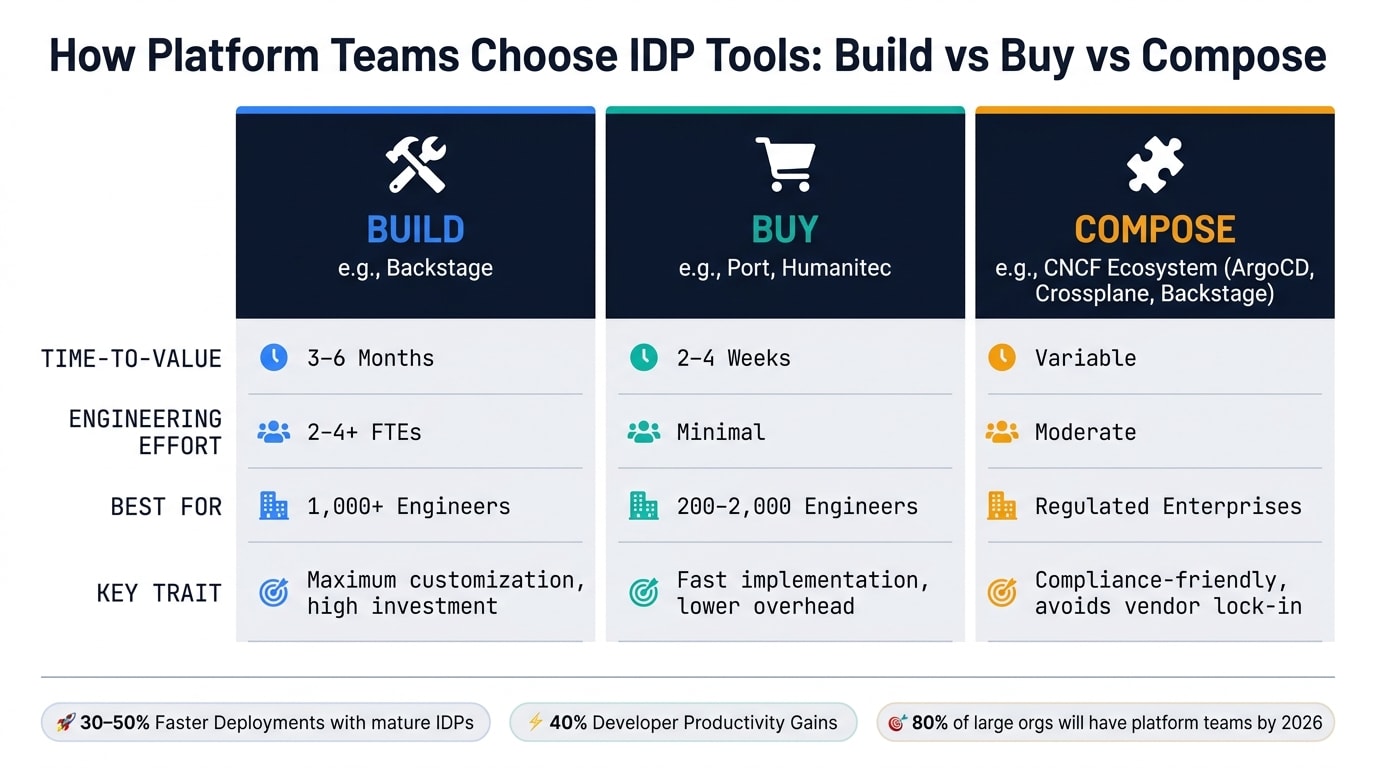
How Platform Teams Assess Tools for Their IDP Stack
Platform teams approach tool evaluation differently than typical software teams. Their top priority is ensuring a tool integrates smoothly into the existing IDP stack without adding unnecessary complexity. For instance, if a tool requires developers to learn Terraform just to deploy a new service, many platform engineers would dismiss it outright .
Another critical consideration is whether the tool can reduce cognitive load across the organization. Platform teams often support dozens - or even hundreds - of engineering squads. A tool that works well for one team but disrupts the "golden path" for others won't make the cut. Self-service capabilities are non-negotiable. If developers still need to submit support tickets to provision a database or set up an environment, the tool hasn't addressed the core problem.
The decision to build or buy tools is another major factor. Enterprises with over 1,000 engineers and the resources to dedicate 2–4 FTEs over 3–6 months might opt to build on open-source frameworks like Backstage . On the other hand, mid-size organizations with 200–2,000 engineers often choose commercial solutions like Port or Humanitec, which offer faster implementation (2–4 weeks) . Regulated enterprises may prefer to assemble CNCF components (e.g., ArgoCD, Crossplane, Backstage) to maintain compliance while avoiding vendor lock-in .
| Approach | Time-to-Value | Engineering Effort | Best For |
|---|---|---|---|
| Build (e.g., Backstage) | 3–6 months | 2–4+ FTEs | 1,000+ engineers |
| Buy (e.g., Port, Humanitec) | 2–4 weeks | Minimal | 200–2,000 engineers |
| Compose (CNCF ecosystem) | Variable | Moderate | Regulated enterprises |
This careful evaluation process also shapes the type of content that resonates most with platform engineers.
Content Formats That Influence Platform Teams
When it comes to content, platform engineers tend to distrust flashy vendor marketing. What they value are materials that reflect their workflows and decision-making processes. Architecture Decision Records (ADRs), for example, are highly effective because they explain the reasoning behind infrastructure choices. Sharing not just what was built but also what was considered and rejected demonstrates a level of technical rigor that engineers respect .
Migration stories that include specific metrics and detailed build-vs-buy analyses are another powerful tool. These stories provide clear evidence of a tool’s impact, such as improved deployment frequency, reduced lead times, or increased self-service adoption rates . The most persuasive examples include hard data that engineers can relate to.
"A golden path is the recommended way to do something... that makes the right choice the easy choice." - Omar Hassan, NovVista
Technical deep dives also carry weight. Topics like GitOps patterns (using ArgoCD or Flux), Infrastructure-as-Code (with Terraform or Crossplane), and policy-as-code (via OPA or Kyverno) help engineers assess a tool's technical soundness before even considering a purchase . Additionally, practical examples - like a functioning catalog-info.yaml file or a ready-to-use scaffolding template - are far more impactful than generic feature descriptions .
Messaging That Connects with Platform Engineers
To align with platform engineers' priorities, successful messaging focuses on measurable outcomes and reduced manual work. Engineers want to see clear proof of how a tool eliminates repetitive tasks and improves efficiency. Anchoring messaging around DORA metrics - such as Deployment Frequency, Lead Time for Changes, Change Failure Rate, and Mean Time to Recovery - works well because these are the same metrics platform teams use to justify tool adoption to leadership .
Messaging around toil reduction is especially effective when it's specific. Developers in organizations lacking a mature platform often spend 30–40% of their time on infrastructure tasks . Highlighting how a tool can reclaim that time and improve engineering capacity speaks directly to how platform teams evaluate ROI. Metrics like voluntary adoption rates (aiming for over 80%) and time to first production deployment (under one hour) further validate a tool’s value in terms engineers already track .
"Platform engineering succeeds when it removes friction from the work developers already need to do." - Omar Hassan, NovVista
Security and compliance messaging also plays a role but works best when framed as built-in by default. Platform engineers prefer tools that embed guardrails directly into the platform, ensuring the secure path is also the easiest path. Messaging that avoids presenting security as an extra layer of complexity aligns better with how top platform teams operate.
Channels and Strategies to Reach Platform Engineers
Communities and Events
Platform engineers tend to steer clear of mainstream channels, gravitating instead toward niche spaces tailored to their needs. Reddit communities like r/devops and r/sre are popular, but the real action happens within the CNCF ecosystem. This includes GitHub repositories, Slack workspaces, and major events like KubeCon North America and KubeCon Europe . At KubeCon, the focus isn't on flashy vendor keynotes but on hallway chats and technical sessions where platform teams can validate tools through peer discussions.
For example, having a Developer Relations expert on hand to answer specific questions about Crossplane integration or Backstage plugin architecture is far more impactful than a branded booth. This hands-on, collaborative approach fosters trust and engagement within the community.
"For devtools, docs produce more pipeline than the marketing site." - Louis Corneloup, Founder, Dupple
Smaller meetups, whether virtual or in-person, are also worth exploring. These gatherings attract practitioners who are actively building or refining their internal developer platforms, making them an ideal setting for meaningful conversations.
How Platform Engineers Consume Content Online
When it comes to consuming content, platform engineers are laser-focused on finding tools and strategies that reduce friction in their tech stacks . They turn to trusted technical newsletters like The Pragmatic Engineer and Console Dev, dive into open-source documentation, and keep a close eye on GitHub activity for projects like Backstage, Argo CD, and Crossplane .
Traditional display ads? They’re often a non-starter - over 60% of developers use ad blockers . Instead, what grabs their attention are resources like runnable examples, architecture walkthroughs, and unbiased build-versus-buy analyses. And when it comes to content access, simplicity wins: ungated content consistently outperforms complicated lead generation forms for this audience .
Reaching Platform Engineers with daily.dev Ads
Leveraging these habits, daily.dev Ads offer a targeted way to reach platform engineers right when they’re exploring new tools. About 24% of the daily.dev audience actively engages with DevOps and Cloud content - topics like Kubernetes, Platform Engineering, and Infrastructure-as-Code - while another 30% consists of senior engineers with seven or more years of experience . Unlike ads based on static profiles, daily.dev Ads target engineers based on real-time reading behavior, zeroing in on interests like Terraform, Kubernetes cost optimization, or GitOps patterns . Campaigns can also be tailored by tech stack (e.g., Docker, Kubernetes, Jenkins), seniority, and focus areas such as DevOps and Cloud .
"Developers do not click on ads. They click on solutions to their problems." - daily.dev
The ad formats align with how platform engineers prefer to consume content. In-feed native ads integrate seamlessly into personalized content feeds, while engagement ads - featuring Branded Tags and Keyword Spotlights - help build brand recognition at the category level. With a desktop-first approach, daily.dev ensures ads appear where engineers are most likely to evaluate infrastructure tools: at their workstations .
Conclusion: Key Takeaways for Marketing to Platform Engineering Teams
Platform Engineers as Infrastructure Decision-Makers
Platform engineers play a role that's distinct from DevOps and SRE teams. As Rack2Cloud aptly explains, "Platform engineering is not a Kubernetes team with a better name... It is a product discipline." Their primary responsibility is managing the internal developer platform (IDP) as a product, where application developers are their end-users. This shift in perspective is critical when considering how to market effectively to this group.
The importance of targeting this persona is growing rapidly. By 2026, 80% of large software organizations are expected to have dedicated platform engineering teams . Companies already using IDPs report impressive results, including 30% to 50% faster deployments and up to 40% gains in developer productivity . These figures highlight why crafting marketing strategies that resonate with platform engineers is so crucial.
Best Practices for Marketing to Platform Engineers
To connect with platform engineers, focus on the outcomes they value most - such as simplifying workflows and accelerating deployments - rather than overwhelming them with feature lists. Their priorities often revolve around creating "golden paths" and improving DORA metrics. Tailor your messaging to align with the metrics they track, including Time to First Deploy, Self-Service Ratio, and deployment frequency.
Compatibility and integration are non-negotiable. If your solution doesn't work seamlessly with tools like Backstage, Crossplane, or Kubernetes-native workflows, it will likely be dismissed early in the evaluation process. Make this compatibility clear and prominent in your messaging, rather than burying it in fine print.
Platforms like daily.dev offer a powerful way to reach platform engineers by targeting their real-time interests, such as Terraform, GitOps, and Kubernetes. As daily.dev puts it:
"Developers do not click on ads. They click on solutions to their problems." - daily.dev
FAQs
Who owns tool decisions in platform engineering teams?
Platform engineering teams usually take charge of deciding which tools to use. Acting like a product team, they are tasked with creating and managing the internal developer platform. Their main goal? To lighten the mental burden on developers and provide self-service infrastructure, ensuring that every tool they choose supports these objectives.
What proof do platform engineers need before they’ll try a new tool?
Platform engineers need solid technical proof before adopting a new tool. This means providing security certifications, detailed performance benchmarks, relevant case studies, and hands-on interactive demos. These components are crucial for building trust and showcasing the tool’s dependability and how well it aligns with their infrastructure requirements.
What’s the best way to target platform engineers with daily.dev Ads?
To effectively reach platform engineers with daily.dev Ads, focus on precise audience segmentation. Tailor your approach based on factors like their seniority, the programming languages they use, and the tools they rely on. Use native ad formats such as in-feed native ads and personalized digest ads to blend naturally with their browsing habits. This approach not only aligns with how they consume content but also helps establish trust more effectively.