

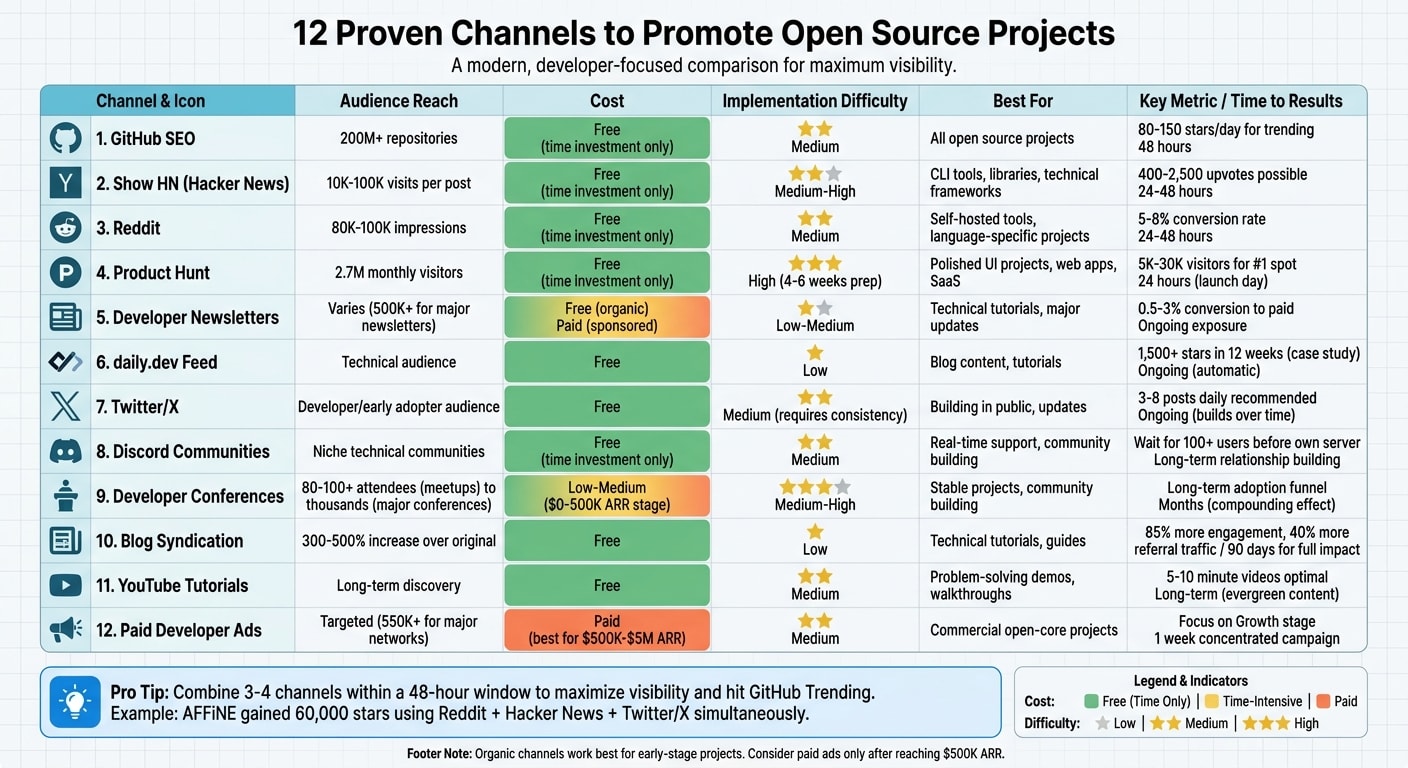
Building an open source project is just the beginning. To grow it, you need a promotion strategy. Here’s the quick answer: successful open source creators use multiple distribution channels to increase visibility, attract contributors, and build communities. These include GitHub SEO, Show HN, Reddit, Product Hunt, newsletters, Twitter/X, Discord, conferences, blog syndication, YouTube tutorials, and even paid developer ads.
Key tactics include:
- GitHub SEO: Optimize repository names, topics, and READMEs for better discoverability.
- Show HN: Use Hacker News to launch your project with a technical focus.
- Reddit: Engage with targeted communities like r/selfhosted or r/programming.
- Product Hunt: Showcase polished projects to a tech-savvy audience.
- Developer Newsletters: Submit your project to niche mailing lists for ongoing exposure.
- Twitter/X: Post threads, updates, and demos to reach developers.
- Discord Communities: Build real-time connections with users and contributors.
- Conferences: Present your project to developers in person.
- Blog Syndication: Republish content on platforms like Dev.to to expand reach.
- YouTube Tutorials: Create short, focused videos to explain your project.
- Paid Ads: Use developer-focused ads to scale growth for commercial projects.
Pro Tip: Combine multiple channels within a 48-hour window to maximize visibility and hit GitHub Trending. For example, AFFiNE grew to 60,000 stars by leveraging Reddit, Hacker News, and Twitter/X simultaneously.
This guide breaks down each channel with actionable steps to help your project thrive.
1. GitHub SEO
GitHub acts as a search engine tailored for developers. With over 200 million repositories vying for attention, optimizing your project is essential to stand out .
Repository names are critical. A descriptive name like ai-chatbot-framework will rank better in search results compared to a branded name like botasaurus. Why? It aligns with existing keyword demand . Similarly, the About section should be concise (under 120 characters) and lead with primary keywords. A higher keyword density here can improve your repository's visibility .
Use topics wisely. GitHub allows up to 20 topic tags per repository. Select single-word topics that reflect your purpose (e.g., automation), tech stack (e.g., react), and industry (e.g., machine-learning). This broadens your search coverage . In one case, a repository with just 2,200 stars outranked another with 22,000 stars because the core keywords were present in its name .
Your README file is more than documentation - it’s your repository’s landing page. Place a standout GIF or screenshot prominently; developers often decide within 10–15 seconds whether to star your project . Include a five-step Quick Start guide and a clear call-to-action, such as: "⭐ If this is useful, a star helps others find it." .
The GitHub Trending algorithm prioritizes velocity over volume. A repository gaining 100 stars today will rank higher than one that gained 10,000 stars last year . To appear on the "All Languages" Trending list, aim for 80–150 stars per day. For language-specific lists like TypeScript or Python, 30–60 stars per day is typically sufficient . Timing is everything - concentrate your promotional efforts within a 48-hour window .
For instance, in August 2022, AFFiNE revamped their README with engaging visuals and launched a coordinated promotional campaign across Reddit, Hacker News, Product Hunt, and Twitter. This strategy propelled them to #1 on GitHub Trending All Languages by Day 5, earning 10,000 stars within 43 days. Their star conversion rate increased by 2.3×, showcasing the impact of well-executed GitHub SEO . These rapid gains not only enhance visibility but also demonstrate how GitHub SEO can be a cost-effective way to boost your project’s reach.
Cost-effectiveness for maintainers
GitHub SEO primarily requires your time. Each appearance on GitHub Trending increases your organic daily star baseline, creating a feedback loop that makes future Trending appearances easier . AFFiNE, for example, appeared on Trending 28 times over five months, raising their organic baseline to about 200 stars per day .
Reaching developers effectively
Optimized repositories do more than just increase star counts - they connect directly with developers. This optimization also improves visibility on platforms like Google, which is GitHub's largest referrer . Hitting 1,000 stars is a significant milestone, often seen as the threshold for a "legitimate project." At this point, conversion rates for landing pages and press outreach typically double .
2. Show HN
Show HN on Hacker News is a go-to platform for developers to introduce their projects. It's often regarded as one of the strongest launchpads for technical and open-source initiatives . Unlike traditional product launches, the Hacker News community values authenticity, transparency, and a focus on technical details . Similar to GitHub SEO, this platform allows creators to directly engage with developers, giving projects a chance to build lasting visibility.
A well-executed Show HN post can result in anywhere from 400 to 2,500 upvotes, driving between 10,000 and 100,000 visits to your repository . For example, in December 2025, the data streaming platform GlassFlow secured the #1 spot on Show HN, staying there for over 12 hours. They achieved this by refining their post over a week, shifting from a broad marketing pitch to an in-depth technical breakdown of their architecture and problem-solving approach . This strategy highlights the importance of technical clarity, much like the principles of GitHub SEO.
Ease of Implementation for Open Source Projects
Posting on Show HN is free, but it requires careful preparation. The best times to post are Tuesday through Thursday, between 7:00 AM and 10:00 AM PT. Use a concise title format like "Show HN: [Product Name] – [specific what-it-does]" and keep it under 80 characters . After posting, immediately add a comment summarizing the problem you're addressing, your solution, and any current limitations . Instead of just linking to your README, include a live demo link to make your project more engaging .
A structured approach, like the one used by Tailscale, can help craft an effective first comment. Their method follows this sequence: Problem → Obvious Solution → Why Obvious Solution Fails → Your Product → How It Works .
"Billing systems are a nightmare"
Lago used this narrative structure in their post, which earned them 777 upvotes . Engaging with commenters during the first few hours is crucial to maximizing your post's impact.
Cost-Effectiveness for Maintainers
While posting is free, Show HN demands a significant time investment. Active engagement - replying to every comment during the first 24–48 hours - is the most critical factor in maintaining your post's ranking .
"Still the most powerful launch vehicle for technical projects" - Louis Corneloup, Founder of Dupple
It's important to avoid asking friends for upvotes, as Hacker News algorithms will penalize such behavior . Show HN is most effective for CLI tools, libraries, and technical frameworks, rather than consumer-facing applications .
3. Reddit
Reddit provides open source maintainers with access to millions of developers through highly targeted communities. Popular developer-focused subreddits include r/programming (6 million members), r/learnprogramming (4 million members), r/webdev (1.5 million members), and r/tech (15 million members) . What sets Reddit apart is its community structure, which allows you to engage with developers based on specific technologies, interests, or use cases. This makes it a powerful platform for meaningful engagement and measurable outcomes.
Audience Reach and Engagement Potential
A successful Reddit launch can generate between 80,000 and 100,000 impressions, with conversion rates often landing between 5% and 8% . For example, in August 2022, AFFiNE launched on subreddits like r/selfhosted, r/opensource, r/programming, and r/PKMS, gaining over 2,000 stars in its first month .
Choosing the right subreddit is critical. r/selfhosted is particularly valuable for open source projects because its community actively seeks new tools to run locally and welcomes self-promotion . Similarly, language-specific subreddits like r/rust, r/golang, r/python, and r/typescript can help you connect with developers interested in tools tailored to particular tech stacks .
Ease of Implementation for Open Source Projects
To build credibility on Reddit, it’s important to participate actively and maintain a karma score above 80 to avoid being flagged as spam . Timing also matters - post between 9:00 AM and 11:00 AM EST, Tuesday through Thursday, for the best results . Avoid cross-posting the same content simultaneously, as Reddit’s algorithms may flag it as duplicate .
When posting in communities like r/selfhosted, take a personal approach by using "I" to connect with readers . Your post should include a clear problem statement, a link to your GitHub repository, and visuals like screenshots or demo videos .
"You shouldn't feel icky about it [self-promotion]. You put a lot of time into making something helpful." - Aaron Francis, Sidecar Maintainer
To maximize impact, coordinate your Reddit launch with other platforms within a 48-hour window. For instance, Nevo David, founder of Postiz, used this strategy in 2024 by launching a project on r/selfhosted, Hacker News, and Dev.to in the same week. This concentrated effort helped a previous project gain 32,000 stars and sparked additional activity, such as Discord joins and pull requests .
Cost-Effectiveness for Maintainers
Promoting your project on Reddit is entirely free, but it does require a significant time investment to build trust within the community . The key is to focus on solving problems rather than overtly pitching your product - stick to the "Show, Don’t Sell" rule .
"One of the biggest mistakes I see is the use of too much technical terminology... what people really care about is why they should use it." - Segun Adebayo, Chakra UI Maintainer
Another tip: include a clear call-to-action in your README file. Developers often need a reminder to star a repository, and a simple "Star CTA" can make a noticeable difference in conversions .
| Subreddit Category | Examples | Best Use Case |
|---|---|---|
| Discovery | r/opensource, r/coolgithubprojects, r/sideproject | Showcasing projects and gathering feedback |
| Technical | r/programming, r/devops, r/webdev | Technical discussions and architectural insights |
| Language-Specific | r/rust, r/golang, r/python, r/typescript | Promoting tools and libraries for specific stacks |
| Specialized | r/selfhosted, r/MachineLearning, r/LocalLLaMA | Targeting niche user behaviors |
Reddit's targeted community structure is an essential part of any well-rounded promotion strategy. It not only builds technical credibility but also complements efforts on platforms like GitHub SEO and Show HN, boosting overall visibility for your project.
4. Product Hunt
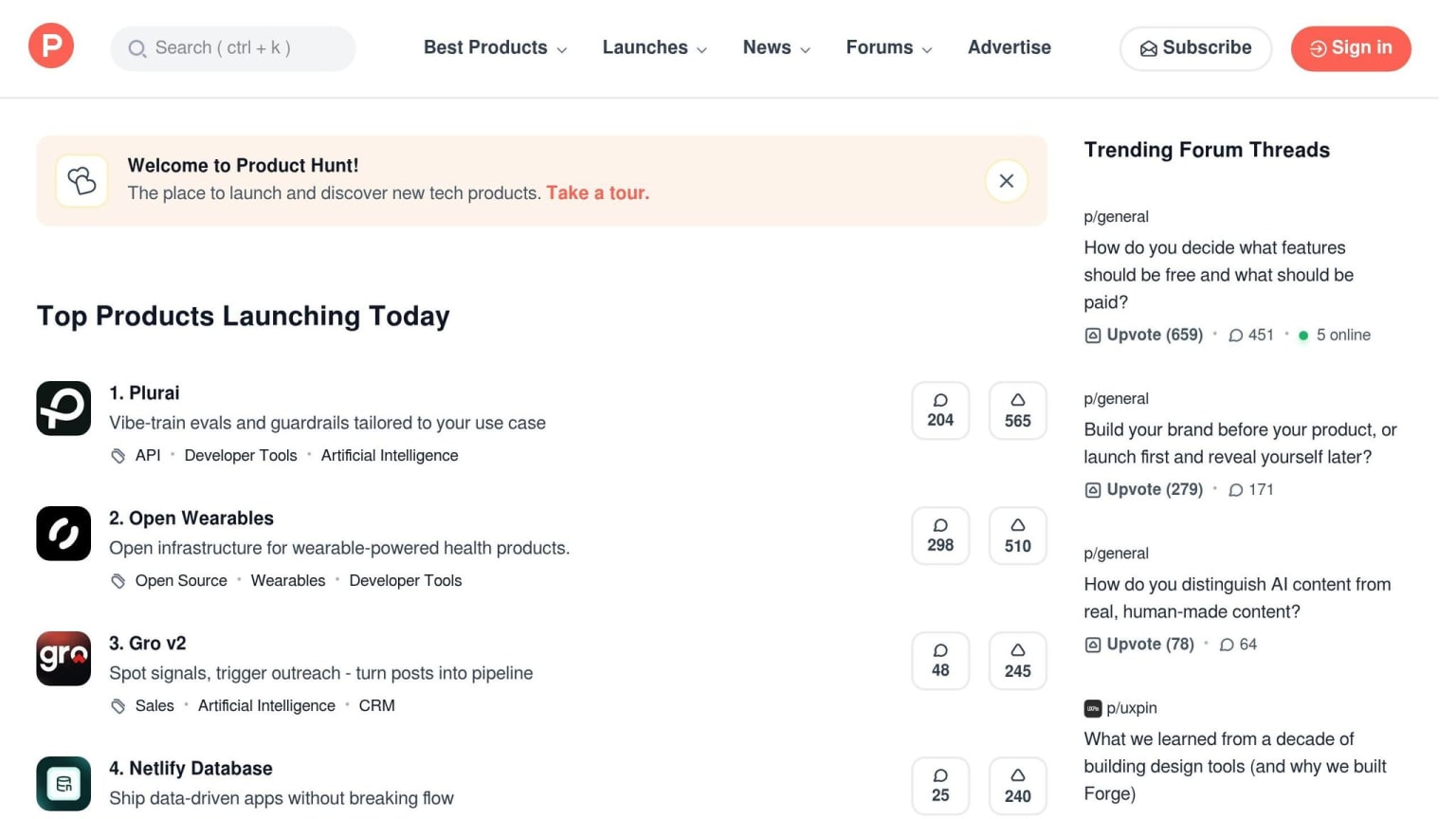
While GitHub SEO and Show HN help establish technical credibility, Product Hunt is all about expanding your reach to a broader tech audience. With 2.7 million monthly visitors and a daily newsletter sent to 1 million subscribers , the platform offers massive exposure for your open source project. If you make it to the front page, you could see 5,000–15,000 views and hundreds of GitHub stars in just 24 hours . However, it’s better suited for projects with polished user interfaces - like web apps, SaaS tools, or browser extensions - than for lower-level libraries or CLI tools .
Audience Reach and Engagement Potential
A successful launch on Product Hunt can attract 2,000–8,000 visitors for a top-10 product, while being crowned the #1 Product of the Day can bring in 5,000–30,000 visitors over 48 hours . A great example is n8n, which launched its 1.0 version in July 2023 with the help of Hunter Chris Messina. Luis Guzmán, Head of Marketing at n8n, explained:
"Every follower we collected from past launches receives a notification about recent launches. This helps get more exposure" .
Ease of Implementation for Open Source Projects
A strong Product Hunt launch isn’t something you can throw together overnight; it takes 4–6 weeks of preparation . Start by creating a "Coming Soon" page about 30 days in advance to collect a waitlist of 200–500+ subscribers who’ll automatically be notified when you go live . You’ll also need to prepare:
- A short, catchy tagline (under 60 characters)
- 4–6 optimized gallery images
- A 60–90 second product walkthrough video
Timing matters, too. Launch at 12:01 AM PST on a Tuesday or Wednesday to make the most of Product Hunt’s 24-hour exposure cycle . On launch day, be ready to stay online for 16 hours, actively responding to comments. The algorithm favors engagement over simple upvotes, so instead of directly asking for votes, invite people to "check it out" or "join the discussion" .
Cost-Effectiveness for Maintainers
One of the best parts? Launching on Product Hunt is completely free . The main cost is your time - the weeks of preparation and the long hours on launch day. With a Domain Rating of 91, Product Hunt also provides high-authority backlinks that can boost your project’s SEO visibility .
To make your launch even more effective, consider using a tagline like "Open source alternative to [Competitor]" to give users instant context . You can also offer time-sensitive perks, like free credits or early access, to create urgency. For maximum impact, coordinate your Product Hunt launch with activity on platforms like Reddit and Hacker News within the same 48-hour window. This can trigger a viral loop that might even land your project on GitHub Trending .
While a Product Hunt launch requires careful planning and active participation, it can set the stage for further promotional efforts - like developer newsletters - to keep the momentum going.
5. Developer Newsletters
Developer newsletters can provide consistent visibility for your project, especially after a spike in attention from platforms like Product Hunt . Rather than relying on a one-day traffic boost, newsletters help you maintain ongoing awareness among engineers who regularly consume technical content. The best part? Getting featured organically doesn’t cost a dime .
Audience Reach and Engagement Potential
Developer newsletters cater to a variety of interests. Some focus on general tech (e.g., TLDR, Techpresso), others on specific programming languages (e.g., JavaScript Weekly), and some target niche audiences (e.g., Console). For example, Techpresso boasts an audience of over 500,000 professionals, with engineers making up 30% of that group . For commercial open-core projects, this kind of targeted exposure is immensely valuable. Typically, conversion rates from free open-source users to paid customers fall between 0.5% and 3% .
Ease of Implementation for Open Source Projects
Submitting to newsletters is straightforward. Many, like This Week in Rust, offer submission forms or PR-based submissions . When submitting, focus on crafting a short, compelling pitch that explains the problem your project solves. Including a link to a live demo rather than just a GitHub repository can make a big difference .
As Segun Adebayo, maintainer of Chakra UI, points out:
"One of the biggest mistakes I see is the use of too much technical terminology" .
Keeping your pitch clear and relatable can significantly improve your chances of being featured.
Cost-Effectiveness for Maintainers
Submitting organically to newsletters is free - your only investment is the time spent researching and reaching out to curators . While cold pitches often have a low success rate, the lack of financial risk makes this strategy worth pursuing. Once your project gains traction and surpasses 1,000 users, newsletters become even more effective for announcing major updates .
For growth-stage projects generating $500K–$5M ARR, sponsored placements in newsletters can be a strategic move. Louis Corneloup, Founder at Dupple, highlights:
"For commercial open-core projects, sponsored placements in developer newsletters reach buyers who'd adopt the paid tier" .
To maximize your chances of success, aim to target at least five newsletters in your niche - whether that's JavaScript, Python, Rust, or DevOps . After that, consider how platforms like daily.dev Feed can further amplify your project's reach.
6. daily.dev Feed
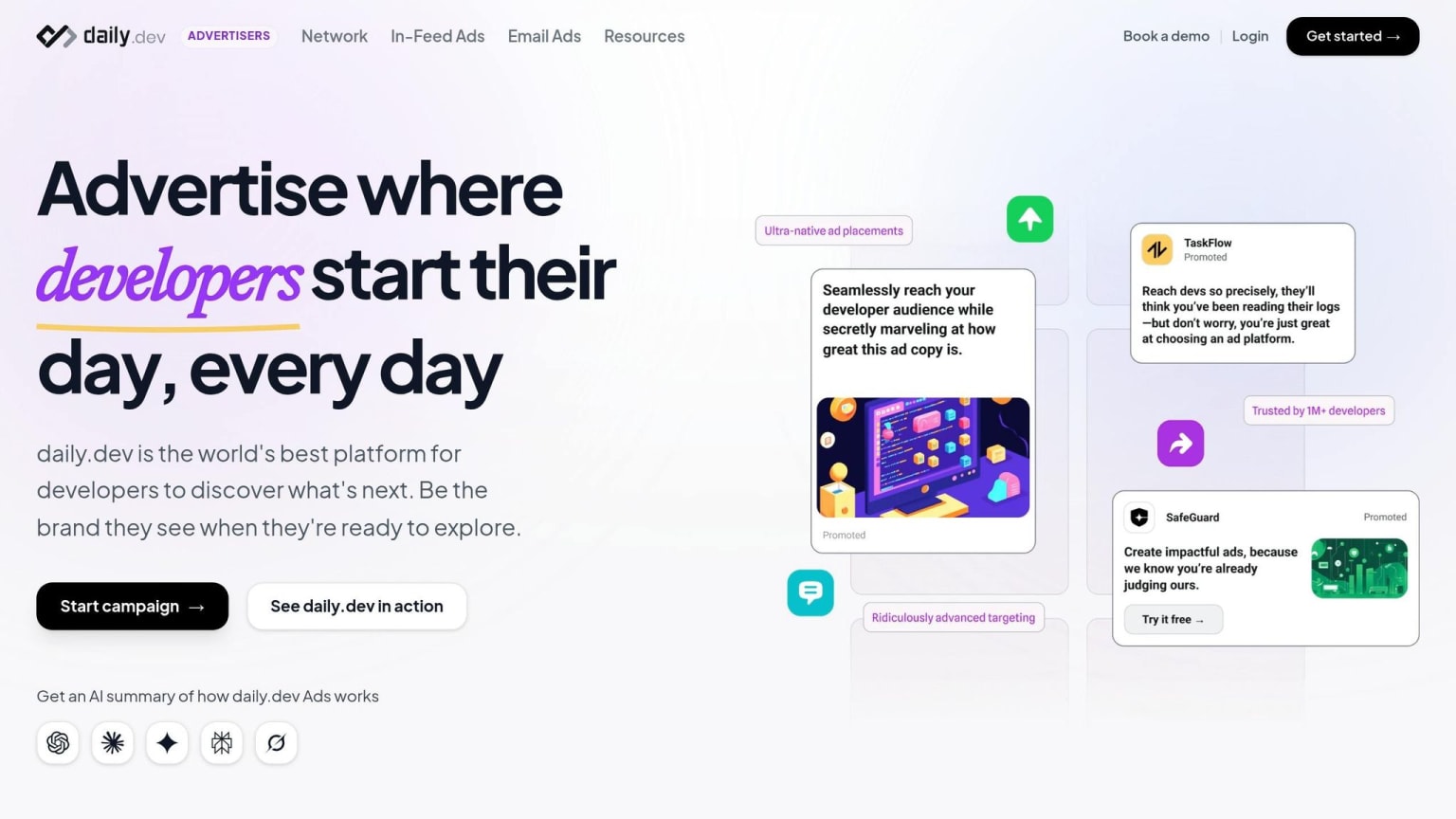
daily.dev is a platform tailored for developers, designed to amplify your project's visibility by automatically distributing your approved blog posts to a technical audience. This tool fits seamlessly into a broader strategy for promoting open source projects. Once your content is approved, new posts are added to the feed automatically - no manual action required .
Audience Reach and Engagement Potential
What makes daily.dev stand out is its ability to target a purely technical audience. This ensures your posts reach developers, potential contributors, and advocates who are genuinely interested in developer-focused content . If your post performs well, it could even catch the attention of algorithms like Google Discover, extending your reach far beyond the daily.dev platform . This streamlined approach makes it an effective addition to your promotional toolkit.
Ease of Implementation for Open Source Projects
Getting started is simple - submit your blog for approval on daily.dev . The platform welcomes a variety of content types, whether you're showcasing a tool, writing a tutorial, or sharing updates about your project. To make the most of this opportunity, focus on creating content that resonates, such as explaining the purpose behind your tool or detailing how it solves specific challenges .
Cost-Effectiveness for Maintainers
In August 2023, Zevi Reinitz, Livecycle's Head of Marketing, demonstrated the platform's potential by using it to promote their open source tool, Preevy. By getting their blog approved on daily.dev, they saw impressive results: within 12 weeks, Preevy gained over 1,500 GitHub stars, along with steady growth in repository traffic, forks, and community contributions .
To maximize results, pair daily.dev posts with launches on platforms like Hacker News and Reddit to drive traffic within 24–48 hours . Before directing this traffic, make sure your GitHub README is polished and optimized with clear descriptions and visuals. Since daily.dev often directs users to your README, this step is crucial . This strategy complements other promotional methods for open source projects discussed in this guide.
7. Twitter/X
Using Twitter/X strategically can significantly expand your project's visibility through targeted and organic engagement. This platform is particularly well-suited for developers, indie hackers, and technical founders. A well-crafted thread, timed just right, can amplify your reach exponentially through retweets .
Suitability for Targeting Developers
Twitter/X thrives as a space for early adopters and buyers of developer tools, who are notably more active here than on other social networks . Personal accounts from maintainers resonate more with developers than formal corporate posts, as they offer relatable insights and real-time interactions . This personal approach builds trust and credibility in a way that static announcements simply can't.
Ease of Implementation for Open Source Projects
Start by treating your profile as a landing page. Use a clear headshot and write a bio that explains exactly what you're building and who it's for . Balance your content with this mix:
- 40% educational tips
- 30% updates about building in public
- 20% product news
- 10% personal insights
This combination helps you attract attention while fostering trust through openness.
Engagement is key. Devote about half of your activity to replying thoughtfully to others' posts - this can attract new followers, especially when interacting with popular accounts . For original content, turn your GitHub activity into bite-sized case studies by highlighting interesting issues or decisions on pull requests . Tagging the creators of tools your project integrates with can also lead to retweets, further expanding your reach.
A great example comes from AFFiNE, an open source project that used Twitter/X as part of their launch strategy in August 2022. On Day 2, after initial pushes on Reddit and Hacker News, they leveraged Twitter/X to help secure 6,000 GitHub stars within a week and claim the top spot on GitHub Trending .
Cost-Effectiveness for Maintainers
Twitter/X is entirely free for organic promotion, making it a no-brainer for maintainers to start using immediately . Personal accounts should aim to post 3 to 5 times daily, while project accounts can post 5 to 8 times to maintain visibility . Keep your pinned tweet updated with your most engaging thread or a key project update to ensure new visitors quickly grasp your project's value .
Stay on top of your notifications and respond promptly. As technology marketing expert Kim McMahon notes:
"If someone takes the time to respond on Twitter, I want to be prompt and respond to them" .
When creating threads, use strong hooks that immediately highlight a specific problem and promise actionable value. To make your posts stand out, include visuals like demo videos, GIFs, or screenshots .
Next up: Dive into Discord Communities to spark real-time conversations and drive even more interest in your project.
8. Discord Communities
Join existing language-specific or framework-focused Discord communities (like Rust or LangChain) before starting your own server. The goal here is to promote your open source project by forming authentic connections with developers.
Suitability for Targeting Developers
Discord is a hub where developers gather for focused, technical discussions. Its real-time communication style makes it perfect for Q&A sessions and feature brainstorming - things that might feel too casual for GitHub issues. This dynamic complements the slower-paced, asynchronous engagement you might have on other platforms.
By participating in these communities, you can connect with developers tackling problems your project addresses. Engage in conversations, offer help, and, when appropriate, mention your solution. Regularly showing up to answer questions and provide support builds trust and positions you as a credible resource before you even begin promoting your project directly.
Ease of Implementation for Open Source Projects
Wait until you have at least 100 active users before launching your own Discord server. This ensures your community feels lively and active from the start. Once you're ready, make the invite link easy to find by adding it prominently to your README and project documentation.
Structure your server thoughtfully - set up channels for feature requests, technical questions, and project showcases. Hosting weekly office hours is another great way to connect with users and show that you're invested in their feedback. Consistent engagement and responsiveness signal that your project is active and values its community .
Cost-Effectiveness for Maintainers
Discord doesn’t require a financial investment - just your time and effort. This makes it an excellent option for early-stage projects looking to grow without spending money. It also provides a reliable space for organic growth and visibility. Use Discord as a platform to celebrate milestones, gather feedback, and turn casual users into loyal supporters .
The relationships you build on Discord can also serve as a foundation for broader outreach. Use these connections to fuel discussions at developer events, and once your community is strong, consider expanding to other channels like conferences or meetups.
9. Developer Conferences
Speaking at developer conferences offers something that digital channels often can't - genuine human connection. When developers meet the person behind a project, it creates a level of trust and curiosity that’s hard to achieve online. Tasha Drew, Co-chair for Kubernetes' Working Group for Multi-tenancy, captures this perfectly:
"I think speaking with people is very human, and we tend to be more willing to try technologies if we meet someone" .
Suitability for Targeting Developers
Conferences are a powerful way to introduce your project to a fresh audience and kick off your adoption funnel . Developers, often skeptical of traditional marketing, are more likely to engage through technical deep dives and peer-to-peer conversations that these events provide. A single speaking slot at a high-profile conference like KubeCon, NeurIPS, or Strange Loop can lead to long-term adoption of open source tools . Beyond that, conferences help strengthen community ties, much like digital channels, but with the added benefit of face-to-face interaction.
Ease of Implementation for Open Source Projects
Starting small with local meetups is a practical way to ease into conference participation. These gatherings, often centered around a specific programming language or ecosystem, typically attract 80 to 100 attendees - enough to help you gain your first active users . Once you've gained confidence, you can submit Calls for Proposals (CFPs) to speak at larger conferences. Timing is critical: aim to promote your project when it's stable, not during rapid development phases . This grassroots strategy not only builds credibility but also provides an affordable way to get the word out.
Cost-Effectiveness for Maintainers
For early-stage projects with limited budgets (e.g., $0–$500,000 in annual recurring revenue), conferences can be a budget-friendly alternative to pricey sponsorships . Aaron Francis, Creator of Sidecar, emphasizes the compounding benefits of these events:
"Each event you do, or each podcast you do, makes it more likely you'll be invited to another event or interview, so you can start building momentum that way" .
To maximize the impact, record your talks and upload them to YouTube. This not only extends your reach but also improves your project's visibility in search results .
10. Blog Syndication
Sharing your content isn't just about social media; blog syndication is another smart way to expand your reach. By republishing your technical articles on platforms like Dev.to, Hashnode, and DZone, you can significantly boost your audience. The trick? Publish the article on your own blog first, give Google 2–10 days to index it, and then syndicate it using a canonical URL that links back to your original post. This approach can increase your content's reach by 300–500% with minimal extra effort.
Audience Reach and Engagement Potential
Syndicating your content can open the door to impressive engagement numbers. For instance:
- Tutorials on Dev.to often attract 1,500–5,000 views.
- Articles on DZone average over 4,000 views per month.
- Medium connects you with a massive audience of over 100 million monthly users.
Syndicated posts tend to see 85% more engagement and can drive a 40% boost in referral traffic within just 90 days. A great example is Convex’s 2024 initiative, where they open-sourced 200,000 lines of code and shared a syndicated post on r/programming. By engaging directly with comments, their Head of Developer Experience turned the thread into an ongoing discovery tool that still ranks well in Google search results. This strategy not only drives immediate traffic but also helps build lasting SEO value.
Ease of Implementation for Open Source Projects
The process is straightforward: publish your article on your blog (e.g., GitHub Pages), wait for Google to index it, and then republish on platforms like Dev.to, Hashnode, or DZone using a canonical URL. Tools like the Cross Post App can simplify this process even further. To maximize performance, tweak your headline and introduction to fit each platform’s tone while keeping the core technical content the same. This small adjustment can boost results by 40–60%.
Cost-Effectiveness for Maintainers
Syndication doesn’t cost a dime - it only requires some time to cross-post. Focus on syndicating 60–80% of your key content, such as in-depth tutorials and guides, while reserving a few premium posts exclusively for your own site. By using canonical URLs, you can gain valuable backlinks without worrying about duplicate content penalties. For open source projects with tight budgets, blog syndication is one of the most effective ways to maximize your reach and impact.
11. YouTube Tutorials
Video tutorials can take your project's visibility to the next level, offering a reach and impact that written content alone often can't match. YouTube serves as a discovery engine, surfacing technical videos long after they've been uploaded. This makes well-crafted tutorials a long-lasting source of traffic and engagement . The trick? Focus on solving specific problems rather than just listing your project's features.
Audience Reach and Engagement Potential
Video content consistently leads the pack when it comes to engagement across all platforms . For developer tools, it often outshines text-based materials . Take this for example: a quick 60-second demo video shared on platforms like Twitter/X or LinkedIn can attract thousands of developers who might otherwise never come across your README file . Developers also tend to favor short, punchy tutorials - ideally 5–10 minutes - over lengthy, hour-long sessions . A great case in point is Vince, the maintainer of OpenSaaS.sh, whose video tutorial helped his project achieve 6,000 GitHub stars in just six months as of July 2024 .
Ease of Implementation for Open Source Projects
You don’t need fancy gear or professional editing skills to get started. Free screen recording tools are more than enough to create screencasts that demonstrate how your project solves practical problems . To make your content even more accessible, organize your videos into playlists that guide users from basic setup to advanced features, and embed these directly into your GitHub README . As Segun Adebayo, the maintainer of Chakra UI, puts it:
"Video is really helpful for a lot of people. People learn in different ways so it's important to provide different types of content" .
Cost-Effectiveness for Maintainers
YouTube hosting is completely free, and creating videos can cost virtually nothing when using free screencasting tools . If you want to polish your tutorials, free professional-grade software like DaVinci Resolve can handle video editing, while free sound effects can add an extra layer of quality without any licensing fees . Your biggest investment here is time, but it can pay off. Just one developer who engages with your video could potentially lead to 10 paying customers . To grab attention, make sure your video dives into the core of your project within the first few minutes .
Next, we’ll dive into how paid developer ads can help you expand your reach even further.
12. Paid Developer Ads
Once you've tapped into organic channels, it might be time to explore paid options to scale your revenue. Paid developer ads are particularly effective for commercial open-core projects that aim to convert technical users into paying customers for managed services or enterprise-level features . The key is to focus on platforms where developers make purchasing decisions.
Reaching Developers Where They Are
Developer newsletters are one of the most precise ways to target open-source project audiences. For example, Techpresso reaches over 550,000 tech professionals - about 30% of whom are engineers. Other networks, like Bytes, Pragmatic Engineer, and the Cooperpress network, are specifically designed for technical decision-makers . As Louis Corneloup, Founder at Dupple, notes:
"For commercial open-core projects, sponsored placements in developer newsletters reach buyers who'd adopt the paid tier."
Additionally, platforms like daily.dev Ads allow you to target developers based on their seniority, preferred programming languages, and the tools they use, giving you a more refined approach.
Timing and Budget Considerations
Paid advertising is best suited for projects that have reached the Growth stage, typically with an ARR between $500,000 and $5 million . Before hitting this milestone, organic channels tend to provide better returns . However, once your project is in the Growth stage, paid ads can significantly boost conversions.
When you’re ready to launch a paid campaign, concentrate your ad spending within a single week . This strategy can create a traffic spike that aligns with GitHub’s trending algorithm, triggering more stars, issues, and pull requests . For an even greater impact, pair your paid campaigns with organic launches on platforms like Reddit, Dev.to, and Hacker News to amplify the momentum .
To start, compile a list of developer newsletters and networks that cater to technical decision-makers. Allocate a small budget for testing and measure your initial conversions. By integrating paid ads with your organic strategies, you can create a promotional cycle that builds on itself over time.
Conclusion
Getting the word out about an open source project takes a well-coordinated, multi-channel strategy to maintain momentum. Launching on platforms like Hacker News, Reddit, and Dev.to within the same 24–48 hours can significantly increase your project's visibility on GitHub Trending. This kind of exposure often leads to higher engagement, with more developers discovering, starring, and contributing to your project.
Each platform plays a unique role in your project's growth. For example, Hacker News and Reddit are excellent for sparking initial interest, while quick-start guides help convert curious visitors into active users. YouTube tutorials can encourage adoption, and communities on Discord or Twitter turn users into advocates. Developer newsletters, on the other hand, can connect you with buyers who may eventually upgrade to paid tiers.
One team noted that consistent engagement across multiple channels builds momentum over time. Instead of spreading yourself too thin, focus on mastering one or two channels initially. Testing your strategy on smaller platforms like DevHunt.org can also help you refine your approach before scaling up. Tools like GitHub Star History charts are great for tracking which efforts are driving real growth. Keep in mind that content-focused efforts, such as SEO and blog syndication, tend to grow steadily over time, while social media often provides quick but temporary boosts. By integrating these approaches, you can turn fleeting interest into sustained growth.
A great example of this strategy in action is AFFiNE, which grew from zero to over 60,000 GitHub stars in just 18 months (2024–2026) by combining organic launches on Hacker News, authentic engagement on Reddit, and endorsements from influential voices. By adopting a similar multi-channel approach, you can build trust and drive growth across the developer community.
For a deeper dive, check out our guide on open source marketing strategies. It covers everything from building a community to monetization tactics that transform contributors into loyal customers.
FAQs
What should I do before promoting my open source project?
Before you start promoting your open source project, it’s important to make sure your repository is well-prepared and professional. Start by ensuring your project is stable and includes all the minimum viable features. Pick a name that’s easy to remember and stands out. Then, focus on creating a detailed README file that clearly explains what your project does, how to install it, and provides practical examples.
Don’t stop there - add essential documentation to further establish credibility. Include a CONTRIBUTING.md file to guide potential contributors, set up CI/CD workflows to demonstrate reliability, and include a code of conduct to foster a welcoming environment. Taking these steps will set a solid foundation for promoting your project effectively.
Which promotion channels work best for libraries vs apps?
When it comes to choosing the right promotion channels, it all boils down to your audience.
Libraries tend to perform well in spaces where technical discovery and community engagement are key. Think platforms like GitHub, Reddit, Show HN, developer newsletters, and conferences. These are places where developers actively search for tools and resources that can help them.
On the other hand, applications thrive in channels with broader reach. Social media platforms like Twitter (or X) and YouTube, along with Product Hunt and community hubs like Discord, are great options. These spaces let you showcase usability and features, attracting users who are looking for practical solutions.
How do I track which channel is driving GitHub stars?
To figure out which channels are driving GitHub stars, you can use the GitHub API to track trends in stars and repository activity. Pair this with UTM parameters in the links you share - whether on social media, newsletters, or other platforms - to pinpoint where your traffic is coming from. While GitHub offers traffic graphs, they don’t link stars back to specific channels. That’s why using external tracking methods is essential for understanding which of your promotional efforts are actually making an impact.