

Reaching developers with ads in 2026 is all about context, precision, and trust. Traditional methods like display ads are losing effectiveness due to widespread ad blocker use (over 50%) and developers’ natural skepticism toward marketing. Instead, successful campaigns focus on privacy-first methods, contextual targeting, and native placements in trusted environments.
Key takeaways:
- Contextual targeting has replaced cookie-based tracking, matching ads to content developers are already engaging with.
- Ads that integrate into developer workflows - like in-IDE placements or native in-feed cards - perform far better than traditional formats.
- Developers prefer hands-on experiences like live demos, sandboxes, and open documentation over gated content.
- AI tools now optimize campaigns in real-time, reallocating budgets to high-performing segments and reducing ad fatigue.
- Metrics like Cost per Trial (CPT) and Trial to Paid Rate are more reliable than clicks or impressions for measuring success.
To succeed, focus on platforms developers trust (e.g., daily.dev Ads), craft ads that address specific technical pain points, and ensure your messaging aligns with their workflow. Skip generic claims - developers value technical depth, community credibility, and actionable solutions.
Programmatic Advertising Trends Shaping Developer Campaigns in 2026
How AI and Automation Are Changing Ad Targeting
AI has become the backbone of modern developer ad campaigns, transforming how budgets are managed. Instead of waiting for weekly performance reviews, platforms now adjust spending in real-time, redirecting funds to the segments that are actively converting - right in the middle of a campaign.
One of the most notable changes is the ability to capture developer intent. Machine learning (ML) tools analyze engagement patterns like content consumption, tool searches, and interactions with documentation - all without relying on cookies. Google's 2025 Smart Bidding Exploration for developer tools proved this point, delivering an average 19% increase in conversions compared to traditional bidding approaches .
Automation is also expanding where ads appear. For instance, ads are now seamlessly integrated into developer environments like VS Code and AI coding assistants such as GitHub Copilot. These ads pop up during natural pauses in workflows, making them feel less like interruptions and more like part of the process .
These advancements highlight a move toward more responsive and data-driven campaigns, where decisions are guided by real-time insights.
Why Privacy-First Advertising Matters Now
Developers are highly aware of how invasive tracking works, from cookies to fingerprinting and data brokers. As a result, behavioral tracking strategies often fall flat in this community, with ad-blocker usage exceeding 50% among technical users .
"Networks that rely on behavioral tracking face ad-blocker rates north of 50% among technical users." - Idlen
In response, companies are pivoting toward privacy-first approaches. For example, Google's 2026 updates to its Ads API have tightened restrictions on session and IP-based tracking, pushing advertisers to adopt contextual targeting instead . This method focuses on what developers are doing - such as the content they’re reading or the tools they’re building - rather than who they are. Contextual networks, which avoid invasive tracking, often bypass ad blockers entirely, ensuring ads actually get seen. On top of that, first-party data from CRMs and logged-in audiences is becoming the go-to solution for precise targeting without violating privacy.
Ad Formats and Channels Gaining Ground in 2026
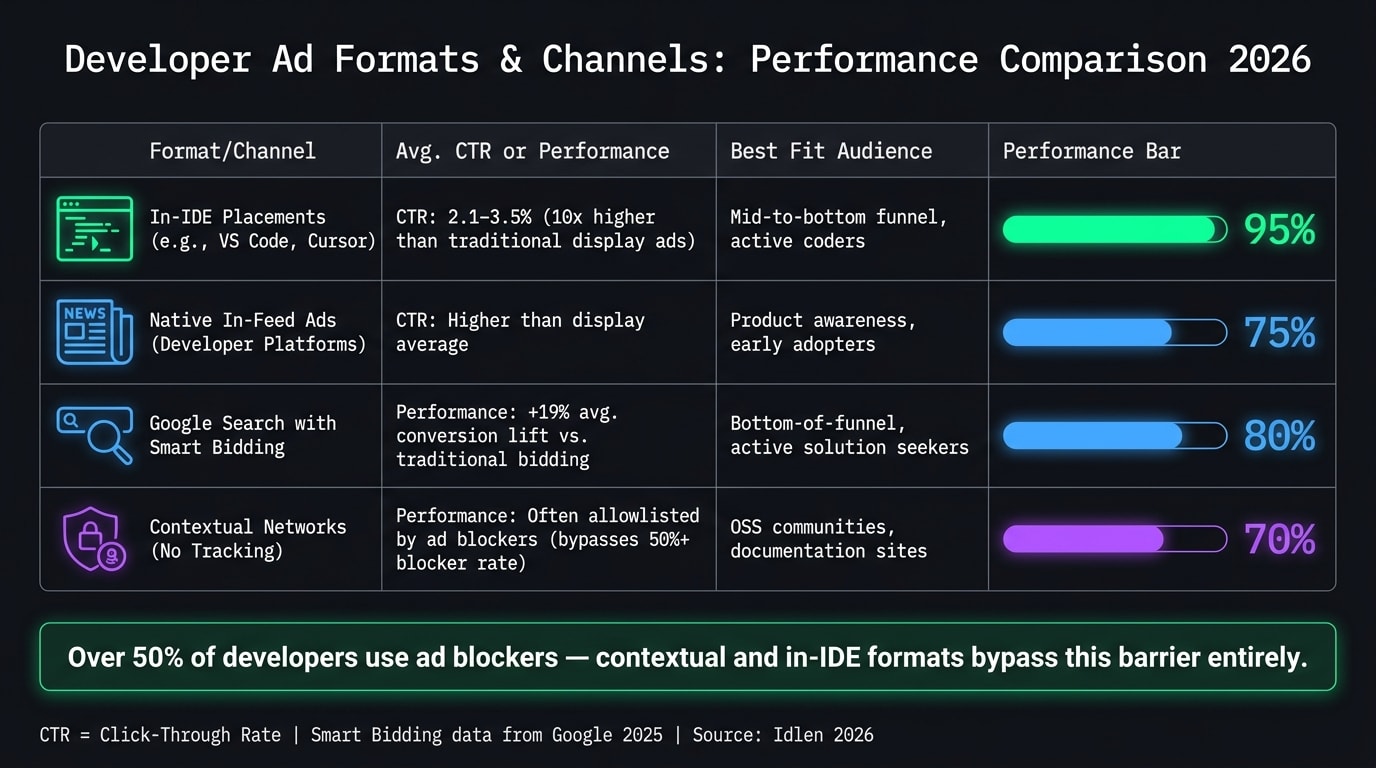
New ad placements are redefining how developers engage with campaigns. The formats that stand out in 2026 are those that integrate naturally into developers' workflows. In-IDE placements are a prime example, with click-through rates (CTR) ranging from 2.1% to 3.5% - roughly 10 times higher than traditional display ads . This higher engagement isn’t because developers suddenly enjoy ads; it’s because these placements are relevant and non-disruptive.
Similarly, native in-feed ads on developer-focused platforms follow the same logic. When ads blend in with the technical content developers are already consuming, they avoid triggering the usual dismissal. Channels built around trust, like niche newsletters, subreddits, and developer content feeds, are becoming increasingly popular for this reason. Instead of casting a wide net, success now hinges on showing up in the right context at the right time.
| Format / Channel | Avg. CTR / Performance | Best Fit |
|---|---|---|
| In-IDE placements (e.g., Idlen) | 2.1–3.5% CTR (10x display avg.) | Mid-to-bottom funnel, active coders |
| Native in-feed (developer platforms) | Higher CTR than display | Product awareness, early adopters |
| Google Search (Smart Bidding) | +19% avg. conversion lift | Bottom-of-funnel, active solution seekers |
| Contextual networks (no tracking) | Often allowlisted by ad blockers | OSS communities, documentation sites |
Targeting Methods That Work for Developer Audiences
Segmenting Developers by Technical Profile
When marketing to developers, it's crucial to segment them based on their technical stack, role, and seniority. Why? Because a DevOps engineer managing Kubernetes clusters has vastly different priorities than a frontend developer working on React applications. Treating these audiences the same not only wastes your budget but also makes your messaging less relevant.
Seniority plays a bigger role than you might think. For example, a mid-level engineer is likely to respond to practical, actionable messaging like, "Set up error tracing in 10 minutes." On the other hand, a staff engineer or an engineering manager will be more interested in messaging that highlights team-wide benefits, such as, "Reduce incident resolution time across your platform team." To resonate with developers, your ad creative, offer, and landing page must align with their current projects and responsibilities.
This kind of precise segmentation sets the stage for smarter, data-driven targeting.
Using First-Party and Contextual Data Effectively
With cookie-based tracking becoming less reliable, first-party data has become the most dependable tool for targeting developers. This involves building audiences based on real behavioral signals, such as visits to documentation, product trial activity, webinar attendance, newsletter signups, or content downloads.
The key is to map these behaviors to different intent stages. For instance, someone downloading an SDK likely needs implementation guides, while a team lead browsing case studies might be looking for ROI-focused messaging. Keep your audience lists fresh by regularly updating them to reflect current behavior.
Contextual targeting is another powerful tool, especially as privacy restrictions tighten. By serving ads that match the content developers are already reading, you can stay effective even when ad blockers are in play. Since contextual signals don’t rely on tracking individual users, they remain a reliable option for reaching developers in privacy-conscious environments.
Combining first-party and contextual data ensures your ads land in front of the right people, at the right time.
Why Developer-Native Platforms Deliver Better Results
When you combine precise segmentation with strong data insights, developer-native platforms emerge as the best choice for running campaigns. Unlike general ad networks, which often rely on vague indicators like browsing behavior, developer-specific platforms focus on audiences that are highly technical and often skeptical of traditional advertising.
Platforms like daily.dev Ads excel because they meet developers where they already are - engaged in learning and discovery. Developers on these platforms are actively consuming technical content relevant to their work, meaning ads feel more like a natural extension of their experience rather than an unwelcome interruption. Native in-feed placements and post-page ads align with how developers prefer to process information, making them far more effective than generic display ads. This is especially true for niche offerings like API platforms, cloud infrastructure tools, or developer experience software.
To get the best results, place your ads in spaces where technical intent is already high, and use targeting options like seniority, programming language, or specific tools to fine-tune your approach.
Ad Creatives and Messaging That Connect with Developers
Ad Formats That Perform Well with Developers
Developers tend to steer clear of ads that interrupt their workflow. Ads that succeed are those that naturally fit into how developers consume content.
Native in-feed cards are a prime example of this. Platforms like daily.dev Ads use placements that blend seamlessly with technical content, avoiding the immediate distrust that banner ads often trigger. Another effective format is in-IDE placements. These ads, appearing in tools like VS Code or Cursor during natural pauses - such as while a build runs or an AI response generates - outperform traditional banners. Additionally, newsletter sponsorships in niche technical publications remain effective, boasting open rates between 40% and 60% in 2026 .
What makes these formats work? They’re non-intrusive, align with the developer’s current context, and attract attention by being relevant rather than demanding it. This approach aligns with the principle of creating ads that respect and integrate into developers’ workflows.
Writing Ad Copy That Speaks to Developers
Once you’ve chosen the right format, the next step is crafting ad copy that resonates. Avoid starting with exaggerated claims. Words like "world-class" or "revolutionary" immediately signal that the ad may not be grounded in the realities of a developer’s work.
Instead, start with a specific problem developers face. Highlighting technical pain points consistently outperforms generic product-focused claims. For instance:
- ❌ "The most powerful CI/CD platform on the market"
- ✅ "Tired of debugging flaky CI pipelines? Fix root causes in minutes."
The second example connects with a real frustration developers experience. Including technical details, such as "Terraform provider available" or "5-minute setup", builds credibility without overselling. When it comes to social proof, developers trust metrics like GitHub stars, npm download counts, and Docker Hub pulls far more than traditional accolades like analyst reports .
Finally, structure your copy for quick readability. Highlight the main benefit in bold, keep explanations concise, and use specific, actionable CTAs like "View docs" or "Try the playground." These resonate better than generic options like "Learn more." This clarity in messaging ensures that developers immediately understand the value being offered.
Using Technical Content as a Landing Page Strategy
The experience after clicking the ad should maintain the same direct, technical tone as the ad itself. A common misstep in developer-focused campaigns is directing users to gated demo-request forms.
Take CircleCI’s approach as an example. By swapping gated landing pages for links to full-featured, self-serve demos on developer-friendly platforms, they reduced their cost-per-lead by 65% . The takeaway is clear: developers prefer to explore tools independently rather than wait for a sales call.
Effective landing pages often include interactive tutorials, live sandboxes, or GitHub repositories, allowing developers to test tools on their own terms. This hands-on approach respects their desire for autonomy and aligns with their workflow.
How to Measure and Optimize Developer Ad Campaigns
The Metrics That Matter for Developer Campaigns
Traditional metrics like impressions or form fills often fall short when it comes to measuring developer engagement. Developers rarely follow a straightforward click-to-conversion path, and many use ad blockers, making conventional display metrics unreliable for over half of your target audience .
To truly assess campaign success, focus on metrics tied to product usage. Start with Cost per Trial (CPT), a key efficiency indicator. A CPT below $30 signals strong campaign performance . Combine this with the Trial to Paid Rate - top campaigns see rates between 25–35% - to evaluate both the quality of your audience reach and the alignment between your product and user needs. For gauging awareness, track Brand Search Lift. A lift of more than 20% in branded searches suggests your campaign is effectively building recognition beyond just direct clicks .
Since developer purchasing decisions often take weeks or even months, use 30–90 day attribution windows to capture the complete conversion journey . Additionally, many key touchpoints - like community discussions, podcasts, or word-of-mouth recommendations - don’t appear in standard click data. To address this, include post-signup surveys with questions like, "How did you hear about us?" This helps uncover the dark funnel, which refers to the unseen influences that UTM tracking can’t capture .
These metrics lay the groundwork for using AI to fine-tune and optimize your campaigns.
Using AI to Improve Campaign Performance
Developers value technical accuracy in ads, and AI can help by improving creative rotation and audience segmentation. Platforms like daily.dev Ads use AI to shift budgets toward the highest-performing segments in real time, without needing manual adjustments .
One area where AI excels is creative rotation. Developer audiences tend to be small and concentrated, so ad fatigue can set in quickly. To counter this, refresh your creatives every 3–4 weeks and let AI determine which versions drive the most trial signups - not just clicks . For example, segmenting results by tech stack shows that audiences using Rust and Go often achieve click-through rates (CTRs) of 125–135, compared to Java or C# audiences at around 85. AI-driven platforms can automatically allocate more budget to these higher-performing segments, continuously improving cost-per-trial efficiency .
Maintaining Media Quality and Brand Safety
While optimizing performance metrics with AI is critical, ensuring your ads appear in trusted, relevant environments is just as important. Ad placement shapes how developers view your brand, and a poorly placed ad can erode trust with an audience already wary of traditional advertising.
Focus on in-workflow placements, such as documentation sites, respected community newsletters like TLDR or DevOps Weekly, and platforms built specifically for developers. These environments offer a trust advantage - developers already rely on these sources, and that trust extends to the brands advertising there . Privacy-respecting networks are often allowlisted by ad blockers, meaning your ads can reach developers who might otherwise never see them .
Regularly audit your ad placements. For a developer audience, brand safety goes beyond avoiding offensive content - it means ensuring your ads appear alongside technically relevant and credible material. For instance, showing up next to a Kubernetes tutorial or a security advisory carries far more weight than being placed in a generic tech news feed. Proper placement ensures your brand is seen as trustworthy and aligned with developer interests.
Conclusion: Your 2026 Developer Advertising Playbook
Key Lessons from 2026 Trends
As we look at 2026, one thing is clear: context beats reach. Casting a wide net with generic programmatic ads just doesn’t work anymore. Developers respond to ads placed in environments they trust - like their IDEs, technical documentation sites, or newsletters they actively read. Ads buried in broad social feeds? Those are easy to ignore.
To connect with engineers, focus on technical precision. Bottom-up adoption thrives when you offer hands-on experiences like sandboxes, live demos, or open documentation. The goal is to blur the line between "content marketing" and "paid advertising" so effectively that developers don’t see the difference .
When it comes to visuals, skip the overly polished marketing images. Instead, use formats that developers naturally engage with: code snippets, terminal screenshots, and product GIFs. These resonate far more with this audience.
With these trends in mind, it’s time to take a structured, phased approach to scaling your campaigns.
Next Steps for Growing Your Developer Campaigns
To grow your campaigns effectively, start by applying these insights in a phased rollout. Contextual ad placements and precise messaging are key. Here’s how you can structure your campaign:
- Phase 1 (Days 1–14): Focus on high-intent traffic. Use Google Search ads to capture developers actively looking for solutions, dedicating about 50% of your budget here. Make sure you’ve set up conversion tracking for trials and signups.
- Phase 2 (Days 15–30): Expand to mid-funnel platforms like daily.dev Ads. Use AI-powered targeting to reach developers based on their preferred tools and programming languages.
- Phase 3 (Days 31–60): Build brand awareness through niche newsletters and community-driven platforms. These channels help you connect with developers where they spend their time.
- Phase 4 (Days 61–90): Review your pipeline-to-spend ratios and refresh your creatives to combat ad fatigue. Use this time to optimize based on what’s worked so far.
A great example of this strategy in action? Back in 2025, CircleCI replaced gated content with full-featured, self-serve demos directly on developer-focused sites. The result? A major drop in cost-per-lead . It’s proof that giving developers direct access to your product can lead to better efficiency and engagement.
Lastly, don’t forget about the "dark funnel." Use post-signup surveys to uncover hidden attribution sources like podcasts, community discussions, or word-of-mouth referrals. Pair this with trusted social proof - GitHub stars, npm download stats, or adoption by respected engineering teams. Over time, this credibility builds momentum that’s hard to ignore.
FAQs
How do I run developer ads without cookies?
To effectively reach developers in a cookie-free world, you'll need to embrace privacy-focused strategies. Start by leveraging privacy-first targeting methods like first-party data, contextual targeting, and AI-powered personalization. These approaches respect user privacy while still delivering relevant ads.
Platforms such as daily.dev Ads are a great example. They rely on behavioral targeting, which analyzes user actions and preferences instead of cookies. Another powerful approach is contextual advertising - aligning ads with the content users are engaging with. This ensures your ads stay relevant and compliant with evolving privacy standards.
The secret to success lies in prioritizing transparency and relevance. Developers value authenticity, so focusing on these principles will help you connect with your audience in a meaningful way.
Which ad formats work best for developers in 2026?
In 2026, the best-performing ad formats for reaching developers are native ads that blend effortlessly into their workflows. Formats such as in-feed ads, post-page placements, and digest placements stand out because they match developers' preferences for ads that are relevant and non-intrusive. By ensuring your ads feel natural and fit seamlessly into the content, you're more likely to capture their attention and encourage engagement.
How do I measure success beyond clicks?
To truly gauge success beyond mere clicks, it's important to look at metrics that reflect deeper engagement, lead development, and lasting impact. Key factors include time spent engaging with your content, the level of interaction, and the quality of the leads generated. Additionally, metrics like conversion rates, activation, and retention provide insight into whether developers are not only adopting your product but also sticking with it over time.
Using AI-driven analytics alongside first-party data allows for more accurate measurement and real-time adjustments to campaigns. This ensures your efforts align closely with developers' preferences and behaviors, giving you a clearer picture of what’s working and where to refine.