
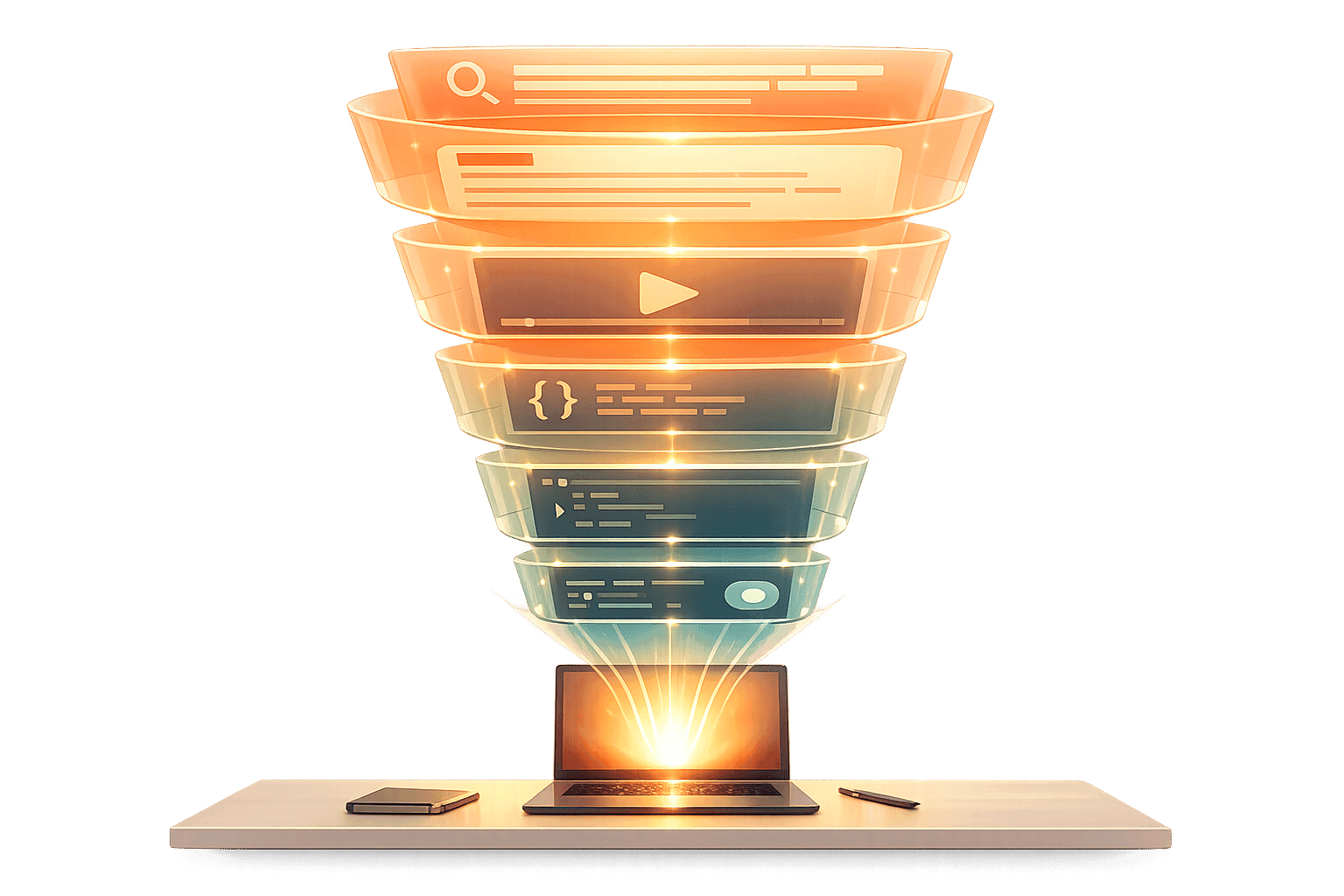
Want to connect with software developers? Here’s the bottom line:
Developers are skeptical of traditional marketing. They block ads, avoid jargon, and value technical accuracy over flashy campaigns. To reach them effectively, focus on these strategies:
- Educate, don’t sell: Provide solutions to their challenges with clear, technical content.
- Be where they are: Use platforms like Stack Overflow, Reddit, GitHub, and newsletters like TLDR.
- Offer hands-on access: Free trials, sandboxes, and open documentation build trust.
- Leverage peer validation: Highlight GitHub stars, npm downloads, or community endorsements.
Quick Tips:
- Developers prefer contextual ads (like in-IDE placements) over behavioral ads.
- Newsletters have high open rates (40–60%) and are a trusted source for many.
- Platforms like Google Search and LinkedIn work well for high-intent targeting.
The key is to meet developers in their workflow, respect their time, and provide real value. Let’s dive into the details.
Understanding the Developer Audience
What Makes Developers Different?
Developers are a unique audience. They spend most of their day - 6 to 8 hours, in fact - immersed in IDEs, documentation, and terminals instead of scrolling through social media feeds . This environment shapes how they think and interact with information.
Their technical expertise makes them naturally cautious about privacy and tracking. Many use ad blockers and are skeptical of marketing tactics . This isn’t just a quirk - it’s a mindset informed by their deep understanding of how technology works.
When it comes to buying decisions, developers take a bottom-up approach. Individual engineers often evaluate and test tools long before procurement teams step in. These engineers frequently become internal advocates for the tools they trust. That means your marketing efforts need to win over the practitioners first, not just the decision-makers at the top.
Another critical point: developers have little patience for marketing jargon. Words like "world-class" or "enterprise-grade" can come across as hollow or exaggerated. Instead, they value accuracy and evidence. A vague claim or technical error can instantly erode your credibility with this audience.
These traits highlight the need for a tailored approach to developer outreach, which we’ll explore next.
Core Principles for Developer Outreach
To effectively connect with developers, your outreach needs to reflect their unique priorities and preferences.
Start with the problem, not the product.
Developers want solutions to their specific challenges, not a generic list of features. For example, instead of saying, “Our tool is fast,” address tangible pain points like “flaky CI pipelines” or “slow build times.” This shows you understand their day-to-day struggles.
Illustrate your points with examples.
Developers respond better to visuals and hands-on demonstrations than to abstract claims. Use code snippets, terminal screenshots, or product GIFs to show how your tool works. For instance, CircleCI saw a 65% drop in cost-per-lead in April 2026 by replacing gated content with full-featured, self-serve demos . Letting developers experiment directly is far more effective than a passive sales pitch.
Make it easy to engage.
Eliminate unnecessary barriers. Provide free access to documentation, sandboxes, or free tiers so developers can test your tools without jumping through hoops. The easier it is for them to try your product, the faster they can see its value.
Leverage developer-respected social proof.
Metrics like GitHub stars, npm download counts, or Docker Hub pulls carry significant weight. Developers trust recommendations from their peers and community more than traditional marketing messages. Highlighting these endorsements can help build credibility and trust.
Top Channels for Reaching Software Developers
Connecting with developers means showing up in the spaces they naturally inhabit. Developers spend much of their time in tools like IDEs, documentation sites, package managers, and CLI outputs. The best strategies integrate seamlessly into these workflows instead of disrupting them.
Here, we’ll break down the top channels into three categories: developer communities and forums, technical content platforms and newsletters, and paid advertising options. Each serves a unique purpose, from building awareness to driving product consideration.
Developer Communities and Forums
These platforms are hubs for developers actively seeking answers, sharing insights, and solving problems. They allow you to connect with developers based on their tools and challenges.
Stack Overflow: With over 50 million monthly users, this is the largest developer community. Its standout feature is technology tag targeting, which helps you reach developers working with specific tools. However, the cost is steep - starting at $10,000 per month for a three-month minimum commitment .
Reddit: A more budget-friendly option, Reddit offers CPMs from $0.50 to $3.50 and CPCs from $0.20 to $1.50 . With a minimum daily spend of $5, you can experiment with subreddit targeting to engage niche developer groups. Just ensure your ads feel authentic and not overly polished.
GitHub Sponsors: This program builds trust by supporting open-source projects. Companies like AWS, Shopify, and American Express have contributed over $33 million through this platform .
daily.dev: This platform reaches over 1 million developers, using AI to optimize campaigns for better conversions based on user engagement .
Keep in mind that many developers use ad blockers - often exceeding 50% adoption. This makes privacy-respecting approaches, like contextual targeting, far more effective than behavioral ads .
Technical Content Platforms and Newsletters
Newsletters are a go-to resource for developers to stay informed without feeling overwhelmed. These opt-in formats foster trust and high engagement levels.
- TLDR: With over 1,250,000 subscribers, TLDR offers daily updates. Sponsorships range from $3,000 to over $15,000 per placement .
- Bytes: Focused on JavaScript, Bytes has 216,286 subscribers .
- O'Reilly Programming Newsletter: This resource reaches more than 594,000 developers .
Developer newsletters tend to have impressive stats, with open rates between 40% and 60% and click rates of 1% to 3% . Smaller niche newsletters, often with under 5,000 subscribers, cost between $100 and $500 per issue, making them ideal for targeted campaigns . To succeed, tailor your message to match the newsletter’s tone, so it feels more like a recommendation than an ad.
- EthicalAds: This platform delivers over 35 million monthly impressions on trusted documentation and open-source sites. With a $1,000 minimum spend, it uses contextual targeting to respect developer privacy .
Emerging tools like Idlen are taking integration further by placing ads directly in IDEs like VS Code and JetBrains. These ads appear during natural pauses, such as build times, achieving click-through rates of 2.1% to 3.5% - 10 times higher than traditional display ads .
Paid Advertising for Developers
Paid advertising can amplify your reach by targeting developers at scale, especially when aligned with their research and evaluation habits.
Google Search: This is a great channel for capturing intent. Keywords related to developer tools typically cost $2 to $15 per click, making it effective for mid-funnel conversions .
LinkedIn: With access to roughly 30 million software engineers and developers globally, LinkedIn enables precise targeting by job title. CPMs average $33 to $65, and CPCs fall between $5 and $8 in software-related verticals . This platform is especially effective for connecting with engineering managers and decision-makers.
As privacy concerns grow and third-party cookies phase out, contextual targeting has become essential. By aligning ads with relevant tech stacks or topics, you can respect developers’ privacy while still delivering meaningful impressions .
Channel Comparison Framework
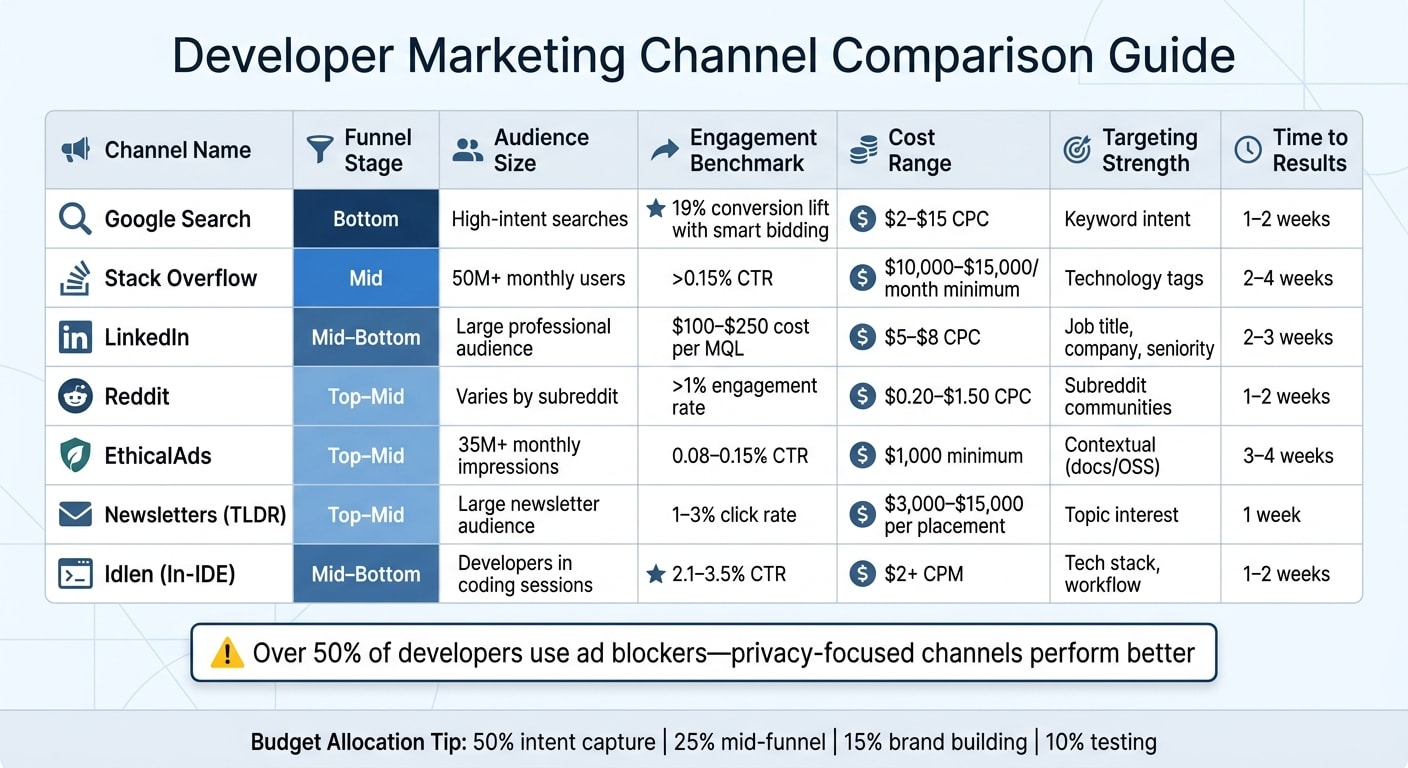
To effectively engage software developers, it's crucial to evaluate each marketing channel based on key performance factors. These include audience size, engagement quality, cost efficiency, targeting precision, and time to results. Each channel serves a unique purpose and delivers varying outcomes, so the choice depends on your goals and resources.
Channel Comparison Table
| Channel | Funnel Stage | Audience Size | Engagement Benchmark | Cost Range | Targeting Strength | Time to Results |
|---|---|---|---|---|---|---|
| Google Search | Bottom | High-intent searches | 19% conversion lift with smart bidding | $2–$15 CPC | Keyword intent | 1–2 weeks |
| Stack Overflow | Mid | 50M+ monthly users | >0.15% CTR | $10,000–$15,000/month minimum | Technology tags | 2–4 weeks |
| Mid–Bottom | Large professional audience | $100–$250 cost per MQL | $5–$8 CPC | Job title, company, seniority | 2–3 weeks | |
| Top–Mid | Varies by subreddit | >1% engagement rate | $0.20–$1.50 CPC | Subreddit communities | 1–2 weeks | |
| EthicalAds | Top–Mid | 35M+ monthly impressions | 0.08–0.15% CTR | $1,000 minimum | Contextual (docs/OSS) | 3–4 weeks |
| Newsletters (TLDR) | Top–Mid | Large newsletter audience | 1–3% click rate | $3,000–$15,000 per placement | Topic interest | 1 week |
| Idlen (In-IDE) | Mid–Bottom | Developers in coding sessions | 2.1–3.5% CTR | $2+ CPM | Tech stack, workflow | 1–2 weeks |
Note: Over half of developers use ad blockers, making privacy-focused channels like EthicalAds or in-IDE advertising more effective than traditional behavioral targeting.
Best Use Cases for Each Channel
Using the metrics above, here’s how to maximize each channel:
Google Search is the go-to for capturing high-intent searches, often leading to conversions within one to two weeks . Allocate roughly half your budget here to secure existing demand before exploring broader awareness strategies .
Stack Overflow is best suited for mid-funnel campaigns, where developers are researching specific tools or technologies. Its tag-based targeting allows precise outreach to developers working with platforms like Kubernetes or React . However, the platform's high minimum spend makes it ideal for larger budgets.
LinkedIn shines for enterprise-focused Account-Based Marketing (ABM). It lets you target engineering managers or decision-makers at specific organizations with detailed professional filters . While it's pricier than Reddit or EthicalAds, LinkedIn delivers highly qualified leads, often costing $100 to $250 per MQL .
Reddit is a cost-effective option for testing messages or generating buzz. Its community-driven nature makes it a great choice for validating ideas or engaging niche developer groups.
Newsletters and EthicalAds are excellent for top-of-funnel brand building. Developers who subscribe to newsletters are often highly engaged, with open rates ranging from 40% to 60% . Niche newsletters, costing between $100 and $2,000 per placement, provide affordable opportunities for targeted campaigns.
In-IDE advertising through platforms like Idlen reaches developers during their most focused moments - while coding. These ads appear during natural pauses, such as build times, and achieve engagement rates far better than traditional display ads . This channel is ideal for promoting tools that integrate seamlessly into developer workflows.
Pro Tip: Developer journeys often involve multiple touchpoints. For example, a developer might see an in-IDE ad, read about your product in a newsletter, and later convert through Google Search. To capture these "dark funnel" interactions, consider using post-signup surveys .
Building a Multi-Channel Approach
Creating a Multi-Channel Strategy
Start with a technical blog as your main content hub. From there, transform each post into bite-sized pieces for platforms like Twitter, LinkedIn, and even search ad copy. This method aligns perfectly with the idea of educating developers rather than just selling to them.
Accuracy beats quantity every time. Research from Gartner and Pendo shows that developers value genuine insights and technical depth far more than traditional marketing gimmicks . Whether it's paid ads, documentation, or social media, every channel needs to maintain this level of precision.
Tailor your voice for each platform, but keep your core message consistent. For example, use Twitter (X) for quick, real-time interactions, LinkedIn for professional networking, and forums like Reddit or Stack Overflow for offering helpful, value-driven contributions . This strategy reinforces the importance of authenticity and technical credibility. Also, make sure your documentation reflects your marketing messaging - developers often use it as their first step in assessing your technical expertise.
By coordinating your efforts across these channels, you create multiple touchpoints throughout the developer journey. Once your channels are working together, focus on measuring their performance to fine-tune your strategy.
Measuring and Optimizing Campaign Performance
With your multi-channel strategy in place, it’s time to track how well it’s working. Monitor key metrics like developer engagement and documentation usage - high usage often indicates strong product interest . Keep an eye on community growth and participation in forums, as these can reveal how healthy and active your developer ecosystem is over time.
When it comes to newsletters, segment your audience by specific technical topics rather than broad categories. This approach leads to higher engagement . For paid efforts, prioritize tracking technical keyword rankings and click-through rates on messaging that solves problems, rather than generic marketing phrases .
Consistency is key. Regularly publishing blogs and newsletters helps build trust with developers . To maximize your content’s reach, repurpose long-form technical pieces. Break them into quick tips for social media or share concise code snippets in newsletters. This way, your messaging remains unified while catering to the unique needs of each platform.
Conclusion
Connecting with software developers isn’t about casting a wide net - it’s about being relevant. The most effective channels are the ones developers already frequent: their IDEs, Stack Overflow, technical newsletters, or niche Reddit communities. As Idlen aptly states, "Developers live inside tools, not feeds" . This insight explains why in-IDE ads achieve click-through rates of 2.1–3.5%, approximately 10 times higher than traditional display ads . It’s clear that a thoughtful, multi-touch strategy that respects developers’ environments is key.
Genuine communication beats flashy marketing every time. Developers are quick to spot insincere messaging, and with over 50% of engineers using ad blockers , most traditional ads don’t even make it to their screens. Campaigns that resonate focus on real technical challenges, include code snippets or terminal screenshots, and steer clear of exaggerated claims.
Trust matters as much as reach when choosing your channels. Showing up in a relevant subreddit, a technology-specific newsletter, or directly within their workflow demonstrates that you understand their world. A solid strategy might begin with bottom-of-funnel efforts like Google Search to capture intent, move into mid-funnel engagement on platforms like Stack Overflow and Reddit, and then build long-term brand recognition through newsletters and contextual networks.
To maximize impact, a balanced approach is essential. Allocate your budget wisely: 50% for intent capture, 25% for mid-funnel engagement, 15% for brand building, and 10% for testing emerging channels . Keep your creative fresh by updating it every 3–4 weeks to avoid fatigue in tightly-knit developer communities . Additionally, use post-signup surveys to uncover the "dark funnel" influences that traditional attribution models might miss . These steps ensure your efforts align with developers’ habits and priorities.
At its core, reaching developers means respecting their time, intelligence, and workflow. Offer immediate value through documentation, sandboxes, or free tiers instead of forcing them through tedious forms. Engage them where they already are, speak their language, and let your product’s technical strengths shine. By delivering clear and relevant content, you’ll address the real challenges developers face and earn their trust.
FAQs
Which channels work best to reach software developers fast?
To quickly connect with software developers, it's crucial to meet them where they already spend their time. Developer-focused native ads - like those on platforms such as daily.dev - are excellent for precise targeting. Beyond that, participating in developer communities like Stack Overflow, Reddit, and Discord helps build credibility and trust. For paid options, consider leveraging newsletters, in-IDE advertisements, and targeted social media campaigns. Just make sure your content is technically accurate and tailored to their interests for the best results.
How can I advertise to developers if they use ad blockers?
To connect with developers who use ad blockers, the key is to rely on trustworthy and non-disruptive approaches. Engage with them where they already spend time, such as developer communities, forums, or technical discussion platforms. Share helpful, technical content that adds real value to their work.
Another effective tactic is using native ad formats. These ads blend naturally into their workflows - like sponsored articles or content partnerships - and are less likely to be blocked. By focusing on relevant messaging and showing up in spaces they trust, you can build meaningful connections with this audience.
How do I measure what’s working across multiple developer channels?
Tracking key performance indicators (KPIs) is essential for understanding how each platform is performing. Focus on platform-specific metrics like click-through rates, conversions, community interactions, and content engagement. Use analytics tools to keep an eye on website traffic, sign-ups, or product trials that come from each channel. Dive into platform-specific data, such as engagement within developer communities and trust signals, to pinpoint which channels are delivering the best results. This approach will help you fine-tune your strategies for maximum impact.