

Stack Overflow advertising in 2026 has shifted due to changes in developer behavior, largely driven by AI tools like GitHub Copilot and ChatGPT. These tools have reduced high-intent traffic, leaving a mix of passive users and engaged contributors. Here's what you need to know:
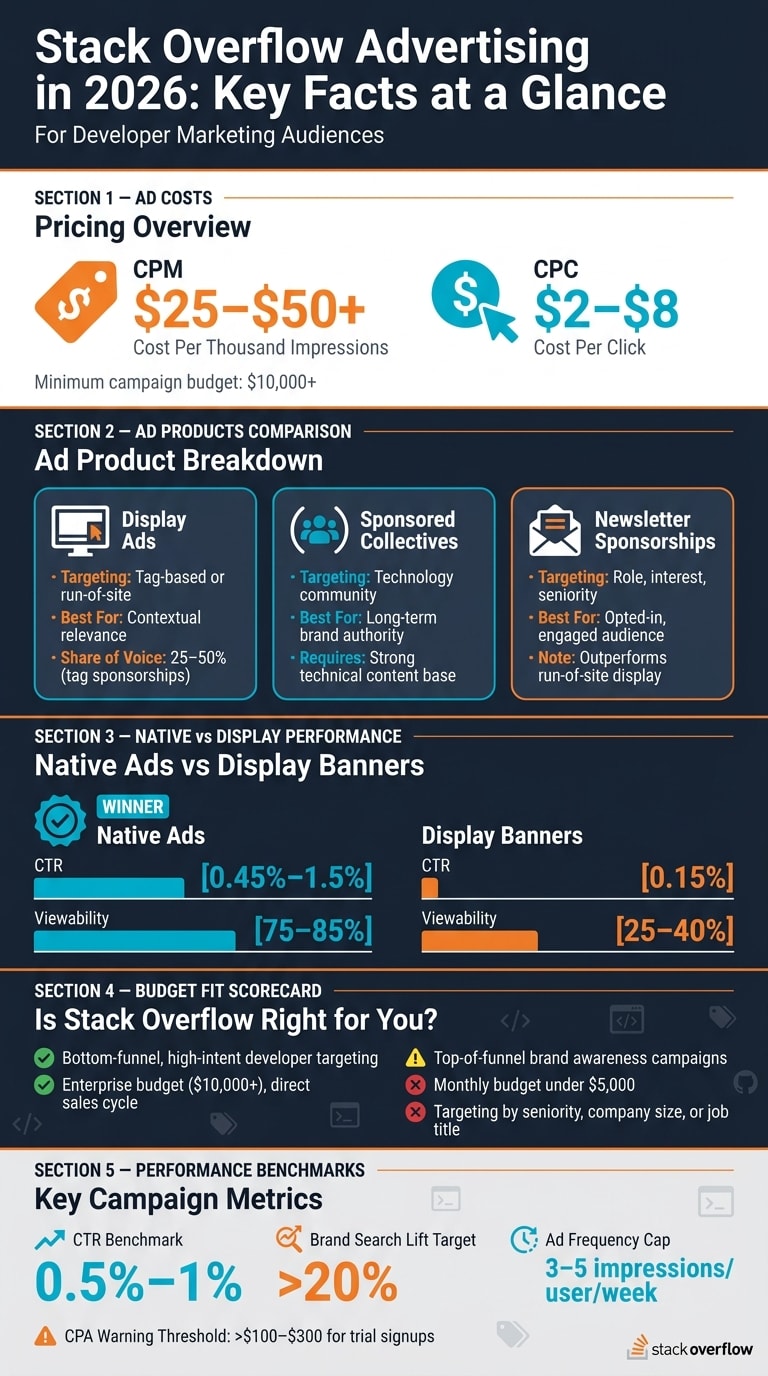
- Ad Costs: CPMs range from $25–$50+, CPCs from $2–$8. Tag-specific ads perform better but require precise targeting.
- Ad Options:
- Display Ads: Broad or tag-targeted; better for contextual relevance.
- Sponsored Collectives: Integrated branding within tech communities; ideal for long-term recognition.
- Newsletter Sponsorships: Direct access to segmented, opted-in audiences.
- Targeting Limitations: Tag-based targeting aligns with specific problems but lacks insights into user roles or seniority.
- Creative Tips: Ads with technical depth, code snippets, and clear CTAs like "Read the Docs" outperform generic SaaS ads.
- Performance Tracking: Use UTM parameters and brand search lift to measure impact, as traditional attribution models often miss developer behavior.
Stack Overflow is best for enterprise budgets targeting high-intent developers solving specific problems. However, it’s less effective for top-of-funnel campaigns or small budgets. Pairing it with platforms like daily.dev can help reach developers earlier in their decision-making process.
Stack Overflow as an Ad Channel in 2026: What the Data Shows
Traffic Trends and Audience Breakdown
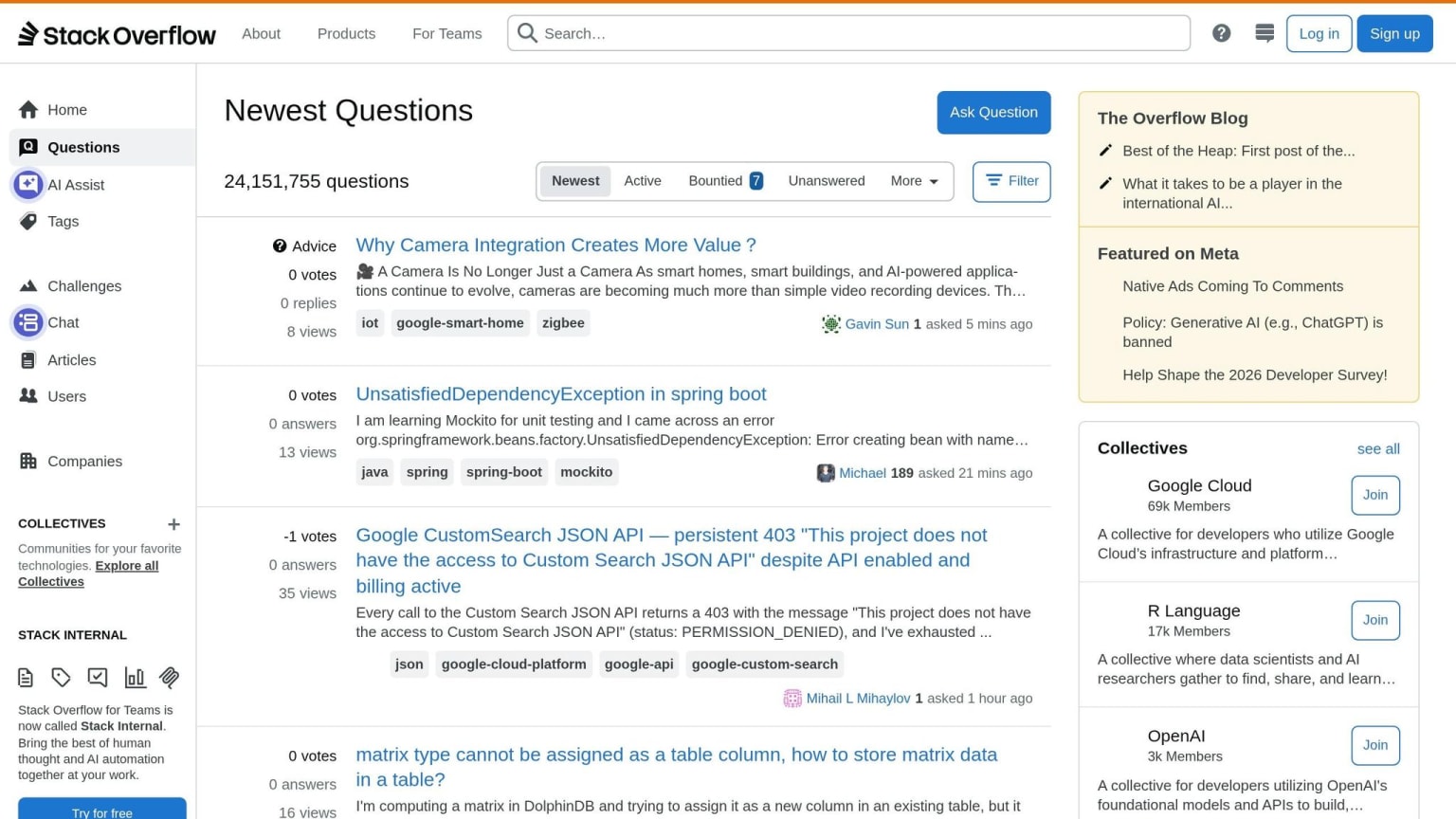
Stack Overflow still sees impressive monthly traffic, but the nature of its audience has shifted. A large chunk of visitors now consists of passive users who land on the site through organic or AI-powered searches, often accessing older threads. Meanwhile, the number of logged-in contributors - those actively asking questions, voting, or commenting - has become a smaller but more engaged group. These contributors are more likely to respond to targeted ads, making them a key demographic for advertisers. This changing mix of users highlights how developers interact with the platform today and sets the foundation for understanding its advertising potential.
How Developers Use Stack Overflow Today
This evolving audience makeup has a direct impact on ad performance. Developers typically visit Stack Overflow with a singular goal: solving an immediate technical problem, whether it’s fixing an error or finding a specific syntax. This focused mindset means they’re less likely to engage with general sidebar or inline ads while troubleshooting.
Advertising metrics reveal a CPM range of $25–$45 and a CPC of $2–$8 for developer-focused campaigns . However, fleeting impressions often fail to leave a lasting impact on brand recognition. Ads placed in active, tag-targeted sections of the site tend to perform better. For example, ads tied to popular, high-traffic tags like Python, JavaScript, or AWS are more likely to align with the context of developers actively searching for solutions.
For media planners, the key takeaway is clear: the effectiveness of Stack Overflow as an ad channel depends heavily on ad placement and audience targeting. Tag-specific placements in areas with active engagement provide better opportunities for reaching developers, but even then, meaningful engagement requires more than just contextual relevance.
Stack Overflow Ad Products: What Each One Does
In today's evolving developer ecosystem, Stack Overflow offers a few distinct ad products, each designed to engage developers at different stages of their journey. These products aren't interchangeable - they serve specific purposes and come with their own trade-offs. Knowing what you're getting into before signing a contract can save you from future headaches. Here's a breakdown of how each product works to connect with developers.
Display Ads: Run-of-Site and Tag-Targeted Placements
Display ads are the most straightforward way to advertise on Stack Overflow. You can choose to run them across the entire site (run-of-site) or focus on specific tags like Python, Kubernetes, or React. Tag-targeted ads are more precise, putting your message in front of developers who are actively working with particular technologies. This makes them more relevant than broad site-wide ads.
However, there's a challenge: developers on Stack Overflow are usually laser-focused on solving technical problems. This means display ads often get overlooked. CPMs for developer audiences typically range from $25 to $50+ , which can feel steep for impressions that don't always grab attention. Tag sponsorships can improve visibility - some packages provide a 25–50% share of voice within a specific tag. But even premium placement doesn't guarantee engagement.
Sponsored Collectives and Native Placements
Sponsored Collectives take things up a notch by offering a more integrated brand presence. A Collective is a dedicated space on Stack Overflow centered around a specific technology, such as Google Cloud, Microsoft Azure, or PHP. As a sponsor, your brand becomes a key part of that community, with your content, articles, and answers featured prominently.
This approach is ideal for boosting long-term brand recognition. Collectives use native placements that blend seamlessly into valuable content developers are already seeking. However, they require a solid base of technical content - documentation, tutorials, or expert answers - to make a meaningful impact. Without this, your sponsorship may come across as superficial to the developer audience.
Newsletter Sponsorships
Newsletter sponsorships provide a way to connect with an opted-in audience in a less cluttered environment. Stack Overflow's newsletters are segmented by developer role, technology focus, and seniority, making this format one of the more predictable options for targeting.
Engagement tends to be steady, with newsletters often outperforming run-of-site display ads. This is largely because the audience has chosen to receive these emails. That said, the size of your target audience may vary depending on how niche the segment is. And success hinges on how well your offering aligns with the newsletter's theme - for instance, a DevOps tool will resonate more in a cloud infrastructure newsletter than in one focused on security.
| Ad Product | Primary Strength | Targeting Mechanism |
|---|---|---|
| Display Ads (Run-of-Site) | Broad brand visibility | Behavioral/demographic |
| Display Ads (Tag-Targeted) | Contextual relevance | Tag-based, topic-specific |
| Sponsored Collectives | Authority and brand association | Technology community |
| Newsletter Sponsorships | Engaged, opted-in audience | Role, interest, seniority |
Targeting on Stack Overflow: How It Works and Where It Falls Short
How Tag-Based Targeting Works
Stack Overflow's ad targeting system revolves around tags - the keywords developers use to categorize their questions. When someone posts a question tagged with terms like Python, Docker, or AWS, ads related to those tags can appear on the same page. This means your ad is placed directly in front of developers actively engaging with the specific technology you're targeting.
For example, if your company offers a Kubernetes management tool, you can target tags like kubernetes and helm to reach developers working with container orchestration. This approach offers highly relevant ad placement, ensuring your message aligns closely with the developer's immediate focus. While this level of precision is a major advantage, it's important to understand both the strengths and the gaps in this targeting method.
What Contextual Targeting Gets Right - and What It Misses
Tag-based targeting works well when developers are searching for immediate solutions to specific problems. Ads placed in this context align neatly with the developer's task-oriented mindset, making them more likely to notice a product that addresses their current challenge.
However, this method has clear limitations. While it shows the topic of the page a developer is viewing, it doesn't reveal much about the person behind the screen. For instance, you won't know if the person browsing a React question is a beginner exploring the framework, a seasoned engineer comparing tools, or a freelancer tackling a client project. This lack of user-specific insights can be a challenge for B2B products that depend on reaching specific roles or seniority levels.
Another drawback is that tag-based targeting only reflects the developer's current question. It doesn't provide a broader view of their overall tech stack, long-term habits, or professional role . Combined with the tendency of technical audiences to ignore banner ads, even well-placed ads can struggle to capture attention when developers are laser-focused on solving a problem .
Understanding these limitations is critical to crafting effective campaigns on Stack Overflow.
| Signal | Tag-Based (Stack Overflow) | Behavior-Based |
|---|---|---|
| What it captures | Current page content / tag | Reading habits, tool usage over time |
| User mindset | Problem-solving, high task focus | Discovery, learning, exploration |
| Role/seniority signal | Weak | Stronger |
| Ad blocker impact | High | Lower with native formats |
| Pricing model | Direct sales, custom contracts | Self-serve or programmatic |
These trade-offs underline the importance of aligning your messaging with the developer's immediate needs. Tag-based targeting is most effective when your product directly solves the problem being addressed on the page. However, if your offering is less tied to a specific issue - like a productivity platform or a collaboration tool - it may be harder to achieve strong results with this approach.
Stack Overflow Ad Pricing in 2026: Costs, Minimums, and What You Can Negotiate
How Stack Overflow Structures Ad Deals
Stack Overflow primarily sells ads through direct deals, which involve working with a sales representative rather than using an automated auction system. This setup allows advertisers to access specialized placements like tag-targeted ads and Sponsored Collectives. However, these deals often come with a required minimum budget. Contracts are typically set for a specific time frame with predetermined metrics, meaning most budget decisions need to be finalized upfront, leaving little room for adjustments during the campaign. This structure shapes how CPM (cost per thousand impressions) rates are determined and highlights areas where negotiation is possible.
Another option Stack Overflow offers is Private Marketplace (PMP) deals. These allow advertisers to secure a fixed or minimum CPM, helping them avoid the unpredictability of open-auction pricing. For those looking for more flexible terms, PMP deals can be a practical alternative .
CPM Ranges and Negotiation Room
Ad costs on Stack Overflow vary depending on the specificity of the tags and the placement. Tags with high traffic tend to have higher rates, while more niche tags are less expensive but come with limited inventory.
Premium formats like Sponsored Collectives and native ads generally cost more. Negotiations for these formats often revolve around factors like share of voice (SOV), custom content options, and access to dedicated support. Native ad formats are particularly effective, with brand recall rates ranging between 25% and 35% .
| Buying Model | Negotiables | Best For |
|---|---|---|
| Direct Buy | SOV, custom bundles, success manager access | High-intent conversions, tag sponsorships |
| PMP Deal | Fixed/floor CPM, inventory access | Avoiding auction price swings, programmatic efficiency |
| Sponsored Collectives | Content integration, package structure | Building brand awareness and technical credibility |
Since Stack Overflow does not publicly share pricing details, the final costs depend heavily on your negotiation skills and campaign needs. To secure better terms, it’s essential to come prepared with a clear understanding of your target audience, campaign duration, and tag strategy. This preparation can give you the upper hand when discussing pricing and package options.
Ad Creative That Works on Stack Overflow
What Makes Developer-Focused Creative Work
To capture the attention of developers on Stack Overflow, your ad creative must align with their unique mindset. Developers on this platform aren’t aimlessly browsing - they’re actively searching for solutions to specific technical challenges. This means your ads need to be both precise and practical.
Specificity is key. Mentioning exact technologies, like "Supports TypeScript, Python, and Java", immediately signals relevance. Developers are far more likely to engage with ads that directly reference the tools and frameworks they use. On the flip side, vague claims or broad benefit statements are often ignored. Visuals also play a major role - ads featuring code snippets, architecture diagrams, or even UI screenshots consistently outperform generic stock images.
"Developers ignore banners. They pay attention to native content."
Native ad formats are particularly effective because they blend seamlessly with the technical content developers are already consuming. For example, in tech environments, native ads typically achieve a 0.45%–1.5% CTR and 75–85% viewability, compared to display banners, which average 0.15% CTR and 25–40% viewability . This stark difference makes native ads a smarter investment for your ad budget.
Headlines also need to be sharp and to the point. Keeping them under 60 characters and focusing on a specific problem can make a big difference. Examples like "Cut Code Review Time and Reduce Bugs by 50%" or "15 Kubernetes Metrics Every DevOps Team Should Track" are far more engaging than generic titles. Similarly, calls to action tailored to developers - such as "Read the Docs", "Try the API," or "View on GitHub" - outperform generic prompts like "Get Started Now" or "Contact Sales" .
This technical, problem-solving approach is a clear departure from the broader strategies often used in SaaS advertising.
Why Generic SaaS Creative Fails Here
Generic SaaS ads often fall flat on Stack Overflow because they lack the technical depth developers expect. These ads typically lean on emotional appeals or abstract visuals, which don’t resonate with an audience looking for practical solutions.
"Developers do not click on ads. They click on solutions to their problems."
The table below highlights the stark differences between developer-focused and generic SaaS creative:
| Ad Element | Developer-Focused Creative | Generic SaaS Creative |
|---|---|---|
| Headline | Technical, specific, problem-oriented | Vague, benefit-heavy, buzzword-filled |
| Visuals | Code snippets, architecture diagrams, UI shots | Stock photos, abstract illustrations |
| Value Prop | "Reduce latency by 40% in Go apps" | "Empower your team to build faster" |
| Call to Action | "Read the Docs", "Try the API", "View on GitHub" | "Contact Sales", "Get Started Now" |
To avoid falling into the trap of generic messaging, focus on addressing real developer needs with technical clarity and relevance.
Finally, remember that developers are quick to tune out repetitive messaging. Ad fatigue is a genuine concern on Stack Overflow, so it’s best to limit exposure to 3–5 impressions per user per week . Consider using sequential messaging - starting with brand awareness, followed by feature highlights, and ending with social proof - to keep your campaigns engaging and effective .
Measuring Stack Overflow Campaign Performance
What Stack Overflow's Reporting Actually Tells You
Stack Overflow's reporting tools provide a snapshot of your campaign's surface-level performance, offering metrics like impressions, clicks, CTR (click-through rate), and tag-level breakdowns. These metrics confirm that your ads are being seen and clicked, but they don't tell the whole story. Specifically, they leave out what happens after someone clicks your ad. For context, CTRs for Stack Overflow campaigns usually range between 0.5% and 1% . This is fairly typical for a technically savvy audience that tends to be skeptical of ads.
The tag-level data, however, is quite useful. It shows which technology audiences are engaging with your ads. For example, if your Python-tagged ads perform better than your JavaScript ones, that's a clear signal to adjust your targeting strategy. But beyond the click, the reporting falls short. Metrics like post-click behavior, return visits, and how your ads influence the sales pipeline aren't covered.
To bridge this gap, UTM parameters are essential. Properly tagging your campaign links allows you to distinguish between tag-specific placements and broader display ads . Without UTM tracking, all your traffic data will get lumped together, making it impossible to identify which ads are driving results.
For brand awareness campaigns, brand search lift is a key metric to monitor. If you see a 20% or greater increase in branded search volume during and after your campaign, that's a strong indicator that your ads are making an impression, even if clicks are low . These extra steps are critical for getting a clearer picture of your campaign's actual impact.
Attribution Gaps with Developer Audiences
Tracking developer behavior presents unique challenges. Developers often multitask, use ad blockers, and switch between devices, which makes it harder to follow their journey from ad view to conversion. Ad blockers, in particular, can skew your data. They may inflate reach estimates while hiding impressions from senior technical decision-makers - who are often the most frequent ad-blocker users .
The developer purchase cycle adds another layer of complexity. Imagine a developer sees your ad on Tuesday while troubleshooting a Python issue. They might not take action until weeks later, after reading documentation, exploring Reddit threads, and watching a demo. In cases like this, last-click attribution models completely miss the mark.
To address these gaps, consider adding a "How did you hear about us?" question to your signup form. While this method is simple, it often reveals attribution paths that tracking pixels can't capture, particularly for journeys involving ad blockers or multiple devices . Combine this with branded search lift tracking, and you'll gain a much clearer understanding of how your Stack Overflow campaigns are influencing your audience.
| Metric Category | Recommended KPI | Why It Matters |
|---|---|---|
| Awareness | Brand Search Lift | Tracks the "halo effect" of your ads; aim for >20% growth |
| Engagement | Tag-Level CTR | Highlights which developer groups are engaging with your ads |
| Attribution | "How did you hear about us?" survey | Captures conversions missed by traditional tracking |
When Stack Overflow Is Worth the Budget - and When It Is Not
How to Assess Whether Stack Overflow Fits Your ICP
Before committing your budget to Stack Overflow, take a closer look at your ideal customer profile (ICP). This platform can be a great choice for certain advertisers, but it may not work for everyone. To make an informed decision, consider three key factors: your target developer audience, your company's stage, and the metrics you’ll use to measure success.
Stack Overflow shines when targeting backend engineers or data scientists who are actively seeking solutions to technical problems your product can address. Ads here hit developers at just the right moment. However, it's best suited for enterprise-level budgets, as campaigns often require a minimum spend of $10,000 or more. The sales-led buying process also demands careful planning and flexibility. If you’re a smaller team working with a monthly budget of $1,000–$5,000, the cost might outweigh the benefits.
That said, Stack Overflow isn’t the best option for top-of-funnel awareness campaigns. Its tag-based targeting lacks the depth to focus on specifics like job title, company size, or real-time interests. This makes it harder to effectively reach senior engineering managers at smaller, fast-growing companies.
| Scenario | Stack Overflow Fit |
|---|---|
| Bottom-funnel, high-intent developer targeting | ✅ Strong fit |
| Enterprise budget ($10,000+), direct sales cycle | ✅ Strong fit |
| Top-of-funnel brand awareness campaign | ⚠️ Weak fit |
| Monthly budget under $5,000 | ❌ Poor fit |
| Targeting by seniority, company size, or job title | ❌ Poor fit |
If your cost per acquisition (CPA) on Stack Overflow starts exceeding $100–$300 for trial signups, it’s a clear sign to revisit your budget allocation. These benchmarks are typical for high-intent platforms, so exceeding them may indicate diminishing returns.
By understanding where Stack Overflow fits into your strategy, you can decide whether to double down or explore other channels that extend beyond immediate problem-solving moments.
Reaching Developers Beyond the Debugging Moment
While Stack Overflow is great for engaging developers when they’re troubleshooting, it captures just a small slice of their day. Developers spend much more time discovering new tools, staying updated on industry trends, and exploring additions to their tech stack. This is where Stack Overflow falls short - it doesn't connect with developers during their broader exploration phase.
This is where daily.dev for Business comes into play. With over 1 million monthly active developers, it reaches professionals during their daily discovery routines, not just when they’re stuck debugging. Native in-feed ads, detailed targeting by programming language, seniority, and job title, plus a self-serve pricing model, make it a versatile addition to your marketing strategy. Think of Stack Overflow as your bottom-of-funnel channel, while daily.dev helps build the pipeline that leads to it.
Conclusion: Getting Real Value from Stack Overflow Ads in 2026
Stack Overflow continues to serve as a sharp tool for developer marketing, but its role has evolved. With AI-assisted search pulling much of the high-intent traffic elsewhere, the platform now caters to a smaller, more specialized audience. This shift means advertisers need to justify their spending more carefully. Stack Overflow shines as a precise, bottom-funnel channel, especially when your ideal customer profile (ICP) includes backend engineers or data scientists actively seeking solutions to problems your product addresses. However, if your goal is to build a broader pipeline, engage developers earlier in their decision-making process, or work within tight budgets, you may quickly notice its limitations in cost-per-acquisition metrics.
For ads to resonate with developers, they must provide direct, technical solutions. Clear messaging, a solution-first approach, and realistic attribution models aren't just helpful - they're the foundation of any successful Stack Overflow campaign.
To expand your reach and address these limitations, consider pairing your Stack Overflow strategy with daily.dev for Business. This combination allows you to target both immediate problem-solving moments and the broader phases of technology adoption, from discovery to evaluation. Together, they create a well-rounded approach to engaging developers throughout their journey.
FAQs
Which Stack Overflow ad format converts best for my product?
To increase conversions on Stack Overflow, choose ad formats that seamlessly integrate into developers' workflows. Topic Tag sponsorships are a great option for targeting specific audiences, giving you a 50% share of voice on tags such as Python or AWS. For developers with higher intent, native content syndication works well. This format places your tutorials or documentation directly on relevant question pages, reaching developers when they’re actively looking for answers.
How do I pick the right tags for Stack Overflow ads?
Stack Overflow offers a massive library of over 60,000 technology tags, giving you the tools to connect directly with your ideal audience. The key is to focus on tags that align with the technical solutions or frameworks your product supports. For instance, if your product integrates with a specific programming language or tool, those tags should be your priority.
To refine your targeting, use the Potential Targets widget. This tool categorizes tags into three groups - total, close, and strong matches - helping you estimate the audience size for each tag.
If you're aiming for broader visibility, think about sponsoring widely-used tags like AWS, Python, or React. These core tags can help you reach a larger segment of developers who are actively engaging with these technologies.
How can I measure conversions if developers don’t click right away?
Tracking conversions on Stack Overflow can be tricky, especially since 83% of conversions happen without a direct click. This makes it essential to measure the impact of ads that are seen but not clicked. Enter view-through conversion tracking - a method that helps you understand how your ads influence users, even if they don’t immediately interact with them.
To keep your data accurate, make sure to use UTM parameters consistently across your campaigns. These parameters help you track where your traffic is coming from and how users are engaging with your content. Another smart move? Survey new users during sign-up to find out how they discovered you. This adds an extra layer of insight into your marketing efforts.
Lastly, developers often take a nonlinear path when researching. By extending attribution windows to 30–90 days, you’ll have a better chance of capturing these delayed conversions and understanding their journey.