
Tech stack targeting is a smarter way to connect with developers by focusing on the tools and frameworks they actively use, like React, Node.js, or AWS, rather than relying on outdated job titles. This approach uses real-time data from platforms like GitHub, daily.dev, and Stack Overflow to identify what developers are currently working on. Here's why it works:
- Better Precision: Developers' job titles often don't reflect their current skills or tools. Tech stack targeting leverages real-time signals like GitHub activity and content engagement to ensure accuracy.
- Higher Engagement: Campaigns using tech stack data see 2–3x higher click-through rates because they deliver messages tailored to developers' immediate needs and workflows.
- Proven Results: For example, targeting React developers with specific challenges like state management can improve conversion rates by 35% compared to generic outreach.
Why Tech Stack Signals Beat Job Titles
Real-Time Data vs. Outdated Profiles
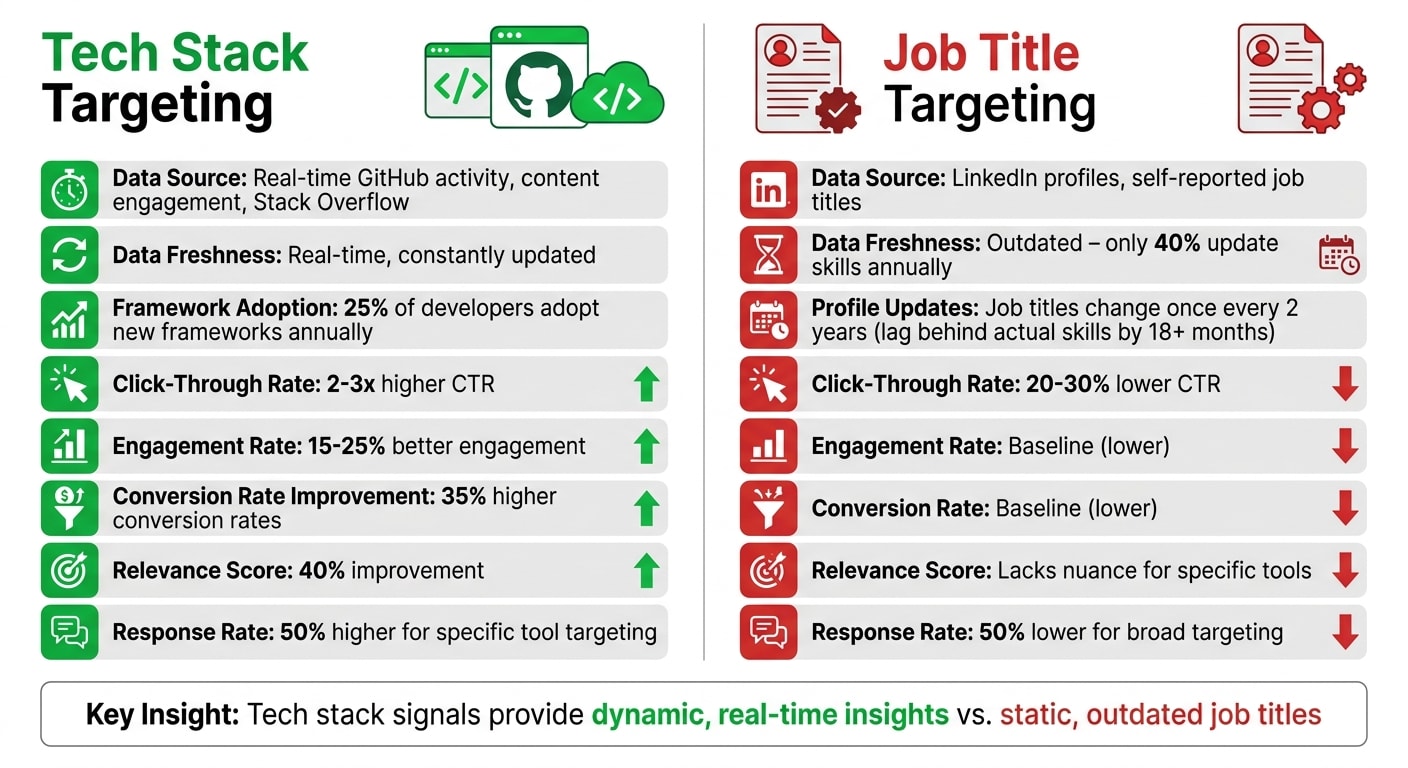
Job titles might seem like a straightforward way to identify developers, but they often fail to capture what someone is actually working on. For instance, a LinkedIn profile that lists "Senior Frontend Developer" might stay unchanged for 18 months, even if the person has shifted their focus to AWS cloud architecture. In fact, only about 40% of LinkedIn users update their skills annually, leaving much of the data stale. On the flip side, tech stack signals offer a dynamic and constantly updated view of what developers are doing right now. Around 25% of developers adopt new frameworks every year, while their job titles typically lag behind, changing only once every two years.
This difference in data freshness directly impacts campaign performance. Broad targeting based on outdated job titles often results in click-through rates that are 20–30% lower compared to strategies that use behavior-based insights. Platforms like daily.dev, which track developers’ engagement with specific technologies, report 15–25% better engagement by leveraging real-time tech stack signals. These up-to-date insights allow for more precise, tool-specific ad messaging, improving how effectively campaigns connect with developers.
How Specific Tools Enable Better Targeting
Real-time tech stack data doesn’t just keep things current - it also enables hyper-targeted messaging by focusing on the exact tools developers are using.
Take React, for example. Knowing a developer actively works with React lets you create highly relevant messages like, "Optimize your React hooks with our profiler", addressing specific challenges such as state management or performance bottlenecks. This kind of tailored approach can improve relevance scores by about 40%. Compare that to the generic "Frontend Developer" label, which lacks the nuance to engage developers meaningfully.
Similarly, spotting activity around AWS - whether it’s reading about AWS Lambda or contributing to AWS repositories - opens the door for targeted ads like, "Scale your AWS Lambda functions 3× faster", which directly address cost or performance concerns. Campaigns targeting "Cloud Engineers" broadly often see response rates that are 50% lower compared to these more focused strategies. And a developer labeled as a "Backend Engineer" but actively contributing to Kubernetes repositories? They’re far more likely to respond to DevOps-oriented messaging, which can double conversion rates. Overall, this kind of precision targeting can improve conversion rates by roughly 35% compared to relying solely on static job titles.
Main Tech Stack Categories to Target
Using real-time behavioral signals, categorizing tech stacks helps ensure your ads reach users of the right tools. Targeting specific tech stack categories - frontend, backend, and cloud/CI/CD - allows for precise and effective campaigns. Each category appeals to developers with unique goals, workflows, and challenges. Here's a closer look at these categories, their tools, and what matters most to their users.
Frontend Frameworks
Frontend developers focus on creating the parts of applications that users see and interact with. Their tool choices directly impact the user interface and experience. React leads this space, especially for single-page applications. It’s widely used for building complex dashboards and interactive apps, thanks to its reusable components and extensive ecosystem. Angular, on the other hand, is favored by enterprises for its built-in features like dependency injection and two-way data binding. For developers who want simplicity and flexibility without the steep learning curve of Angular or React's reliance on third-party libraries, Vue strikes a great balance, making it ideal for interactive UIs.
Backend Technologies
Backend developers handle the server-side logic, APIs, and data management that power applications. Node.js is a top choice for teams that want a unified JavaScript stack, enabling frontend developers to work on backend code without switching languages. Django excels in secure, data-driven application development, offering rapid deployment capabilities. Then there’s Ruby on Rails, which emphasizes convention-over-configuration, speeding up development. As Sergey Kisly puts it:
Ruby on Rails continues to shine... thanks to its blend of simplicity, flexibility, and scalability.
Each backend tool caters to developers with distinct language preferences and project needs.
Cloud Platforms and CI/CD Tools
DevOps specialists and cloud engineers focus on automation, infrastructure, and deployment. The "Big Three" cloud platforms - AWS, Microsoft Azure, and Google Cloud Platform (GCP) - dominate this space, with AWS leading in market share. For CI/CD automation, Jenkins is a go-to for teams needing custom pipeline configurations, while GitHub Actions has quickly gained traction for its seamless GitHub integration and straightforward YAML-based workflows. Tools like Docker and Kubernetes are also critical, with Kubernetes being essential for managing container orchestration at scale. These professionals prioritize reliability, automation, and infrastructure-as-code practices to streamline their workflows.
How to Identify Tech Stack Signals
To pinpoint developers' tech stacks, focus on real-time activity rather than relying on static profiles. The most reliable insights come from observing developers' current actions, which reveal their immediate interests and tool evaluations. For example, starring several database repositories in a single week indicates a strong intent to explore tools, far more than a generic job title ever could . By tracking these real-time behaviors, you can fine-tune your tech stack targeting, ensuring your messaging aligns with developers' current tools and challenges.
Content Reading Habits
A developer’s reading habits provide a direct window into their technology priorities. If someone frequently reads articles about Kubernetes or React, it’s a clear sign they’re either using these tools or actively learning about them. Platforms like daily.dev capture these content preferences, offering detailed insights into where developers are focusing their attention. Whether they’re deepening their expertise in their existing stack or exploring new tools, their reading patterns offer valuable clues. These insights often complement the signals gathered from their coding activities on GitHub.
GitHub Activity
GitHub is a goldmine for identifying tech stack preferences because it tracks developers' identity-linked technical actions. For example, forking a repository signals strong intent, while starring multiple repositories or actively participating in issues shows a deeper evaluation process . Developers' comments and issue openings also shed light on the challenges they’re encountering during evaluations .
In 2026, Tim Grassin, CEO of Kubegrade, leveraged GitHub activity to identify developers engaging with Kubernetes repositories. His campaign achieved a 22% response rate and secured five demos . Unlike traditional B2B intent data, which often relies on anonymous IP tracking, GitHub signals are tied to specific usernames. These usernames can then be enriched to uncover real names, employers, and professional roles . When combined with content consumption insights, these technical signals provide a clearer picture of developers' interests and pave the way for deeper community engagement.
Community Participation and Tags
Developers' community engagement offers additional insights into their technology preferences. Beyond coding and content consumption, participation in forums and tagging patterns can reveal evolving interests. For instance, Stack Overflow tags and activity highlight areas where developers have expertise or are seeking solutions. Similarly, monitoring "Awesome lists", tutorials, and community-curated tool repositories can identify developers in the early stages of exploring new technologies .
In 2026, Orlando Nieves, RevOps Lead at Unstructured.io, expanded developer signal tracking to include community engagement. This approach resulted in a 20% increase in booked meetings and contributed to 40% of the company’s total pipeline . As Kevin Doubleday, Communications Director, noted:
We now know who's looking at our documentation or who's reviewing our GitHub. That's a much easier and frictionless path to building pipeline versus your traditional approach on outbound .
When developers engage across multiple community platforms, it confirms their strong interest and provides a clearer picture of their intent .
Creating Tech Stack Audience Segments
Using real-time tech stack signals, audience segmentation ensures your ads connect with developers exactly when they're searching for solutions. By combining core technology, additional criteria, and behavioral signals, you can create tailored audience segments that address developers' immediate needs. This approach helps craft campaigns that directly speak to their challenges.
Grouping by Primary Technology
Start by segmenting your audience based on the core technologies they use. Instead of targeting all frontend developers, create separate groups for those working with React, Vue, or Angular. Each framework has its own community, learning curve, and specific applications. Similarly, when focusing on cloud platforms, distinguish between AWS, Google Cloud Platform, and Azure users, as their infrastructure needs often differ.
On daily.dev Ads, you can create these segments using content tags that track the technologies developers engage with daily. For instance, someone frequently reading articles about Kubernetes, Docker, and CI/CD processes likely falls into the DevOps category. Similarly, on Stack Overflow, over 60,000 technical tags help match ads with specific content, ensuring your ads align with developers' real-time interests rather than outdated profile data .
Refining with Secondary Criteria
Primary technology is a good starting point, but layering in secondary criteria makes your segmentation far more effective. For example, targeting "backend developers at Series A-C startups using Python and facing PostgreSQL scaling challenges" is much more impactful than simply targeting "Python developers" .
Consider refining your segments by:
- Company size: Startups versus large enterprises.
- Seniority level: Junior developers exploring tools versus senior engineers making key decisions.
- Location: Especially useful for region-specific campaigns.
By narrowing your audience to match your ideal customer profile, you avoid wasting ad spend on developers who aren’t decision-makers or don’t share the challenges your product addresses.
Setting Up Campaigns
On daily.dev Ads, you can launch campaigns by selecting content tags and behavioral signals that align with your audience segments. For example, if you’re promoting a PostgreSQL optimization tool, target developers engaging with PostgreSQL performance content, database-related articles, and signals of scaling challenges.
Define your campaign parameters by choosing:
- Primary tags: Such as PostgreSQL and database optimization.
- Secondary tags: Like backend development and cloud infrastructure.
- Audience behaviors: For instance, how often they engage with database-related content.
This layered strategy ensures your ads reach developers while they’re actively researching solutions. Keep an eye on performance metrics like click-through rates and conversions to fine-tune your segments further, adjusting tags and criteria as needed for better results.
Writing Messages for Different Tech Stacks
Crafting the right message is essential when using tech stack targeting in developer advertising. Generic messaging often misses the mark because the challenges faced by a React developer are vastly different from those of a Kubernetes engineer. By using precise terms like "React Server Components" or "layer caching" , you demonstrate a deep understanding of the technology. This not only builds credibility but also shows that the message is tailored for their specific needs.
Messaging for Frontend Developers
Once you've identified audience segments based on tech stack signals, your messaging should address the unique priorities of each group. Frontend developers, for instance, care about UI performance and how quickly they can develop features. For React developers, use terms like "React Server Components" or highlight metrics such as "5ms video load time" instead of making broad claims like "better performance" . Angular developers often resonate with messaging that discusses architecture and TypeScript integration, while Vue developers value simplicity and progressive enhancement. The key is to focus on clear, measurable benefits rather than vague statements. This precise approach can yield impressive results: tech stack targeting has been shown to achieve an average click-through rate of 3.0%, which is six times higher than traditional display ads .
Messaging for Cloud and DevOps Engineers
When targeting cloud and DevOps engineers, your messaging should revolve around automation, scalability, and deployment efficiency. For AWS users, emphasize cost optimization and seamless service integration. Kubernetes engineers, on the other hand, are often focused on managing drift and preparing for AI workloads . For Docker users, highlight the speed of containerization and the simplicity of deployment. Messaging that directly addresses these specific challenges and tools can deliver two to three times the impact of generic advertising . By aligning your ad copy with the exact needs of cloud engineers, you create a message that resonates and sparks meaningful engagement.
Targeting Developers Learning New Tools
This strategy also works well for developers who are expanding their skillset. Developers exploring related technologies are a valuable audience. For example, someone regularly engaging with Docker content might soon be looking into Kubernetes as the next step. Acknowledge their current tools and present a clear path toward complementary technologies that can improve their workflow. Platforms like daily.dev Ads allow you to target developers based on the content they consume, enabling you to reach those actively learning about new tools. Instead of hard sales pitches, focus on offering peer insights and actionable advice. As Sarah Chen, Marketing Lead at DevToolsCo, put it:
Finally, ads that reach actual React developers. Our CTR went from 0.3% to 3.2% overnight .
Where to Run Tech Stack Targeting Campaigns
Running effective tech stack targeting campaigns boils down to three key factors: keeping data fresh, ensuring precise signals, and focusing on granular audience insights. The fresher and more relevant the signals, the better your campaign will perform.
Targeting with Content Tags and Behavior
Platforms like daily.dev Ads offer real-time insights by tracking the technologies developers are actively reading about. Instead of relying on outdated profile data, this approach focuses on current behavior. For instance, if a developer frequently reads articles on Kubernetes or Docker, it signals an ongoing interest or need, which is far more actionable than a skill they added to their profile years ago. This method captures developers right when they’re exploring new tools or solving specific challenges. With data aggregated from over 1 million developers, you can target audiences based on what they’re actively researching - whether it’s React Server Components, optimizing AWS Lambda, or improving CI/CD pipelines.
Platform Comparison for Tech Stack Targeting
Different platforms use varying methods to identify developer tech stacks. Traditional tools often depend on self-reported skills or job titles, while developer-focused platforms rely on real usage signals. Here’s a closer look:
| Feature | Developer-Centric Platforms | Traditional Intent Tools |
|---|---|---|
| Primary Signals | GitHub activity, Docker pulls, npm/pip installs, open source telemetry | Firmographics, broad web intent, contact data |
| Data Freshness | Real-time usage and documentation engagement | Periodic database updates and broad intent surges |
| Audience Granularity | Specific developer skills and tool-level usage | Job titles and department-level interests |
| Context | Technical evaluation and implementation stages | General buying committee awareness |
This comparison highlights why using developer-specific signals is more effective for targeting. By focusing on what developers are actively doing, rather than relying on broad or outdated data, you can achieve much better results.
For example, one company reported that 40% of their pipeline and a 20% increase in meetings came from identifying accounts based on developer usage signals . Ting Wang, CEO of Timeplus, shared:
Reo.dev brings together GitHub activity, tech stack visibility, Docker pulls, and website/docs engagement in one place, giving us a much clearer view of real developer intent .
Matching Targeting Strategies to Developer Behavior
Understanding where developers spend their time is crucial for effective targeting. For instance, JavaScript remains the most widely used technology, with 65–70% of developers engaging with it . Meanwhile, Python is a key signal for reaching AI and machine learning developers, as 84% of them are either using or planning to use AI tools . To refine your targeting, combine multiple signals - like GitHub stars, website visits, and documentation engagement - to distinguish between casual interest and serious evaluation .
Measuring Tech Stack Targeting Performance
Tracking the right metrics is essential to separate effective tech stack campaigns from mere guesswork. These numbers show how well your targeting aligns with actual developer needs.
Key Metrics to Track
- Reply Rates: Back in April 2026, a sales researcher named Zackrag ran a competitor displacement campaign targeting 340 accounts using tech stack data. The result? An 11.4% reply rate, compared to just 3.2% for general targeting - over three times better performance .
- Reply-to-Demo Conversion: Excluding companies with incompatible tech stacks had a big impact, boosting the reply-to-demo conversion rate from 31% to 44% .
- Pipeline Generation and Sales Cycle: That same campaign generated $84,000 in pipeline within six weeks. For context, direct competitor displacement typically takes 3–6 months, while greenfield campaigns (targeting developers without a specific tool) can stretch to 4–8 months .
- Demo Rate with Layered Intent Data: Combining tech stack fit with active research behavior led to a 4.1x higher demo rate in the first week compared to relying on tech fit alone .
These figures clearly highlight the advantages of stack-specific outreach compared to broader targeting strategies.
Stack-Specific vs. Broad Targeting Results
Messaging that directly references a competitor delivers a 9.1% reply rate, significantly higher than the 3.8% reply rate for generic outreach. This emphasizes how powerful it is to address developers' current tools . As Zackrag put it:
The problem wasn't the ICP - it was that I had no idea which of those 40,000 companies in my TAM were actually ready to switch .
To maximize results, dedicating 60% of efforts to displacement lists, 30% to integration fit, and 10% to greenfield accounts strikes the right balance between conversion speed and deal size potential .
Conclusion
Tech stack targeting works because it focuses on the actual tools developers are using, rather than relying on outdated or static profiles. For example, if you're targeting a React developer exploring state management techniques or a DevOps engineer researching Kubernetes, you're connecting with them at the exact moment they're immersed in their technology. This level of precision leads to impressive results.
Campaigns built around tech stacks achieve much higher engagement rates. For instance, targeted outreach results in an 11.4% reply rate, compared to just 3.2% for generic outreach. Additionally, aligning stack compatibility with your messaging can boost demo conversion rates from 31% to 44% . These are not just small gains - they represent a major shift in efficiency, cutting down on wasted resources and engaging with developers who genuinely need your solution.
The key takeaway? Use real-time behavior to reach developers when they’re actively engaged. Platforms like daily.dev monitor the technologies developers are reading about daily, providing live signals that reflect their current interests - not outdated resume data. For example, if a developer is consuming content about Django or AWS, that’s a real-time opportunity to deliver relevant messaging. By focusing on specific frameworks at the moment of need, you can align your outreach with their immediate challenges.
"Technographic data tells you who fits. Intent data tells you who's ready. Layering them is where the real acceleration happens." – Zackrag, Sales Ops & OSINT Nerd
To make the most of these insights, define your audience segments carefully, craft messaging that resonates, and measure performance rigorously. With tech stack targeting, you can turn insights into consistent, measurable success.
FAQs
What counts as a reliable tech stack signal?
A reliable tech stack signal offers a snapshot of the tools and technologies developers are currently using and interested in. It can be identified through several key indicators, such as content consumption patterns, GitHub activity, job postings, and community memberships. Together, these signals reveal valuable insights into the technologies developers are actively engaging with and adopting.
How do I build a tech stack audience segment in daily.dev Ads?
When building a tech stack audience segment in daily.dev Ads, focus on developers' behavioral signals to understand their tool preferences. These signals might include GitHub activity, content consumption habits, and community memberships.
You can group developers into categories based on their tools and technologies, such as:
- Frontend frameworks like React or Angular
- Backend tools like Node.js or Django
- Cloud providers such as AWS or Azure
By taking advantage of daily.dev's tracking capabilities, you can ensure your segments stay accurate and reflect developers' current interests. This approach allows for precise targeting and ensures your messaging resonates with the right audience.
Which metrics best prove tech stack targeting is working?
Metrics such as click-through rate (CTR), conversion rate, cost per click (CPC), and cost per thousand impressions (CPM) are key indicators of how well your tech stack is targeting the right audience. These numbers provide insights into higher engagement levels, improved campaign efficiency, and stronger overall ad performance.