

Account-Based Marketing (ABM) for developer tools requires a unique approach because developers and decision-makers have different priorities. Developers often discover and adopt tools independently, while executives sign off on purchases based on proven usage. To succeed, focus on two key areas:
- Engage Developers: Provide technical content like clear documentation, GitHub repositories, and integration guides. Avoid hard sells; developers value transparency and utility.
- Target Decision-Makers: Use data like adoption reports and ROI analyses to address concerns of VPs, CTOs, and procurement teams.
Key strategies include:
- Tracking intent signals like GitHub activity, product usage, and hiring trends.
- Tailoring content for each audience (developers, tech leads, executives).
- Using developer-friendly platforms and combining digital campaigns with field events.
- Measuring success through account-wide engagement and adoption depth.
How to Build Your Developer ABM Target Account List
When it comes to developer tools, traditional ABM strategies don't cut it. Why? Because these tools demand a deeper understanding of both technical needs and active interest - not just a surface-level company profile. Developer tools generate rich behavioral data that goes beyond simple demographics, making it essential to track specific technical actions to identify genuine buying intent.
Key Data Signals That Identify Ready Accounts
The best indicators of intent come from four main areas: GitHub activity, first-party product usage, documentation engagement, and hiring trends.
GitHub Activity: Actions like starring, forking, or submitting pull requests signal varying levels of interest. For example, a star suggests awareness, a fork indicates evaluation, and a pull request shows active usage. These GitHub signals are most relevant within a 60-day window, so timing is critical.
First-Party Product Usage: Signals like multiple developers from the same company signing up with corporate emails or installing a multi-user integration point to serious interest. These behaviors typically remain relevant for about 30 days, meaning quick, tailored engagement is key .
Documentation Engagement: Developers searching for advanced topics like SSO configuration, migration guides, or security documentation are showing deeper intent compared to someone browsing a "Getting Started" page.
Hiring Patterns: A company hiring for roles in Kubernetes, Terraform, or other cloud technologies indicates a shift in their technical environment. A particularly strong signal is the arrival of a new VP of Engineering. Why? New engineering leaders often reassess their team's tooling within their first 90 days, giving you a 120-day window to make your pitch .
By combining these signals, you can create a structured scoring system to prioritize accounts effectively.
Target-Account Scoring Framework
Here’s a scoring system to help you decide how to act on these signals:
| Signal | Intent Level | Points | Action |
|---|---|---|---|
| Pull request submitted | Highest | 10 | Reach out within 24 hours |
| Issue opened | Very High | 8 | Follow up with technical support |
| Multi-user integration install | High | 7 | Trigger buyer-side conversation |
| Repository fork | Medium-High | 5 | Share integration patterns |
| Doc view (SSO, security, migration) | Medium | 3 | Add to technical nurture sequence |
| GitHub star | Low | 1 | Top-of-funnel awareness only |
Accounts scoring 20+ points in a 30-day period should receive immediate, personalized outreach. Those in the 10–19 point range are best suited for targeted technical content. For accounts scoring below 10, keep them in a general awareness track until their activity increases.
It’s also important to aggregate signals at the account level. For instance, a single developer with 10 points is interesting, but three developers from the same company collectively scoring 25 points? That’s a clear sign of a formal evaluation underway .
Accounts sourced through ABM outperform traditional lead generation, boasting 48% higher win rates and 171% higher average contract values . But achieving this level of success depends on basing your target list on real intent data - not just a filtered list from your CRM.
Multi-Threading: Reaching Everyone in the Buying Committee
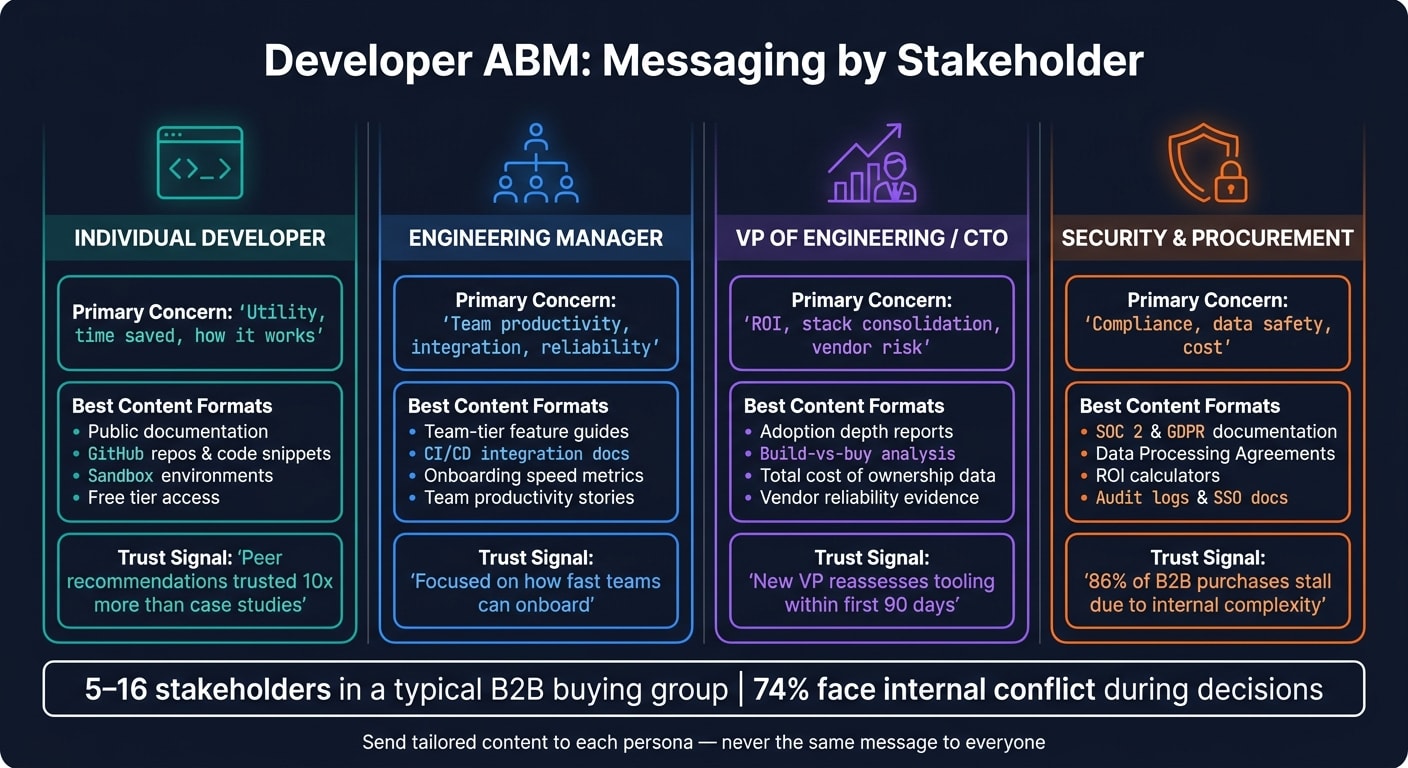
After pinpointing high-intent accounts, it's time to connect with all the key stakeholders using timely, personalized messaging. In most B2B buying groups, there are anywhere from 5 to 16 stakeholders spread across different functions . And here's the kicker: 74% of these teams face internal conflict during the decision-making process . Translation? You can't depend on just one champion to push the deal through.
By leveraging the intent signals you've identified, multi-threading ensures every decision-maker is looped in. But there's a catch - don't attempt this with accounts that lack internal developer engagement. Only start a coordinated outreach when a developer within the account shows clear high-intent actions, like forking your repository or installing a free-tier integration. The reality is, deals close only when internal adoption justifies the investment. In this framework, account-based marketing connects signals from both the user side and the buyer side .
Once you've got that foundation, the next step is engaging developers in a way that resonates with them - without setting off any alarm bells.
How to Reach Developers Without Annoying Them
Developers are naturally skeptical of aggressive sales tactics. They respond best to content that's genuinely useful and tailored to their needs. Meet them where they already are - on GitHub, in documentation, or within online developer communities. Share resources like code snippets, sandbox environments, and integration tutorials.
Peer recommendations carry massive weight here. Developers trust insights from their peers 10 times more than traditional case studies . So, showcasing real engineers discussing real workflows will always outperform polished marketing content.
At this stage, your priority is building trust. When a developer finds your content genuinely helpful, they might just become your internal advocate - without you even asking.
Messaging for Engineering Leaders and Procurement Teams
While developers can become internal champions, you also need to craft messaging that resonates with executives and other decision-makers. Here's a breakdown of what each persona cares about most and the best content formats to address their needs:
| Persona | Primary Concern | Best Content Format |
|---|---|---|
| Individual Developer | Utility, time saved, "how it works" | Docs, GitHub repos, sandboxes |
| Engineering Manager | Team productivity, integration, reliability | Team-tier features, CI/CD integration guides |
| VP of Engineering | ROI, stack consolidation, vendor risk | Adoption reports, build-vs-buy analysis |
| Security / Procurement | Compliance, data safety, cost | SOC 2/GDPR docs, DPAs, ROI calculators |
Engineering managers are focused on how quickly their teams can onboard, how the tool impacts productivity, and whether it integrates with their CI/CD pipelines . VPs and CTOs are more concerned with the bigger picture - things like total cost of ownership, stack consolidation, and vendor reliability . Meanwhile, procurement and security teams are laser-focused on documentation, such as SOC 2 reports, GDPR compliance, and data processing agreements.
The biggest mistake you can make? Sending the same message to everyone. Instead, tailor your outreach so that each persona receives content that directly addresses their specific concerns. Use your CRM to track engagement and guide smarter, more informed sales conversations.
"The earliest warning sign that a deal is in trouble is when one stakeholder is fully engaged and the others aren't... the champion is on board, but the CFO, CTO, and security lead haven't touched anything." - Dag Holmen, CMO, ContactLevel
Stage-by-Stage Content for Developer ABM
To effectively navigate the multi-stage buying journey, you need tailored content for each phase - starting with the curiosity of an engineer, moving to the scrutiny of a tech lead, and ultimately landing on the desk of a procurement manager. Each of these stages demands a unique approach, building on the multi-threading strategy mentioned earlier.
Awareness: Capturing Interest with Technical Content
Developers approach awareness differently than traditional B2B buyers. They prefer to explore independently - diving into GitHub, poring over documentation, and scrolling through Reddit threads - long before they engage with sales. In fact, around 70% of the buying journey happens anonymously during this research phase .
So, what grabs their attention? Offer content like changelogs, benchmarks, RFCs, and post-incident reviews . These formats demonstrate that your team understands the challenges developers face because they’ve been in the trenches themselves. For example, a transparent post-mortem or a detailed performance benchmark speaks volumes compared to a polished "Why Choose Us" page.
Another effective strategy is founder-led thought leadership. When a founder or senior engineer shares honest, technical insights - not polished marketing language - it builds credibility early on with the buying committee, even before any formal sales outreach begins .
Once you've captured their attention, the next step is providing detailed evaluation content that addresses specific technical challenges.
Evaluation: Empowering Technical Teams to Decide
At this stage, developers and tech leads are looking for depth. They need content that helps them make an informed decision - architecture guides, integration documentation, and honest performance benchmarks are all essential tools for moving deals forward.
Craft a "Why us vs. the alternative" one-pager designed for internal sharing . This document should be concise, technically accurate, and geared toward addressing common objections. It gives your internal advocate a ready-made case to present to others - whether it's a staff engineer or a principal architect - without feeling like they’re handing out a sales pitch.
Tailor your content to meet the needs of different stakeholders, as outlined here:
| Stakeholder | Key Content Focus |
|---|---|
| Individual Developer | Public documentation, code snippets, free tier access |
| Tech Lead / Manager | Stories about team productivity, CI/CD integration guides |
| Staff / Principal Engineer | Architecture fit, open architecture details, public roadmaps |
| VP Engineering / CTO | Reports on adoption depth, ROI estimates, vendor reliability |
Procurement: Addressing Risks for Enterprise Buyers
The biggest obstacle at this stage isn’t enthusiasm - it’s paperwork. 86% of B2B purchases stall due to internal complexity . To keep things moving, you need to eliminate any potential friction.
Prepare an Enterprise-Readiness Pack that includes everything a procurement or security team might need: SOC 2 reports, SSO documentation, audit logs, GDPR compliance details, and support SLAs . Having this material ready to go can make all the difference. As Dag Holmen, CMO at ContactLevel, explains:
"This person [Security Lead] can kill a deal in one email if they don't find what they need."
Additionally, be ready with a "build vs. buy" narrative for engineering teams that might question whether they could develop the solution in-house. Use concrete data to illustrate the maintenance costs, security risks, and opportunity costs of diverting engineers from core projects . Finally, share proof of organic internal adoption - highlighting how many developers are already using the tool, which features they depend on, and for how long. This kind of evidence often seals the deal .
The Right Channel Mix for Developer ABM in 2026
Reaching developers isn’t just about delivering content - it’s about choosing platforms they trust and ensuring every stakeholder at a target account gets a consistent, relevant message. By refining earlier strategies, this approach ensures a unified and engaging experience for all stakeholders. Let’s dive into how developer-focused platforms and integrated digital strategies can effectively connect with technical audiences.
Using Developer-Native Platforms for Account-Level Targeting
Most traditional B2B ad platforms rely on job titles and company size to target audiences. That might work for roles like a VP of Finance, but it misses the mark when it comes to developers. Engineers are more likely to identify with the tools they use, the challenges they tackle, and the communities they trust.
This is where developer-native platforms stand out. For instance, daily.dev for Business allows you to target accounts based on real-time behavioral signals - like the programming languages they use, the frameworks they follow, or their seniority level - instead of static profile data . This means you can directly engage with engineers who are actively consuming content relevant to your product category.
The format of your ads also matters. Developers are more responsive to native sponsored cards embedded in technical feeds than to traditional display banners . For example, when your content appears next to articles about Rust performance or Kubernetes cost optimization, it feels relevant and earns their attention, instead of prompting them to scroll past.
Combining Digital Channels with Field Marketing and Events
While digital targeting is powerful, combining it with in-person interactions can amplify your account-based marketing (ABM) strategy. For Tier 1 accounts, a "surround-sound" approach - blending digital campaigns with face-to-face engagement - can make a big impact . Timing is key: run digital campaigns targeting developers at a specific account for one to two weeks before initiating direct outreach or field marketing. This "pre-warming" phase builds familiarity, increasing the likelihood of positive responses .
When you meet developers at conferences or workshops, avoid hard sales pitches. Developers attend these events to learn, not to be sold to. Hosting workshops, technical talks, or sessions on open-source contributions can establish credibility far more effectively than handing out branded swag. Track which target accounts engage with your sessions and use that data to refine your digital retargeting campaigns. For high-value accounts, follow up with a personalized note referencing their recent activity to reinforce the connection.
Research highlights the power of multichannel coordination: combining email, digital ads, and direct contact around intent signals can accelerate pipeline progression by 234% compared to relying on a single channel .
Keeping Messaging Consistent Across All Channels
Using multiple channels can sometimes lead to inconsistent messaging. For example, if a developer sees a detailed technical post on daily.dev but then receives a vague email saying "transform your workflow", it can create confusion and erode trust. The key is to tailor messages to each role while maintaining consistency across platforms.
For instance, communications targeting senior engineers should focus on technical specifics like architecture compatibility and performance benchmarks. Meanwhile, messages for a VP of Engineering should highlight broader benefits like adoption depth and ROI. Whether it’s a LinkedIn post, a follow-up email, or an internal presentation, the messaging should align with the recipient’s role and priorities .
To ensure consistency, assign one person to oversee messaging for each Tier 1 account. A shared document that maps key personas to their core messages - and is regularly updated - can help keep your sales, content, and campaign teams on the same page.
How to Measure ABM Results for Developer Tools
After rolling out targeted ABM strategies, the real measure of success goes beyond initial clicks. Instead, it’s about sustained, account-wide engagement and driving revenue. While many ABM teams rely on metrics like MQLs or form fills, these traditional benchmarks don’t fully capture the unique buying journey of developer tools. The real indicators lie in product usage, content engagement, and account-wide behavior rather than individual lead scores.
Tracking Engagement Across the Whole Account
To truly measure success, you need to track engagement across all key stakeholders in a target account. Are multiple engineers exploring your technical content? Is your data showing activity from developers, tech leads, and engineering managers? These are the signs to watch for.
It’s also important to map developer actions to their intent levels. For instance:
- A GitHub star reflects awareness.
- A repo fork suggests active evaluation.
- An open issue or pull request points to active integration.
- A production deployment signals committed usage.
Each step up in engagement represents a stronger buying signal, which should guide how your sales team responds.
"The strongest signal is product usage inside the account, not external content consumption." - Abmatic AI
The table below provides a framework for monitoring engagement and intent:
| Developer Action | Intent Level | Recommended Metric |
|---|---|---|
| GitHub Star | Low | Account Reach |
| Repo Fork | Medium | Engagement Depth |
| Issue / Pull Request | High | Technical Intent |
| Production Deploy | Highest | Adoption Depth |
Adoption depth - the number of unique users per account using your product and the duration of their usage - provides one of the clearest signals for when to initiate conversations about team-tier or enterprise-level deals .
Once you’ve tracked these engagement signals, the next step is to connect them to pipeline influence and revenue outcomes.
Measuring Pipeline and Revenue Impact
Attributing pipeline and revenue in developer ABM can be tricky. The path from discovery to a closed deal isn’t always straightforward. For example, a developer might find your tool organically, use it for months, and then involve their engineering manager, who brings in procurement. These dynamics don’t fit neatly into traditional attribution models.
To measure pipeline influence, track which target accounts have open opportunities and count the number of ABM touchpoints - digital targeting, field events, or personalized outreach - that occurred before the opportunity was created. Additionally, look for signs of sales-cycle compression. Accounts exposed to a mix of ABM strategies should ideally move faster from initial contact to a closed deal.
Another important metric is identifying "dark" stakeholders - key decision-makers like CFOs or security leads who haven’t engaged with your content. If critical stakeholders in a target account aren’t interacting with your technical or compliance content, it’s a sign that your campaign needs to address this gap to prevent roadblocks later in the sales process .
Using Developer Feedback to Sharpen Campaigns
While data shows trends, developer feedback uncovers the reasons behind them. Tools like Gong or Chorus can analyze sales call recordings to reveal which technical messages resonate with engineers and which fall short . For instance, if engineers frequently ask about latency in specific environments, it’s a clear signal to create more targeted content addressing that topic.
The most effective teams continuously refine their campaigns through this feedback loop. Marketing launches a campaign, sales provides feedback on the quality of conversations it generates, and content is adjusted based on real-world developer insights. Think of it as marketing "pushing a commit" while sales reviews the "build" . This iterative process ensures your ABM strategy evolves rather than stagnates over time, keeping it relevant and impactful.
Conclusion: Running ABM That Developers Actually Respond To
When it comes to developer tools, ABM strategies need to be built with developers in mind. Why? Because up to 70% of the buying journey happens in the "dark funnel" - a space filled with activities like reading documentation, forking repositories on GitHub, and engaging in online communities . By the time an engineering leader is ready to sign off on a decision, their team has often already formed an opinion about your product. This means your ABM efforts need to show up during this invisible research phase - not just when decisions are being finalized.
Engaging developers early lays the groundwork for stronger account relationships. The key is to earn their attention before making any asks. Developers tend to ignore generic outreach, but they respond to content and solutions that respect their expertise. The data backs this up: ABM-sourced accounts in the developer space boast 48% higher win rates and deliver 171% higher average contract values compared to traditional lead generation . This success comes from building trust early in the process.
Targeting is essential to cutting through the noise. Connecting with the right developer at the right company, with the right technical context, makes all the difference. Tools like daily.dev for Business help achieve this by allowing precise targeting based on company, role, and technical interests - all within a platform developers already trust. Why does this matter so much?
"Developers do not click on ads. They click on solutions to their problems." - daily.dev Ads
This insight underscores the importance of offering value-driven, contextually relevant solutions that developers genuinely care about.
FAQs
Which intent signals best predict a dev-tool purchase?
When it comes to predicting whether someone is likely to buy developer tools, first-party, technical signals from your product analytics and account-level activity are key. These signals provide valuable insights into user behavior and interest.
Here are some of the most important indicators to watch:
- Product adoption: Look for free-tier signups using corporate emails or instances where multiple users from the same organization integrate and install your tool. These actions hint at broader organizational interest.
- Deep engagement: When users frequently dive into advanced documentation, it’s a clear sign they’re actively implementing your tool in their workflows.
- Public signals: Metrics like GitHub stars or activity linked to corporate email addresses can reveal external validation and interest from professional developers.
- Organizational changes: Keep an eye on events like new engineering leadership hires or team expansions. Such changes often lead companies to reassess and update their tech stack.
These signals, when combined, can give you a clearer picture of who’s ready to make a purchase and when.
When should I start multi-threaded outreach in an account?
When you're ready to start multi-threaded outreach, make sure you've spotted bottom-up adoption signals within the account first. These signals might include:
- Five or more active users
- Multi-team integrations
- Signs of procurement intent, such as visits to the pricing page or requests for security questionnaires
Once these indicators are present, it's time to engage decision-makers. Instead of going in with a cold pitch, share a documented adoption story. This shifts the conversation toward team-tier expansion, highlighting the account's proven internal usage and success.
What metrics prove developer ABM is driving revenue?
To demonstrate that developer ABM (Account-Based Marketing) contributes to revenue growth, shift your focus to account-level engagement and pipeline health rather than vanity metrics like MQLs (Marketing Qualified Leads).
Key metrics to watch include:
- Pipeline influence: How ABM efforts impact opportunities in the sales pipeline.
- Sales-cycle compression: Whether ABM shortens the time it takes to close deals.
- Expansion revenue: The additional revenue generated from existing accounts.
For developer tools, it’s crucial to track adoption-depth metrics such as:
- The number of unique users per account.
- Feature usage across accounts.
- Longevity, or how long accounts actively use the product.
Also, keep an eye on Time to First Success (TTFS) and API key activations. These metrics highlight bottom-up adoption and indicate whether your product is ready for enterprise-scale growth.