
Want your developer tool to stand out? You need to optimize for both SEO (Search Engine Optimization) and AEO (Answer Engine Optimization). Developers don’t just rely on Google anymore - they’re searching on platforms like Stack Overflow, GitHub, and AI tools like ChatGPT. Each platform has unique quirks, and ignoring them could mean your tool gets overlooked.
Here’s the game plan:
- SEO: Improve your ranking on Google with clear headings, schema markup, and well-structured content.
- AEO: Make your content easy for AI systems to understand and cite by using concise summaries, proper tags, and structured layouts.
- Developer Search Habits: Developers use different platforms for specific needs (e.g., troubleshooting on Stack Overflow, code search on GitHub). Tailor your content for each platform.
- Content Formats: Tutorials, API references, how-to guides, and code examples work best for developers and AI alike.
- Programmatic SEO: Scale your content with landing pages targeting specific frameworks, languages, or integrations.
- Paid Ads: Use platforms like daily.dev to amplify your reach while your organic efforts grow.
Start by auditing your content to ensure it’s clear, actionable, and structured for both humans and AI. Combine organic SEO with targeted paid campaigns to maximize visibility and engagement.
Bottom line: Developers click on solutions, not ads. Make sure your tool is the solution they find - on Google, GitHub, or even ChatGPT.
How Developers and AI Systems Search for Information
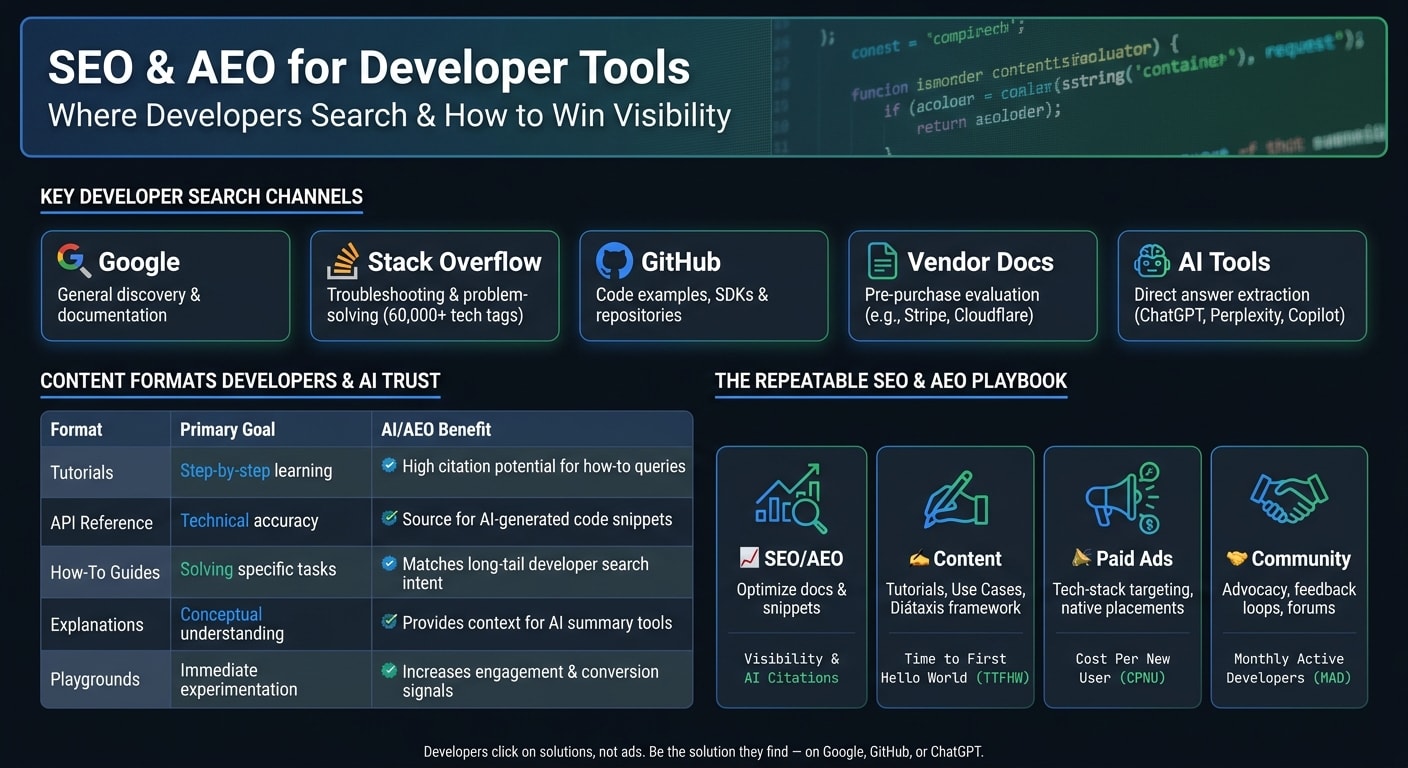
Where Developers Search: Key Channels
Google still plays a role in developer searches, but it’s far from the only option. Developers now turn to a range of platforms, each tailored to specific needs - and each with its own quirks.
Stack Overflow is the go-to when something breaks. This platform thrives on its 60,000+ technology tags, focusing on problem-solving rather than user profiles. If your tool can solve a common issue, having visibility here can elevate both your reach and your credibility in answer engine optimization (AEO). GitHub, on the other hand, is all about code. Developers head there to find sample implementations, SDKs, and working examples. The visibility of your repository depends on details like its name, the "About" section, and the tags you use.
Vendor documentation is another critical stop. Before committing to a tool, developers often evaluate its relevance through its documentation. Companies like Stripe and Cloudflare treat their docs as a product in themselves, incorporating interactive features and real-time code examples to reduce "Time to First Hello World" (TTFHW). This kind of investment builds trust while making your content easier to find.
AI assistants like ChatGPT, Perplexity, Copilot, and Cursor have also become staples in developer workflows. Increasingly, these tools deliver answers that pull code snippets directly from documentation, often bypassing your website entirely.
Understanding these search habits is key to preparing for how AI systems evaluate and cite content.
How AI Systems Select and Cite Content
AI systems analyze content differently than traditional search engines. Instead of ranking pages, they pull together information from multiple trusted sources, relying on specific signals to determine credibility and relevance.
Community validation - such as upvotes, comments, and shares - serves as a major signal of trust. Structured taxonomy, including consistent tags and clear categorization, ensures content is discoverable within relevant tech stacks . Additional trust signals, like verified authorship and proper meta tags (twitter:creator, schema markup), help AI accurately attribute content to its source .
Since large language models (LLMs) have knowledge cutoffs, fresh and real-time content becomes essential. Platforms offering up-to-date, community-validated information with structured taxonomy allow AI tools to stay relevant even after their cutoff dates .
"LLMs have knowledge cutoffs. daily.dev provides real-time, community-validated developer content with structured taxonomy... Agents can use this to stay current." - daily.dev
To stay visible in both human and AI-driven searches, it’s crucial to structure and tag your content effectively. Clear headings, accurate tags, active community engagement, and verified authorship don’t just improve SEO - they’re the factors AI systems rely on to decide whether to cite your content or move on.
Creating Developer-Focused Content That Ranks
Content Formats Developers Trust
When developers search for information, they’re looking for quick, actionable answers - often paired with working code. This makes the format of your content just as critical as the information it delivers.
Here’s a breakdown of the most effective content formats and their purposes:
| Content Format | Primary Goal | AI/AEO Benefit |
|---|---|---|
| Tutorials | Step-by-step learning | High citation potential for "how-to" queries |
| API Reference | Technical accuracy | Source for AI-generated code snippets |
| How-To Guides | Solving specific tasks | Matches long-tail developer search intent |
| Explanations | Conceptual understanding | Provides context for AI summary tools |
| Playgrounds | Immediate experimentation | Increases engagement and conversion signals |
Tutorials and how-to guides are particularly impactful because they align with how developers typically approach problem-solving: focusing on specific tasks and desired outcomes. API references, on the other hand, stand out for their precision and clarity, building trust with developers. Explanations add depth by addressing the "why", helping developers evaluate whether a tool aligns with their needs. Each format serves a unique role, and a well-rounded content strategy incorporates them all.
Once you’ve identified the right formats, the next step is ensuring your content is structured for both developers and AI systems to quickly find the answers they need.
How to Structure Content for AEO
AI-driven systems like ChatGPT and Perplexity don’t rank pages - they extract answers directly. This means your content must be structured to make it easy for these systems (and developers) to locate key information.
Headings are essential. Use clear H2 and H3 headings to guide readers and AI tools to the right sections. Each section should tackle one specific question or topic, avoiding the temptation to cram in loosely related ideas.
Beyond headings, two other structural elements are game-changers:
- Provide plain-text or Markdown versions: These formats reduce HTML clutter, making it easier for AI systems to process your content effectively .
- Use proper meta tags and schema markup: Tags like
twitter:creatorand schema metadata ensure your content is correctly attributed by platforms and AI tools .
These aren’t just nice-to-haves - they’re critical signals that determine whether your content gets cited or ignored.
Writing for Both Developers and AI Systems
Writing for developers while keeping AI systems in mind isn’t as tricky as it sounds. In fact, content that’s clear, well-organized, and technically accurate often works well for both audiences.
- Get to the point. Share the solution or code example immediately - don’t make readers dig through paragraphs to find it.
- Stay consistent. Use the same naming conventions across all your content. For example, if a function is called
authenticate()in a tutorial, don’t refer to it asauth()in your API documentation. This consistency helps both humans and AI systems avoid confusion. - Tag and format code blocks correctly. Properly tagged code blocks ensure AI tools can execute them without errors.
- Leverage structured taxonomy. Consistent tagging across your content helps AI systems discover and reference your material, even after their training cutoffs. Real-time signals from the developer community can keep your content relevant .
Programmatic SEO and AEO for Developer Tools
Programmatic SEO is a powerful way to expand your reach in developer-focused content strategies, especially by targeting specific integrations and use cases.
Building a Scalable Page System
Creating individual pages for every possible use case isn't practical. That's where programmatic SEO steps in, enabling you to generate targeted landing pages at scale. Think of it as having a page ready for every integration, language, framework, or use case your product supports.
For example, developers often search for terms like "Stripe with Next.js", "Python SDK for Twilio", or "Astro authentication tutorial." These are high-intent queries with a clear audience in mind. A well-organized programmatic page system ensures there's a dedicated, optimized page for each of these searches.
But here's the catch: every page has to feel tailored. Generic content with just the variable swapped out won't cut it. Instead, provide framework-specific or language-specific examples and context. Whether it's Next.js, Astro, Vue, Python, Go, or Ruby, each page should reflect the unique quirks and requirements of that integration or language.
Making Programmatic Pages Work for AEO
Getting your pages to rank on Google is just the first step. To be cited by AI systems like Perplexity or ChatGPT, your pages need to be structured in a way that makes the answers easy to extract.
Start each page with a clear, two- to three-sentence summary that highlights the content. This ensures AI systems can quickly identify and extract relevant information. Avoid beginning with dense marketing language - AI systems are likely to skip over it.
From there, stick to a predictable structure:
- Prerequisites: What the user needs before starting.
- Step-by-step instructions: A clear guide to follow.
- Working code: Examples that developers can use directly.
- Explanations: Briefly clarify why each step matters.
This structure aligns with what AI systems recognize as authoritative and complete. Pair it with schema markup and clean meta tags to make sure your content is properly attributed across platforms .
While summaries are essential for AI extractability, the rest of the page should dive deep into the topic. Avoid shallow content that could dilute the value of your pages.
Avoiding Thin or Duplicate Content
One of the biggest pitfalls in programmatic SEO is creating pages that feel too similar. To avoid this, make sure every variable - like the name of a framework or language - results in truly distinct content. This means including specific code examples, error-handling techniques, and ecosystem details unique to that framework or language.
For instance, a page on "Go SDK setup" should feature examples that reflect Go's concurrency model, such as async API calls. These details wouldn't apply to a Ruby page, which has its own unique characteristics.
If swapping out the framework name leaves the rest of the content unchanged, the page is too generic. By focusing on quality and specificity, you can maintain the integrity of your programmatic SEO strategy while complementing broader developer SEO efforts.
Combining SEO, AEO, and Paid Amplification
Why Organic and Paid Strategies Work Better Together
Organic SEO and AEO are excellent for building long-term visibility for developer tools, but they often take months to show results. Paid amplification fills that gap by putting your best content in front of developers immediately, giving your organic strategy the time it needs to grow.
Combining the two strategies also speeds up feedback loops. Paid campaigns can quickly show which headlines, use cases, or technical approaches resonate most with developers. These insights directly influence your organic content efforts - helping you decide what to expand, update, or even turn into a series of programmatic pages.
For paid amplification to work, it needs to lead developers to content that genuinely addresses their challenges. This could be anything from an integration guide to a detailed product comparison or a migration walkthrough. The stronger your organic content, the more effective your paid campaigns will be.
Using daily.dev for Business to Reach Developers

daily.dev for Business is designed specifically to connect with developers in their natural workflows. Instead of interrupting them on social platforms, it reaches them through the technical content they’re already consuming. The platform uses real-time reading behavior to target developers who are actively researching technologies like React, Rust, or Kubernetes, rather than relying on outdated profile data .
Here’s a breakdown of the platform’s placement options:
| Placement Type | Function | Ideal For |
|---|---|---|
| In-Feed Ads | Sponsored cards in the main developer feed | Product launches, driving traffic, signups |
| Branded Tags | Logo attached to specific topic tags (e.g., #ai) | Building awareness and passive associations |
| Keyword Spotlights | Sponsor card appears when hovering over keywords in articles | High-intent targeting and AEO support |
| Stack Placements | Suggested tool when developers update their profile stack | Team adoption and social proof |
| Post Boost | Amplifies reach of individual technical articles | Boosting engagement on high-performing content |
The Keyword Spotlights feature is particularly valuable for AEO. It ensures your content appears exactly when a developer encounters a term you want to dominate, reinforcing the associations you’re building through structured organic content.
This precise targeting aligns with developer intent and strengthens the impact of your campaigns, complementing efforts like programmatic SEO.
"Category leadership beats interruption. Every time." - daily.dev
These placement options allow for detailed tracking and optimization, ensuring your combined strategies deliver measurable results.
Tracking Performance Across Channels
Once you’ve integrated organic and paid strategies, tracking their performance is crucial. Organic search performance is relatively simple to monitor - tools like Google Search Console can track rankings, impressions, and clicks. For AEO, you can measure how often your content appears in AI-generated responses by testing queries in tools like Perplexity, ChatGPT, and Gemini over time.
Paid campaigns require a different set of metrics, covering the entire user journey:
| Metric Type | Key KPIs |
|---|---|
| Top-of-Funnel | Cost Per Click (CPC), Click-Through Rate (CTR) |
| Engagement | Signups, Time to First Hello World (TTFHW) |
| Conversion | First API Call, Activated Users, Free-to-Paid Rate |
| Unit Economics | Cost Per New User (CPNU), Customer Acquisition Cost (CAC), Lifetime Value (LTV) |
A particularly useful metric for developer tools is Time to First Hello World (TTFHW). This measures how quickly a user reaches their first meaningful interaction with your product after clicking an ad. If TTFHW is low, it’s a sign that your landing page and onboarding process are in sync with developer expectations. A high TTFHW, on the other hand, often points to a content issue rather than a targeting problem.
When launching paid campaigns, test 10–15 creative variations at once. Developers have diverse needs - for instance, a backend engineer evaluating an observability tool might respond differently than a frontend developer exploring the same product. Let the data guide you on which messaging works best, and use those insights to refine your organic content strategy.
Conclusion: Building a Repeatable SEO and AEO Playbook
Key Takeaways
Driving visibility for a developer tool requires tapping into multiple platforms. While developers rely on Google for searches, they also turn to resources like Stack Overflow, GitHub, Perplexity, and ChatGPT. Each of these platforms demands a tailored content approach, and the strategies discussed here reflect that diversity.
The foundation of a repeatable playbook revolves around four core areas:
| Strategy Component | Focus Area | Actionable Metric |
|---|---|---|
| SEO/AEO | Optimize docs and snippets | Visibility & AI citations |
| Content | Diátaxis framework, Tutorials, Use Cases | Time to First Hello World (TTFHW) |
| Paid Ads | Tech-stack targeting, Native placements | Cost Per New User (CPNU) |
| Community | Advocacy, Feedback loops, Forums | Monthly Active Developers (MAD) |
These components work together seamlessly. For example, well-crafted content boosts AI citation rates, while data from paid campaigns can refine your organic content strategy. Engaging with the developer community uncovers common questions and challenges, which directly inform keyword research and guide content creation. Clear headings and schema markup not only improve SEO but also increase the likelihood of AI systems citing your content. Use these insights as a launchpad for action.
Next Steps to Grow Developer Visibility
Start by fine-tuning your developer documentation based on the strategies outlined. Audit your existing docs to ensure they address frequent error messages and integration challenges. Make sure your content includes clear headings, definitions, and examples of code - these structural elements are key for AI systems like Perplexity and Gemini to recognize and cite your work confidently.
A strong organic strategy enhances the effectiveness of paid campaigns. Align your programmatic SEO efforts with native ad placements to create a repeatable, scalable playbook. Platforms like daily.dev for Business, which reaches over 1,000,000 developers, can be a powerful tool for native advertising .
FAQs
What’s the difference between SEO and AEO for developer tools?
SEO (Search Engine Optimization) is all about helping your content rank higher on traditional search engines like Google. The goal? To drive more traffic to your site by making it more visible to users searching for related topics.
On the other hand, AEO (Answer Engine Optimization) takes a different approach. It focuses on formatting your content specifically for AI platforms like ChatGPT and Perplexity. The aim here is to ensure your content is structured in a way that allows it to be cited directly in AI-generated responses.
While SEO is about increasing overall visibility, AEO zeroes in on creating precise, well-organized, and authoritative content that AI tools can reference accurately. It’s a shift from broad exposure to providing clear, dependable answers.
How can I get my docs cited by AI assistants like ChatGPT?
If you want AI assistants like ChatGPT, Claude, or Perplexity to reference your documentation, it's essential to make your content easy for machines to read and understand. Here are some key tips:
- Stick to Plain Markdown: Avoid cluttering your docs with extra JavaScript or unnecessary design elements. Simple, clean markdown works best for machine readability.
- Add a Sitemap: A sitemap helps AI systems navigate and index your content more effectively.
- Include an
llms.txtFile: Place this file at the root of your domain to guide large language models (LLMs) in discovering your content.
Finally, prioritize content that adds real value. AI tools are more likely to cite clear definitions, tutorials, and working code examples - practical and well-structured information stands out.
How can I scale programmatic SEO without creating duplicate pages?
To expand programmatic SEO efforts while avoiding duplicate content, stick to a flat URL structure with straightforward, unique paths. Use metadata to dynamically assign sections or categories, keeping the organization efficient and logical. Prioritize modular content, such as landing pages tailored to specific integrations, frameworks, or use cases. This approach ensures that every page addresses a distinct search intent.
Additionally, maintain a clean sitemap and establish strong internal linking. This helps search engines navigate your site more effectively and reduces the risk of duplicate content issues.