

Marketing to AI developers is hard. Traditional tactics like ads, vague buzzwords, or long sales calls don’t work for this audience. Engineers working with tools like LangChain, OpenAI Agents SDK, and Anthropic MCP want quick, hands-on results and technical transparency.
Here’s a breakdown of what works:
- Know your audience: AI developers fall into distinct roles (e.g., AI application engineers, MLOps engineers, agent developers, research scientists, and decision-makers). Each has unique priorities, from latency to cost-per-token.
- Provide hands-on tools: Offer runnable notebooks, API examples, or sandbox environments that deliver results in under 5 minutes.
- Focus on transparency: Share concrete metrics like latency, throughput, and costs. Highlight tradeoffs openly to build trust.
- Use the right platforms: GitHub, MCP directories, technical newsletters, and niche communities (e.g., Discord, Slack) are where these developers discover tools.
- Create effective content: Tutorials, workflow demos, benchmarks, and even post-mortems resonate more than polished marketing materials.
Key success metrics: Track meaningful engagement like GitHub stars, API calls, and sandbox signups, not just clicks or impressions.
Skip the fluff. Show real data, make it actionable, and meet developers where they are.
Understanding the AI Developer Audience
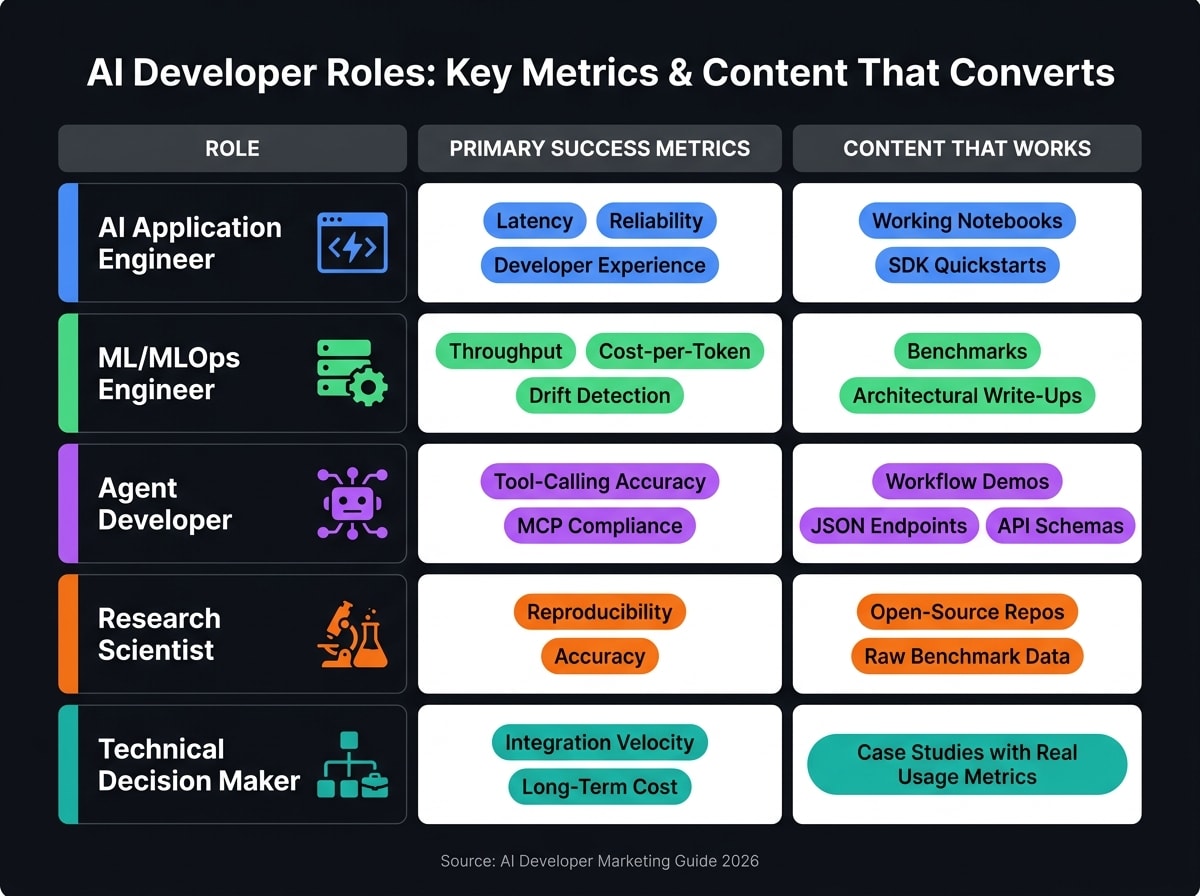
"AI developers" isn't just one homogenous group. By 2026, the people working with LLMs, building agents, and utilizing MCP fall into several distinct roles, each with its own priorities and decision-making process. Trying to market to all of them with a one-size-fits-all approach? It just doesn’t work. Below, we dive into these roles and explore how tailored marketing strategies can meet their specific needs.
Key AI Developer Roles in 2026
Here’s a snapshot of the five main roles you’ll encounter:
AI Application Engineers: These are software engineers who integrate LLMs into products using frameworks like LangChain, LlamaIndex, or the OpenAI Agents SDK. Their focus? Speed and simplicity. They care about latency, a smooth developer experience, and getting something functional in under three minutes.
ML/MLOps Engineers: These folks are all about infrastructure. They deal with model serving, throughput, drift detection, and feature stores. They aren’t swayed by vague promises - they want concrete performance metrics.
Agent Developers: A rapidly growing group, they specialize in creating autonomous workflows with tools like LangGraph, CrewAI, and Anthropic's MCP. They need machine-readable APIs, MCP registry compatibility, and tools that can be quickly configured for integration.
Research Scientists: Found in AI labs or R&D departments, they value reproducibility, open-source credibility, and peer-reviewed benchmarks. Vendor claims won’t cut it - they rely on hard data and transparency.
Technical Decision Makers: These are the Directors of Engineering and senior architects. Their focus is on the bigger picture: long-term reliability, cost-per-token, and how quickly their teams can adopt new solutions .
How Each Role Shapes Your Marketing Approach
Each role has distinct priorities, so a generic landing page won’t cut it. The table below highlights what matters to each group and the kind of content that resonates:
| Role | Primary Success Metrics | Content That Works |
|---|---|---|
| AI Application Engineer | Latency, reliability, developer experience | Working notebooks, SDK quickstarts |
| ML/MLOps Engineer | Throughput, cost-per-token, drift | Benchmarks, architectural write-ups |
| Agent Developer | Tool-calling accuracy, MCP compliance | Workflow demos, JSON endpoints, API schemas |
| Research Scientist | Reproducibility, accuracy | Open-source repos, raw benchmark data |
| Technical Decision Maker | Integration velocity, long-term cost | Case studies with real usage metrics |
Joe Karlsson, Developer Advocate at CloudQuery, captures this perfectly:
"Your README, your examples directory, your API reference, and your SDK docs are your LLM marketing."
For most of these roles, the product itself does the talking. Offering engineers something tangible - like a working notebook, a deployable example, or even a simple curl command - before they ever interact with your team is the fastest way to build trust. Recognizing these distinct roles allows you to craft campaigns that align with each group’s technical priorities.
How AI Developers Evaluate Tools
The Metrics That Matter: Performance, Cost, and Reliability
When it comes to evaluating tools, AI developers rely on hard data - not flashy slogans. They test APIs and tools against measurable benchmarks to assess their performance. Key metrics like millisecond latency, cost-per-token, throughput, and uptime take center stage. Vague promises won’t cut it; developers need precise performance data. Here’s a breakdown of the metrics they prioritize:
| Metric Category | What Developers Look For |
|---|---|
| Performance | P50, P95, P99 latency; inference speed; throughput |
| Cost | Cost-per-token; API pricing tiers; open-source vs. managed overhead |
| Reliability | Error rates; version stability; integration complexity |
| Credibility | GitHub stars/forks; documentation depth; reproducible benchmarks |
These numbers don’t just measure performance - they build trust. Transparent benchmarks that clearly show strengths and weaknesses set the foundation for credibility.
Why Transparency Builds Trust With AI Engineers
AI developers value transparency. They trust tools that openly share where they fall short just as much as where they excel. For instance, benchmarks that highlight tradeoffs - like slower speeds in exchange for lower costs - demonstrate honesty. On the other hand, hiding weaknesses can raise red flags.
Take Anthropic's Claude Cookbook as an example. By mid-2026, it had earned over 30,000 GitHub stars, thanks to its 200+ self-contained notebooks updated weekly. This resource outperformed Anthropic's sales materials and official documentation when it came to driving first-time activations. Why? Developers could verify claims themselves, building confidence in the tool’s capabilities .
The connection between documentation quality and conversions is also striking. A strong correlation (0.6+) exists between well-crafted documentation and trial-to-paid conversions for AI tools . Developers who explore five or more documentation pages during their first session are 340% more likely to convert than those who visit just one page . What grabs their attention? Honest content - like architectural breakdowns, discussions of failure modes, and benchmarks with raw datasets and methodologies.
"I've watched one comparison post stay in the top 10 performers for over a year with zero updates. Good data ages better than good writing." - Joe Karlsson, Developer Advocate, CloudQuery
For AI engineers, credibility stems from reproducibility and openness, not from polished presentations. Show your tradeoffs. Lock in your dependencies so code samples don’t break. Publish your failures alongside your successes. That’s how you earn the trust that leads to conversions.
Where AI Developers Discover and Evaluate Tools
Discovery Channels With High Impact
AI developers rely on specific, high-value platforms to find and assess new tools. Knowing where they look can make or break your strategy.
GitHub stands out as the go-to platform. A well-maintained cookbook repository with functional notebooks can outperform traditional sales efforts or even dedicated documentation. For example, one Series A AI infrastructure startup hit $6M ARR without hiring a single DevRel professional. Instead, they focused on a GitHub cookbook that earned 30,000 stars and was updated weekly by their three founding engineers. Meanwhile, a competitor with eight DevRel hires only reached $1.8M ARR .
Beyond GitHub, MCP server directories and registries are quickly becoming essential discovery tools. Platforms like AgentShare.dev and standardized MCP Server Cards (/.well-known/mcp/server-card.json) allow MCP-enabled IDEs - such as Cursor and Windsurf - to automatically connect developers with tools. This eliminates the need for manual browsing and integrates seamlessly with automated agent recommendations .
Another emerging trend is the influence of coding agents in tool discovery. When developers ask agents like Cursor or Claude Code for library recommendations, these tools synthesize suggestions based on indexed technical content. Thalia Barrera, Software Engineer and Writer at Parallel Content, highlights this shift:
"If a developer asks an agent which tool to use, will our content be in the answer?"
Other impactful channels include technical newsletters, niche Discord communities (e.g., LangChain, LlamaIndex, and EleutherAI), and Hacker News "Show HN" threads. Interestingly, about 52% of developer tool discovery occurs through "dark social" channels - private Slack groups, Discord DMs, and direct messages that evade traditional analytics .
Using daily.dev for Business to Reach AI Developers
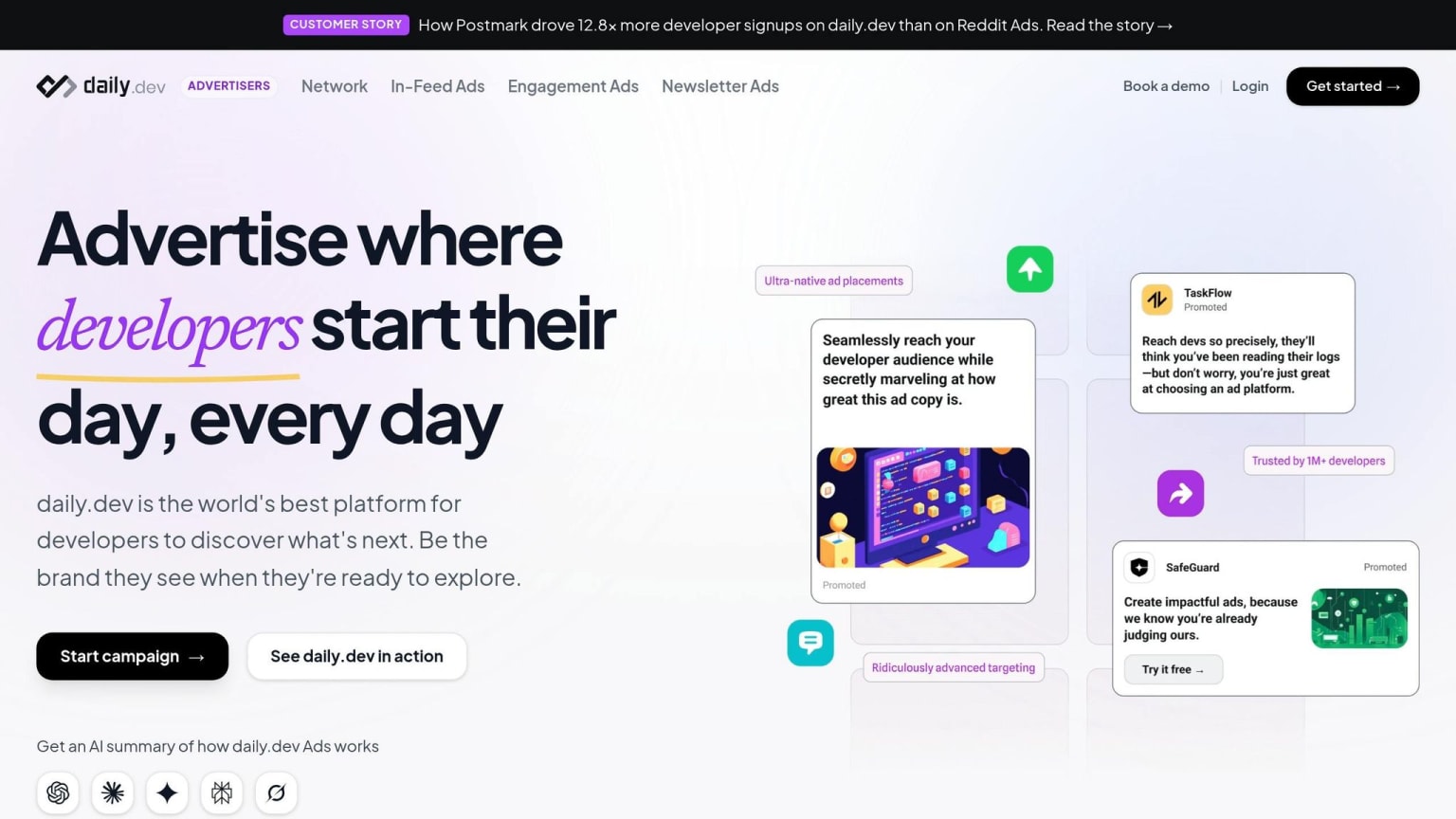
While organic discovery channels are crucial, scaling your reach requires targeted strategies. That’s where daily.dev for Business comes in, connecting you with developers in their natural habitat for technical insights.
daily.dev for Business places your content directly in front of developers who are already engaging with topics like LLMs, agents, and MCP. Using precise AI-tag targeting, your message appears as native in-feed placements and post-page ads within their regular reading routine. This ensures your content feels like a natural part of their workflow rather than an interruption.
With this high-precision approach, you can target engineers based on the tools they use, the topics they follow, and their level of expertise. Whether it’s a LangGraph tutorial or a benchmark for RAG architecture, your material reaches the engineers actively working on those systems, ensuring your message hits the right audience.
Content That Works With AI Developers
When it comes to connecting with AI developers, understanding how they evaluate and discover tools is crucial. Certain content formats have consistently proven effective in building trust and credibility within this audience.
Benchmark-Driven Case Studies
AI engineers value data and transparency over vague marketing claims. If your case study simply states that your tool is "fast" or "cost-effective" without presenting hard numbers, you'll quickly lose credibility. Instead, share specific metrics like latency, token costs, throughput rates, and model versions. To go a step further, include links to your test setup and code to ensure reproducibility - this is essential for earning technical trust.
What makes a benchmark truly stand out is honesty about tradeoffs. For example, if your tool is slower than a competitor's but offers significantly lower cost-per-token, acknowledging this builds far more trust than presenting a one-sided victory. As Louis Corneloup, Founder at Dupple, aptly says:
"Technical specificity beats marketing polish every time."
Joe Karlsson, Developer Advocate at CloudQuery, provides a great example of this in action. Over a three-month period, his technical comparison posts featuring reproducible benchmarks led to a 61% increase in trial signups and an all-time high in organic traffic .
Detailed benchmarks are just one part of the equation. To further solidify trust, hands-on examples are essential.
End-to-End Tutorials and Workflow Demos
While benchmarks demonstrate performance, interactive tutorials prove your tool's practical value. In recent years, platforms like Jupyter and Colab notebooks have become the go-to tools for showcasing AI developer tools. These notebooks often outperform traditional documentation when it comes to driving first-use activation .
The Forkoff team highlights this shift perfectly:
"In AI, it's inverted: notebooks are the funnel, docs are the reference."
The gold standard for a notebook is achieving a "time-to-first-output" of three minutes or less. If developers can't see results within that timeframe, activation rates drop significantly. To address this, maintain a well-organized cookbook repository with self-contained, regularly updated notebooks. Tag each notebook with its expected time-to-first-output and focus on real-world use cases like "PDF RAG pipeline" or "multi-agent orchestration" .
For tools like LangGraph, LlamaIndex, or the OpenAI Agents SDK, tutorials that guide developers through an entire workflow - from tool setup to final output - perform far better than isolated feature demonstrations. Developers want to see how your tool integrates into a broader architecture, not just how to call an API.
Post-Mortems and Failure Mode Write-Ups
One of the most effective ways to build credibility with AI engineers is by sharing what went wrong. Post-mortems and failure mode write-ups are rare in vendor content, which is exactly why they stand out. When you provide an honest account of a production issue - detailing the root cause, debugging process, and the changes made - you demonstrate real-world expertise that polished marketing content simply can't replicate.
This approach works because it treats developers as peers rather than prospects. By explaining issues like a RAG pipeline faltering under high concurrency or inconsistent MCP server responses, you showcase your technical depth and transparency. These are the qualities engineers look for before trusting a new tool in their stack.
Running Campaigns Aimed at AI Developers
Channel Selection and Ad Placement
To effectively target AI developers, focus on the platforms and spaces where they naturally spend their time. Skip the usual marketing tactics and instead prioritize technical newsletters, open-source repositories, community Discord servers, and developer-centric feeds.
Sponsoring newsletters is a smart and cost-effective way to start. For instance, newsletter sponsorships typically deliver CPCs between $1.50 and $3.00 . ElevenLabs managed to achieve a $1 CPC by using targeted newsletter placements, while DigitalOcean’s campaign combined Primary and Spotlight ad formats to generate over 1 million impressions at a $1.70 CPC .
Another key channel? Open-source contributions. By offering a public SDK, reference implementation, or a cookbook repository, you can get your tool in front of developers who are actively assessing architecture options. These efforts ensure your product becomes part of their evaluation process.
For paid ad placements, platforms like daily.dev for Business are highly effective. They allow you to target engineers directly in their daily learning feed using AI-specific tags. Ads are integrated naturally alongside the technical content developers are already consuming, reducing the banner fatigue that often plagues traditional campaigns. With targeting options that include seniority, programming languages, and specific tools, you can ensure your LLM inference product reaches developers working on LLM-related projects. This approach makes your content feel like a seamless part of their workflow.
Once you’ve selected the best channels, the next step is creating content that delivers measurable results.
Creative Formats That Get Results
Choosing the right creative formats is just as important as selecting the right channels. The most effective campaigns focus on real data and technical credibility. Developers respond to content that prioritizes evidence over hype, making transparency and authenticity essential.
Start with eval-driven case studies and head-to-head benchmarks. Show real-world metrics, openly discuss tradeoffs, and share reproducible data. For example, when presenting benchmarks, include details like the test setup, dataset, and raw results. This level of transparency establishes your methodology as trustworthy, saving developers the hassle of verifying it themselves. Be upfront about tradeoffs too - saying something like, "our tool is 20% slower than X but costs 40% less per million tokens", builds credibility and trust.
Post-mortems and architectural deep dives are another valuable format. Vendors rarely discuss failures, but sharing lessons learned from challenges can make your content stand out. Pair these with detailed explanations of why specific design decisions were made - not just how to use a feature. This approach resonates with developers seeking meaningful insights. As the Forkoff team aptly puts it:
"AI DevRel is a cookbook problem, not a docs problem."
Finally, steer clear of AI-generated copy. AI engineers can spot it instantly, and it sends the wrong message about your understanding of their needs. Whether it’s ad copy, landing pages, or tutorials, make sure every piece of content is written by someone who has firsthand experience working with the tools you’re promoting.
Measuring What Works in AI Developer Marketing
Metrics That Reflect Developer Behavior
When assessing the success of your AI developer marketing, it’s crucial to focus on metrics that indicate actual engagement and tool adoption - not just vanity stats like impressions or clicks. The most valuable metric? Product Qualified Leads (PQLs). These are developers who interact meaningfully with your product, such as exploring a sandbox environment or making their first API call. PQLs convert to paying customers at a rate of 15–30%, far outpacing the 2–5% conversion rate of standard marketing leads . That difference can redefine what success looks like in your campaigns.
Another critical metric is how quickly developers achieve a tangible result, often measured as time-to-first-successful-call. Ideally, this should happen in under three minutes . If developers abandon the process before reaching this milestone, no amount of ad spend or marketing tweaks will salvage your funnel.
For open-source tools, focus on metrics like package downloads from platforms such as PyPI or npm. Unlike GitHub stars, which often reflect curiosity, downloads indicate actual usage. Similarly, fork velocity - the speed at which developers fork your repository - signals deeper engagement, as it shows they’re investing time in your project . And don’t underestimate the influence of dark social: 52% of developers discover tools through private channels like Slack, Discord, or direct messages, which traditional analytics often miss .
| Signal Type | Vanity Metric | Effective Metric |
|---|---|---|
| Interest | Page views / impressions | GitHub stars / repo traffic |
| Usage | Logins | PyPI/npm downloads / integration installs |
| Trust | Case study downloads | AI-answer citations / notebook fork velocity |
| Conversion | MQL (form fill) | PQL (sandbox signup / first API call) |
By tracking these more meaningful metrics, you can better understand what resonates with developers and refine your strategies accordingly.
Using daily.dev Campaign Data to Improve Results
Platforms like daily.dev for Business provide granular insights into developer behavior, particularly through tag-level engagement data. This allows you to identify which technical topics spark genuine interest. For example, developers might self-select into tags like LangChain, LLMs, agents, or MCP, giving you a clear view of what content drives not just clicks but qualified signups.
You can use this data to fine-tune your content strategy. If content on LLM inference latency captures attention from developers tagged under LangGraph or OpenAI Agents SDK, but RAG architecture content underperforms, it’s a signal to shift focus. Tailor your messaging to align with the preferences of specific subgroups within the AI developer community.
Corporate-domain engagement is another key signal. If engineers from multiple teams at the same AI-focused company are engaging with your MCP server tutorial, that’s a strong indicator of enterprise interest - perfect for flagging to your sales team .
"The question isn't 'will this rank on page one of Google?' The new question is 'if a developer asks an agent which tool to use, will our content be in the answer?'" - Thalia Barrera, Software Engineer & Writer
This evolving perspective highlights the importance of metrics such as AI-answer citations. In 2026, these citations are becoming a legitimate way to measure the visibility of developer tools. Content that earns these citations typically shares key traits: it’s benchmark-driven, technically accurate, and resonates within developer communities . By focusing on these metrics, you can ensure your marketing efforts build trust and credibility while effectively engaging the AI developer audience.
Conclusion: Earning Trust and Driving Results With AI Developers
AI developers aren’t your typical tech audience. They skip ads, see through buzzwords, and can identify AI-written marketing copy in no time. The engineers working with tools like LangChain, LlamaIndex, OpenAI Agents SDK, and Anthropic MCP evaluate products the same way they approach code - by testing them, analyzing the results, and verifying whether the data checks out.
This is the heart of everything discussed here. Engineers prioritize clear, measurable outcomes, making technical accuracy a must. Straightforward cost-per-token breakdowns and benchmarks that anyone can replicate build far more credibility than a flashy landing page. Being upfront about tradeoffs also earns more respect than presenting a one-sided "perfect" solution .
But trust isn’t just built through metrics. About 52% of developer tool discovery happens in private spaces like Slack groups, Discord servers, and direct messages . In these channels, your brand either gets a positive mention or is completely overlooked. That’s why sharing real-world failure scenarios, publishing transparent post-mortems, and contributing to open-source evaluation frameworks can have just as much impact as a paid campaign.
"Good data ages better than good writing." - Joe Karlsson, Developer Advocate, CloudQuery
Reaching the right audience is what ties all of this together. Whether it’s MLOps engineers, agent developers, or prompt-pipeline builders, targeting specific subgroups ensures that your accurate, technical content reaches the people who actually need it. Tools like daily.dev for Business help by matching content to developers based on relevant tags, so your MCP server guide or LLM latency analysis gets in front of the right eyes.
The takeaway is clear: provide real data, make trials easy, be transparent about limitations, and share your content where AI developers are already active. Stick to this consistently, and trust will naturally follow.
FAQs
How do I segment AI developers by role?
AI developers generally fall into four interconnected roles, each contributing uniquely to the field:
AI engineers: They specialize in creating applications powered by large language models (LLMs). Their responsibilities often include tasks like prompt engineering and integrating these applications into broader systems.
ML engineers: These professionals focus on training machine learning models, managing MLOps processes, and setting up the infrastructure needed for running inferences.
Research scientists: Typically found in R&D departments or labs, they establish their expertise by publishing research papers and contributing to open-source projects.
Data scientists and data engineers: They handle the data pipelines that are essential for supporting machine learning tasks.
What’s the fastest way to prove value to AI engineers?
To create a seamless, self-serve experience, prioritize tools that users can access and see results from almost instantly. Forget about gated content or lengthy sales calls - let users dive right in. Offer something practical, like a Colab or Jupyter notebook, or even a one-command deployable sandbox. These options give users hands-on access without unnecessary barriers.
Want to build trust? Provide a reference implementation that demonstrates the architecture of a real-world app. It’s much easier for users to connect with your offering when they can see how it works in a real scenario.
When presenting your solution, focus on specific metrics such as latency, token costs, and throughput. Be upfront about the tradeoffs involved and any potential failure modes. Transparency here not only sets realistic expectations but also establishes credibility.
Which metrics best predict AI tool adoption?
When it comes to predicting the adoption of AI tools, two factors stand out: product-qualified leads and developer engagement with your technical setup. These elements provide a clear picture of how likely users are to embrace your tools. Here are some important metrics to keep an eye on:
- Interaction with documentation: Developers who engage with 5 or more unique documentation pages show a remarkable 340% boost in conversion rates.
- API usage signals: Metrics like sandbox signups and the time it takes for users to make their first successful API call reveal strong intent to adopt.
- Community activity: Indicators such as repository fork velocity, package downloads, and the 30-day retention rate of hackathon participants demonstrate trust within the developer community and signal long-term adoption potential.
By paying close attention to these metrics, you can better understand user behavior and refine your approach to driving adoption.