

Building a great project isn’t enough - developers won’t discover it unless you promote it effectively. The goal is to attract users and contributors by focusing on clear documentation, real engagement, and consistent updates. Here's a quick breakdown of the essentials:
- Start with the basics: A polished README, easy quickstart guide, and a roadmap that outlines future plans.
- Focus on results: Track metrics like weekly active installs, contributor retention, and downstream dependencies - GitHub stars alone don’t mean much.
- Promote smartly: Use developer-friendly platforms like Hacker News, Reddit, and dev.to to share your project. Timing and honesty matter.
- Build trust: Share testimonials, usage data, and real-world examples to show your project’s impact.
- Stay consistent: Treat every update as a chance to re-engage your audience and grow your community.
Effective promotion is about creating value for developers and showing them why your project is worth their time. Let’s dive into the details.
Getting Your Project Ready to Promote
Before you start promoting your project, make sure it’s fully polished. A poorly written README or a broken quickstart guide can leave a bad impression that’s hard to shake. To grab attention and keep it, focus on fine-tuning these key elements first.
Writing a Clear README
Think of your README as your project’s front door - it’s the first thing people see, so make it count. Start by clearly explaining what your project does and the problem it solves. A great structure includes: what it is, why it matters, how to get started, and where to find more details. For example, Supabase excels at this by beginning with a simple, no-nonsense description: “an open source Firebase alternative.” This kind of clarity makes developers feel confident they’ve found the right tool.
Providing Instant, Functional Code Examples
Your quickstart guide should deliver results fast - ideally, in under five minutes. Include copy-paste-ready code snippets that get users to a working “Hello World” without hassle. Avoid putting technical resources behind sign-up walls - developers are likely to leave rather than fill out a form. For a major launch, consider offering a live demo environment. This eliminates setup entirely, making it even easier for users to engage with your project.
| Component | Signal to the Developer |
|---|---|
| README with runnable examples | Proof that the project works |
| Contributor guide | Easy entry point for collaboration |
| Published security policy | Shows responsible project handling |
| Changelog with regular updates | Indicates consistent development |
Publishing a Roadmap People Can Trust
A roadmap does more than outline future plans - it builds trust. When developers see a clear path forward, they can decide if your project is worth their time. The best roadmaps focus on user-facing features - things that enable new capabilities - rather than internal updates or vague promises of “performance improvements.” Linear’s public GitHub issues are a great example: they’re specific, transparent about tradeoffs, and consistently updated. However, an outdated roadmap can do more harm than good, so only publish one if you’re committed to keeping it current.
Launching and Distributing Your Open Source Project
Preparing Your Core Messaging and Assets
Start with one concise sentence that clearly explains your project and who it’s for. For example, Excalidraw nails it with: "a virtual whiteboard for sketching hand-drawn like diagrams." It’s simple, direct, and avoids unnecessary jargon.
In addition to your one-liner, prepare a few key assets ahead of time to make your launch smoother. These should include:
- A short demo video (under two minutes) that highlights the project’s key features.
- A live sandbox link, if possible, to let users try it out firsthand.
- Reusable social assets like a project logo, a screenshot of the tool in action, and a code snippet that captures the "aha moment."
When describing updates or fixes, focus on the benefits to users. For instance, instead of saying "fixed duplicate event handling", say "prevented users from being charged twice." This approach makes the value of your work immediately clear.
Using Developer-Focused Platforms to Launch
Each platform has its own culture and best practices, so tailoring your approach is crucial.
Hacker News (Show HN): Honesty and clarity win here. Use the format "Show HN: [Project] - [what it does]" and keep it under 80 characters. Follow up with a comment that explains the problem your project solves, how your solution is different, and any current limitations. Timing matters: launching between Tuesday and Thursday, from 7:00 AM to 10:00 AM PT, gives you the best chance to reach the front page . A strong post can drive 10,000 to 100,000+ visits to your repository . Engage actively by responding to every comment within the first 24–48 hours to boost your ranking and show your project is alive and well.
Reddit: Success here often depends on being part of the community before you post. Share your project in relevant subreddits like r/programming, r/javascript, or r/rust. Focus on the problem your project addresses rather than leading with the product itself.
dev.to and daily.dev: These platforms are excellent for reaching developers. On dev.to, long-form technical posts work well, while daily.dev integrates your content into developers’ daily reading habits. For paid promotion, daily.dev for Business allows you to target developers based on seniority, programming language, and tools they use.
Developer Newsletters: Don’t overlook newsletters that cater to specific programming languages or ecosystems. A mention in a popular weekly digest can bring in a highly focused audience that already cares about your subject.
By tailoring your launch to these platforms, you can maximize your project’s visibility and set the stage for long-term engagement.
Keeping Distribution Going After Launch
Your launch day is just the start. While the initial buzz from platforms like Hacker News fades quickly - usually within 48 hours - sustained growth depends on consistent updates over time.
A practical approach is to treat every meaningful change - whether it’s a commit, a pull request merge, or a new release - as an opportunity to share content. Post updates within 30 minutes of a release to capture the momentum while the context is still fresh. For example, a quick post like "Just shipped X because users kept running into Y" feels timely and genuine, making it more engaging than a polished announcement shared much later.
To keep the momentum going, follow up with additional activities like short updates, talks, podcasts, or even office hours. Collaborating with popular adjacent projects can also help. For instance, creating a plugin for a widely-used framework introduces your project to an existing, enthusiastic audience. This approach turns the initial spike of interest into ongoing growth and engagement over time.
Building Credibility and Social Proof
For open source projects, credibility doesn’t happen overnight - it’s built gradually through real user experiences, transparent data, and an engaged community. Once you’ve laid that foundation, you can amplify it by incorporating user feedback and measurable results to strengthen trust in your project.
Using Testimonials and Case Studies
Gather testimonials that highlight specific, measurable outcomes - such as reduced setup time or simplified workflows. To get these, reach out directly to active users on platforms like Discord, Slack, or GitHub Discussions. A simple question like, "What problem did this solve for you, and how long did it take to get started?" can lead to insightful responses.
When creating case studies, focus on connecting technical improvements to real-world benefits. Even a short post on GitHub Discussions or dev.to from a user can provide more authenticity than a lengthy, overly polished case study.
Publishing Benchmarks and Usage Data
Sharing benchmarks and usage data is another way to build trust. For example, metrics like download growth, weekly active installs, or an increase in downstream dependencies can demonstrate your project's momentum. Developers appreciate transparency, so be clear about your testing process - share details about the environment, versions tested, and what metrics you focused on. Supabase is a great example; they’ve published performance comparisons with detailed methodologies, giving developers the tools to evaluate their performance claims.
But it’s not just about numbers. Highlighting how your project is being used in real-world scenarios or showing active contributor engagement can be just as impactful.
Recognizing Contributors and Ecosystem Adoption
A simple but often overlooked way to boost credibility is by showcasing who relies on your project. GitHub features like the "Used by" badge and dependency graph make it easy to display adoption. Consider listing well-known companies or projects using your tool in your README or on your website for added visibility.
Acknowledging contributors is equally important. Mentioning them in release notes or dedicating a page on your website to their efforts demonstrates a thriving, collaborative community. Tailwind CSS does this exceptionally well by consistently crediting contributors in changelogs and on their site, reinforcing the image of an active and healthy project. Highlighting this kind of collaboration strengthens your project's credibility and encourages further growth.
Measuring and Improving Open Source Growth
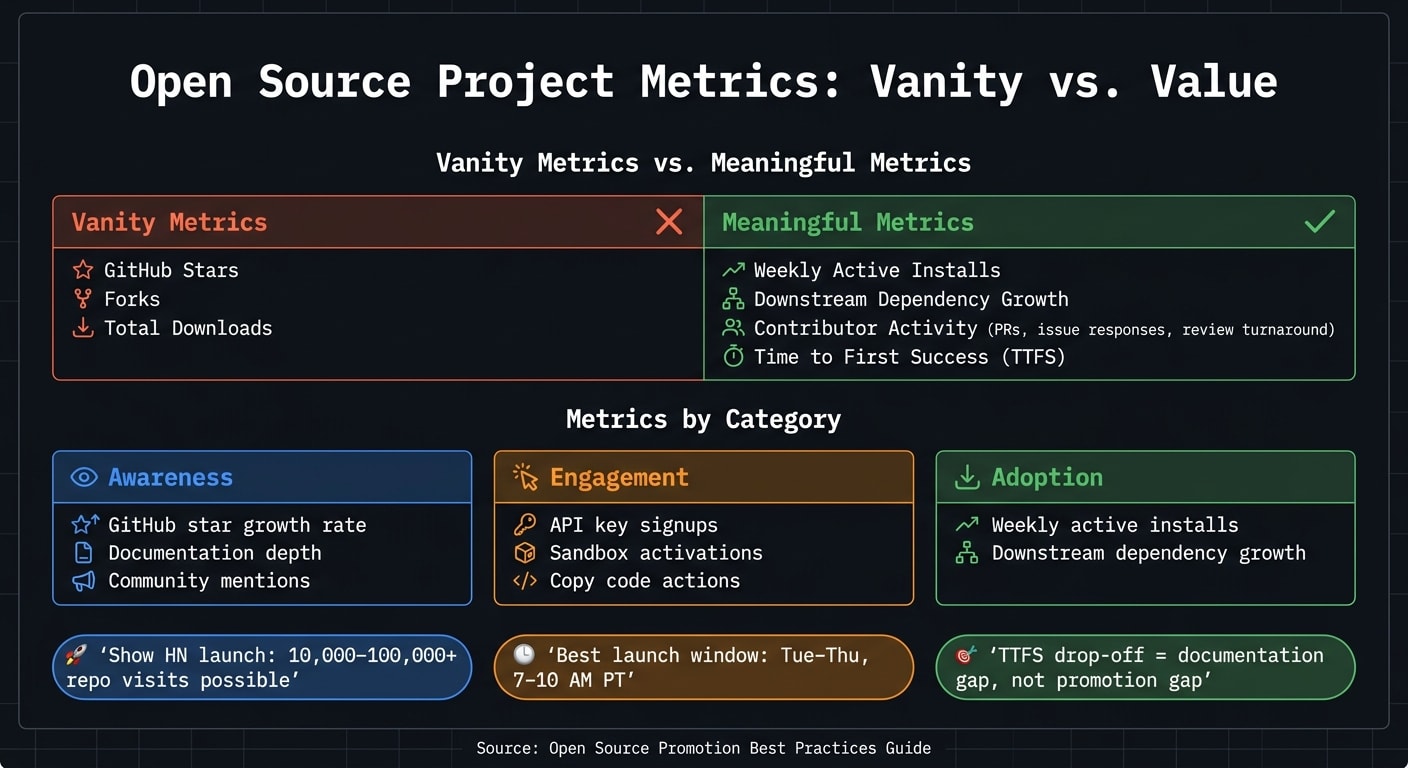
Once you've laid the groundwork with promotion and social proof, the next step is to quantify your growth. Tracking the right metrics helps pinpoint what’s working and what needs adjustment.
The Core Metrics to Track
While metrics like stars and forks may look impressive, they don’t always reflect meaningful engagement. Instead, focus on metrics tied to consistent, repeated behavior.
- Weekly active installs: This shows how often developers are incorporating your project into their work.
- Downstream dependency growth: Tools like npm’s dependents list or GitHub’s dependency graph can help you see how many other projects rely on yours. This is a strong indicator of real adoption.
- Contributor activity: Track new pull requests, issue responses, and review turnaround times to gauge your community’s health and engagement.
Here’s a quick breakdown of metrics by category:
| Metric Category | Key Indicators |
|---|---|
| Awareness | Growth in GitHub stars, depth of documentation, mentions in the community |
| Engagement | API key signups, sandbox activations, "copy code" actions |
| Adoption | Weekly active installs, downstream dependency growth |
Another critical metric is Time to First Success (TTFS), which measures how quickly a new user can achieve their first meaningful result with your project. If users drop off before reaching this milestone, the issue likely lies in your documentation rather than your promotional efforts. These metrics help identify areas where you can improve user retention and community engagement.
Analyzing Contributor Retention
Retention metrics are as important as testimonials when it comes to building trust within your community. Keeping contributors engaged over time is a challenge, but cohort analysis can help. By grouping contributors based on when they first joined and tracking their activity, you can identify patterns and potential drop-off points.
For example, breaking cohorts down by region or tech stack can reveal trends. You might notice that contributors from a specific framework community are quick to start but disengage after their first merge. This could point to gaps in onboarding resources or a lack of beginner-friendly tasks, like well-defined "good first issues."
To improve retention, consider these strategies:
- Maintain active communication channels like Discord or Slack.
- Host regular office hours each month.
- Keep GitHub issues organized and up-to-date.
These efforts can make contributors feel more supported and encourage long-term involvement.
Using Metrics to Decide What to Do Next
Metrics don’t just tell you what’s happening - they guide your next steps. For instance, if weekly active installs are increasing but contributor activity remains stagnant, it’s a sign to focus on improving contributor onboarding rather than pushing more promotional content. On the other hand, if installs level off after an initial surge, revisit your TTFS metric and ensure your documentation addresses common user challenges.
Pay attention to patterns in your analytics, too. For example, if you notice high repeat engagement from a specific region, it may be time to prioritize localized documentation or even translate your UI. Projects like Supabase and Excalidraw excel by treating their metrics as a feedback loop, using the data to refine and grow continuously.
Conclusion: Key Takeaways for Promoting Open Source Projects
Promoting an open source project isn’t about chasing quick wins or racking up vanity metrics. It’s about creating something that developers genuinely find useful, making it easy to discover, and staying engaged with your community over time.
The basics come first: a clear README, a functional quickstart guide, and a roadmap that developers can rely on. Without these, no amount of promotion will stick. Projects like Tailwind CSS and Supabase didn’t grow because of flashy marketing - they grew because their user experience and documentation made an immediate and lasting impression. These essentials lay the groundwork for everything else.
From there, distribution requires consistent effort. While a successful launch on platforms like Show HN or Product Hunt can generate a burst of attention, long-term growth depends on steady, ongoing work - like regular updates and transparent communication. Sharing timely updates about commits or milestones helps build trust and keeps your community engaged. Once you’ve gained initial traction, maintaining credibility becomes crucial.
Social proof often speaks louder than words. Highlighting contributors, showcasing real-world use cases, and sharing public dependency graphs can establish trust far better than promotional copy. And when you’re ready to invest in paid promotion, aim to meet developers where they are - whether it’s promoting a new release or an integration - without turning it into a hard sell.
Lastly, let data guide your next steps. Metrics like weekly active installs, contributor retention, and dependency growth offer a clearer picture than star counts alone. When these numbers shift, they signal where to focus your attention next. By combining these strategies, maintainers can grow projects that truly meet the needs of developers and stand the test of time.
FAQs
What should I fix before promoting my project?
Before you start promoting your project, it’s crucial to ensure it’s dependable and easy for developers to use. A good starting point? Make sure a developer can run a working "Hello World" example in under five minutes. Time is valuable, and first impressions matter.
Here’s what you should include in your README to make it a standout resource:
- Runnable Examples: Provide clear, working examples that developers can easily follow.
- Error Handling: Show how your project handles errors effectively, so users aren’t left guessing.
- Edge-Case Coverage: Address potential edge cases upfront to build confidence in your project.
Beyond the README, establish trust with these key elements:
- Security Policy: Outline how you handle vulnerabilities to reassure users.
- OSI-Approved License: Use a recognized open-source license to clarify usage terms.
- Governance for Releases: Ensure there’s a clear and transparent process for updates.
Finally, include developer-friendly signals that show you’re serious about maintaining the project:
- CI/CD Badges: Highlight automated testing and deployment processes.
- Contributor Guide: Make it easy for others to contribute by providing clear guidelines.
- Changelog: Keep it updated consistently to reflect new features, fixes, and improvements.
These steps not only make your project more appealing to developers but also demonstrate your commitment to quality and transparency.
How can I measure adoption beyond GitHub stars?
To get a clearer picture of adoption beyond just GitHub stars, focus on activation metrics. These could include tracking completed quickstarts or the number of example runs. Keep an eye on package installation numbers and the growth of downstream dependencies to understand how actively your project is being used.
You can also analyze documentation traffic and search logs to identify which features are drawing the most interest. On top of that, community engagement is a strong indicator of adoption. Look at support tickets, GitHub issues, and participation in events - these provide a more meaningful understanding of how your project is being embraced compared to surface-level metrics.
When should I use paid promotion like daily.dev for Business?
Paid promotion with daily.dev for Business is most effective when your project has already earned developers' trust. This means having clear documentation, transparent licensing, and solid security measures in place. The best time to use it? During pivotal moments like your launch week or when announcing a major release.
It’s also a smart choice for boosting brand awareness, promoting event registrations, or driving targeted traffic to your landing pages. With daily.dev, you can reach developers based on their tech stack, seniority level, and specific interests, ensuring your message hits the right audience.