

Want developers to adopt your API? Focus on their needs. Developers care about clear documentation, reliability, and ease of integration - not flashy marketing. Here's how you can make your API stand out:
- Documentation is key: Developers evaluate APIs through docs first. Offer a 5-minute quickstart guide, real-world code samples, and multi-language SDKs.
- Build trust: Be transparent about rate limits, uptime, and deprecation policies. A public status page and working code samples matter.
- Streamline onboarding: Reduce time-to-first-call (TTFC) to under 5 minutes. Auto-generate test API keys and provide runnable examples.
- Discovery matters: Developers find APIs through platforms like GitHub, Stack Overflow, and documentation portals. Be present where they search.
- Pricing transparency: Offer clear, upfront pricing with a free tier that allows meaningful testing.
Developers value tools that solve their problems efficiently. Make your API easy to find, simple to use, and reliable in production to turn curiosity into adoption.
The API Marketing Funnel, Explained
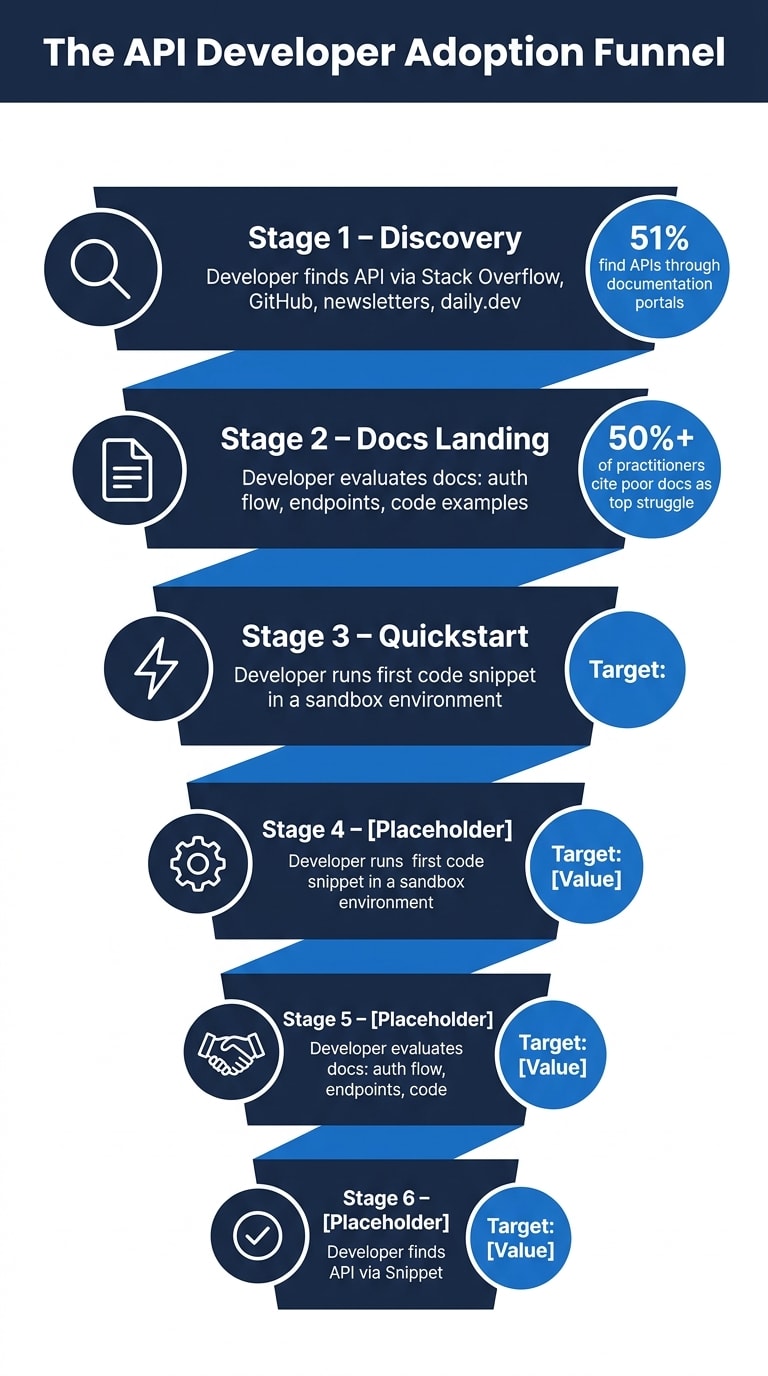
The API marketing funnel is more detailed, technical, and product-centered than a typical B2B sales pipeline. While a standard SaaS funnel might follow a path like awareness → trial → purchase, an API funnel takes a more nuanced approach: discovery → docs landing → quickstart → first successful call → first production use → expansion. Each step reflects a growing level of developer engagement, requiring tailored marketing strategies that align with the technical evaluation developers undertake.
From Discovery to First Successful API Call
Developers don’t stumble upon APIs through ads or cold emails. They find them while tackling a specific technical problem - whether on Stack Overflow, in a GitHub README, via a developer newsletter, or through platforms like daily.dev. This means developers arrive with intent, and your marketing needs to address that intent immediately.
Once a developer lands on your documentation, they quickly assess its usefulness. They’re looking for key details: how the API works, the authentication process, and a runnable code example. If these elements are missing or unclear, they’ll leave just as quickly. Companies like Twilio aim for "Hello World in under 5 minutes" as a core activation goal, while Algolia focuses on delivering search results from a real index within minutes. These quickstarts aren’t just onboarding tools - they’re powerful marketing assets that turn interest into tangible integration. Achieving this early success lays the groundwork for overcoming production-level hurdles.
From First Call to Production Use
Getting a developer to make their first successful API call is a win, but moving that call into production is a bigger challenge. This is where many developers pause, often due to a lack of operational clarity.
At this stage, developers shift from exploring the API’s potential to evaluating its risks. They want to know how to rotate API keys, handle rate limits, retry errors, and monitor requests in real time. Clear documentation and reliable SDKs - introduced earlier in the funnel - are crucial here. According to SmartBear, performance and uptime rank among the top three factors developers consider when deciding to move an API into production. If your documentation is unclear about error handling, rate limits, or service-level agreements (SLAs), developers may test your API but never fully adopt it. Features like sandbox environments, clear guidance on staging versus production, and SDKs that handle idempotency and pagination help reduce these risks and encourage production use.
Growing Usage and Building Developer Advocacy
Once an API is in production, the focus shifts to expanding its use and building advocacy. Growth occurs in three ways: developers explore additional endpoints, increase request volumes, or apply the API to new use cases or teams. Postman’s research highlights that organizations with deeper API integrations report greater business impact, showing how value grows as usage broadens.
Marketing efforts now aim to deepen engagement. Use-case guides, advanced tutorials, and "recipe-style" content inspire developers to go beyond their initial usage. When the experience is consistently strong - reliable uptime, clear documentation, and responsive support - developers naturally become advocates. They’ll mention the API in GitHub issues, write blog posts about it, and recommend it in forums. This kind of organic word-of-mouth isn’t something you can force - it’s earned through a great product and amplified by marketing that gives developers tools and stories worth sharing.
How to Make Documentation Your Best Marketing Asset
Your documentation is often a developer's first hands-on experience with your API. Before they engage with sales, read case studies, or even consider signing a contract, they're already diving into your docs. Postman's 2023 research reveals that over 50% of API practitioners struggle most with poor or inaccurate documentation. This isn't just a support issue - it's a marketing challenge. Strong, clear documentation can turn initial curiosity into lasting adoption. A 5-minute quickstart guide, for example, not only aligns with key activation benchmarks but also builds trust with developers. Below, we’ll explore how to make your documentation a powerful marketing tool that keeps developers engaged.
How to Write a Getting Started Guide That Works
The goal of a quickstart guide is simple: help a developer make a successful API call in under five minutes. That’s it. Keep the focus tight - sign up, grab credentials, make one call, and see a meaningful response. No unnecessary detours.
To make this happen, prioritize strict scoping. Don’t overwhelm users by diving into every endpoint or edge case. Instead, choose one clear use case - like "Send your first SMS", "Create your first payment intent", or "Index your first document" - and guide them through it step by step. Your quickstart should include:
- A sandbox environment with a test API key ready at sign-up.
- A fully runnable code snippet, complete with imports and headers.
- A clear success condition, such as: "If you see
HTTP 200withstatus: "succeeded"in the response, you’re done."
Label your guide as "5-minute quickstart" and stick to that promise. Reducing the time-to-first-call is critical for keeping developers interested and moving them further down the adoption funnel.
When writing, adopt the tone of a technical peer. Use short paragraphs, numbered steps, and avoid unnecessary fluff. Reserve callouts like "Warning" or "Note" for critical issues - like preventing the accidental exposure of secret keys in client-side code. Pair your quickstart with a variety of ready-to-run code samples to cater to a broader audience.
Offering Code Samples in Multiple Languages
Developers expect to see code samples in the programming language they’re most comfortable with. Providing multi-language samples is essential. Start with curl, JavaScript/Node.js, and Python, as they cover most web and backend developers in the U.S. Include realistic, domain-specific data - like a $19.99 charge, a U.S. phone number in the format +1XXXYYYZZZZ, and real field names - so developers can use the snippets with minimal adjustments (aside from swapping in their API key). For enterprise and infrastructure-focused teams, consider adding Java, Go, and C#.
Effective code samples reflect real-world scenarios. Each snippet should include:
- Imports and client initialization.
- Authentication headers.
- Basic error handling.
- Consistent logical flow across all languages (same endpoint, payload, and success check).
Make sure the patterns are idiomatic to each language. For example, use async/await in modern JavaScript, the requests library in Python, and HttpClient in .NET. These thoughtful details reduce friction and make your documentation a seamless tool for adoption.
Making Your Docs Easy to Find
If your documentation is locked behind a login, you’re likely losing potential users before they even get started. Keep your core reference materials, quickstarts, and guides public and ungated. Search engines and AI coding assistants can only surface content that’s accessible.
Organize your documentation with clear, task-focused navigation, such as: Overview → Quickstart → Guides → API Reference → SDKs & Tools → Examples → Changelog. Use descriptive <title> and <h1> tags that align with how developers search - like "Python SDK quickstart", "Webhook authentication", or "Rate limits and retry logic." Clean, predictable URLs (e.g., /docs/api/authentication) also improve discoverability.
This isn’t just about Google. Developers increasingly rely on AI tools to generate integration code. When your endpoint descriptions are clear, parameter names are unambiguous, and example requests are placed alongside reference content, AI tools can accurately replicate your API’s patterns. In essence, every AI-assisted coding session becomes an opportunity for your API to shine.
How to Drive Discovery and Demand for Your API
Great documentation keeps developers engaged, but the real hurdle is making sure they find your API in the first place. Many API marketing strategies falter here - not because the product lacks quality, but because they miss where developers actually look to solve problems. Let’s dig into the most effective channels for connecting developers with your API.
The Developer Discovery Channels That Work
Postman’s 2023 State of the API report revealed some telling stats: 51% of developers find APIs through documentation portals, about 40% through web searches, and 27% via developer communities. This shows developers actively search for solutions - they’re not passively waiting for ads to pop up.
Stack Overflow is a goldmine for developer engagement. When someone searches for "how to handle webhook retries in Node.js" and lands on a clear, actionable answer that links to your API’s quickstart, it’s a perfect introduction. The key? Solve the problem first, then naturally reference your API as part of the solution. Keep a list of common technical questions in your niche and update your answers as your API evolves.
GitHub is where developers validate an API’s reliability. Hosting SDKs, sample repositories, and Postman collections with clear READMEs and relevant GitHub Topics (e.g.,
payments-api,ecommerce,fraud-detection) makes your API easier to find. With over 100 million developers on GitHub in 2023, it’s the go-to platform for assessing whether an API is actively maintained and worth using.Developer content feeds are ideal for top-of-funnel visibility. Platforms like daily.dev for Business let you place guides, tutorials, and quickstarts directly in front of developers while they’re already consuming technical content. For example, a post like "How to build a PCI-compliant checkout flow in under 15 minutes" appearing as someone researches payment integrations positions your API as a timely solution.
Hackathons, Sample Apps, and Integration Partnerships
Interactive events and strategic integrations can greatly expand your API’s reach. Once developers discover your API, hands-on experiences like hackathons can deepen their interest.
Hackathons work best when they tackle real-world problems. Prompts like "Build a buy-now-pay-later checkout for US e-commerce" or "Automate ACH payouts for US gig workers" give developers a clear challenge and a reason to explore your API in depth. Provide a starter kit with pre-configured authentication, a test API key, and a verified API call so participants can focus on building rather than debugging.
Sample apps are another way to showcase your API’s potential. These should mimic real-world use cases, include relevant data, and provide clear, step-by-step instructions. A README that takes developers from
git cloneto a working demo in minutes can make all the difference.Integration partnerships embed your API into the tools developers already use. For instance, Algolia grew quickly by offering open-source integrations and plugins for platforms like Shopify, Magento, and WordPress. Similarly, Segment (now Twilio Segment) built a catalog of over 300 integrations, making their API visible wherever data was being transferred. Listing your API in marketplaces like Shopify App Store, Salesforce AppExchange, or QuickBooks Apps ensures developers find you when searching for specific solutions.
Comparison and Evaluation Content That Helps Developers Decide
When evaluating APIs, developers care about technical details - not flashy sales pitches. They want answers to questions like: Does this work with my stack? How does pricing scale? What happens if a request fails?
The best way to address these concerns is through evaluation guides. Titles like "How to choose an API for [use case]" or "Build vs. buy for [capability]" resonate well. Include a checklist covering things like latency, SLA guarantees, language support, pricing transparency, integrations, and support responsiveness. Twilio’s team, for example, credits tutorials, sample apps, and "cookbook" content as key drivers of signups, with tutorial pages ranking as some of their highest converters.
Avoid attacking competitors in these guides. Instead, focus on presenting objective tradeoffs and linking directly to your quickstart so developers can test your claims themselves. Pairing these guides with a 5-minute quickstart (see How to Write a Getting Started Guide That Works) gives developers the hands-on proof they need to move from curious to committed users.
Pricing, Activation, and Measuring What Works
Once you've captured developer interest with clear documentation and effective discovery channels, the next step is aligning pricing and activation metrics. A focused, data-backed approach to pricing and onboarding helps transform initial curiosity about your API into consistent, long-term usage.
How to Design a Pricing Page Developers Will Trust
When developers land on your pricing page, they aren't looking for a sales pitch - they want straightforward, transparent information. The quickest way to lose their trust? Hiding prices behind a "Contact us" button or sneaking overage fees into the fine print.
The best pricing pages are simple and upfront. Display all USD rates clearly and allow developers to sign up without unnecessary friction. Companies like Stripe, Twilio, and SendGrid excel here:
- Stripe: Lists a flat rate of 2.9% + $0.30 per successful card charge.
- Twilio: Charges $0.0079 per outbound SMS to US numbers.
- SendGrid: Offers a free tier of 100 emails/day, with clearly labeled volume bands and overage rates.
Aim to structure your pricing into three or four tiers, with one plan clearly recommended. For each tier, include the base monthly price (e.g., "$49/month"), usage limits (e.g., "500,000 calls/month"), and overage rates (e.g., "$0.50 per 1,000 additional calls"). To make costs easier to grasp, add a cost estimator - like a table or slider - showing real-world scenarios. For example, "If your app makes ~150,000 requests/month, you'll pay about $49 on the Starter plan." Pair this with reassuring microcopy such as "No contracts required" or "Cancel anytime" to ease decision-making.
If you offer a free tier, make it substantial enough for developers to build a meaningful proof of concept. For instance, "Up to 50,000 calls/month free" provides real value, while "100 calls/month free" just frustrates users.
Time-to-First-Call: The Metric That Matters Most
Time-to-first-call (TTFC) measures how long it takes a developer to sign up and receive their first successful 2xx API response. This metric is a direct reflection of your onboarding process and a strong predictor of whether a developer will stick around.
Stripe built its early success on the promise that developers could "accept your first payment in 10 minutes." Similarly, Twilio required new hires to build a working app in just 5 minutes as part of their onboarding. These aren't just catchy slogans - they highlight a commitment to minimizing friction during the first interaction.
Here's a practical TTFC benchmark:
| TTFC Range | Onboarding Health |
|---|---|
| Under 5 minutes | Excellent |
| 5–15 minutes | Acceptable |
| 15–60 minutes | Friction present |
| Over 60 minutes | High friction - investigate immediately |
Accounts that hit their first successful call in under 5 minutes are 2–3 times more likely to convert into weekly active users compared to those taking over 30 minutes. To shorten TTFC, focus on removing unnecessary steps. For example:
- Auto-generate a sandbox API key immediately after signup.
- Provide ready-to-use cURL examples and quickstart guides for popular languages like JavaScript, Python, Java, and Go.
- Include a
client.testConnection()helper in your SDKs for quick setup verification. - Track TTFC metrics (median and 75th percentile) by acquisition channel to identify bottlenecks.
These improvements not only enhance the initial experience but also set the stage for stronger long-term engagement.
The KPIs That Tell You If Your API Marketing Is Working
Tracking developer activity is key to understanding how well your API marketing efforts are performing. While raw signups are easy to measure, they don't mean much unless developers are actively using your API. The most valuable KPIs connect marketing efforts to actual developer behavior.
Start with activation rate: the percentage of new signups that make at least one successful API call within 24 hours. Combine this with median TTFC to gauge how effectively your onboarding converts interest into action. Next, monitor weekly active accounts (WAAs) - developers making at least 50 successful requests weekly or calling a meaningful endpoint like create-order or send-payment. This filters out noise from internal tests or one-off experiments.
Here’s how key metrics align with the developer funnel:
| Funnel Stage | Key Metrics | What They Tell You |
|---|---|---|
| Awareness | Referral traffic, impressions by channel | Which channels are reaching developers |
| Activation | TTFC, API key creation rate, first-call rate within 24 hours | Onboarding efficiency |
| Engagement | Weekly active accounts, SDK downloads | Developer reliance on your API |
| Growth | Production accounts, API call volume growth (MoM) | Adoption and scaling trends |
| Business | Sandbox-to-production conversion, plan upgrades | Revenue impact from marketing efforts |
To connect marketing to these outcomes, use UTM parameters to tag every inbound channel and track the entire journey: channel → signup → first call → production go-live → expansion. For instance, if developers arrive via a daily.dev for Business placement, source tags can help you measure their TTFC, WAA rate, and eventual conversion to paid plans. This level of attribution transforms your marketing budget into a measurable growth tool.
According to the 2023 Postman State of the API report, only 6% of organizations rated their API onboarding as "excellent." This gap presents a clear opportunity - one that these metrics can help you close.
Building an API Marketing Strategy That Lasts
Creating a long-lasting API marketing strategy goes beyond quick wins like streamlined onboarding and clear documentation. It’s about building a foundation that ensures developers keep coming back.
Take a page from companies like Stripe and Twilio. They’ve mastered the art of sustaining developer adoption by focusing on four key areas: documentation, discovery, trust, and measurement. These pillars work together in a cycle - great documentation boosts activation rates, which makes discovery channels more effective, leading to more usage data that further improves the product.
One of the most crucial changes you can make is to treat your documentation as a living, breathing asset - not just a static support tool. Assign someone to own it, monitor your "Getting Started" page for drop-offs, and test your onboarding process regularly. Aim for a setup where developers can make their first API call in under five minutes. If activation isn’t quick and easy, even the best discovery efforts won’t stick.
Speaking of discovery, it needs to be steady and reliable, not something you focus on sporadically. Use evergreen content, strategic placements in high-intent spaces, and engage actively with developer communities. Platforms like daily.dev for Business can help position your API right where developers are looking for solutions.
At the core of everything is developer trust. Don’t overpromise or market features your API can’t deliver. Be transparent - maintain a public status page and clearly document incidents or limitations. Developers are quick to share bad experiences, but they’re just as quick to champion tools that consistently deliver on their promises.
Finally, keep your measurement sharp and focused. Track the entire funnel - from signups to production use. Regularly analyze where users drop off and adjust your roadmap to address those pain points. This way, your strategy evolves and improves over time, instead of stalling after launch.
FAQs
What should I measure to prove my API marketing is working?
To showcase the effectiveness of your API marketing efforts, zero in on metrics that provide clear, actionable insights. For instance, keep an eye on weekly API call volume and trial activations - these indicators reveal how often your API is being used and how many developers are taking the next step.
You should also track documentation engagement by analyzing session durations. A solid benchmark is sessions lasting over 8.5 minutes, as this suggests developers are genuinely exploring your content. Additionally, monitor SDK adoption by reviewing the number of weekly installs - this reflects how many developers are actively implementing your tools.
Finally, evaluate your funnel performance by measuring key milestones like sign-ups, time-to-first-value, and a decrease in support tickets. These metrics highlight whether developers are not only engaging but successfully integrating your API into their workflows, rather than just interacting with ads.
How can I get my API’s time-to-first-call under 5 minutes?
To hit a time-to-first-call under 5 minutes, prioritize a smooth developer experience. Provide copy-paste-ready code samples in various programming languages and a quickstart guide that requires minimal setup. Make sure your examples are clear, include syntax highlighting, and allow developers to make an authenticated API call without dealing with complicated setups. Reducing obstacles and offering instant value helps meet developers' expectations and speeds up adoption.
What makes developers trust an API enough to ship it to production?
Developers are more likely to trust an API for production when they can personally confirm its reliability and performance through hands-on testing. In fact, 72% of developers validate claims by reviewing documentation, making clear, detailed docs a cornerstone of trust. Providing runnable code samples and performance benchmarks further strengthens this confidence.
Additionally, offering sandboxes or API keys for direct testing allows developers to experience the product firsthand, which often proves more convincing than traditional sales pitches. Engaging with the developer community also plays a key role in earning credibility and fostering long-term trust.