

Developers don’t trust cold emails or ads - only 6% engage with them. Instead, they value resources like strong documentation, tutorials, and active community support. That’s where Developer Relations (DevRel) comes in: connecting your product with developers by solving their challenges and earning their trust.
If you’re building a DevRel team, here’s a quick breakdown:
- DevRel's Role: Create technical resources, manage communities, and collect feedback to improve the product.
- Team Placement: DevRel works best under Engineering, Marketing, or Product - avoid putting it under Sales.
- First Hire: Start with a technical builder who can create content and connect with developers.
- Scaling the Team: Add specialists like Developer Advocates, Community Managers, and Technical Writers as the workload grows.
- First-Year Plan: Focus on onboarding insights, creating useful content, and building feedback loops with the community.
DevRel isn’t about quick results - it’s about long-term trust and developer engagement. Done right, it can drive adoption, retention, and advocacy for your product.
Defining DevRel's Mission and Where It Fits
Before building or organizing a Developer Relations (DevRel) team, it’s crucial to define its purpose. Without a clear mission, the team can easily get pulled in too many directions, losing focus along the way.
DevRel's Core Functions
DevRel sits at the intersection of education, community, and product feedback. Its role involves creating resources like tutorials, code samples, and documentation that directly address developers' challenges . Beyond content creation, DevRel fosters vibrant communities by managing platforms like Discord servers and Slack groups, hosting office hours, and designing systems that turn casual users into passionate advocates . Another key responsibility is gathering insights from the community to help shape product and engineering priorities .
A helpful framework to understand DevRel’s role is the "Why, Try, Buy, Fly" model . This concept highlights how DevRel supports every phase of a developer’s journey - from understanding why a tool is valuable, testing it out, putting it into production, and finally becoming an advocate for it.
By clearly defining DevRel’s purpose, you can ensure its efforts align with broader business objectives.
Aligning DevRel Goals with Business Objectives
DevRel’s focus should evolve alongside your company’s growth. For early-stage companies, the emphasis might be on creating strong documentation and validating the product with early users. As revenue increases, priorities shift to producing more in-depth content and fostering a thriving community. At scale, the goal becomes building a global ecosystem.
To measure success, tie DevRel’s activities to key metrics like activation rates, time-to-first-value, user retention, and ecosystem expansion.
Once the goals are clear, the next step is determining where DevRel fits within your organization to maximize its impact.
Where DevRel Should Sit in Your Organization
Where DevRel reports within the company has a significant impact on its priorities, budget, and credibility with developers. Each reporting structure has its strengths and challenges:
| Reporting Line | Best For | Primary Risk |
|---|---|---|
| Engineering | Technical or open-source products | Risk of being reduced to a support role without growth metrics |
| Marketing | Driving adoption and demand generation | Could lose community trust by appearing overly "salesy" |
| Product | Product-led growth (PLG) strategies and detailed product feedback | May overlook community engagement and advocacy |
| Executive (CEO/CTO) | Large organizations with 10+ DevRel team members | Risks becoming disconnected from go-to-market (GTM) efforts |
A good rule of thumb is that DevRel should report to the leader who values developer engagement the most - whether that’s the CMO, CPO, or CTO. Avoid placing DevRel under Sales, as the short-term focus on pipeline metrics conflicts with DevRel’s long-term goal of building trust . If DevRel is part of Marketing, consider creating a dotted-line relationship with Engineering to maintain technical accuracy and ensure effective feedback loops.
Choosing the right reporting structure ensures DevRel can bridge product, marketing, and executive strategies while staying true to its mission.
Hiring and Structuring Your DevRel Team
What to Look for in Your First DevRel Hire
Your first DevRel hire sets the tone for your entire team. Prioritize hiring a hands-on builder over someone focused on public speaking. Look for someone who can create clear documentation, genuinely connect with developers, and channel community feedback effectively back to your product team.
"Your first DevRel hire should be a builder, not a speaker." - Prashant Sridharan, Developer Marketing Expert
An engineering background is key. This enables them to write code samples, build trust with developers, and identify issues in the onboarding process. Strong listening and communication skills are equally important.
To get a real sense of a candidate’s abilities, consider a paid trial day. Ask them to draft a 90-day plan or create a technical tutorial. Their approach to this task can reveal far more than a traditional interview ever could .
As your organization grows, you’ll need to expand your team with specialized roles to address specific challenges.
Key DevRel Roles and What They Do
When scaling your DevRel team, focus on hiring for specific roles rather than expecting one person to handle everything. Here are four key roles commonly found in DevRel teams:
| Role | Primary Responsibility | Key Metric | Salary Range (US) |
|---|---|---|---|
| Developer Advocate | Education, content, community feedback | Activation rate, content reach | $120,000–$180,000 |
| Community Manager | Managing forums, Discord/Slack, events | Active members, engagement rate | $85,000–$130,000 |
| DevRel / DevEx Engineer | SDKs, sample apps, demo integrations | Time-to-First-Success | $140,000–$200,000 |
| Technical Content Writer | Documentation, tutorials, guides | SEO ranking, signups, doc quality | $80,000–$130,000 |
Your hiring priorities depend on your strategy. For a product-led approach, hire a generalist who can drive self-service activation. If you’re sales-led, start with a Developer Advocate who can build technical credibility with enterprise clients. If you’re focused on organic growth, a Technical Content Writer is essential to establish a strong documentation base .
A Step-by-Step Hiring Plan
Once you’ve identified the roles you need, follow a hiring approach that matches your company’s growth stage. Keep the team lean initially and expand only when the workload justifies it.
| Stage | ARR Range | Team Size | Who to Hire |
|---|---|---|---|
| Seed | $0–$1M | 0–1 | Founder handles DevRel or hires a generalist contractor |
| Early Growth | $1M–$5M | 1–3 | Founding Developer Advocate + Content Lead |
| Scale | $5M–$20M | 4–10 | Specialized Advocates, Community Manager, Technical Writer |
| Expansion | $20M+ | 15–30+ | VP of DevRel, Global Field Leads, Ops Director |
This progression ensures your team grows alongside your company’s needs. In the early stages, founders should take on DevRel tasks themselves - answering forum questions, writing tutorials, and participating in developer communities. This hands-on experience not only helps validate your strategy but also makes you a more effective hiring manager .
When it’s time to hire specialists, make sure there’s a clear need. For example, bring in a Technical Writer when your engineers are overwhelmed with documentation tasks. Add a Community Manager when your forums or Discord community grow beyond what one person can manage. Always let workload demands guide your hiring decisions .
Building a Lean DevRel Organization
Running DevRel as a Team of One
At the start, your DevRel team might just be one person juggling all the responsibilities. That’s doable if you focus on the essentials: creating technical content, listening to the community, and sharing feedback with the product team.
Here’s a smart way to plan your first 90 days: break it into three phases - learn and listen (days 1–30), publish and connect (days 31–60), and systematize (days 61–90) . Spend the first month onboarding yourself as if you were a new user. Document every friction point along the way. This simple exercise often reveals more actionable insights than lengthy team retrospectives.
When it comes to budgeting, keep it realistic. A solo DevRel team or one with up to three members typically costs $400,000–$700,000 in salaries, with an additional $100,000–$200,000 for travel and tools . These numbers highlight the importance of making thoughtful hiring decisions. As the workload grows, you’ll need to define specific roles to expand effectively.
Growing to a Small DevRel Team
As your DevRel efforts grow, it’s important to add specialists rather than duplicate skills. When the workload becomes too much for one person, don’t just hire another generalist . Instead, look for someone who complements the strengths of your first hire. For example, if your initial advocate excels in writing, your next hire might focus on community management or building SDKs and demo integrations.
For a small but functional team (four to eight people), here’s a common structure:
- A Lead Advocate to set strategy and manage external relationships.
- Two or three Developer Advocates to handle content creation and engage with the community.
- A DevEx Engineer to focus on SDKs and sample apps.
- A Community Manager to keep forums and chat channels active.
Typically, the Lead Advocate reports to either the VP of Product or VP of Marketing, depending on where DevRel fits within your organization. Expect to budget around $1M–$2M annually at this stage, which includes events and sponsorships .
"The moment you put your DevRel team under a sales leader or give them pipeline targets, you change the relationship developers have with your advocates." - Prashant Sridharan, Developer Marketing Expert
How DevRel Works with Other Teams
As your team grows, integration with other departments becomes crucial. DevRel interacts with nearly every part of the company, so clear ownership is essential to avoid spreading the team too thin.
Here’s a breakdown of responsibilities using a RACI framework:
| Activity | Responsible | Accountable | Consulted | Informed |
|---|---|---|---|---|
| Technical Blog Posts | DevRel | DevRel | Marketing (SEO) | Product |
| Developer Webinars | DevRel & Marketing | Marketing | Sales | Leadership |
| Community Management | DevRel | DevRel | Marketing | Support |
| Paid Developer Ads | Marketing | Marketing | DevRel (Review) | Leadership |
One of DevRel’s most important roles is serving as a feedback loop. Your team hears developers’ frustrations, shares that information with Product and Engineering, and then publicly communicates changes - giving credit to the community members who raised the issues . GitLab is a great example of this in action. They use public issue trackers to show developers exactly how their feedback influences decisions .
To keep these collaborations active, establish regular touchpoints: a weekly sync with Product, a monthly review with Marketing, and a dedicated Slack channel for urgent community feedback. Without these structures, cross-functional collaboration often becomes reactive, only happening when something goes wrong.
First-Year DevRel Roadmap
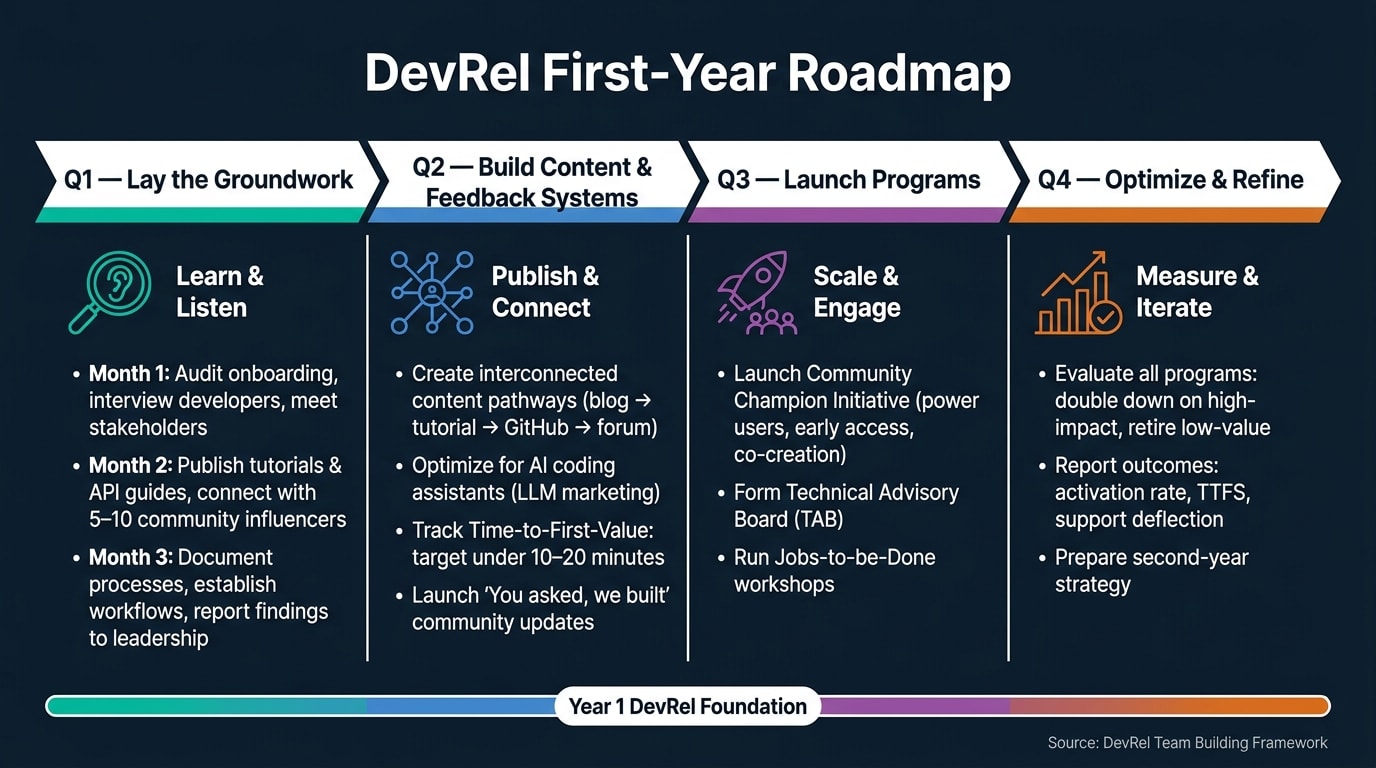
This roadmap builds on your team structure by outlining a detailed quarter-by-quarter plan to deepen developer engagement and improve product feedback. While having the right team is essential, knowing exactly what to do once everyone is onboard is just as important. A clear, actionable plan keeps the team aligned and gives leadership measurable outcomes.
Quarter 1: Lay the Groundwork and Achieve Early Wins
The first 90 days are all about learning the ropes, not diving into big campaigns. Before creating any tutorials, take the time to experience your product like a new developer. Sign up, explore the documentation, and build a simple project. Pay close attention to any friction points you encounter, focusing on insights relevant to your first year rather than revisiting earlier onboarding steps.
At the same time, keep an eye on community spaces like Discord, Reddit, and Hacker News to understand what developers are already discussing. Meet with Product and Engineering teams to get a sense of the roadmap. In months two and three, start publishing tutorials and guides that address common developer challenges. These early activities help your team establish credibility by showcasing their technical and community expertise.
| Phase | Focus | Key Activities |
|---|---|---|
| Month 1 | Learn & Listen | Audit onboarding, interview developers, and meet internal stakeholders |
| Month 2 | Publish & Connect | Create tutorials and API guides, build relationships with 5–10 community influencers |
| Month 3 | Systematize | Document processes, establish workflows, and report early findings to leadership |
With these early wins under your belt, you’ll be ready to focus on building interconnected content and feedback loops in Quarter 2.
Quarter 2: Develop Content Workflows and Feedback Systems
Now that you’ve gained insights into the developer experience, it’s time to shift from standalone content to creating interconnected pathways. For example, a blog post should lead to a tutorial, which links to a GitHub repository, which then points to a community forum thread. This approach creates a seamless journey rather than isolated resources.
Make sure your content is optimized for both developers and AI coding assistants. READMEs, API references, and examples should be clear and accessible. High-quality technical content can act as "LLM marketing", ensuring that AI tools surface accurate implementations of your product . This is where your Developer Advocates and Technical Content Writers shine.
Strengthen feedback loops with the Product team by tracking metrics like time-to-value - the time it takes for a developer to go from landing on your homepage to completing a successful "Hello World" or their first API call. Aim for under 10–20 minutes . Communicate progress back to the community with updates that emphasize "You asked, we built", reinforcing trust and engagement .
Quarters 3 and 4: Launch Programs and Fine-Tune Strategies
With content workflows and feedback systems in place, the second half of the year is the time to roll out structured programs and refine your approach. This is when you introduce community champion initiatives - identifying power users and offering them perks like early access, co-creation opportunities, or recognition in exchange for authentic advocacy . These relationships are built on mutual value, not transactional influencer deals.
Another key step is forming a Technical Advisory Board (TAB). This small group of experienced practitioners provides candid feedback on your product direction and highlights areas for improvement . Their insights often prove more actionable than survey data. Pair this with "Jobs-to-be-Done" workshops, led by your DevEx Engineer and Lead Advocate, to better understand the workflows developers are trying to accomplish .
"If you can't draw a line from your work to business outcomes, you don't have a function - you have a hobby." - Tessa Kriesel, CEO & Founder, Built for Devs
In Q4, evaluate what’s working and cut what isn’t. Programs that drive engagement or yield valuable product feedback should get more resources, while ineffective ones should be retired or reworked. This disciplined approach - focusing on high-impact initiatives and eliminating low-value efforts - is what sets successful DevRel teams apart as they move into their second year.
Measuring and Reporting DevRel Performance
To achieve DevRel's purpose of boosting product engagement and fostering ecosystem growth, measuring and effectively reporting performance is a must. Once your initiatives are underway, the real challenge often lies not in executing the work but in proving its value. Survey data shows that 60.7% of DevRel practitioners identify demonstrating impact through data and metrics as their biggest hurdle . A well-structured framework can help build leadership's confidence in your reporting approach.
Key Metrics to Track
Steer clear of vanity metrics like follower counts or event attendance. Instead, focus on three critical areas: content, community, and business impact.
For content, prioritize metrics like Time-to-First-Success (TTFS) - the time it takes a developer to go from signup to achieving a tangible result, such as making their first API call or completing a test. Also, monitor failed search queries in your documentation (searches resulting in zero results) and "helpful" vote rates, which offer more valuable insights than basic page views.
For assessing community health, track metrics like participation depth and week-over-week changes in GitHub stars instead of relying on cumulative star counts.
"Ten developers actively building integrations are worth more than 10,000 lurkers." - Iva Dobrosavljevic, Content Writer, RZLT
When it comes to business impact, use first-touch attribution in your CRM. This allows you to trace a developer's initial interaction - whether it's a question on Stack Overflow or a GitHub issue comment - all the way to a paid conversion. This approach helps reposition DevRel as a revenue-driving function rather than a cost center.
Combining Metrics with Qualitative Evidence
Numbers alone can’t paint the whole picture. While metrics like a rising activation rate are important, pairing them with qualitative insights - like feedback explaining why a quickstart guide finally resonated - can make your case to leadership far more compelling.
For example, in early 2026, Tessa Kriesel’s team working on the Snap Camera Kit SDK uncovered through technical office hours and community forum discussions that most live apps were being developed for educational purposes rather than gaming or retail . Structured feedback sessions revealed these insights, which not only reshaped the product strategy but also reduced support tickets by 85% by addressing specific SDK pain points.
Treat every support ticket, Discord message, and forum thread as a valuable signal. Categorize these by themes - such as integration issues, documentation gaps, or onboarding challenges - and look for patterns across multiple developers. This approach helps you focus on systemic issues rather than isolated cases, laying the groundwork for concise, outcome-driven reports.
How to Report Results to Leadership
The best DevRel reports prioritize outcomes over activities. Instead of starting with "we published 12 tutorials and attended 3 conferences", begin with a statement like, "Developer activation rate increased from 4% to 14% over 90 days, directly linked to the quickstart rewrite" .
A one-page quarterly report works well, structured to highlight business outcomes, leading indicators, and qualitative evidence:
| Reporting Layer | What to Include | Why It Matters |
|---|---|---|
| Business outcomes | Activation rate, support deflection | Shows DevRel’s impact on revenue and cost savings |
| Leading indicators | TTFS benchmarks, participation depth, documentation effectiveness | Offers early warning signs before revenue impact becomes visible |
| Qualitative evidence | Developer quotes, TAB feedback, case studies | Provides context and depth that numbers alone can't convey |
Leadership needs to see a direct link between DevRel efforts and business results. Wrap up every report with a "you asked, we built" section to show how community feedback has shaped the product roadmap. This reinforces DevRel's strategic role and keeps the feedback loop visible across the company.
Conclusion: Setting Up DevRel for Long-Term Success
Building a Developer Relations (DevRel) team that thrives over the long haul requires more than just good intentions - it demands thoughtful planning, purposeful hiring, and a roadmap that adapts as your company grows.
One critical factor? Maintaining developer trust. To do this, it's essential to keep DevRel efforts distinct from sales goals. Why? Because trust isn't built through cold outreach - data shows less than 6% of developers respond to cold emails. Instead, trust grows through consistent, meaningful interactions and support .
As your team evolves, focus on two key areas: helping new developers achieve their first meaningful success quickly and creating a feedback loop between your community and your product teams. For example, when a developer flags an issue and you address it, make sure to publicly acknowledge their contribution. This simple act can build trust that grows exponentially over time .
To guide your DevRel efforts, consider this growth-stage framework:
| Growth Stage | ARR Range | DevRel Priority | Key Metrics |
|---|---|---|---|
| Early Growth | $1M–$5M | Generalist/Content Lead | SEO, self-serve activation, documentation views |
| Scale | $5M–$20M | Specialized Directors | Influenced pipeline, trial-to-paid conversion, active users |
| Expansion | $20M+ | Global/Field Department | Net Dollar Retention, global community health |
The takeaway? Stay focused on your current stage. Resist the temptation to jump ahead before your foundation is solid. When done right, DevRel doesn't just support growth - it becomes a compounding engine of value for your business.
FAQs
When should a company create its first DevRel role?
A company should consider creating its first DevRel role once it has seen some early success with community engagement or related activities. This gives the new hire a solid foundation to build on. Initially, founders or executives should take on these responsibilities themselves. This hands-on experience helps them figure out what resonates with their audience and clarifies the company’s goals.
It’s important not to rush into this hire without clear objectives. The role should align with your overall strategy. For example, a developer advocate might be a better fit for a sales-led model, while a technical writer could suit a hybrid approach.
How do I decide whether DevRel should report to Engineering, Product, or Marketing?
The ideal reporting structure for Developer Relations (DevRel) hinges on finding an executive who genuinely understands its role within your company. Reporting to Marketing can be beneficial because it often comes with larger budgets and alignment with go-to-market strategies. On the other hand, reporting to Engineering or Product can boost technical credibility and improve the developer experience.
However, avoid placing DevRel under Sales, as their goals often conflict with the community-driven focus of DevRel. Above all, the DevRel lead must have a voice in developer-related decisions and strong executive backing to ensure long-term success.
What are the best ways to prove DevRel impact without relying on vanity metrics?
To effectively showcase the impact of DevRel, tie your efforts to adoption metrics and business outcomes that leadership already monitors. Focus on key indicators such as the number of active developers using your product, the time-to-value (TTV) for achieving initial success, and any measurable influence on revenue.
Align your contributions with the developer journey - spanning discovery, evaluation, learning, building, and scaling. Use dashboards to present clear progress. For example, demonstrate how tutorials boost signups or how streamlined onboarding leads to better retention. These connections not only build trust but also strengthen your case for securing additional resources.