

Want to grow your developer tool business? Focus on building a community. Traditional sales and ads often fall flat with developers, but peer recommendations and shared expertise can drive growth like nothing else.
- What is Community-Led Growth (CLG)? It’s a strategy where user communities fuel discovery, engagement, and revenue. Developers trust peers over ads - 78% find tools via recommendations.
- Why it works: Companies with active communities see higher trial-to-paid conversions (15–25%) and lower churn (2–4%).
- How it compares: Unlike product-led or sales-led models, CLG builds defensibility through relationships and shared knowledge that competitors can’t replicate.
- Business impact: Examples like Supabase and MongoDB show how CLG drives retention, loyalty, and revenue growth.
This approach takes time - often 6–18 months - but the long-term payoff is worth it. Let’s dive into how you can turn community engagement into a revenue engine.
How CLG Fits Into Developer Marketing
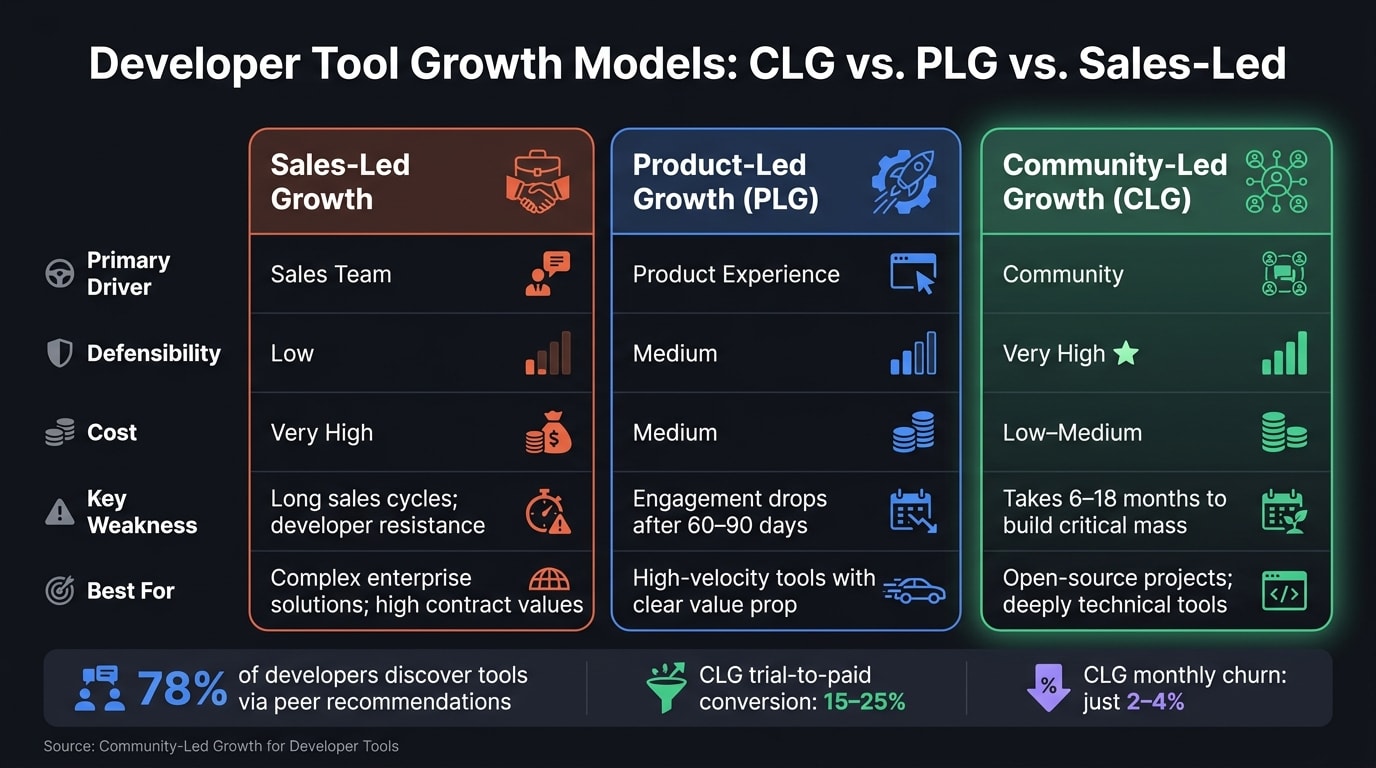
CLG vs. PLG vs. Sales-Led: Key Differences
Many developer tool companies begin with either a product-led or sales-led approach. Sales-led growth can be costly and slow, as its scalability is directly tied to rising expenses. It also often faces pushback from developers who feel excluded from the decision-making process. On the other hand, product-led growth (PLG) allows users to activate independently. However, PLG frequently struggles to maintain user engagement beyond the first 60–90 days, leaving no clear path to re-engage users once momentum fades .
This is where community-led growth (CLG) steps in, complementing both PLG and sales-led models by addressing their limitations and sustaining engagement over the long term.
| Growth Model | Primary Driver | Defensibility | Cost | Key Weakness |
|---|---|---|---|---|
| Sales-Led | Sales team | Low | Very High | Long sales cycles; resistance from developers |
| Product-Led (PLG) | Product experience | Medium | Medium | Engagement drops after 60–90 days |
| Community-Led (CLG) | Community | Very High | Low–Medium | Takes time to build critical mass |
This table highlights the unique strengths of CLG, particularly its defensibility. Competitors can replicate your product's features or outspend you on advertising, but they can't recreate the depth of relationships, shared expertise, and trust cultivated within a thriving community. Over time, this community becomes a durable asset, driving sustained revenue and loyalty for your developer tool.
"A competitor can match your feature set. They cannot replicate your community's institutional knowledge, the relationships among members, or the trust that comes from years of shared practitioner conversation." - James Doman-Pipe, Co-founder, Inflection Studio
Companies like Snyk, GitHub, and HashiCorp illustrate this strategy by layering sales efforts on top of a foundation built through PLG and community engagement. This allows them to secure enterprise revenue while maintaining developer trust .
Next, let's explore how CLG integrates into each stage of the developer funnel.
How CLG Maps to the Developer Funnel
CLG influences the entire developer journey, with its role shifting at different stages of the funnel.
At the awareness stage, communities excel at driving discovery. Peer recommendations, GitHub stars, and community-created tutorials naturally reach developers in ways that paid advertising cannot replicate . For activation, experienced members of the community play a critical role in helping new users achieve their "aha" moment more quickly. This reduces technical support tickets by 40% to 70%, keeping support costs manageable as your user base grows .
The most significant impact of CLG emerges at the retention and expansion stages. For example, MongoDB's data reveals that developers who answer at least one community question within their first 90 days show 65% higher retention rates and 40% greater usage expansion compared to those who remain passive . This sense of ownership and connection within the community fosters loyalty that no automated onboarding sequence can replicate.
Finally, at the advocacy stage, active community members often evolve into Champions. These individuals contribute by creating tutorials, answering questions, and referring peers, effectively feeding new developers back into the top of the funnel. This process happens organically, without additional acquisition costs .
"A developer audience is a compounding asset, not a campaign." - Ryan Boyd, Author, (the) Developer Advocate
Building and Scaling a Developer Community
Choosing the Right Platform for Your Developer Community
The platform you select plays a major role in shaping your community's tone, audience, and the effort required to keep it thriving. There's no universal solution here - your choice should align with what your audience needs most.
| Platform | Best For | Key Strength | Key Weakness |
|---|---|---|---|
| Discord | Developers, AI/ML builders | Real-time chat, free history, bot automation | Poor SEO; informal for enterprise |
| Slack | B2B SaaS, enterprise teams | Integrates with existing work workflows | Approximately $7.25/user/month at scale; free tier caps history at 90 days |
| GitHub Discussions | Open-source, technical builders | Collocated with code; searchable | High barrier for non-technical users |
| Discourse | Large-scale knowledge bases | Strong SEO; evergreen content structure | Requires heavy curation; less suitable for real-time interactions |
A hybrid approach often works well. For instance, you could use Discord for real-time conversations and GitHub Discussions or Discourse for hosting searchable, long-term resources. Once you've picked the right platform, the next step is organizing your community channels to encourage meaningful engagement.
How to Structure Your Community Channels
Overloading your community with too many channels can overwhelm members and stifle interaction. Instead, start with a streamlined setup that includes key areas like:
- Onboarding: (#welcome)
- General Discussion: (#general)
- Technical Support: (#help)
- Product Feedback: (#feedback and #showcase)
- Off-Topic Social: (#off-topic)
This simple structure creates a strong foundation for moderation and engagement. Among these, the #help channel often becomes the most active, as developers frequently join communities to solve technical challenges. By focusing on support early, you set a collaborative and solution-oriented tone.
"The core metric for a community is like how fast did you solve someone's problem? It's not like how many messages in random do we have." - Milica Maksimovic, Co-founder, Literally.dev
Committing to a public response time - say, within 24 hours - can quickly earn trust. Over time, as the community grows, members often start stepping in to answer questions themselves. This is a strong indicator that your community is becoming self-sustaining.
Setting Up Moderation and Community Guidelines
Moderation isn't just about managing bad behavior; it’s about shaping the culture of your community from the very start. Clear guidelines, such as those provided by frameworks like the Contributor Covenant, can help establish expectations without requiring you to draft rules from scratch.
To streamline daily moderation tasks, consider using tools like MEE6, Dyno, or Carl-bot. These can handle routine tasks, allowing your team to focus on fostering genuine conversations. The goal is to create an environment that's safe, respectful, and welcoming.
A long-term strategy involves building an engagement ladder. In most communities, about 60–70% of members are passive observers, while only 1–2% become highly active contributors. By providing clear opportunities for participation - like reacting to posts, commenting, or creating content - you can guide members to become more involved over time. This gradual engagement helps ensure your community grows in an authentic and sustainable way.
With these foundational steps in place, you're ready to explore how to turn that engagement into revenue.
Turning Community Engagement Into Revenue
What Are Community-Qualified Leads (CQLs) and How to Track Them
A Community-Qualified Lead (CQL) is someone whose actions demonstrate genuine purchase intent. Unlike Marketing Qualified Leads (MQLs), which are often based on form submissions, CQLs earn their status through meaningful engagement - like forking a repository, asking deployment-specific questions, or inviting teammates to collaborate on a project.
To identify CQLs, it's helpful to establish a hierarchy of signals to separate casual interest from clear intent. For example, a GitHub star might indicate mild interest, while a repository fork shows active experimentation. More advanced actions, like opening a pull request or asking questions such as "How do I deploy this to AWS Lambda?" suggest a developer is moving closer to production. Datadog offers a great example of this in action: they define Product Qualified Leads (PQLs) as users who send at least 100 monitoring events and stay active for more than seven days. This approach has led to a 22% PQL-to-paid conversion rate, far surpassing typical MQL benchmarks .
To track CQLs effectively, assign a Signal Depth Score to different behaviors (e.g., Star = 1, Fork = 3, PR = 5). Multiply this by an ICP Fit Score, which takes into account factors like company size, funding stage, and user role. This scoring system helps prioritize leads, giving your team a focused list of high-potential prospects instead of an overwhelming pool of everyone who joined your community. This method not only clarifies intent but also ensures a smoother transition to sales.
Handing Off Community Members to Sales Without Breaking Trust
The transition from community to sales is a tricky one - and it's where many Community-Led Growth (CLG) programs falter. If a developer senses they’re being tracked and passed off to a sales rep, trust can evaporate in an instant.
The solution lies in contextual outreach. This means reaching out based on specific, helpful signals rather than generic triggers. As the LeadCognition team explains:
"The message that lands: 'Hey Sarah - I saw you forked our observability SDK... Happy to share a few patterns if that's useful.' The message that doesn't: 'I noticed you forked our repo at 2:47pm last Tuesday. Are you ready to buy?'"
Sales reps should always review a prospect's community activity before reaching out. Referencing something specific - a question they asked or a tutorial they contributed - leads to much better results than using a cold, impersonal template. Avoid mentioning exact timestamps of activity; instead, focus on the intent behind their actions. When done right, community-influenced B2B deals close 72% faster than deals initiated through traditional sales methods . The key is ensuring the handoff feels like a natural continuation of the relationship - not an abrupt sales pitch.
Attribution Models for Community-Led Growth
Once you've identified CQLs and refined your sales handoff process, the next step is to measure the value your community brings. This can be challenging - 52% of developer tool discovery happens through "dark social" channels like private Slack groups, internal wikis, and direct messages, which traditional analytics often miss . Relying on single-touch attribution models can significantly undervalue your community’s impact.
A better approach is weighted multi-touch attribution, which distributes credit across the entire developer journey. For example, you might assign credit like this: Discovery (15%), Evaluation (25%), Trial (35%), Validation (20%), and Purchase (5%) . This method reflects how community interactions often play a bigger role during the evaluation and trial stages rather than at the point of purchase. To capture moments traditional tools miss, include a simple "How did you hear about us?" survey during onboarding.
For a more comprehensive view, use cohort analysis to compare community-engaged users with those who never participated. The results are often striking: community-engaged customers typically show 10–25% higher Net Dollar Retention and adopt new features 37% faster . As Mindy Faieta, Customer Success Lead at Stateshift, puts it:
"The fix isn't more activity reports. It's running your program through a structured attribution model that maps sources to outcomes."
Using Paid Channels to Accelerate Community Growth
When community engagement already drives revenue, targeted paid campaigns can help speed things up even more.
When Paid Campaigns Make Sense for CLG
Paid advertising doesn’t have to clash with authentic community building - it can actually help you connect with the right people faster. Here’s the challenge every new community faces: you need members to create value, but you also need to offer value to attract those members. Well-targeted ads can break this cycle by bringing in developers who are genuinely interested in what you’re building .
But timing is everything. If you start investing too early in an underdeveloped community, you risk high churn rates. A good rule of thumb? Adjust your budget as your community grows:
| Community Stage | Community Budget | Advertising Budget | Strategy |
|---|---|---|---|
| 0–500 members | 70% | 30% | Focus on building the foundation first |
| 500–2,000 members | 50% | 50% | Balance community building and growth |
| 2,000–10,000 members | 40% | 60% | Use ads to scale while community sustains itself |
| 10,000+ members | 30% | 70% | Community drives itself; ads fuel the scale |
One key insight: ads that directly ask people to "join our community" don’t perform well. Instead, ads promoting free resources - like tutorials or guides - see much higher conversion rates. For example, these resource-based ads can convert at 15–25%, while direct "join" ads only convert at 3–5% . Always lead with value before making the ask.
Next, let’s explore how daily.dev Ads can help you achieve these goals by reaching developers where they already are.
Using daily.dev Ads to Grow Your Developer Community
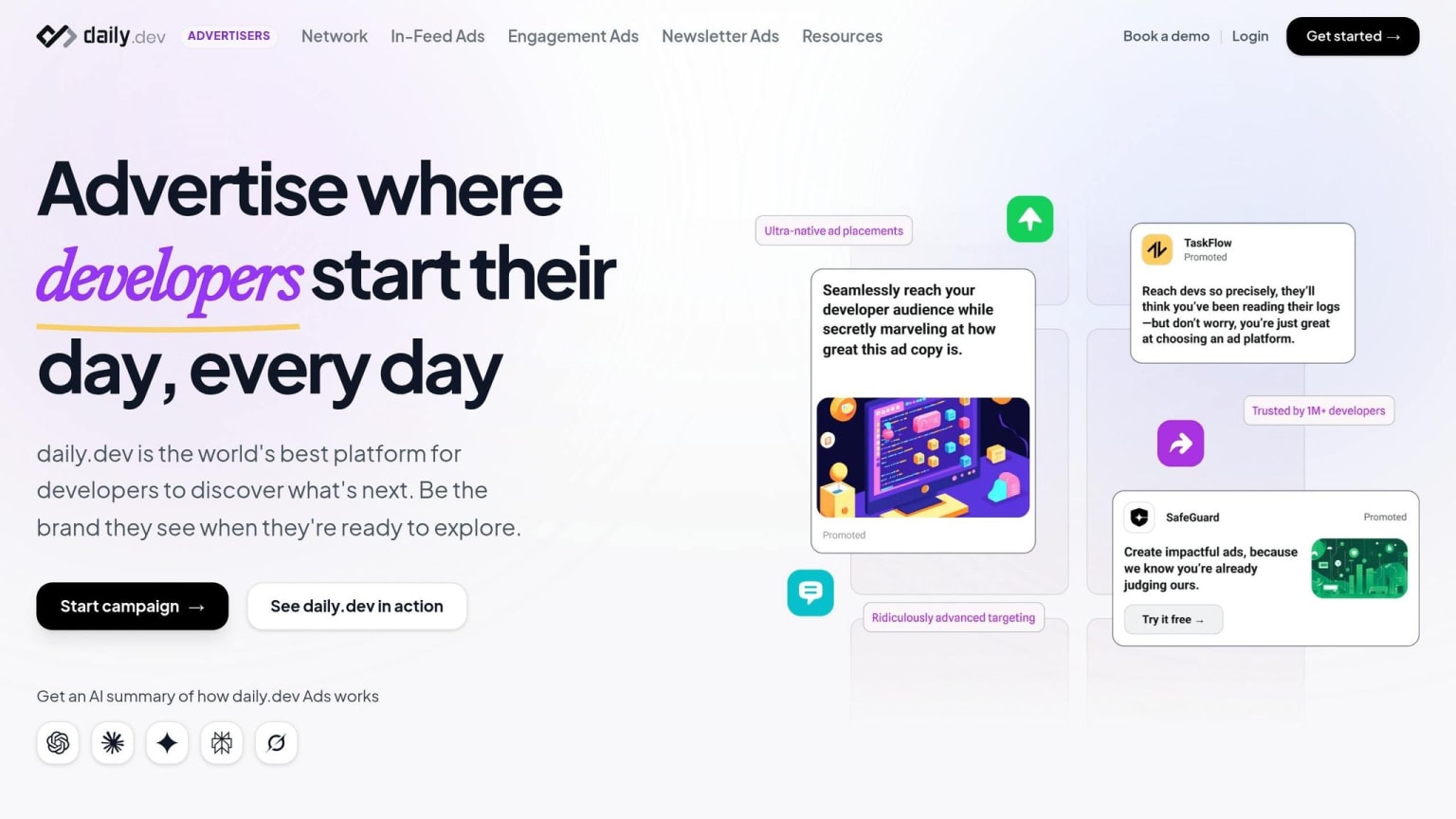
Did you know 60% of developers use ad blockers, and less than 15% interact with standard web ads ? That’s why native ad placement is so important. Generic display ads simply don’t cut it with this audience. What works better is placing ads in trusted spaces developers already use daily.
"Community-Led Growth and advertising are not opposed. In fact, advertising can accelerate community growth, and a strong community makes advertising far more effective." - Idlen.io
This is where daily.dev Ads shines. With access to over 1 million developers worldwide, daily.dev places native ads directly into its feed - right alongside the tools, frameworks, and industry news developers are already engaging with. You can target based on seniority, programming language, or specific tools, so a Rust-focused community, for instance, can directly connect with Rust developers rather than casting a wide net for "software engineers."
Campaigns are easy to launch, and real-time analytics let you tweak and optimize as you go. Some of the most effective ways to use daily.dev Ads for Community-Led Growth (CLG) include:
- Promoting helpful resources like tutorials or templates.
- Driving attendance to events like office hours or AMAs.
- Retargeting developers who’ve visited your docs but haven’t joined your community yet.
Tracking the Impact of Paid Campaigns on Community Growth
Once you’ve launched your campaigns, tracking their success is essential to ensure sustainable growth. Add UTM parameters or referral codes to every campaign link so you can trace which ones are driving actions like Discord joins, GitHub sign-ups, or forum registrations. But don’t stop there - track what these members actually do once they’re in your community. Use an engagement ladder to categorize members into groups like Lurkers, Reactors, Commenters, Contributors, and Champions. A campaign that brings in 100 active contributors is far more valuable than one that nets 500 passive lurkers .
It’s also important to monitor downstream behaviors. For example:
- Trial-to-paid conversions: Active community members convert at rates of 15–25%, compared to 8–12% for non-members .
- Churn rates: Monthly churn for engaged users is just 2–4%, compared to 5–8% for those who don’t participate .
These improvements show up in your customer acquisition cost (CAC) metrics over time. Companies with active communities report a blended CAC of $100–$250, compared to $200–$500 for those without . In short, paid campaigns that support a thriving community don’t just grow your membership - they also make your entire go-to-market strategy more cost-effective.
Conclusion
Community-Led Growth (CLG) isn't a quick fix. Building a developer community that truly matters takes time - typically 6 to 18 months. And the real business impact? That often doesn’t show up until after the first year . But here’s the thing: the payoff can far outweigh the investment, especially compared to traditional paid campaigns.
Here’s why: 78% of developers rely on peer recommendations to discover new tools . A strong, authentic community becomes your most reliable distribution channel. And what makes CLG so powerful is also what makes it a slower process - the trust, relationships, and shared knowledge that evolve naturally over time. These elements can’t be rushed or artificially created.
"A competitor can match your feature set. They cannot replicate your community's institutional knowledge, the relationships among members, or the trust that comes from years of shared practitioner conversation." - James Doman-Pipe, Co-founder, Inflection Studio
This guide has highlighted that CLG isn’t just another marketing strategy - it’s a long-term approach for driving success in developer tools. The key is shifting how you view your developer audience. As Ryan Boyd, developer advocate and author, puts it:
"A developer audience is a compounding asset, not a campaign."
Every piece of content created by your community, every question answered by a peer, and every recommendation from a loyal champion adds to a growth engine that builds momentum over time. CLG transforms engagement into a resource that doesn’t just grow - it compounds, turning your community into a lasting, revenue-generating asset.
FAQs
What’s the fastest way to get a developer community to critical mass?
To build a thriving developer community with 100–500 active members, targeted engagement is key. Start by forming a small, dedicated core group and actively involve them in your efforts. Share your progress publicly on platforms like Twitter or niche forums to attract attention and spark interest.
Introduce regular activities to keep members engaged - think weekly threads, Q&A sessions, or member spotlights. Highlighting individual contributions not only fosters a sense of belonging but also encourages participation. Focus your efforts on a single platform, such as Discord, to maintain consistency and avoid spreading your resources too thin.
Finally, track metrics that matter, like weekly active members and signups directly driven by the community. These numbers will give you a clear picture of your growth and help you refine your strategy.
How can I turn community activity into sales without losing trust?
The key to success lies in offering real value and forming genuine relationships. Be present and actively engage by answering questions, sharing useful resources, and contributing thoughtfully to conversations. Authentic participation is what earns trust and respect.
When interacting, keep an eye out for natural buying signals. These might include someone asking for recommendations or discussing problems that your product or service could address. Use these moments to provide helpful, personalized responses that show you’re attentive and genuinely interested in solving their challenges.
One thing to avoid? Aggressive selling. Instead, focus on being a trusted resource. By consistently offering value, you’ll naturally build trust and credibility over time.
Finally, track your progress by looking at meaningful engagement metrics - like how your interactions lead to conversions or stronger relationships - rather than getting caught up in vanity metrics like likes or follower counts. It’s about quality over quantity.
What metrics best prove community-led growth ROI to leadership?
To demonstrate the return on investment (ROI) of community-led growth, focus on metrics that tie community initiatives directly to business results. Here are the key areas to track:
Community-Attributed Signups: Measure how many new users or customers are joining as a direct result of community efforts.
Activation and Retention Rates: Compare the activation and retention rates of community members versus non-members to highlight the impact of community engagement.
Support Ticket Deflection: Track how effectively the community reduces the need for customer support by resolving questions or issues.
Community Content Contributions: Monitor the volume and quality of content created by community members, such as forum posts, tutorials, or product feedback.
Community-Influenced Revenue: Evaluate the revenue generated through community influence, including impacted sales pipeline and net revenue retention.
By focusing on these metrics, you can clearly link community activities to measurable business outcomes, making it easier to demonstrate their value.