

Engineering managers (EMs) are often overlooked in developer-focused go-to-market (GTM) strategies, yet they hold a critical role in bridging the gap between grassroots developer adoption and executive buy-in. Unlike developers who focus on solving immediate problems or executives who prioritize budgets and compliance, EMs care about team efficiency, delivery timelines, and reducing technical debt. They have the authority to approve smaller expenses and often formalize informal tool adoption within teams.
Key Takeaways:
- Who are EMs? They manage teams, approve smaller budgets (~$500/month), and push for upgrades on tools already adopted by developers.
- Why are they missed in GTM? EMs don’t fit neatly into developer or executive personas, making them hard to target with traditional messaging.
- What do they prioritize? Team productivity, reduced technical debt, hiring challenges, and compliance.
- How to market to them? Use precise, outcome-focused messaging and provide formats like ROI calculators, migration cost analyses, and peer case studies. Avoid vague buzzwords.
- Where to reach them? Trusted engineering blogs, leadership newsletters, events like KubeCon, and platforms like daily.dev Ads.
For a successful GTM strategy, align your messaging to both developers and EMs. Developers need resources like clear documentation and free trials, while EMs require ROI summaries and compliance documentation. Timing outreach when internal adoption signals are strong ensures relevance and impact.
Understanding Engineering Managers as Buyers
How Engineering Managers Shape Tool Adoption
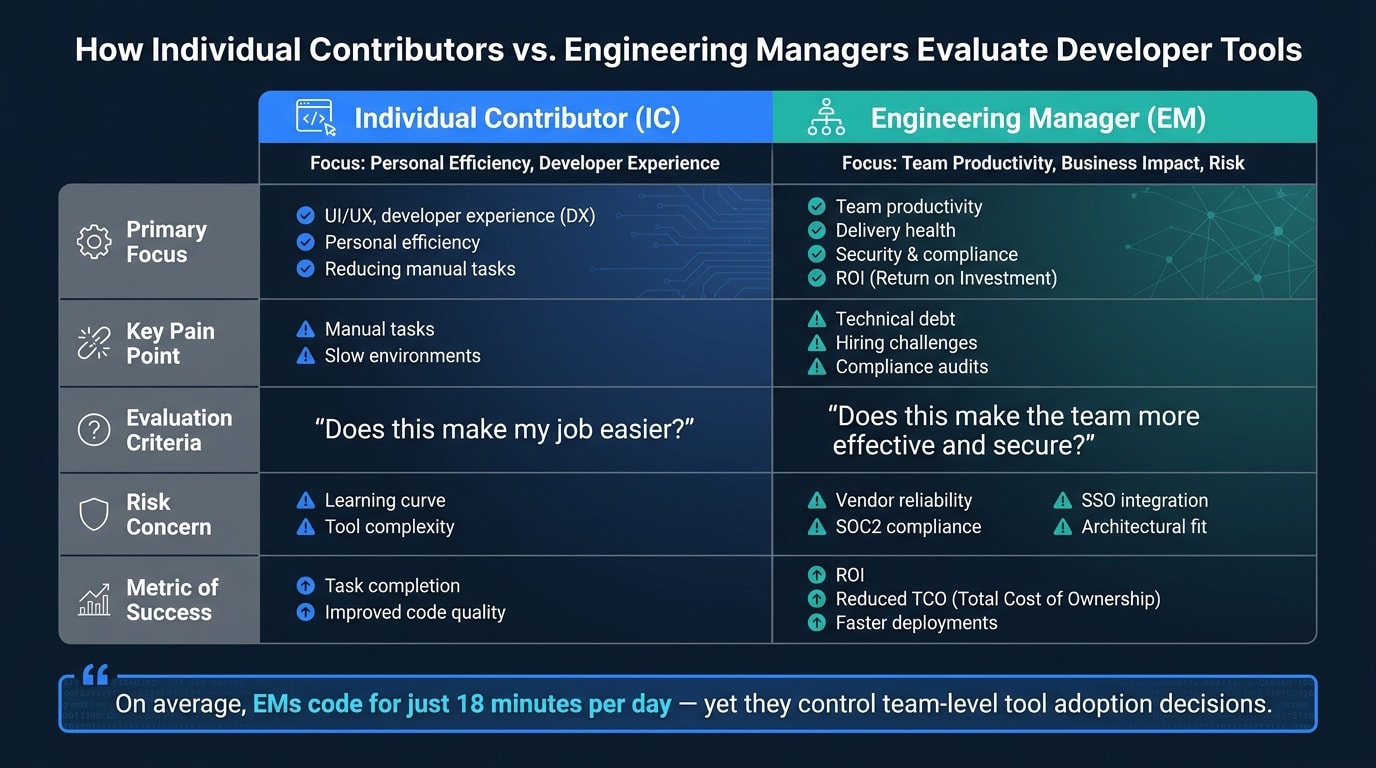
Engineering managers (EMs) hold a distinct place in the buying process. They’re not the ones spending their day writing code - on average, an EM codes for just 18 minutes per day . Nor are they the executives signing off on large contracts. Instead, their role is to decide if a tool that a developer champion endorses is worth allocating budget for.
EMs act as both gatekeepers and sponsors. As gatekeepers, they assess a tool’s technical compatibility, security standards, and how well it fits within the broader architecture. As sponsors, they build the internal case for adoption, translating developer benefits like "this speeds up my workflow" into business outcomes such as "this lowers our total cost of ownership (TCO) and improves delivery timelines." This dual role is crucial in determining whether a tool gets adopted, while also presenting unique challenges for marketers and sellers.
Key Pain Points Engineering Managers Face
To engage EMs effectively, you need to address their core challenges: technical debt, hiring difficulties, and compliance issues. Technical debt is a particularly pressing concern today. By 2025, 90% of engineering teams are expected to use AI coding tools . However, AI-generated code tends to create 1.7 times more issues compared to human-written code . This means EMs often deal with an increasing backlog of quality and structural problems, even as these tools make teams appear more productive. As Willian Correa puts it:
"The engineering managers who are still in their jobs in two years will be the ones who can tell the difference between a team that is faster and a team that just feels faster."
Beyond code quality, EMs are feeling the strain of organizational changes. In 2023, 32% of layoffs targeted middle managers , leaving surviving EMs to manage larger teams with fewer resources. For them, tools that streamline coordination or automate governance processes aren’t just helpful - they’re essential for staying afloat.
How EMs Evaluate Tools Differently from Individual Contributors
There’s a noticeable divide between how individual contributors (ICs) and engineering managers evaluate the same tool. This difference often explains why developer-focused go-to-market strategies can stall at the team level.
| Dimension | Individual Contributor (IC) | Engineering Manager (EM) |
|---|---|---|
| Primary Focus | UI/UX, developer experience (DX), personal efficiency | Team productivity, delivery health, security, ROI |
| Key Pain Point | Manual tasks, slow environments | Technical debt, hiring challenges, compliance |
| Evaluation Criteria | "Does this make my job easier?" | "Does this make the team more effective and secure?" |
| Risk Concern | Learning curve, complexity | Vendor reliability, SOC2 compliance, SSO, architectural fit |
| Metric of Success | Task completion, improved code quality | ROI, reduced TCO, faster deployments |
Understanding these differences is key to crafting messaging that resonates with EMs, setting the stage for the next steps in the process.
Crafting Messaging and Content for Engineering Managers
How to Position Your Product for EMs
A common misstep in developer marketing is focusing too heavily on features when targeting engineering managers (EMs). Unlike individual contributors, EMs aren't primarily concerned with how a tool will make their own day easier. Instead, they’re evaluating whether it will enhance their team's effectiveness without introducing unnecessary complications.
To resonate with EMs, translate features into outcomes that matter at the operational level. For example, instead of saying "faster data access", explain it in terms of team impact: "Multi-region replication reduces latency to under 30ms, ensuring instant cart loads during traffic spikes." This approach - tying the mechanism to its tangible result - helps EMs see both how the tool works and why it’s relevant to their team’s success .
Avoid vague buzzwords like "AI-driven magic" or "next-gen performance", as these can erode trust. EMs value precise, technical language, such as "SOC 2 Type II certified" or "AES-256 encryption", which directly addresses their concerns. Ninad Pathak, a freelance technical writer, underscores this point:
"If your marketing papers over the details with phrases like 'AI-driven magic' or 'proprietary algorithms' without explaining how they work, you lose credibility instantly."
Another way to build trust? Be upfront about what your product can’t do. Acknowledging limitations makes your claims about what it can do far more believable .
Once your messaging is clear, focus on the content formats that best convey these operational benefits.
Content Formats That Work for EMs
Engineering managers often complete 60–80% of their evaluation independently before engaging with sales . This means your content needs to deliver actionable insights and provide materials they can share with their teams. Build trust by focusing on measurable outcomes, acknowledging product limitations, and incorporating peer experiences. Effective formats include:
- ROI calculators: Allow EMs to input details like team size, build times, or incident frequency to estimate potential savings in both time and money.
- Migration cost analyses: Be honest about the time and effort required to switch to your tool. EMs are skeptical of claims that onboarding is entirely frictionless.
- Productivity benchmarks: Offer side-by-side comparisons, such as performance metrics for teams using your tool versus those who don’t, backed by clear data.
- Peer case studies: Highlight stories from engineering managers at similar organizations, complete with specific names and measurable outcomes.
Documentation is another critical factor. Poorly maintained or outdated documentation can signal deeper quality issues with your product. As one expert puts it:
"If your docs are messy, outdated, or hard to read, the assumption is that your code is messy, outdated, and hard to read."
Providing concise code snippets and well-organized technical guides can demonstrate product quality before any direct interaction.
Connecting Evaluation Decisions to Technical Debt, Velocity, and Hiring
Beyond operational outcomes, your content should address the broader challenges EMs face. Adding a new tool to their stack must solve a pressing problem, and the most convincing narratives focus on reducing technical debt, improving developer velocity, and supporting hiring and retention efforts.
Technical debt is often a top concern. Position your tool as one that minimizes maintenance demands - less firefighting, fewer manual processes, and more time to focus on advancing the product roadmap.
Developer velocity is another critical area. EMs want tools that deliver measurable improvements, such as faster build times, shorter on-call rotations, or fewer incidents. Dimitar Petkov, Co-Founder of LeadHaste, explains it well:
"Engineering leaders don't care about features. They care about whether their on-call rotation gets shorter, their builds get faster, their incidents get fewer, or their team can do more with the same headcount."
For hiring and retention, frame your product as part of a modern, well-maintained tech stack. This helps EMs demonstrate the operational and strategic benefits of your tool, especially when attracting and retaining top talent.
To support internal buy-in, provide easy-to-digest materials like one-pagers or ROI summaries . These resources make it simpler for EMs to advocate for your product within their organization.
Reaching Engineering Managers Through the Right Channels
Where Engineering Managers Spend Their Attention
Engineering managers (EMs) juggle technical know-how with leadership and operational responsibilities, which shapes the platforms and communities they engage with.
They regularly turn to trusted engineering blogs and leadership newsletters - spaces where experienced peers share practical insights about managing teams at scale. Events like KubeCon and AWS re:Invent are also on their radar, offering not just the latest in technology but a chance to gauge their teams against industry benchmarks. Beyond these, many EMs are active in Slack and Discord communities focused on specific engineering topics. These forums are valued for their candid, peer-driven discussions, free from vendor influence .
This reliance on technical content platforms presents a unique opportunity for targeted digital campaigns. Timing is key: campaigns launched during the last three weeks of a quarter and the first two weeks of the next align perfectly with EMs’ planning and budgeting cycles. During these periods, they’re actively exploring new tools and solutions, making them more receptive to relevant messaging .
Understanding these habits is essential for using daily.dev Ads to effectively reach this audience.
Using daily.dev Ads to Target EMs
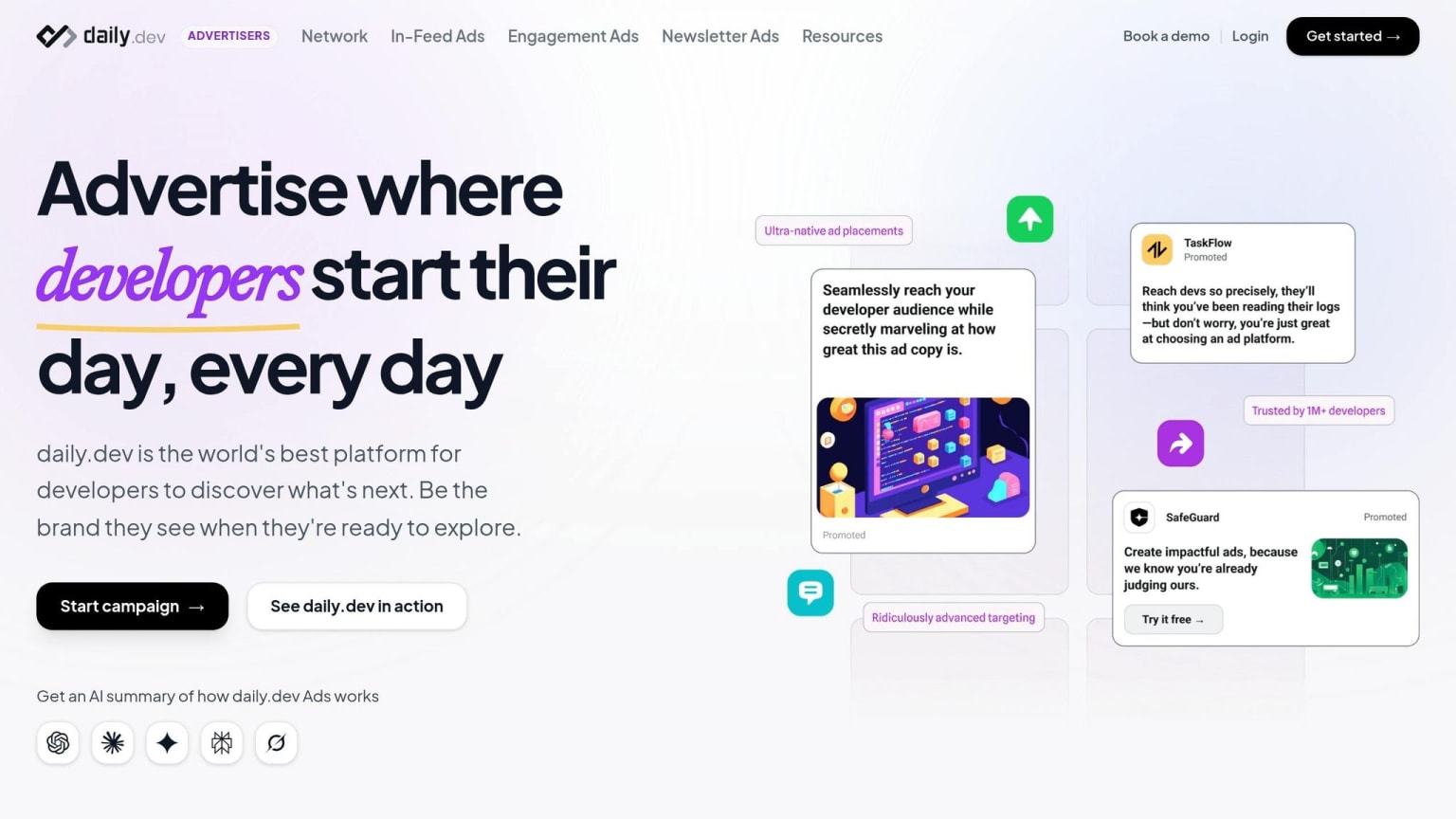
daily.dev Ads bridges the gap between developers’ interests and EMs’ decision-making, offering a fresh approach to developer-focused go-to-market strategies. Unlike platforms that rely on outdated profile data, daily.dev Ads leverages real-time user behavior to target active interests.
"daily.dev targeting is based on real behavior inside the platform, not stale profile data." - daily.dev
This dynamic targeting ensures precision. By combining a seniority filter - focusing on users with 7+ years of experience (who make up 30% of the platform’s audience) - with topic tags like "leadership", "productivity", and "architecture", advertisers can bypass junior developers and directly engage decision-makers .
To truly connect with EMs, ad content must address their specific challenges. Ads should feel like native content, blending seamlessly into their browsing experience. Formats like interactive guides, technical whitepapers, or benchmark reports work well in this context . As daily.dev aptly puts it:
"Developers do not click on ads. They click on solutions to their problems." - daily.dev
For EMs, this means focusing on tangible outcomes. Highlighting benefits like faster build times, fewer on-call disruptions, or reduced incident rates will resonate far more than a generic product pitch. For example, an ad titled "The engineering leader's guide to reducing CI/CD pipeline costs in 2026" directly addresses a pressing concern, making it far more compelling than a standard feature list.
Building a Developer GTM Strategy That Includes Engineering Managers
A GTM strategy that focuses only on individual contributors often gets stuck at the free tier. On the flip side, targeting just VPs and CTOs can stall because the team isn’t actively using the product. Engineering managers (EMs) play a crucial role in bridging the gap between grassroots adoption and signed contracts. They are the key to aligning product usage with business decisions.
Think of this approach as running on two parallel tracks. Developers need resources like clear documentation, a free tier, and a quick demo they can try in under five minutes. Meanwhile, EMs are looking for detailed adoption reports, quantifiable ROI tied to metrics like delivery speed or on-call workload, and compliance documentation.
Timing is everything. When five or more users from the same company domain sign up, it’s the perfect moment to reach out to the engineering leader - not with a cold pitch, but with a compelling adoption story. As Abmatic AI explains:
"The buyer signs only when there is documented internal adoption to justify the spend."
This kind of product signal ensures your outreach is both timely and relevant.
To make the dual-track approach work, tailor your messaging to the audience. For individual contributors, focus on implementation details like API quality, error handling, and how quickly they can achieve their first successful build. For EMs, tie the technical benefits directly to business outcomes. Avoid vague claims like "faster pipelines." Instead, offer precise data: "Teams using this tool cut CI/CD wait times by 40%, saving approximately 3 hours per developer each week." This level of detail resonates with technical leaders and builds credibility.
Finally, empower your developer advocates with the tools they need to make a case internally. Provide them with an ROI estimate, a security FAQ, and a one-page build-vs-buy comparison. These resources can help smooth the path from trial to procurement during their 1:1 meetings.
FAQs
When should I start marketing to engineering managers?
Start reaching out to engineering managers once your product demonstrates internal adoption, clear ROI, and technical value. This moment usually comes when developers within an organization are actively using or testing your tool. Look for key signals like increased usage or deeper engagement within the team.
When targeting engineering managers, focus on their core priorities. Highlight how your product can boost team productivity and help reduce technical debt. Addressing these concerns will make your message far more relevant and impactful.
What proof do engineering managers need to approve spend?
Engineering managers rely on data-backed evidence to justify expenses. They look for technical specifications, security and performance benchmarks, case studies, and ROI calculations. Their focus is on information that clearly shows measurable improvements in team productivity, cost savings, and long-term benefits.
How do I target engineering managers on daily.dev Ads?
To reach engineering managers effectively with daily.dev Ads, use audience filters such as seniority levels (like "Engineering Manager") and specific technical interests (like scalability or team productivity). Opt for native ad formats that emphasize team results and return on investment (ROI).
Blend bottom-up and top-down approaches to connect with both developers and decision-makers. Finally, track key performance metrics like click-through rates and conversions to fine-tune your campaigns and maximize their impact.