

Marketing to developers is unlike traditional B2B marketing. Developers value functionality, precision, and evidence over flashy presentations or emotional appeals. If you're a founder or CMO looking to scale your developer-focused product, this guide helps you decide whether to hire an agency, choose the right type, and avoid costly mistakes.
Key Takeaways:
- When to hire an agency: If your internal team lacks bandwidth, needs faster execution, or struggles with technical content production.
- When not to hire an agency: If your product isn't validated or your messaging is unclear.
- Agency types: Full-service GTM, Content/SEO specialists, Paid media buyers, and DevRel-as-a-Service.
- Red flags: Agencies that lack technical expertise, focus on vanity metrics, or ignore AI-focused optimization.
- Green flags: Engineer-reviewed content, developer-specific paid channels, and a strategy-first approach.
- Budget: Agencies charge $3,500–$25,000/month depending on your company stage and scope.
Quick Comparison of Agency Types:
| Agency Type | Best Fit | Watch Out For |
|---|---|---|
| Full-Service GTM | New launches, Seed–Series A | High cost, shallow developer expertise |
| Content/SEO Specialists | PLG, organic growth | Results take 3–6 months |
| Paid Media Buyers | Scaling demand gen | Ineffective without clear messaging |
| DevRel-as-a-Service | Community engagement | Hard to measure ROI without clear KPIs |
By the end, you'll know how to evaluate agencies, structure a 90-day roadmap, and ensure your investment drives measurable results.
Agency vs. In-House Developer Marketing: How to Decide
Choosing between an agency and an in-house team hinges on factors like your product's stage of development, budget, and the marketing infrastructure you already have in place. By understanding these elements, you can better evaluate the pros and cons of each option.
Signs You Are Ready to Hire an Agency
One major sign? Your internal team doesn’t have the bandwidth to produce technical content. Recent statistics show that 42% of developer marketing teams outsource content creation to external vendors , and this trend is growing as teams aim to scale output without expanding headcount.
Here are a few other scenarios where bringing in an agency makes sense:
- You’ve nailed down your product-market fit and developed an ideal customer profile, but your team lacks the capacity to maintain consistent marketing efforts. An agency can step in to boost content production.
- Speed is critical. Agencies often deliver their first piece of content within 3 weeks of kickoff. Compare that to the 3–6 months it typically takes to hire and onboard an in-house team .
- Your internal DevRel team is stretched too thin. As Abhishek Iyer from Descope explains:
"Partnering with Draft.dev has accelerated our technical output while also extending the bandwidth of our developer relations team to focus more on core product activities."
When Hiring an Agency Is the Wrong Move
If your product isn’t fully validated or your messaging lacks clarity, hiring an agency might not be the best choice. Agencies excel at execution but aren’t equipped to define your strategy. Spending $9,000 or more per month on technical content without knowing your target audience or their pain points can drain resources you’ll never recover.
Similarly, agencies need clear and detailed briefs to produce effective content. If your team can’t provide this direction, the result will likely be generic content that fails to resonate with developers.
Agency vs. In-House: A Direct Comparison
| Dimension | In-House Team | Developer Marketing Agency |
|---|---|---|
| Speed to start | Slow (3–6 months to hire/onboard) | Fast (~3 weeks to first deliverable) |
| Cost model | High fixed costs (salaries, benefits, equity) | Predictable monthly retainer (typically $9,000+/month) |
| Technical depth | Deep product knowledge; lives the codebase | Broad SME network across languages and stacks |
| Scalability | Hard to scale without new hiring cycles | Easy to increase or decrease output based on budget |
| Flexibility | Low; restructuring headcount is slow and costly | High; most engagements can pivot after a 3-month term |
| Management lift | High; requires direct day-to-day management | Lower; agencies typically provide dedicated project managers |
While in-house hires gain deep product expertise over time, agencies offer faster results and broader reach. If quick execution and scalability are your priorities, an agency might be the better fit.
The 4 Types of Developer Marketing Agencies
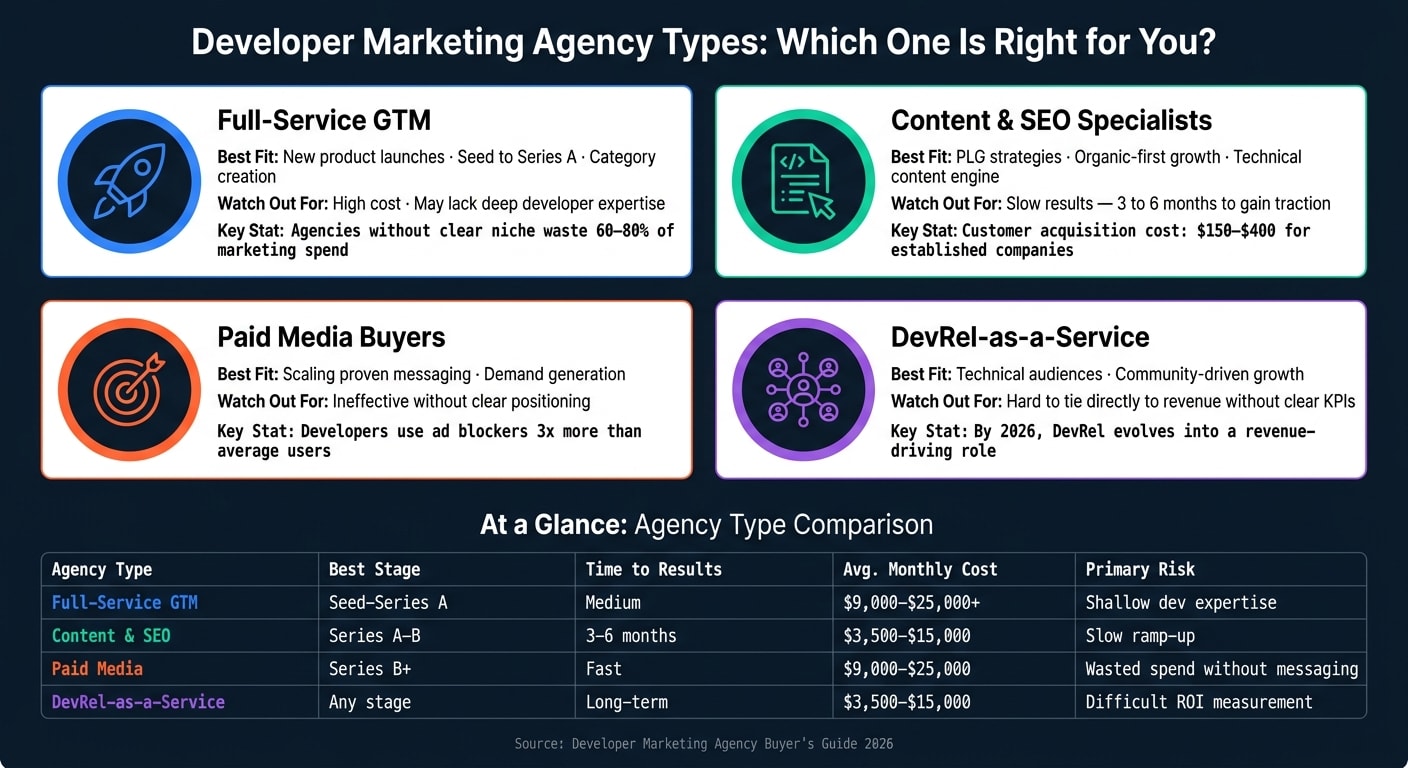
Developer marketing agencies generally fall into four main categories. Picking the wrong one can burn through your budget without delivering results. Here’s a breakdown to help you align the right agency with your product's stage and marketing goals.
Full-Service Developer GTM Agencies
These agencies manage the entire go-to-market process, including positioning, messaging, defining your ideal customer profile (ICP), content creation, developer relations (DevRel), and paid campaigns - all seamlessly integrated. Their strength lies in coordination: when these elements are developed together, they complement each other instead of working at odds.
But there’s a catch: the "full-service trap." As Peter Korpak of 100Signals explains:
"Positioning must come before tactics - agencies that run channels without a clear niche amplify mediocrity and waste 60-80% of marketing spend."
These agencies are ideal when launching a new product, redefining your market category, or scaling from Seed to Series A. However, if your focus is narrower, other agency types may better suit your needs.
Content and SEO Specialists
These agencies focus on building a technical content engine - producing tutorials, API documentation, comparison pages, and code samples crafted by subject matter experts (SMEs). This kind of content can deliver impressive returns, with customer acquisition costs ranging from $150 to $400 for established companies .
For instance, Sinch Mailgun revitalized its developer-focused content strategy by working with Draft.dev. Limited internal resources didn’t slow them down; the agency’s SME-driven tutorials and thorough editorial reviews helped achieve click-through rates of 20% to 45% on technical content . The downside? Results take time - typically 3 to 6 months to see meaningful outcomes .
Looking ahead to 2026, top content agencies are also optimizing for Generative Engine Optimization (GEO), ensuring content surfaces in AI coding tools like Claude Code and Cursor, not just traditional search engines. As Joe Karlsson, Developer Advocate at CloudQuery, puts it:
"Your README, your examples directory, your API reference, and your SDK docs are your LLM marketing."
Paid Media Buyers for Developer Audiences
Paid media agencies specializing in developer audiences take a different approach compared to traditional performance marketers. Developers are three times more likely to use ad blockers , making standard display ads ineffective. Instead, these agencies focus on high-intent channels like curated newsletters, Reddit sponsorships, and niche technical publications.
Platforms like daily.dev for Business are central to this strategy. These developer-focused ad networks connect advertisers with an audience already in a technical mindset - something generic demand-side platforms (DSPs) can’t replicate. However, paid media only works if your positioning is rock-solid. Without clear messaging that resonates, these campaigns can quickly drain your budget. These agencies excel when you’re scaling demand generation after validating your message through organic channels.
DevRel-as-a-Service Studios
These studios specialize in developer relations, community engagement, and technical advocacy. Their services often include managing Discord communities, maintaining SDKs, delivering conference talks, contributing to open-source projects, and hosting office hours. By 2026, DevRel is evolving from a support function to a revenue-driving role, tied to metrics like pipeline influence and customer expansion .
| Agency Type | Best Fit | Watch Out For |
|---|---|---|
| Full-Service GTM | New launches; category creation; Seed–Series A | High cost; may lack deep developer expertise |
| Content/SEO | PLG strategies; organic-first growth | Slow results; takes 3–6 months to gain traction |
| Paid Media | Scaling proven messaging; demand generation | Ineffective without clear positioning |
| DevRel-as-a-Service | Technical audiences; community-driven growth | Difficult to tie directly to revenue without KPIs |
Understanding these distinctions allows you to choose an agency that directly addresses your marketing bottlenecks. The right choice depends on your growth stage and the challenges you’re facing.
How to Evaluate a Developer Marketing Agency: Red Flags and Green Flags
Once you’ve figured out the type of agency that suits your needs, the next step is spotting the true experts in developer marketing from the generalists who just slap “developer marketing” on their websites. There are clear signs that separate specialists from generalists. This guide builds on earlier advice about aligning agency expertise with your product’s stage and specific needs.
Red Flags That Should End the Conversation
One of the easiest ways to identify a poor fit? Pay attention to how an agency starts the conversation. If they’re quick to recommend specific channels like LinkedIn ads, Google Ads, or HubSpot sequences without first asking about your positioning or Ideal Customer Profile (ICP), that’s a major red flag.
Specialization is another critical factor. Agencies that focus on a niche tend to report profit margins of 40–75%, compared to just 18–22% for generalists . The reason? Specialists deliver results because they understand the space deeply.
Steer clear of agencies that lack in-house engineers or rely on vanity metrics like impressions, social media followers, or raw traffic. These metrics don’t align with what actually drives success in developer marketing. Instead, focus on metrics like pipeline-qualified meetings, Time-to-Value (TTV), API calls, and Product Qualified Leads (PQLs). For context, PQLs convert to paying customers at a rate of 15–30%, while standard MQLs lag far behind at just 2–5% .
Another dealbreaker? Agencies that ignore Generative Engine Optimization (GEO). By 2026, 47% of enterprise tech buyers will begin their vendor research with AI assistants . Yet, only 4% of developer agencies are currently recognized by these tools for relevant queries . If an agency isn’t already thinking about GEO, they’re behind the curve.
Once you’ve ruled out agencies with these red flags, you can focus on finding a true partner.
Green Flags That Signal a Real Partner
After weeding out the bad fits, look for the positive indicators that show you’ve found a genuine developer marketing partner.
A reliable agency will start with strategy - not just a content calendar. They’ll dig into your competitive positioning gaps before suggesting any tactics. Their case studies will go beyond traffic stats, featuring architecture diagrams, detailed technical outcomes, and migration guides that can stand up to scrutiny from a CTO.
Engineer-reviewed content is another must-have. The best agencies have workflows where every deliverable is reviewed by a subject matter expert (SME) or senior engineer before it’s finalized. This is essential because 78% of developers rank documentation quality as a top priority when evaluating new tools . Publishing technically inaccurate content can ruin your credibility faster than having no content at all.
On the paid media front, a real partner understands that developers use ad blockers at three times the average rate . Instead of relying on generic display networks, they’ll allocate your budget to developer-specific platforms. For example, daily.dev for Business places ads directly in front of developers who are already in a technical mindset, offering far better targeting than traditional options.
"Developer marketing is no longer just about traffic. It's about trust, distribution, and sustained visibility across both humans and machines." - Karl Hughes, CEO at Draft.dev
RFP Checklist: What to Ask Every Agency
Here’s a list of key questions to help you determine if an agency truly understands developer marketing.
| RFP Question | What a Strong Answer Looks Like |
|---|---|
| "Show us three case studies with technical metrics." | Includes architecture diagrams, code-level results, and stack-specific outcomes - not just traffic growth |
| "Detail your content review process." | Clear workflow with named engineers or SMEs reviewing every deliverable |
| "How do you track dark social and word-of-mouth attribution?" | Uses tools like “How did you hear about us?” forms, UTM tracking, and pipeline-sourced reporting |
| "What does your first 90-day roadmap look like?" | Focuses on positioning validation before content creation and includes competitive gap analysis in the first week |
| "How do you optimize for AI assistants (GEO/AEO)?" | Provides a specific strategy for appearing in tools like ChatGPT, Perplexity, and IDE-native platforms like Cursor |
| "What developer-native paid channels do you use?" | Mentions niche platforms like newsletter sponsorships, Reddit, or community sites - not just LinkedIn or Google Display |
Lastly, test their understanding of your ICP. Ask them to define it. A strong response might be, “VP of Engineering at mid-market fintech companies with 50–200 engineers.” A vague one like, “technical decision-makers at B2B SaaS companies,” suggests they lack the precision needed to execute effectively.
Scoping and Pricing a Developer Marketing Agency in 2026
Once you've pinpointed the right type of agency, the next step is defining the scope of work and pricing to ensure you're getting value for your investment.
Retainer vs. Project: Choosing the Right Engagement Model
The engagement model you choose directly affects the speed, flexibility, and level of commitment you can expect from the agency.
A retainer is designed for long-term growth. With this model, the agency typically runs a continuous content strategy, often publishing twice a week, while fine-tuning the approach over time. Most developer marketing agencies require a 3- to 6-month minimum commitment, as technical content takes time to rank and build trust with developers .
On the other hand, a project-based engagement is ideal for specific, short-term needs like revamping technical documentation, creating a competitive comparison page, or producing an original research report for a product launch. These projects usually last between 2 to 8 weeks and come with a fixed list of deliverables. It’s also a great way to "test the waters" with an agency before committing to a longer partnership. A clear project scope helps set expectations for both outcomes and timelines.
| Retainer | Project-Based | |
|---|---|---|
| Best for | Scaling without increasing headcount; PLG (Product-Led Growth) motions | Specific launches or filling technical content gaps |
| Typical duration | 3+ months (ongoing) | 2–8 weeks |
| Strategy included | Yes - evolves over time | Fixed scope based on initial brief |
| Primary goal | Building authority and driving consistent pipeline growth | Delivering targeted results within a set timeframe |
Deliverables That Truly Make an Impact
Not all content drives results. The key is focusing on deliverables that help developers achieve something, such as tutorials, migration guides, comparison pages, and activation sequences. These types of content go beyond being informative - they provide actionable value.
However, producing great content isn’t enough. Promotion is where many companies fall short. Publishing technical posts without a promotion plan wastes their potential. Set aside an additional monthly budget of $5,000–$10,000 for promoting content through developer newsletters and community sponsorships . Platforms like daily.dev for Business can amplify your reach significantly. For example, in April 2026, DigitalOcean achieved over 1 million impressions from 8 placements in Techpresso, with an average CPC of just $1.70 .
Instead of focusing on vanity metrics like impressions or traffic, prioritize KPIs that tie directly to revenue, such as pipeline-qualified meetings, API call volume, Time-to-Value (TTV), and Product Qualified Leads (PQLs). These metrics demonstrate the real impact of agency work on your business goals.
Budgeting by Funding Stage
In 2026, developer marketing agencies typically charge between $3,500 and $25,000 per month . Your budget will depend on your company’s stage, the complexity of your product, and the type of services you need - whether it’s original research or ongoing content production.
| Funding Stage | Typical ARR | Monthly Agency Budget | Typical Scope |
|---|---|---|---|
| Seed | <$3M | $3,500 – $9,000 | SEO foundations, technical audits, and 2 pillar content pieces per quarter |
| Series A | $3M – $15M | $9,000 – $15,000 | Original research, GEO/AEO engineering, and 4–8 technical posts per quarter |
| Series B+ | $15M+ | $15,000 – $25,000+ | Custom research, CRO for landing pages, dedicated account director, and global scaling |
For comparison, hiring a mid-level in-house SEO or content specialist costs around $3,000–$5,000 per month in salary alone - excluding benefits, tools, and management overhead. Meanwhile, a "Growth" tier agency retainer at a similar price point typically provides a senior team of four with established workflows and expertise in developer-focused marketing . This cost-effectiveness is worth considering when deciding between hiring internally or outsourcing.
How to Onboard and Work with a Developer Marketing Agency
Signing the contract is just the beginning; the real work starts in the first 90 days. A well-organized onboarding process ensures both you and the agency stay aligned and focused on achieving results from the very start.
Your First 90 Days: A Step-by-Step Playbook
The first three months are critical for building momentum. Here’s how to approach it:
- Weeks 1–2: Begin with discovery. This includes conducting a technical audit, identifying gaps in competitor strategies, and creating a clear 90-day roadmap.
- Weeks 2–6: Start rolling out deliverables like technical tutorials, "Getting Started" guides, and flagship research pieces.
- Month 2: Shift gears to content distribution. This means launching paid campaigns, engaging with developer communities on platforms like Discord or GitHub, and ensuring your content reaches the right audience.
- Month 3: Use this time to evaluate progress. Look at keyword rankings, traffic trends, and early conversion data to assess the impact. If measurable pipeline results aren’t evident by day 90, it’s time to revisit the strategy.
| Onboarding Phase | Timeline | Key Deliverables |
|---|---|---|
| Discovery | Weeks 1–2 | Technical audit, competitor gap map, 90-day roadmap |
| Initial Launch | Weeks 2–6 | Technical tutorials, "Getting Started" guides, flagship research |
| Optimization | Month 3+ | CRO for pricing/landing pages, AI search engineering |
By sticking to this structured approach, you’ll have a clear path to success and measurable outcomes by the end of the onboarding period.
How to Collaborate Without Wasting Budget
Collaboration is key to making the most of your investment. To keep things running smoothly, set up clear processes and regular communication:
- Kickoff Call: Start with a detailed kickoff meeting to align on goals and expectations.
- Quarterly Roadmap Reviews: Approve and adjust plans every quarter to stay on track.
- Regular Updates: Use weekly Slack updates, bi-weekly strategy calls, and monthly executive reports to track progress.
It’s also vital to assign a single internal point of contact - someone like a developer advocate or senior engineer - who can provide quick and accurate technical feedback. Delays in feedback can derail timelines and disrupt publishing schedules. Sharing your product roadmap with the agency is equally important. This allows them to plan content around upcoming launches instead of reacting to changes after the fact. These steps ensure your agency remains aligned with your goals and delivers results that resonate with developers.
Briefing Your Agency on daily.dev for Business
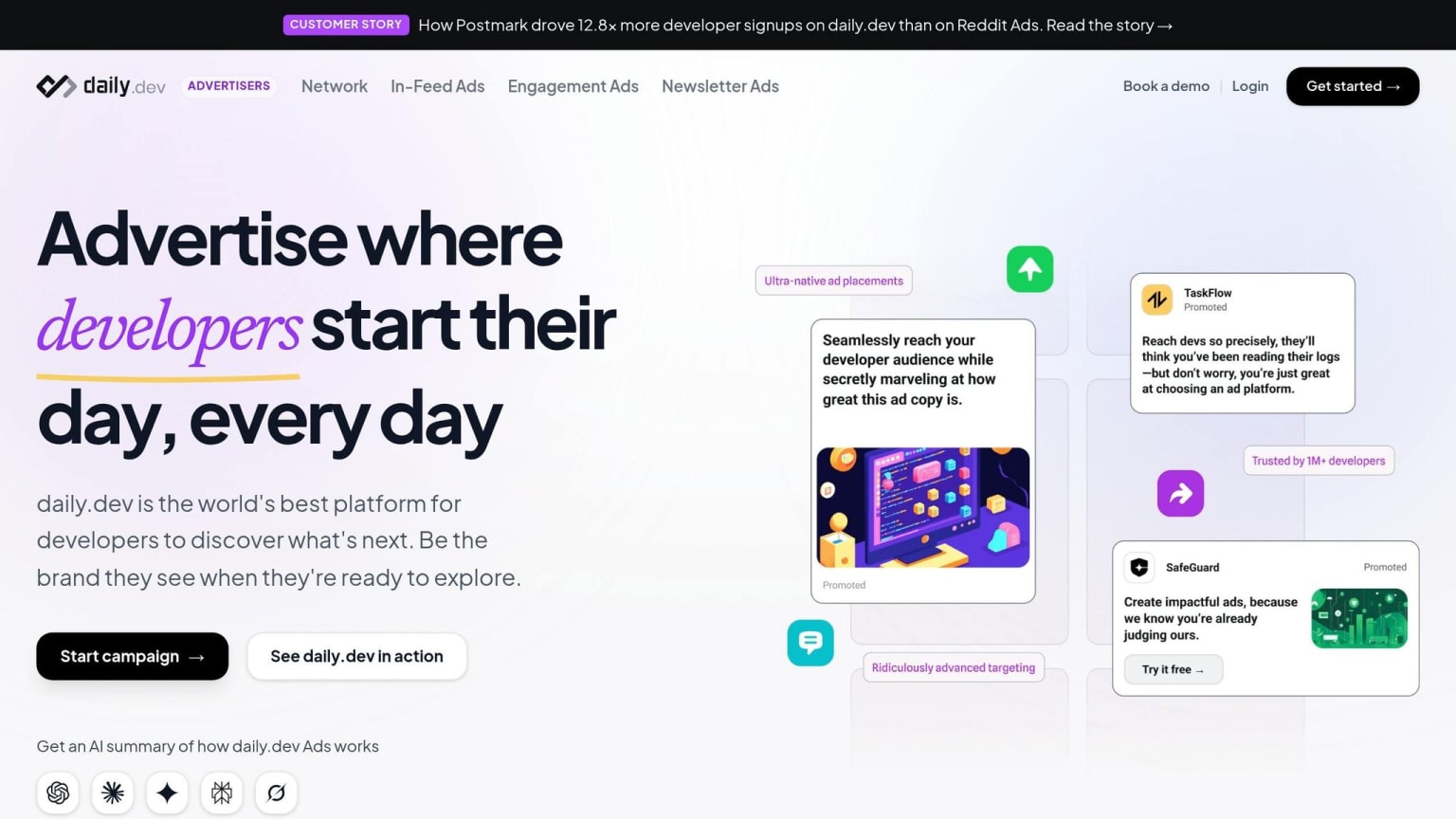
If your agency handles paid media, providing a detailed brief is essential for success on platforms like daily.dev for Business. Vague targeting won’t cut it. Your brief should include a clear technical ICP (Ideal Customer Profile) covering programming languages, frameworks, cloud platforms, and the specific problems your product solves.
The creative direction matters just as much as the targeting. Developers respond to actionable content - think working code examples and technical demonstrations - not generic claims like "enterprise-grade" or "seamlessly integrated." Platforms like daily.dev for Business offer native ad placements, including in-feed and post-page formats, with precise targeting options based on seniority, programming languages, and tools. With over 1 million developers globally, this platform can drive meaningful engagement when your brief aligns targeting, creative messaging, and technical depth.
Conclusion: Choosing the Right Developer Marketing Agency for Your Stage
Developer marketing stands apart from traditional B2B marketing - it’s not just another branch of B2B SaaS strategies. The agencies that excel in this space bring something extra to the table: they employ engineers, craft technical case studies, produce content that resonates with developers, and prioritize pipeline metrics over vanity stats like page views.
The best way to spot a true partner? Pay attention to the metrics they focus on. Agencies that highlight Product Qualified Leads (PQLs), time-to-first-successful API call, and trial-to-paid conversion rates are the ones that understand what really matters. On the flip side, those stuck on impressions or keyword rankings are likely missing the mark. As Peter Korpak of 100Signals explains:
"Positioning must come before tactics - agencies that run channels without a clear niche amplify mediocrity and waste 60-80% of marketing spend."
These metrics should align with your company’s current stage of growth. For example:
- Seed-stage startups need help defining their positioning and creating a few standout technical assets.
- Series A companies require strong distribution strategies and readiness to expand into new regions. With 47% of enterprise tech buyers now using AI assistants to begin their vendor research , it’s critical for your brand to show up in AI-generated answers, not just in Google search results.
- Series B and beyond demands a focus on optimizing conversion rates and building a dedicated account team to unify all growth efforts.
Before committing to an agency, look for a 90-day roadmap that starts with positioning validation. If they can’t deliver that, they’re likely not equipped to handle the technical audience you’re targeting. A solid agency will also have the expertise to brief developer-focused media platforms like daily.dev for Business, ensuring precise targeting and creative direction. Platforms like daily.dev for Business help avoid the pitfalls of generic display ads, offering a more effective way to connect with developers .
As we move further into 2026, the developer marketing field is favoring precision and focus. With 62% of developer marketing teams increasing their budgets this year , choosing the right agency has never been more critical. A generalist agency dabbling in developer marketing might waste your resources, while a specialist with a proven track record of creating technical content, building developer communities, and focusing on meaningful metrics can set you on a path to sustainable growth. Use these insights to make a choice that drives your next phase of success.
FAQs
What should I have figured out before hiring a developer marketing agency?
Before bringing on a developer marketing agency, it’s crucial to lay a solid foundation. Start by defining your positioning, messaging, and the ideal developer persona you want to target. Make sure your product has achieved market fit - agencies aren’t the best fit for companies still in the very early stages of development.
Be clear about the business outcomes you’re aiming for, whether it’s boosting revenue or speeding up developer onboarding. Lastly, understand the level of technical depth your audience expects. Developers tend to prioritize accurate, hands-on resources over broad, generic B2B marketing tactics.
Which agency type fits my stage: GTM, Content/SEO, Paid media, or DevRel?
The right agency largely depends on where your business is and what you want to achieve:
- Full-service GTM agencies: Perfect for early-stage startups (Seed to Series A) working on finding product-market fit and laying the groundwork for growth.
- Content/SEO specialists: A great choice for scaling technical education, establishing authority, and improving organic search visibility.
- Paid media agencies: Focused on targeted campaigns to increase product adoption and generate more leads for products that are already validated.
- DevRel-as-a-service: Tailored for building community trust, engaging developers, and encouraging organic advocacy.
What KPIs demonstrate developer marketing ROI beyond traffic and impressions?
To demonstrate developer marketing ROI, prioritize product-level metrics and pipeline impact instead of superficial numbers. Key metrics to watch include:
- Time-to-first-successful-API-call: How quickly developers achieve success with your API.
- Documentation engagement: For example, tracking users who visit 5 or more unique documentation pages.
- Team invite rates: How often users invite others to collaborate, signaling deeper engagement.
To gauge stickiness, monitor indicators like GitHub star velocity, package downloads, and weekly NPM installs. These metrics reflect how consistently developers are interacting with your product.
For the business side of things, focus on metrics like trial-to-paid conversion rates, pipeline velocity, and expansion revenue. To bridge gaps in attribution, use tools like "How did you hear about us?" surveys to better understand where your leads are coming from.