

Developers don't respond well to traditional marketing. Instead, effective developer marketing requires three key functions working together:
- Product Marketing (PMM): Defines positioning, messaging, and strategy to resonate with technical users.
- Developer Relations (DevRel): Builds trust through education, content, and community engagement while gathering product feedback.
- Growth: Scales adoption with data-driven experiments in SEO, paid ads, and onboarding.
These roles create a cycle where PMM sets the narrative, DevRel builds credibility, and Growth ensures adoption. Reporting structures and team priorities evolve as companies scale, starting with generalists at the seed stage and adding specialists as ARR grows. Clear alignment, practical hiring choices, and consistent collaboration are essential for success.
Core Functions of a Developer Marketing Org
A developer marketing organization operates through three main pillars: Product Marketing (PMM), Developer Relations (DevRel), and Growth. Each plays a specific role in a cycle designed to deliver ongoing results.
Product Marketing Management (PMM)
PMM serves as the strategic core of the team. It handles positioning, messaging, competitive analysis, and launch strategy, offering a clear framework for defining and communicating the product's value. Collaborating closely with Product teams, PMM transforms roadmap decisions into messaging that resonates with developers and technical buyers. Developer persona research is key here, ensuring the narrative appeals to technical audiences, not just decision-makers.
PMM also works with DevRel to ensure technical accuracy and alignment, creating a seamless connection between the two functions. The main metrics PMM tracks include win rate, sales cycle velocity, and message adoption across the organization.
This foundational work establishes a strong narrative, which DevRel then validates and enhances.
Developer Relations (DevRel)
DevRel operates at the crossroads of Marketing, Engineering, and Product. As Adam FitzGerald, VP of Developer Relations at HashiCorp, explains:
"DevRel is the process of building trust with technical users who are loath to give you trust."
DevRel focuses on creating content and initiatives that engage developers while also serving as a feedback loop, bringing valuable insights from the community back to the product team. A helpful guideline for resource allocation is the 50/30/10/10 rule: dedicate 50% of efforts to content creation, 30% to advocacy, 10% to events, and 10% to community programs .
A key shift in thinking is the recognition of DevRel as a critical part of the Go-To-Market (GTM) strategy, rather than just a support function. Its efforts contribute to four major business goals: generating new revenue, improving net revenue retention (NRR), lowering customer acquisition costs (CAC) through word-of-mouth, and reducing support costs via community-driven self-help .
With DevRel building a trusted and engaged audience, the Growth team steps in to expand acquisition and retention strategies.
Growth
The Growth team focuses on scaling acquisition, activation, and retention. While PMM crafts the messaging and DevRel engages the audience, Growth ensures these efforts reach a broader scale. This involves running experiments on SEO, paid advertising, onboarding processes, and conversion optimization to boost signups and daily active users.
Collaboration is key for Growth to succeed. PMM provides the messaging that shapes ad campaigns and landing pages, while DevRel supplies the technical content that drives organic traffic. Considering that 63% of developers spend over 30 minutes daily searching for technical solutions , high-quality, well-placed content becomes a long-term asset. Tools like daily.dev for Business help Growth teams target developers effectively, using criteria like seniority, programming language, and tech stack to place ads in trusted environments.
Here’s a breakdown of how these functions differ in focus and measurement:
| Function | Primary Goal | Key Metrics | Core Output |
|---|---|---|---|
| PMM | Positioning & GTM strategy | Win rate, sales cycle velocity | Messaging docs, launch plans |
| DevRel | Community trust & education | Active users, time-to-first-API-call, NPS | Tutorials, docs, code samples |
| Growth | Acquisition & activation | Signups, CAC, conversion rate | SEO, paid campaigns, funnel ops |
Together, this cycle - PMM defining the message, DevRel building trust, and Growth scaling results - creates the foundation for a successful developer marketing organization. As Ryan Boyd, author of The Developer Advocate, notes: "A developer audience is a compounding asset, not a campaign."
Reporting Lines and How the Org Evolves by Stage
Reporting Lines That Work and Ones That Don't
Where a team reports within an organization can significantly influence its focus, collaboration, and success metrics. Misaligning these reporting lines is a frequent and costly mistake, especially in developer marketing.
Take DevRel (Developer Relations) as an example. If DevRel reports to Engineering, it gains technical credibility and aligns closely with the product, but this setup might undervalue areas like documentation, SEO, and proactive growth efforts. On the other hand, placing DevRel under the CMO risks drawing the team into demand-generation activities, potentially undermining trust within the developer community. Adam FitzGerald, VP of Developer Relations at HashiCorp, sums it up well:
"The DevRel org should report to the leader who believes that developer relations is a critical component of what they are responsible for. If it's product, great. If it's engineering, great. If it's marketing, great."
Product Marketing Managers (PMMs) face a similar challenge. Reporting to the CPO often works in product-led growth (PLG) scenarios, as it integrates positioning into the product strategy. However, under a CMO in content-heavy environments, PMMs risk being evaluated by lead metrics like MQLs instead of more meaningful metrics like win rates or ARR.
For mid-sized companies (50–200 employees), a hybrid model often proves effective. This approach involves a single Director of Developer Marketing & Relations overseeing both DevRel and Marketing, reporting to either the CMO or CPO. Such a structure eliminates the turf wars that can arise when these functions are separate, ensuring a unified strategy for the developer journey.
| Reporting Model | Best For | Primary Risk |
|---|---|---|
| DevRel under Engineering | Technical or open-source products | Becomes a support function; lacks growth metrics |
| DevRel under Marketing | Driving adoption and demand generation | Risks losing community trust; seen as overly "salesy" |
| PMM under Product | PLG and complex product strategies | Lacks investment in sales enablement and competitive insights |
| PMM under Marketing | Inbound-heavy, content-focused GTM | Focuses on MQLs instead of ARR or win rates |
These reporting structures don't just shape current priorities - they also set the tone for how the organization scales in the future.
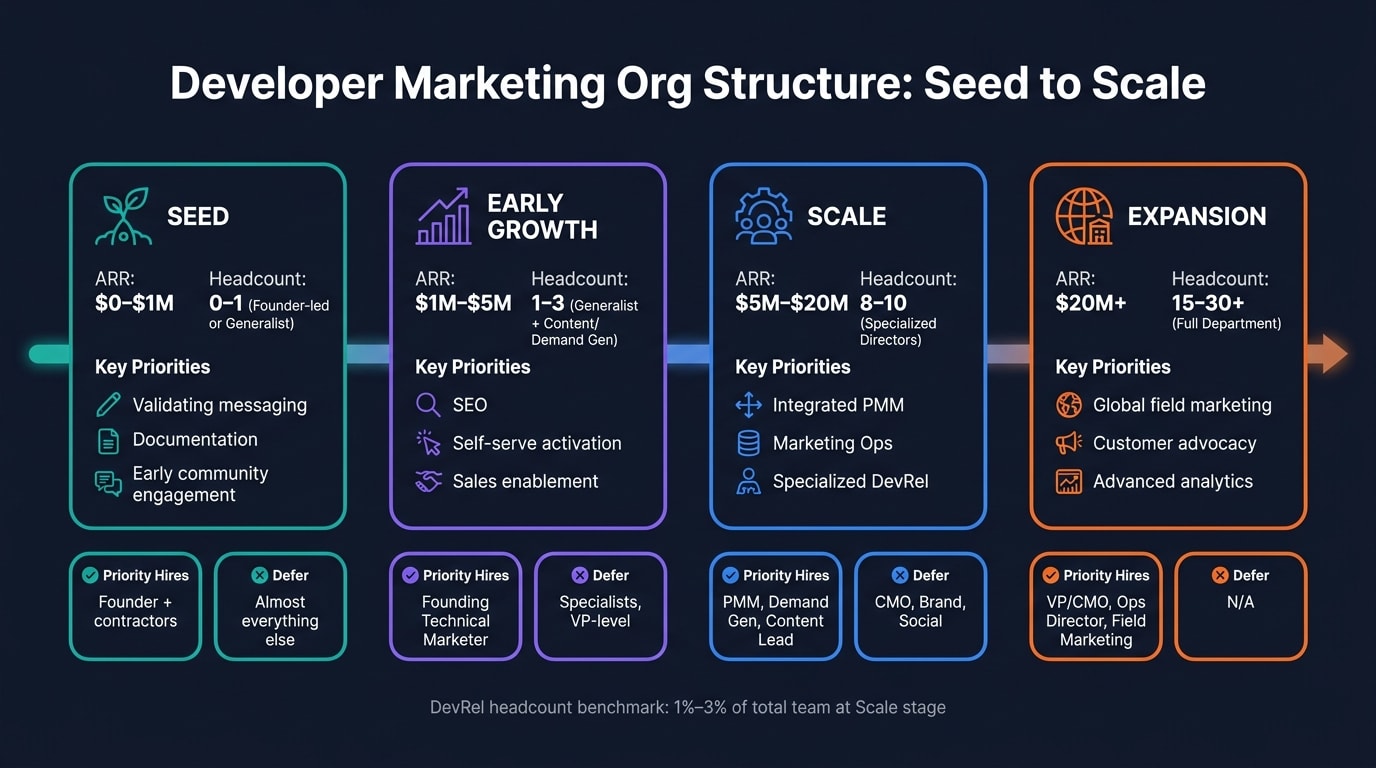
How the Org Evolves from Seed to Scale
The right reporting structure lays the groundwork for how your organization grows and adapts over time. What works for a small, seed-stage startup often needs to evolve as the company scales. Each growth phase demands specific headcount and shifting priorities.
At the seed stage (ARR of $0–$1M, fewer than 50 employees), the founder typically handles messaging and positioning. Any early hire is likely a generalist or a part-time DevRel contractor, focusing on documentation and initial community engagement. The primary goal here is to validate that your messaging resonates with the right developers.
As the company enters early growth (ARR of $1M–$5M, 50–200 employees), priorities start to shift. Key hires often include a Marketing Generalist and a Content Lead. During this phase, SEO becomes more impactful, self-serve activation gains importance, and sales enablement emerges as a critical focus. This is also when a hybrid Director role overseeing both DevRel and Marketing can offer significant advantages.
By the scale stage (ARR of $5M–$20M), the team typically expands to include a VP of Marketing, dedicated Product Marketing Managers, and specialized Developer Advocates. At this point, DevRel headcount usually accounts for 1% to 3% of the total team - a ratio that balances technical expertise with growth needs.
| Stage | ARR Range | Headcount | Key Priorities |
|---|---|---|---|
| Seed | $0–$1M | 0–1 (Founder-led or Generalist) | Validating messaging, documentation, early community engagement |
| Early Growth | $1M–$5M | 1–3 (Generalist + Content/Demand Gen) | SEO, self-serve activation, sales enablement |
| Scale | $5M–$20M | 8–10 (Specialized Directors) | Integrated PMM, Marketing Ops, specialized DevRel |
| Expansion | $20M+ | 15–30+ (Full Department) | Global field marketing, customer advocacy, advanced analytics |
As James Doman-Pipe, a B2B SaaS Positioning Specialist, wisely points out, "Structure follows strategy, not the other way around." Before adding to your team, consider what the business needs to achieve in the next year and identify which function is currently the bottleneck.
Hiring Order and Career Paths for Developer Marketing Roles
Who to Hire First and What to Skip
Once you've sorted out reporting lines, your first hire should be a generalist. At the $1M–$5M ARR stage, a Founding Technical Marketer who can juggle content, paid campaigns, analytics, and website management is more effective than diving into early specialization . This person needs to excel in both strategy and hands-on execution, covering tasks like writing and basic campaign management, instead of focusing on a specialized Product Marketing Manager (PMM) or Developer Relations (DevRel) lead.
Specialized roles like PMMs, Demand Generation leads, and Content leads usually make sense once your ARR surpasses $5M and you've identified which channels deliver results. On the other hand, roles like Brand/Creative, Social Media Managers, and Marketing Ops specialists can often wait longer than expected. While these functions are important, prioritizing them too early can create unnecessary overhead without driving immediate results .
When hiring, give every candidate a practical challenge. For example, ask them to draft a 90-day plan to increase the pipeline by 30% for your Ideal Customer Profile (ICP). Additionally, include a technical writing test for all marketing roles. Clear communication with developers is non-negotiable - no matter how impressive a résumé looks, weak writing skills will be a dealbreaker .
| Stage | ARR Range | Priority Hires | Roles to Defer |
|---|---|---|---|
| Stage 1 | $0–$1M | Founder-led + contractors | Almost everything else |
| Stage 2 | $1M–$5M | Founding Technical Marketer (generalist) | Specialists, VP-level hires |
| Stage 3 | $5M–$20M | PMM, Demand Gen Lead, Content Lead | CMO, Brand, Social Media Manager |
| Stage 4 | $20M+ | VP/CMO, Ops Director, Field Marketing | N/A - full team now warranted |
Once these foundational hires are in place, focus on defining clear career paths to retain and grow your technical marketing talent.
Career Ladders for PMM, DevRel, and Growth
As your team evolves from generalists to specialists, creating dual career tracks is essential for long-term growth and retention. Developer marketing roles typically split into two tracks: Individual Contributor (IC) and Management. The IC track emphasizes technical expertise and execution, progressing through levels like Junior → Senior → Staff → Principal. The Management track, on the other hand, focuses on strategy, team leadership, and cross-functional collaboration, advancing from Team Lead → Director → VP → CMO .
It's important to separate seniority from management readiness. A Staff-level PMM or Principal Developer Advocate can often have a bigger impact than a Director managing a small team. By clearly defining both tracks and ensuring comparable compensation at senior levels, you can prevent your top ICs from feeling pressured into management just to advance their careers.
For DevRel, HashiCorp offers a useful benchmark: as of August 2024, their DevRel team of about 50 people made up roughly 2% of their 2,500-person headcount . This 1%–3% ratio is a helpful guideline for scaling DevRel teams, regardless of whether individuals are on the IC or Management track.
Here are some 2026 U.S. salary benchmarks to help with compensation planning:
| Role | Mid-Level (3–5 yrs) | Senior (5–8 yrs) | Director+ |
|---|---|---|---|
| Product Marketing (PMM) | $100,000–$130,000 | $120,000–$160,000 | $140,000–$180,000 |
| Demand Gen / Growth | $90,000–$120,000 | $110,000–$140,000 | $130,000–$170,000 |
| Content / SEO | $80,000–$110,000 | $100,000–$130,000 | $110,000–$150,000 |
| Marketing Ops | $90,000–$120,000 | $110,000–$140,000 | $120,000–$160,000 |
| VP of Marketing | - | - | $160,000–$250,000 |
One challenge worth noting: PMMs often hit a ceiling at the Senior level because advancing to Staff or Principal requires them to influence product strategy rather than just supporting it. The most effective Senior PMMs break through this plateau by taking ownership of competitive intelligence and win/loss analysis - work that directly shapes the product roadmap instead of merely contributing to launch campaigns .
Rituals, Paid Growth, and Pitfalls to Avoid
Cross-Functional Rituals That Keep Teams Aligned
Once career paths are set and the right people are in place, the next challenge is ensuring PMM, DevRel, and Growth teams stay aligned. Without proper structure, these teams can easily veer off course, focusing on different metrics and priorities.
The key? Keep it simple. A weekly 30-minute sync is perfect for aligning on content calendars, launch plans, and event logistics. On a broader scale, a monthly 45-minute leadership meeting can use a "still true / partly true / no longer true" scorecard to identify and address any messaging shifts early on . For long-term planning, quarterly sessions tackle developer segment alignment, conference schedules, and budget allocation. These meetings can also include a quality review of the latest customer-facing assets to ensure messaging consistency .
"PMM quality is mostly cadence quality." - James Doman-Pipe, GTM Specialist
To support these rituals, two tools are essential: a shared content and launch calendar accessible to all three teams and a dedicated Slack channel. The Slack channel allows Growth to notify DevRel about new paid campaigns, ensuring documentation gets updated in sync . A RACI matrix is also invaluable, clearly outlining responsibilities for content and ads to avoid any confusion or territorial disputes .
With these rituals in place, the next step is scaling through paid channels.
Using Paid Channels to Scale Developer Reach
Paid advertising is often the last thing developer marketing teams explore - and for good reason. Developers tend to dislike traditional ads. But that doesn’t mean paid channels are off the table; it just requires a different approach.
The best strategy? A content-first approach. Instead of driving traffic to sales-heavy landing pages, focus on directing developers to documentation, tutorials, or "Getting Started" guides. This method builds on PMM’s messaging clarity and DevRel’s established trust with the community, ensuring the content resonates and maintains technical accuracy. Simplicity works best - use straightforward, descriptive language. For instance, "Identifies security gaps using AI" outperforms exaggerated headlines . DevRel should review paid creatives to catch any technical inaccuracies before they reach a discerning developer audience .
Platforms like daily.dev for Business are designed specifically for this purpose. With over 1 million developers actively engaging with technical content, it offers native ads in formats like in-feed, post pages, and personalized digests. The platform allows for precise targeting by seniority, programming language, and tooling, ensuring campaigns reach the right audience. Real-time tracking also enables Growth teams to adjust quickly, minimizing wasted budget on low-performing campaigns.
Common Org Mistakes and How to Avoid Them
Even with strong rituals and scaling strategies, structural missteps can derail progress. Developer marketing teams often fall into similar traps.
The most costly mistake? Hiring a VP of Marketing or CMO too early - before reaching $15M–$20M ARR. At this stage, senior leaders often spend more time creating strategy decks than executing campaigns, leaving critical work undone . Instead, opt for a "player-coach" Head of Marketing who can balance strategic direction with hands-on execution until the team grows enough to justify a leadership-heavy structure.
Another frequent error is letting DevRel and Marketing operate independently. DevRel often avoids anything that feels like selling, while Marketing focuses heavily on pipeline. This disconnect can result in duplicate content and inconsistent messaging . The solution? A one-page mandate document that clearly defines each team's responsibilities - and just as importantly, what they’re not responsible for. This eliminates confusion when priorities clash .
"When the macro tightens, get closer to revenue, not further from it. The instinct to retreat into 'pure community work' when budgets get cut is exactly backwards." - Ryan Boyd, Developer Advocate
Lastly, don’t treat brand and documentation as afterthoughts. A consistent brand voice is crucial for earning and maintaining developer trust, which is hard-won but easily lost. Similarly, poorly written documentation creates unnecessary friction right when developers are deciding whether to invest their time in your tool. While fixing these issues may not seem glamorous, neglecting them can lead to compounding problems over time .
Conclusion: How to Build a Developer Marketing Org That Grows With You
Creating a developer marketing organization that thrives over time isn't about how big your team is or how much money you can spend. The real key is getting the PMM, DevRel, and Growth triad to move in sync at the right moments. Each part plays a vital role: PMM defines your positioning, DevRel establishes technical credibility, and Growth drives acquisition and retention.
As your company grows - from seed stage to Series B - your org structure will need to adapt. Early on, a single generalist might take you from $0 to $1M ARR. But once you're in the $5M–$20M range, it's crucial to bring in specialists who can focus on specific areas. A common pitfall is hiring for where you wish your company was, instead of addressing the needs of your current stage.
Keeping everything aligned requires ongoing collaboration, which is where cross-functional rituals come in.
"A developer audience is a compounding asset, not a campaign." - Ryan Boyd, Developer Advocate
These rituals - like weekly syncs, shared calendars, and a RACI matrix - ensure that the triad stays connected and consistent. They help prevent your messaging from going off course. When you're ready to scale your reach through paid channels, tools like daily.dev for Business allow Growth teams to target over 1 million developers with pinpoint accuracy - filtering by seniority, programming language, and tools - while maintaining the trust that DevRel has built.
"Consistency compounds. Small, disciplined updates beat dramatic rebrands every time." - James Doman-Pipe, B2B SaaS Positioning Specialist
The most successful teams approach developer marketing as a long-term system rather than a collection of short-term campaigns. Build your structure early, adapt it thoughtfully as you grow, and let the power of compounding work in your favor. For more expert insights on developer marketing, explore our resource library.
FAQs
Who should DevRel report to at my company?
DevRel teams should align with leadership that prioritizes strengthening developer engagement. This often means reporting to Product or Engineering, especially when the focus is on driving product adoption and gathering developer feedback.
However, if responsibilities for developer growth are divided among various functions, the structure can shift:
- CTO or Product: DevRel may report here when its role emphasizes technical engagement, while Developer Marketing operates separately under the CMO.
- Marketing-Led Approach: In cases where Marketing oversees developer growth, DevRel might report directly to the CMO, creating a unified strategy for all developer-focused initiatives.
The reporting structure depends on where DevRel can most effectively contribute to the organization's goals.
What should I hire first for developer marketing?
When building a developer marketing team, your first hire should align with your go-to-market strategy rather than focusing on seniority. Here's a breakdown:
- Product-led growth strategy: Start with a Growth Marketer who can drive user acquisition and engagement.
- Sales-led strategy: A Developer Advocate is your best bet to connect with the developer community and build trust.
- Hybrid models: Consider a Technical Content Writer to produce content that bridges both approaches effectively.
For early-stage companies, it's smart to bring on a versatile generalist. Look for someone who blends technical expertise with marketing skills - someone capable of writing content, managing campaigns, and tracking performance metrics. At this stage, execution is far more critical than hiring for high-level leadership roles. Focus on getting things done.
How do PMM, DevRel, and Growth share ownership of results?
In a well-organized developer marketing team, the roles of PMM, DevRel, and Growth are clearly defined to ensure smooth collaboration. PMM (Product Marketing Management) focuses on crafting the right positioning, creating compelling messaging, and managing product launches. On the other hand, DevRel (Developer Relations) emphasizes building a strong community and earning developers' trust. Meanwhile, the Growth team concentrates on driving acquisition, activation, and retention.
Key practices like aligned metrics, structured rituals (e.g., launch reviews and content councils), and open communication keep these teams working together effectively. DevRel acts as the bridge between engineering and marketing, while PMM and Growth focus on generating demand and building the pipeline. Together, this synergy helps prevent silos and ensures the team operates as a cohesive unit.