

Hook: Developer onboarding isn't just about guiding users - it's a powerful way to drive growth and conversions.
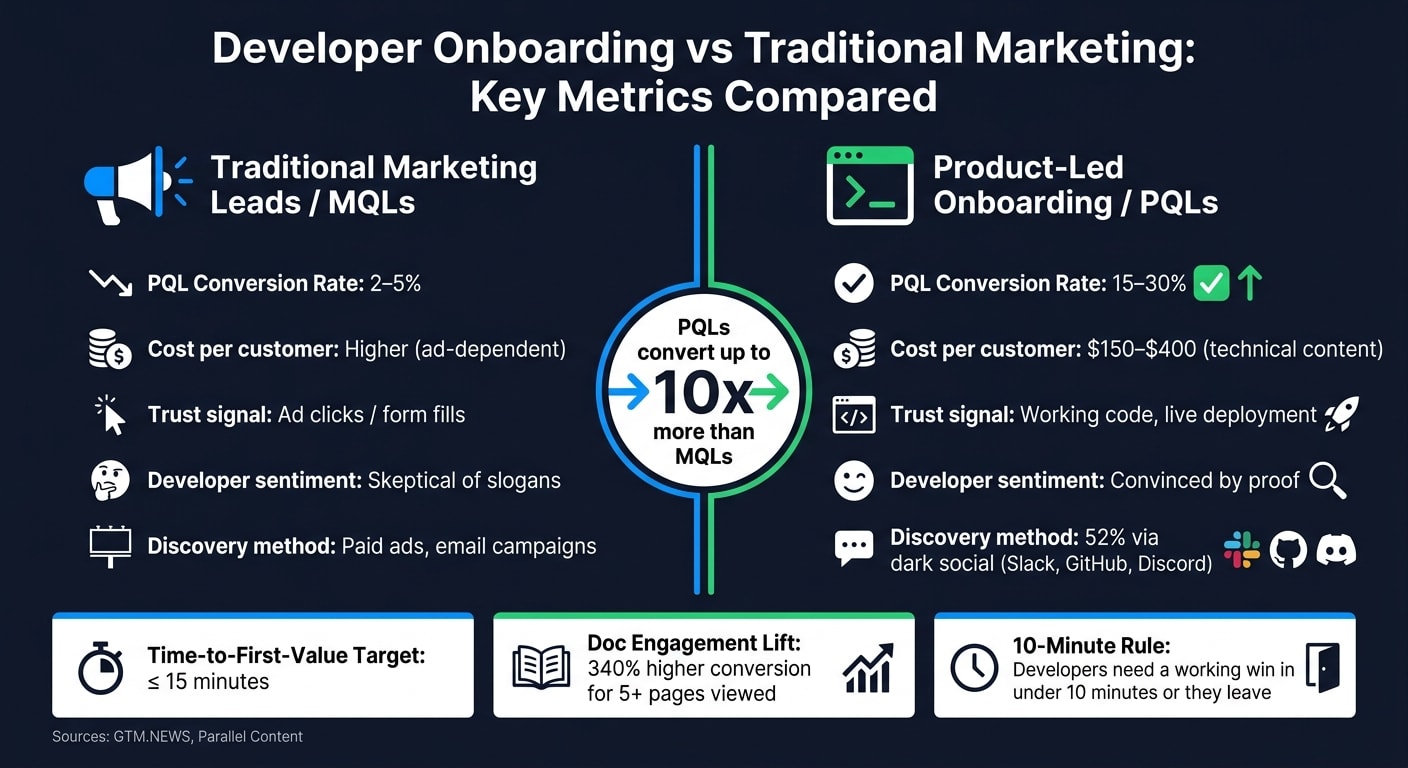
Value Summary: The key to turning signups into paying customers lies in helping developers achieve their first success quickly. Metrics like Time-to-First-Value (TTFV) and activation rates show that effective onboarding can convert 15–30% of users, compared to 2–5% for traditional marketing leads. By focusing on streamlined onboarding, tailored paths, and strong documentation, you can transform this often-overlooked phase into a growth engine.
Quick Overview:
- First Success Matters: Conversion happens when developers experience success, not at signup.
- Key Metrics: TTFV ≤ 15 minutes, activation rates, and documentation engagement directly impact conversions.
- Onboarding Drives Growth: Early wins lead to word-of-mouth referrals and higher retention.
- Actionable Steps: Simplify onboarding, focus on the 10-minute rule, and create tailored paths for different personas.
Bridge: Let’s dive into how companies like Vercel and Supabase use onboarding to fuel growth.
The Link Between DX and Developer Marketing
Why Developer Marketing Begins Inside the Product
Developers aren’t swayed by flashy marketing slogans - they’re driven by proof. They rely on documentation, quickstarts, and sample API calls to validate a product's value before even signing up. Thalia Barrera, Software Engineer and Writer at Parallel Content, sums it up perfectly:
"Documentation is not just where developers learn your product; it is where they decide whether it is worth their time."
This means your onboarding flow and documentation aren’t just support tools - they’re your front-line marketing assets. A poorly designed quickstart or a broken code snippet doesn’t just annoy developers; it actively hurts your chances of acquiring them. Here’s a telling statistic: developers who interact with five or more unique documentation pages during their first session are 340% more likely to convert compared to those who visit just one page .
Core DX Mental Models for Growth
To turn onboarding into a growth engine, focus on these three guiding principles:
Time-to-First-Value (TTFV): This is the time it takes for a developer to go from signing up to successfully using your product. Aim for under 15 minutes. Every extra step - like unnecessary verifications - adds friction and lowers conversion rates.
The 10-Minute Rule: Your "Getting Started" guide should empower developers to achieve a working implementation in 10 minutes or less.
The Happy Path: Create the simplest, most streamlined route to an early success. Avoid one-size-fits-all onboarding. Instead, design tailored "golden paths" for different user personas. For example, a solo developer experimenting in a sandbox environment will need a different experience than a DevOps lead evaluating security features. Each path should minimize setup and maximize early wins .
These principles are the backbone of effective onboarding. Once they’re in place, you can measure success with clear, actionable metrics.
Key Metrics and Benchmarks for Developer Onboarding
To treat onboarding as a marketing asset, focus on outcomes instead of just activity. The following metrics tie the quality of developer experience (DX) directly to acquisition success:
| Metric | What It Measures | Benchmark |
|---|---|---|
| Time to First Value (TTFV) | The time from signup to first success | ≤ 15 minutes |
| Activation Rate | Percentage of signups reaching a meaningful first use | Directly linked to PQL conversion |
| PQL Conversion Rate | Percentage of engaged users converting to paid customers | 15%–30% |
| Trial-to-Paid Rate | Conversion rate from free trial to paid tier | 15%–25% |
| Doc Engagement Lift | Increase in conversion for developers engaging with documentation | 340% (for 5+ pages) |
The difference between PQL conversion rates (15%–30%) and typical MQL conversion rates (2%–5%) highlights how impactful a strong onboarding experience can be. A developer who achieves an early success is up to 10 times more valuable than one who merely clicks on an ad. This makes onboarding not just a product decision but one of the most effective marketing investments a developer-focused company can make.
How Onboarding Drives Organic Developer Acquisition
Word of Mouth and Referral Loops
Developers don't recommend tools because of flashy ads - they do it because those tools deliver real results. When a developer successfully launches their first project or executes their first API call, that success becomes a story they want to share. These stories spread in private Slack channels, GitHub issues, Discord servers, and even during quick talks at conferences.
The challenge? This kind of sharing is invisible to analytics. Studies reveal that 52% of developer tool discovery happens through "dark social" channels - spaces like private messages, internal Slack groups, and direct recommendations . While you can't track these interactions, you can earn them by delivering an exceptional first experience.
"Acquisition ends at first success, not first signup." - Peter Strauss, Author at GTM.NEWS
Once developers experience success, word-of-mouth can snowball. After about 30–60 satisfied users, you'll start noticing organic signups from untraceable sources - someone dropped your docs in a team meeting or mentioned your tool in a private chat . These organic endorsements highlight how effective onboarding lays the groundwork for both immediate wins and sustained growth.
The 10-Minute Rule for Developer Tools
To build on word-of-mouth momentum, the 10-minute rule is critical: developers need to achieve a meaningful win fast. When trying out a new tool, they usually allocate a short window of attention. If they can't see results - like a real API response, a successful deployment, or a passing test - within 10 minutes, they're likely to move on . This window is your one shot to make a lasting impression.
The goal is to help developers confirm the tool's functionality quickly. For example, the first API call should return a real response, or a deployment should go live without a hitch. If developers experience your tool's core value before they lose interest, you've already won half the battle.
This approach also reduces the need for sales follow-ups. When a developer achieves a quick win, they're already convinced . They're also more likely to involve their team or mention the tool in a blog post or forum.
Onboarding as a Growth Loop
Effective onboarding doesn't just convert one developer - it creates a ripple effect. A new user experiences success quickly, becomes an advocate, and brings in the next wave of users. Those new users then repeat the cycle, creating a continuous loop.
This self-sustaining growth is what sets product-led strategies apart from traditional marketing. Every improvement in onboarding - whether it's simplifying a setup step, addressing a common failure point, or shortening the time to first success - not only helps the current user but also enhances the experience for future users. And each positive experience increases the likelihood of advocacy .
The key metric for measuring this loop isn't just activation rates - it’s referral behavior tied to early activation. Developers who achieve success in their first session are the ones who later say, "A colleague recommended it", or "I saw it on Hacker News", in response to "How did you hear about us?" That’s the loop in action. This cycle of quick wins and advocacy transforms onboarding into a powerful marketing asset, setting the stage for further exploration in the next section.
Turning Onboarding Into a Marketing Asset
Quickstarts, Tutorials, and SEO
For many developer tool companies, documentation is often seen as just a support resource. But here's the thing: it can also be a powerful discovery channel. Developers aren’t searching for your product by name - they’re searching for solutions to their problems. Queries like "postgres connection pooling node.js" or "how to handle webhook retries in Python" are what they type into search engines. A well-crafted quickstart that addresses these specific issues not only builds trust but can also drive conversions before a developer even visits your homepage. In fact, when developers engage with multiple documentation pages, conversion rates see a noticeable boost .
Targeting these long-tail technical queries with actionable, runnable examples is one of the most efficient ways to attract new users. Technical content marketing often costs between $150–$400 per customer for established companies, making it a cost-effective strategy .
"Your README, your examples directory, your API reference, and your SDK docs are your LLM marketing." - Joe Karlsson, Developer Advocate, CloudQuery
This approach is even more relevant as AI-native tools like Cursor and Claude Code become integral to the developer workflow. When a developer asks their coding assistant to scaffold a project using your SDK, the quality of your documentation will determine whether your tool gets recommended or overlooked. Keeping your README, examples, and API reference up-to-date isn’t just about good maintenance - it directly impacts how frequently your product appears in AI-generated code suggestions .
Interactive methods can take this concept even further, accelerating user success and engagement.
Interactive Tutorials and Code Sandboxes
Even the most well-written quickstart can lose a developer if they hit a snag with their local setup. That’s where in-browser sandboxes shine. By removing the need for local configuration, developers can run their first API call or see a live deployment instantly. This drastically shortens the time to that all-important "It works" moment.
Hands-on training is a game-changer for driving adoption. In fact, 42.6% of developers rank real-world, interactive training as the most effective method for learning, compared to 39% for step-by-step documentation . Yet, fewer than one-third of organizations currently invest in interactive labs . This gap presents a major opportunity. Sandboxes aren’t just a user experience perk - they’re a conversion tool. Developers who experience a working product in under 15 minutes are far more likely to return, upgrade, and recommend .
The key is to focus on identifying the single "It works" moment in your product. Whether it’s the first successful API response, a passing test, or a live deployment, remove every unnecessary step that stands in the way. Pre-configure permissions, automate repository connections, and include fallback paths with reliable sample projects to ensure success even when issues arise .
These interactive solutions create a seamless bridge between targeted advertising and personalized onboarding, paving the way for tailored user journeys.
Connecting Ad Campaigns to Onboarding Paths
With strong quickstarts and sandboxes in place, ad campaigns can directly funnel high-intent developers into tailored onboarding experiences. Sending all developers to a generic signup page wastes the precision targeting efforts of your ads. Instead, align the ad content with specific onboarding paths designed for different developer needs.
For example, a DevOps lead evaluating reliability will require different onboarding materials than a solo developer looking to ship quickly. Developers who engage meaningfully with your product - Product Qualified Leads - convert to paying customers at rates of 15–30%, compared to just 2–5% for traditional marketing leads . By creating a tight, relevant path from ad click to first success, you can close that gap.
| Developer Persona | Onboarding Focus | Goal |
|---|---|---|
| Solo Developer | Sandbox evaluation | Immediate "It works" moment |
| Startup Engineer | Real repo integration | Validation of time-saving |
| Enterprise Lead | Security/workflow fit | Evidence-based trust |
| DevOps Lead | Multi-environment rollout | Reliability and scalability |
Platforms like daily.dev Ads make this approach feasible. With precise targeting based on roles, programming languages, and tools, you can direct a backend engineer to a Python-specific quickstart or a frontend developer to a framework-specific sandbox - all from the same campaign. The targeting handles segmentation, and your onboarding paths handle the conversions. Over time, these optimized pathways turn ad campaigns into reliable acquisition engines that fuel sustained growth.
Measuring Onboarding as a Marketing Channel
This section dives into how to evaluate onboarding performance and fine-tune your process to better drive acquisition results, building on the earlier benchmarks.
Metrics That Show Whether Onboarding Is Working
Signups alone don’t indicate demand. As Peter Strauss from GTM.NEWS puts it: "A signup is not proof of demand. A signup is proof of curiosity." The real measure of success is when a developer achieves their first meaningful milestone, like a successful API call, a live deployment, or passing a test.
The Time-to-First-Success (TTFS) - the median time it takes from signup to that initial win - is one of the most telling metrics. Pair it with activation rate (the percentage of signups reaching that first milestone) to identify where your onboarding process excels or falters.
Another key signal is documentation engagement. Developers who explore five or more unique documentation pages during their first session convert at a rate 340% higher than those who only view one . If most users leave after viewing a single page, it’s a clear sign that your onboarding isn’t effectively drawing them into the product.
| Metric | What It Measures | Why It Matters |
|---|---|---|
| Time-to-First-Success (TTFS) | Median time from signup to first win | Faster success builds trust and encourages organic referrals |
| Activation Rate | % of signups reaching first use | Directly impacts trial-to-paid conversion rates |
| Doc Page Depth | Unique doc pages viewed in session one | Viewing 5+ pages correlates with a 340% higher conversion rate |
| Team Invite Rate | Users who invite colleagues | Reflects viral growth potential and user confidence in the product |
| Community Contribution | Users answering questions within 90 days | Predicts 65% higher retention and 40% greater product usage expansion |
These metrics provide a solid foundation for assessing how well your onboarding aligns with acquisition goals.
Connecting Onboarding Quality to Acquisition Outcomes
A seamless onboarding experience doesn’t just retain users - it also drives acquisition. Developers who have a smooth first experience are far more likely to recommend your product through word-of-mouth. While much of this happens in private channels that analytics tools can’t track, you can uncover these referrals by asking directly. A simple "How did you hear about us?" field during onboarding can reveal insights you’d otherwise miss.
The numbers back this up. Product Qualified Leads (PQLs) - users who’ve meaningfully engaged with your product - convert to paying customers at a rate of 15–30%, compared to just 2–5% for traditional marketing leads . Boosting your activation rate isn’t just a product improvement; it’s a direct multiplier for acquisition efficiency. Additionally, developers who contribute to the community early on (e.g., answering a question within 90 days) show 65% higher retention rates and 40% more usage expansion . These users often become internal advocates, bringing teammates on board.
A/B Testing and Continuous Improvement
Once you’ve identified key metrics, the next step is to test and refine your onboarding flow. Observing real users can quickly reveal friction points. For example, a 30-day activation audit - where you track 10 users as they attempt to reach their first success and note where they struggle or detour - can highlight bottlenecks faster than analytics alone .
From there, experiment with targeted changes. Compare a generic onboarding flow to a “golden path” tailored for specific personas, like solo developers in a sandbox versus enterprise engineers integrating a real repository. Also, test fallback options - such as troubleshooting pages or pre-built sample projects - at common drop-off points. Finally, monitor second-step behaviors after the first win to ensure onboarding builds momentum instead of ending with a single action. Incremental, focused improvements over time can transform your activation rates from average to outstanding.
Common DX Problems That Hurt Acquisition
Building on the earlier discussion of onboarding metrics, it's clear that DX (Developer Experience) issues can undermine even the best acquisition strategies. As Peter Strauss aptly says: "If the developer does not reach a real first win fast enough, you did not really acquire them." Most DX problems fall into three common categories, often causing developers to give up before they experience the product's value.
Setup and Installation Problems
Broken setup scripts, version mismatches, and overly complex permission processes can lead to abandonment in as little as five minutes. Many onboarding flows focus solely on the "happy path", leaving developers stranded when something goes wrong, with no clear way forward.
To counter this, design with potential failures in mind. Offer fallback options like a troubleshooting guide and a sample repository that developers can clone and run immediately. Observing a small group of real users as they navigate the setup process - and timing each step - can uncover friction points far more effectively than analytics tools alone.
Beyond just setup, the quality of documentation plays a key role in building trust and ensuring early success.
Documentation Gaps and Outdated Content
Poor or outdated documentation sends a strong message about product readiness.
"Thin docs signal that the product is immature. Outdated docs signal that the team is not on top of it. Confusing docs erode confidence in product quality." - Thalia Barrera, Software Engineer and Writer
Developers often evaluate your documentation before deciding to sign up. If it looks neglected or incomplete, many won't even try the product. To keep documentation in good shape, establish a routine: update relevant pages before every release, audit pages with high "Was this helpful? No" votes monthly, and thoroughly review your top 100 most-visited pages every quarter. Every code snippet should also be tested, versioned, and linked to a live repository to ensure it matches the latest SDK.
Cryptic Errors and Poor Debugging Paths
Unclear error messages can be a major roadblock during onboarding. When developers encounter errors without any guidance, frustration builds quickly.
To address this, link common error codes or messages to searchable troubleshooting guides. Track your support-to-docs ratio to identify recurring issues that confuse users. As Thalia Barrera points out, "Nothing erodes trust faster than a tutorial where the happy path works but everything else is undocumented." Each support ticket should be treated as a clue to improve your documentation and reduce future friction.
| DX Failure | Acquisition Impact | Recommended Fix |
|---|---|---|
| Broken setup scripts | High abandonment in the first five minutes | Provide a troubleshooting guide and a sample repository |
| Outdated documentation | Loss of technical credibility before signup | Sync documentation updates with every release and test all code snippets |
| Cryptic error messages | Frustration leading to silent churn | Link errors to specific, searchable troubleshooting guides |
Fixing these DX issues is essential to maintaining the onboarding momentum that helps convert developers into loyal users.
Case Studies: DX-Led Growth at Vercel, Supabase, and Clerk
Great onboarding can sidestep common developer experience (DX) challenges, turning it into a powerful driver of growth. Let's look at how Vercel, Supabase, and Clerk have transformed onboarding into an acquisition powerhouse. Each company focuses on delivering rapid results by defining a clear "first success" moment and cutting out any extra steps.
Vercel: Live Deployments in Minutes
Vercel’s secret to success? A live deployment in under 15 minutes . By connecting directly with a developer's Git repository, Vercel automates setup and deployment into a single, seamless process. This "Golden Path" approach ensures developers see the product’s value almost instantly, with no unnecessary hurdles.
While Vercel emphasizes automation, Supabase takes a different route by offering familiar tools that feel intuitive.
Supabase: Familiar Tools for Quick Wins
Supabase simplifies the onboarding process with hosted dashboards and ready-to-go starter templates. These tools remove the pain of setup, making it easy for developers to dive in and achieve success quickly .
Clerk: Authentication Made Simple and Memorable
Clerk’s onboarding ensures developers can implement a working authentication flow in less than 15 minutes . The use of straightforward SDKs makes this possible, providing a quick validation of the product’s utility. What’s more, Clerk’s well-organized SDK documentation plays a critical role. Developers who explore five or more documentation pages during their first session are 340% more likely to convert compared to those who visit just one page .
"Acquisition ends at first success, not first signup." - Peter Strauss, Author, GTM.NEWS
These examples highlight a common thread: when onboarding is optimized, DX becomes a growth engine. Whether it’s through automation, familiar tools, or clear documentation, the formula is simple - define the first success milestone, remove unnecessary steps, and let the onboarding experience speak for itself.
Conclusion: Making Onboarding a Core Growth Lever
Companies like Vercel, Supabase, and Clerk have shown that winning over developers doesn't come down to outspending competitors - it’s about creating a better onboarding experience. Developer onboarding is a powerful, measurable growth channel that many dev tool companies still overlook.
What can we learn from their success? It starts with cross-functional alignment. By bringing marketing, product, and developer experience (DX) teams together under one shared goal - Time-to-First-Success (TTFS) - you can transform onboarding into a strategic asset. It’s not just a step in the product journey; it’s a key opportunity to close the gap between Product-Qualified Leads (PQLs) and Marketing-Qualified Leads (MQLs). By improving this process, you can eliminate friction, shorten feedback loops, and see measurable improvements in user acquisition.
Once your onboarding is dialed in, other growth strategies, like targeted ad campaigns, become much more effective. For example, using daily.dev Ads to attract high-intent developers can drive them straight into optimized onboarding flows. This creates a seamless path where curiosity turns into action, and action fuels meaningful growth.
FAQs
What counts as 'first value' in a developer onboarding flow?
The 'first value' in a developer onboarding experience is that pivotal moment when a user confidently thinks, "It works." It could be something like successfully making their first API call, deploying an application live, or running a test that passes. This milestone needs to be clear, tangible, and impactful - a point that clearly showcases the product's capabilities and usefulness.
How can I measure onboarding-driven acquisition if referrals happen in dark social?
To get a handle on onboarding-driven acquisition in dark social, keep an eye on leading indicators like activity on Discord linked to company domains and the growth in GitHub stars. During onboarding, use surveys that ask, "How did you hear about us?" to pick up on word-of-mouth referrals. Pair these insights with UTM attribution data from measurable channels. Together, this strategy helps connect the dots between untraceable and trackable referral sources.
What’s the fastest way to cut Time-to-First-Value to under 15 minutes?
To get Time-to-First-Value under 15 minutes, streamline the activation path so developers can hit an early win - like making their first API call or completing a deployment - fast. Eliminate extra steps, pre-configure workflows where possible, and provide handy tools like copy-paste code snippets or one-click demos to make the process smoother and quicker.