
Developer-focused advertising is expensive and challenging in 2026. Here's why:
- 67% of developers use ad blockers, making traditional ads less effective.
- CPCs for developer-specific keywords can range from $25 to $80, far higher than general B2B terms ($2.50–$7).
- LinkedIn Ads CPMs are $60–$120, while Google Display CPMs are $20–$40 with low CTRs (0.25–0.35%).
Key insights:
- Google Search is best for high-intent users, but niche terms cost $12–$30 per click.
- LinkedIn excels in role-based targeting but is expensive ($8–$14 CPC).
- Reddit Ads are affordable (~$0.44 CPC) but work better for awareness than conversions.
- X Ads (formerly Twitter) offer strong engagement (0.8–1.2% CTR) with CPMs of $25–$45.
- In-IDE Ads and developer content platforms deliver the highest CTRs (up to 2.5%) and better conversion rates, bypassing ad blockers.
Takeaway: Developer ads cost more but perform better with precise targeting, contextual placements, and tailored messaging. Focus budgets on high-performing channels like native ads and in-workflow placements to maximize results.
Why Developer Ad Costs Are Higher and More Variable
Developer advertising tends to be pricier and less predictable compared to standard B2B campaigns. To manage budgets effectively, it's crucial to understand the factors driving these costs.
Smaller Audience, Higher Intent
The pool of developers is much smaller than the broader B2B market, which creates fierce competition for impressions and clicks. For example, niche search terms like "API platform" can cost $12–$25 per click, while "developer tools" ranges from $15–$30 CPC . Broader terms, such as "software development company", are even more expensive, often attracting non-qualified traffic from job seekers and students instead of actual buyers .
"The niche determines whether paid ads are your most efficient pipeline channel or your most expensive marketing mistake." - Peter Korpak, Founder, 100signals
Premium Ad Inventory
The scarcity of the developer audience is further compounded by the widespread use of ad blockers. With 67% of developers using ad blockers , traditional display ads often go unseen. This limited visibility drives up the cost of ad inventory that does reach developers, such as native placements, in-IDE ads, and ads on developer-focused platforms.
For instance:
- LinkedIn CPMs for developer targeting range from $60 to $120 .
- In-IDE advertising costs $35–$55 CPM but delivers 5–8x more trial signups per dollar compared to standard display formats .
These higher costs reflect both the scarcity of the audience and the value of placing ads in a context that resonates with developers. This is why careful budget allocation is critical when targeting this niche group.
What This Means for Budget Planning
Using general B2B benchmarks for developer campaigns can lead to underfunded and ineffective efforts. For example, expecting a $0.50 CPC in this space is unrealistic.
A tiered budgeting strategy can help focus spending on the channels where developers are most engaged:
- Under $2,000/month: Concentrate on one high-intent channel to maximize efficiency.
- $2,000–$10,000/month: Split spending across native placements (50%), newsletter or community sponsorships (30%), and retargeting (20%).
- $10,000+/month: Adopt a full-funnel approach, balancing acquisition, awareness, search intent, and retargeting, with an emphasis on channels offering the best contextual fit.
Seasonality also plays a role. Developer engagement often peaks in January and September but drops significantly in December and during major tech conference weeks . Understanding these dynamics is key to setting realistic CPM, CPC, and CTR benchmarks for your campaigns.
CPM, CPC, and CTR Benchmarks by Channel
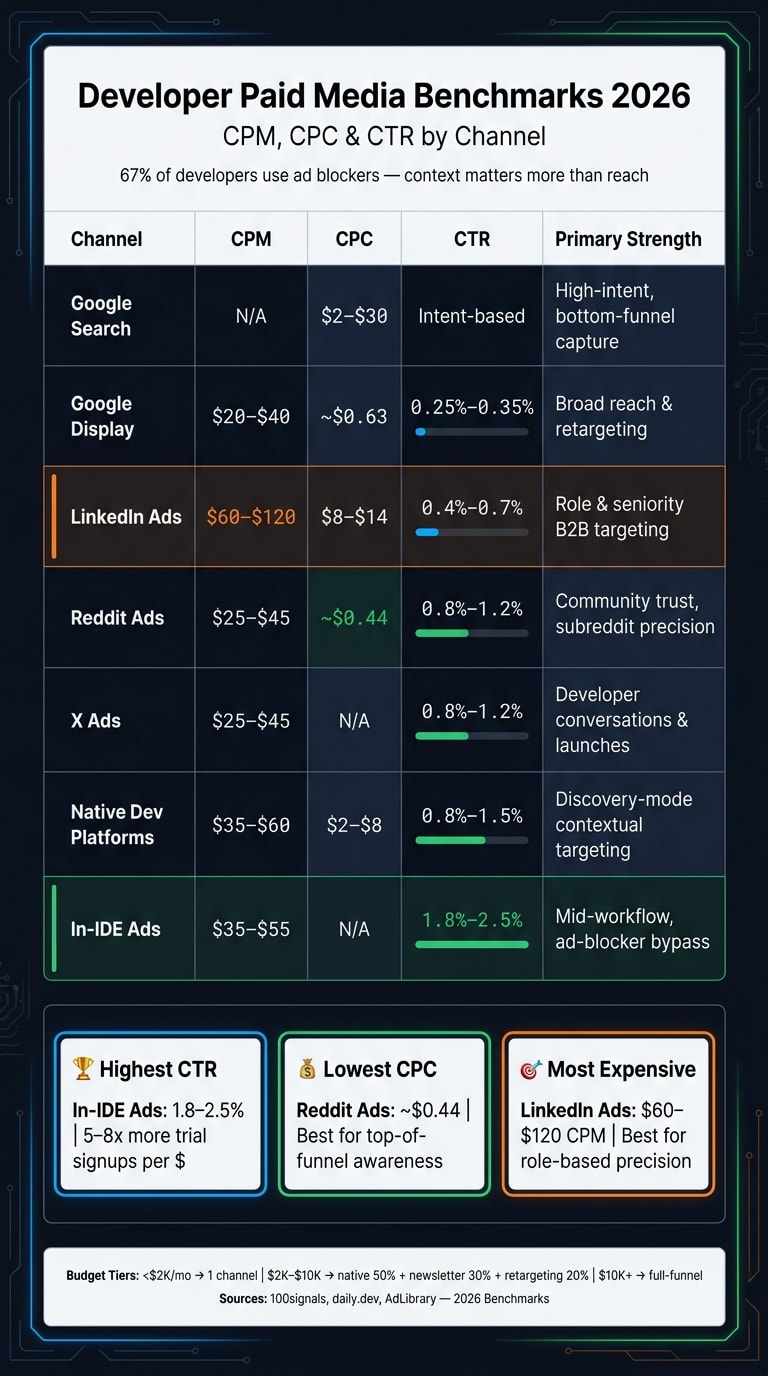
When targeting developers, each advertising channel offers a unique mix of costs and engagement levels. The difference between the least and most expensive options can be striking, but raw CPM or CPC figures only tell part of the story. Let’s dive into the data for 2026 to see how the major channels stack up.
Google Ads: Search vs. Display for Developers
Google Search is still the top choice for reaching high-intent users, but it’s not cheap. CPCs have climbed 12–18% year-over-year in most B2B sectors. For developer-related keywords, costs range from $2–$8 CPC for general terms like SaaS or software. However, niche phrases such as "API platform" or "developer tools" can hit $12–$30 CPC .
Meanwhile, Google Display offers a very different landscape. CPMs fall between $20–$40, but with CTRs of just 0.25–0.35% . Ad blockers further reduce visibility, making this option less effective for some campaigns. To avoid wasting your budget, use aggressive negative keyword lists to filter out irrelevant searches like "jobs", "tutorial", or "free" .
LinkedIn Ads: Precision Targeting with Higher Costs
LinkedIn offers unmatched targeting for professional roles and seniority, but it comes with a steep price tag. CPMs range from $60 to $120, and CPCs have increased 20–25% since 2024, with median B2B SaaS CPCs now at $8–$14 . Standard sponsored content achieves a CTR of 0.4–0.7% .
For better engagement, try LinkedIn's Thought Leader Ads. These promote authentic posts from founders or employees, delivering a 0.95% CTR - nearly double the standard sponsored content rate - at a lower cost per engagement .
"Paid ads for software development companies is the channel that separates agencies with clear positioning from agencies burning cash." - Peter Korpak, 100signals
Reddit Ads: Affordable Access to Technical Communities
Reddit offers the lowest CPC on this list at ~$0.44 . It’s a great channel for top-of-funnel awareness, especially in subreddits like r/programming, r/devops, or r/golang. However, your ads need to blend seamlessly with the community’s tone. Overly promotional content can backfire, leading to negative engagement.
Reddit works best for volume and discovery rather than direct conversions. Pair it with retargeting efforts on higher-intent platforms for a more effective strategy.
X Ads: Engaging Developers Through Conversations
X (formerly Twitter) excels at connecting with developers. CPMs range from $25–$45, and the platform boasts a developer-specific CTR of 0.8–1.2% . This outperforms LinkedIn’s standard formats and is far superior to Google Display. Developers on X often engage with technical discussions, product launches, and open-source updates, making it an ideal environment for relevant ads.
However, while engagement is strong, the conversion path can be longer and less direct compared to search or native placements.
Developer Content Platforms: High-Context Native Ads
Native ads on developer-focused platforms strike a great balance between cost and performance. CPMs range from $35–$60, with CTRs between 0.8–1.5% . These platforms provide a natural context for ads, as developers are already exploring tools, frameworks, and solutions.
In-IDE advertising takes this a step further. With CPMs of $35–$55 and CTRs of 1.8–2.5%, these ads generate 5–8x more trial signups per dollar compared to standard display ads. By targeting developers mid-workflow, they also bypass ad blockers entirely .
Channel Comparison at a Glance
Here’s a quick overview of how these channels perform:
| Channel | CPM | CPC | CTR |
|---|---|---|---|
| Google Search | N/A | $2–$30 | N/A (intent-based) |
| Google Display | $20–$40 | ~$0.63 | 0.25%–0.35% |
| LinkedIn Ads | $60–$120 | $8–$14 | 0.4%–0.7% |
| Reddit Ads | N/A | ~$0.44 | N/A |
| X Ads | $25–$45 | N/A | 0.8%–1.2% |
| Native (Dev Platforms) | $35–$60 | N/A | 0.8%–1.5% |
| In-IDE Ads | $35–$55 | N/A | 1.8%–2.5% |
Sources:
Conversion Rates and CPA Benchmarks by Product Type
Understanding conversion rates alongside ad costs is key to crafting a realistic budget. While ad costs reveal the initial investment, conversion rates shed light on the performance of developer-focused ads after the click. These metrics vary significantly depending on the product type, making it essential to evaluate post-click results carefully.
SaaS and API Products
For SaaS and API offerings, the average click-to-signup (trial) rate ranges between 3–5%, with top-tier campaigns achieving 8–15% . The difference often comes down to whether the landing page aligns with the ad's intent. A well-targeted landing page can outperform a generic homepage by boosting conversion rates by 2×–5× .
Once users sign up for a trial, the trial-to-paid conversion rate averages 12–18%, with leading products reaching as high as 25–35% . Conversion rates also vary by developer role: DevOps and SRE professionals lead with a trial signup rate of 11%, followed by backend developers at 9% and full-stack developers at 8% . If your product is tailored for infrastructure or backend workflows, this distinction could give you a competitive edge.
When it comes to costs, Google Search trial signups typically fall in the $100–$300 range . Achieving a cost per trial (CPT) under $30 is considered strong, and under $15 is exceptional . These benchmarks provide a useful comparison point for analyzing the performance of open source projects and developer tools.
Open Source Projects and Developer Tools
Open source projects and developer tools operate under different dynamics. Developers exploring these tools are often in a discovery phase - testing, integrating, and learning - rather than being ready to purchase. This means contextual, in-workflow ad placements tend to outperform traditional search or social ads.
Advertising within integrated development environments (IDEs) yields trial signup rates of 6–10%, with the top 25% of campaigns reaching 12–18% . On developer content platforms, native ads produce a cost per qualified lead of $50–$150 , which is notably lower than LinkedIn's range of $80–$200 . When you factor in the number of trials generated per dollar spent, the efficiency of these channels becomes even clearer:
| Channel | Trials per $1,000 Spent | Estimated Paid Conversions |
|---|---|---|
| In-IDE Advertising | 35–55 | 5–8 |
| Google Search | 15–25 | 2–4 |
| Native Ads | 8–12 | 1–2 |
| LinkedIn Ads | 2–4 | 0.3–0.6 |
Company size also influences conversion rates. Startups with 1–50 employees convert 1.5× faster than average, while enterprise accounts with 500+ employees convert at just 0.9× the baseline rate . For open source projects and developer tools that rely on bottom-up growth, this startup advantage underscores the importance of precise audience targeting over broader campaigns.
"The niche determines whether paid ads are your most efficient pipeline channel or your most expensive marketing mistake." - Peter Korpak, 100signals
daily.dev Native Ads: Performance in Context
In-Feed Placement Performance
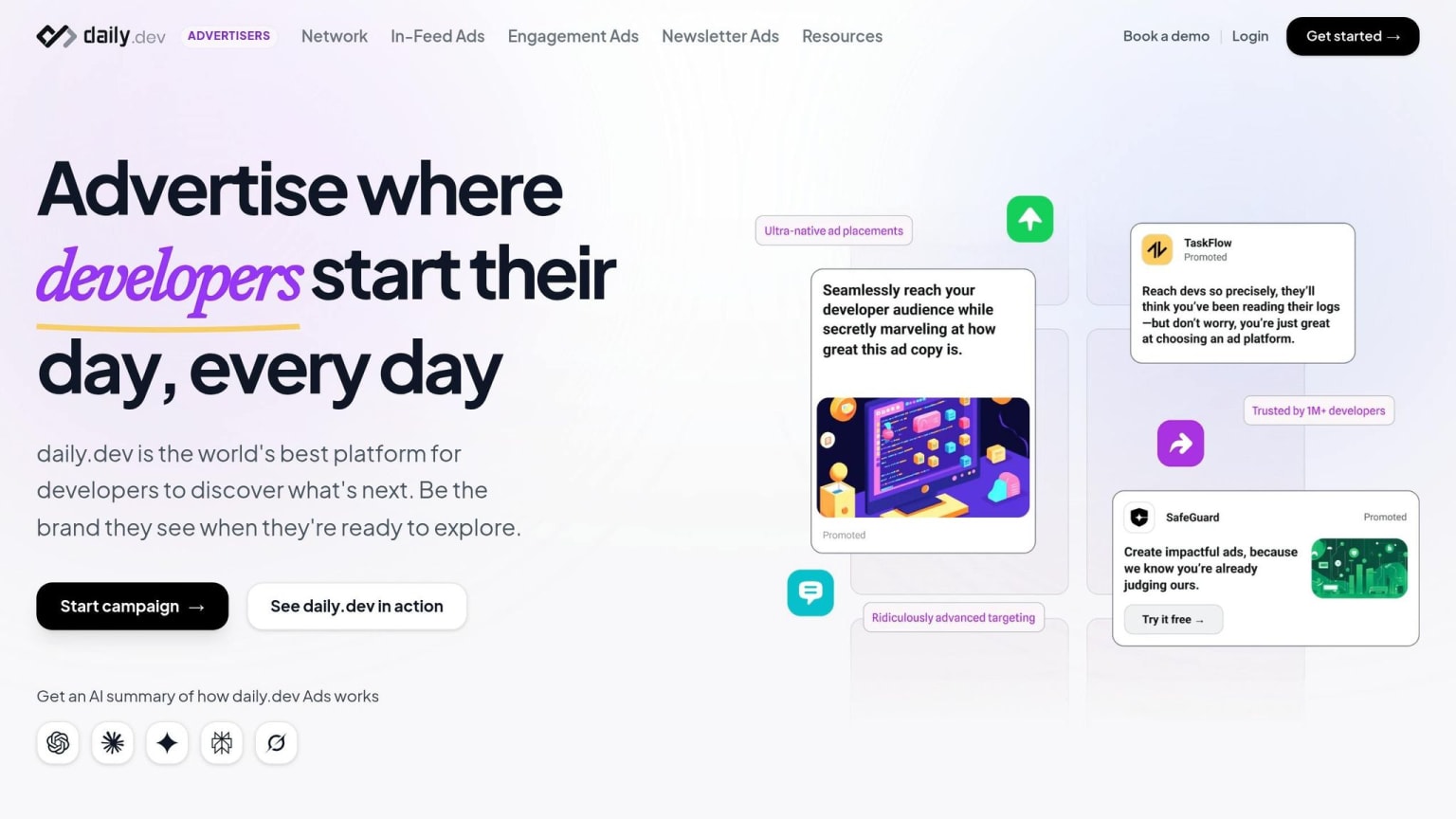
daily.dev native ads stand out by seamlessly blending into the browsing experience. Developers on the platform are actively looking for tools, frameworks, and ideas - not just idly scrolling. This intentional browsing mindset means that ads placed alongside content developers specifically choose to engage with grab far more attention than those sandwiched between unrelated posts.
The numbers back this up. Native ads on developer-focused platforms like daily.dev achieve an average CTR of 0.8–1.5% . That’s significantly higher than LinkedIn Ads (0.4–0.7%) or traditional display ads (0.25–0.35%) . Beyond clicks, these ads also deliver 25–35% brand recall, compared to just 8–12% for display ads . Engagement time tells a similar story: users spend an average of 45–90 seconds with native ads, compared to a fleeting 1.4 seconds for standard desktop banners . These metrics highlight the power of delivering ads in a contextually relevant environment.
What sets daily.dev apart is its real-time behavioral targeting. Instead of relying on static job titles, ads are tailored to what developers are actively reading. For instance, a campaign for a Rust-based infrastructure tool can be shown specifically to developers currently exploring systems programming - not just anyone labeled "software engineer" on LinkedIn .
"Ads only work when the context makes sense." - daily.dev
Another advantage? daily.dev is a desktop-first platform . This aligns perfectly with how developers evaluate technical products like APIs, SDKs, and infrastructure tools, which are rarely assessed on mobile devices. By focusing on desktop impressions, daily.dev minimizes wasted ad spend on low-conversion mobile traffic.
These in-feed performance metrics give daily.dev a clear edge, as illustrated in the channel comparison table below.
Channel Comparison Table: CPM, CPC, and CTR
Here’s how daily.dev stacks up against other major advertising channels based on 2026 benchmarks:
| Channel | Avg. CPM | Avg. CPC | Avg. CTR | Primary Strength |
|---|---|---|---|---|
| daily.dev / Native Dev Pubs | $35–$60 | $2–$8 | 0.8–1.5% | Discovery-mode context, behavioral targeting |
| LinkedIn Ads | $60–$120 | $8–$15+ | 0.4–0.7% | Seniority and role-based B2B targeting |
| Reddit Ads | $25–$45 | ~$0.44 | 0.8–1.2% | Community-level trust, subreddit precision |
| Google Search | N/A (CPC model) | $15–$30 | Intent-based | Capturing high-intent, in-market queries |
| Traditional Display | $20–$40 | N/A | 0.25–0.35% | Broad reach, retargeting |
LinkedIn Ads, while strong for targeting senior roles, come with a 2–3x higher CPM than native developer-focused platforms and lower CTR, making it the priciest option on a per-click basis. Reddit, on the other hand, offers the lowest CPC at around $0.44 , but lacks the precise intent signals of other channels. Google Search excels at capturing high-intent users already looking for solutions, but its $15–$30 per click cost makes it less ideal for awareness campaigns.
Native ads on developer platforms like daily.dev strike a balance: lower CPMs than LinkedIn, higher CTRs than display ads, and the kind of contextual relevance that search ads can’t match during the discovery phase. These insights can help advertisers fine-tune their budgets for maximum impact in reaching developers.
Key Takeaways for Developer Advertising in 2026
Developer advertising comes with its own set of hurdles. For one, developers are heavy users of ad-blockers, and traditional display ads typically see low engagement, with click-through rates (CTRs) hovering between 0.25% and 0.35% . The most effective developer marketing strategies focus on meeting developers where they are - whether during active research or directly within their workflows.
Channel selection plays a huge role in keeping costs efficient. Different platforms come with varying costs and levels of user intent. For example, LinkedIn excels at precise role-based targeting, Google Search captures high-intent users at the bottom of the funnel, and native placements shine during the evaluation phase with their contextual relevance. These differences make it essential to tailor your channel strategy to each stage of your campaign.
Beyond choosing the right channels, high-quality creative content can significantly reduce advertising costs. Platforms reward ads with higher CTRs by lowering their effective CPMs. Ads that feature highly technical, stack-specific details and present an honest value proposition are more likely to resonate with developers and drive engagement .
"Average price per click is an auction artifact. It tells you what the market cleared for clicks, not whether those clicks were worth anything." - Murat Bock, Founder, AdLibrary
Another key shift is moving beyond traditional Cost per Click (CPC) or Cost per Lead (CPL) models and adopting Cost per Trial (CPT) metrics for developer campaigns. A CPT under $30 is considered solid, while under $15 is excellent . Pair this with a longer attribution window of 30–90 days to account for the extended evaluation cycles common with developer tools.
For smaller budgets, focusing on a single high-performing channel is often the most efficient approach. Larger budgets, on the other hand, benefit from a full-funnel strategy that combines acquisition, awareness, search, and retargeting efforts. These practices, grounded in the benchmarks discussed earlier, provide a data-driven roadmap for building effective developer advertising campaigns.
FAQs
What’s a realistic monthly budget for developer ads in 2026?
A realistic monthly budget for developer ads in 2026 generally falls between $2,000 and over $10,000. If you're working with a smaller budget, you'll likely concentrate on high-performing channels such as in-IDE or native ads. On the other hand, larger budgets allow for multi-channel, full-funnel strategies that cover a broader range of platforms and tactics. Ultimately, the amount you allocate will depend on the specific goals and scope of your campaign.
Which channel is best for trials versus awareness?
The right advertising channel depends on what you’re trying to achieve.
In-IDE ads are a powerhouse for driving trial signups. By targeting developers directly within their workflow, these ads deliver results that are hard to ignore - generating 5-8x more signups per dollar compared to traditional display ads.
If your goal is awareness, native in-feed ads and newsletter sponsorships are the way to go. These formats naturally blend into developers' daily routines, helping you build brand recognition and stay visible to your target audience.
In short: use in-IDE ads to boost trial signups and native formats to grow awareness.
How do I measure CPA when developer sales cycles take 30–90 days?
To calculate CPA over extended developer sales cycles (30–90 days), it's crucial to use multi-touch attribution. This approach ensures credit is given to all interactions, from the first touchpoint to the final conversion. Additionally, tracking view-through conversions helps capture delayed actions that might otherwise be overlooked.
For efficiency, focus on metrics like the pipeline-to-spend ratio, which typically ranges from 10:1 to 20:1. By also factoring in insights such as the average time-to-qualified meetings (usually 1–3 months), you can achieve a more accurate understanding of CPA in these long, multi-touch sales journeys.