
Launching a developer tool successfully takes 30 days of preparation - not just a flashy launch day. Here’s the formula: build anticipation, engage with your audience, and ensure your tool delivers real value. Developers care about clear documentation, functional demos, and authentic discussions - not gimmicks.
Key Takeaways:
- Set measurable goals: Examples include 500 signups in the first week or a 30% activation rate within 48 hours.
- Prepare essential assets: Landing pages with 20–35% conversion rates, concise demo videos, and strong documentation.
- Engage early: Join developer communities and create problem-focused content to build trust.
- Follow a timeline: Break tasks into weekly goals, from creating awareness (Week 4) to finalizing assets (Week 1).
- Launch strategically: Mid-week launches (Tues-Thurs) perform better. Use platforms like Product Hunt, Hacker News, and Reddit effectively.
This guide ensures your launch is the harvest of your efforts, not a last-minute scramble.
The 30-Day Pre-Launch Roadmap
Core Concepts for Developer Tool Launches
A launch isn’t just a one-day event - it’s a process. The 30 days leading up to launch are all about building anticipation, securing early advocates, and priming your audience. This way, launch day becomes the culmination of your efforts, not just the start. Louis Corneloup, Founder at Dupple, emphasizes the importance of documentation in this process:
"For devtools, docs produce more pipeline than the marketing site."
In other words, your documentation can be one of your strongest marketing tools.
When planning your launch, you can choose between a gradual rollout (like alpha access) or a high-impact, all-at-once debut. Your decision here will influence how you organize your pre-launch activities. With that in mind, let’s break down the timeline.
Week-by-Week Timeline Summary
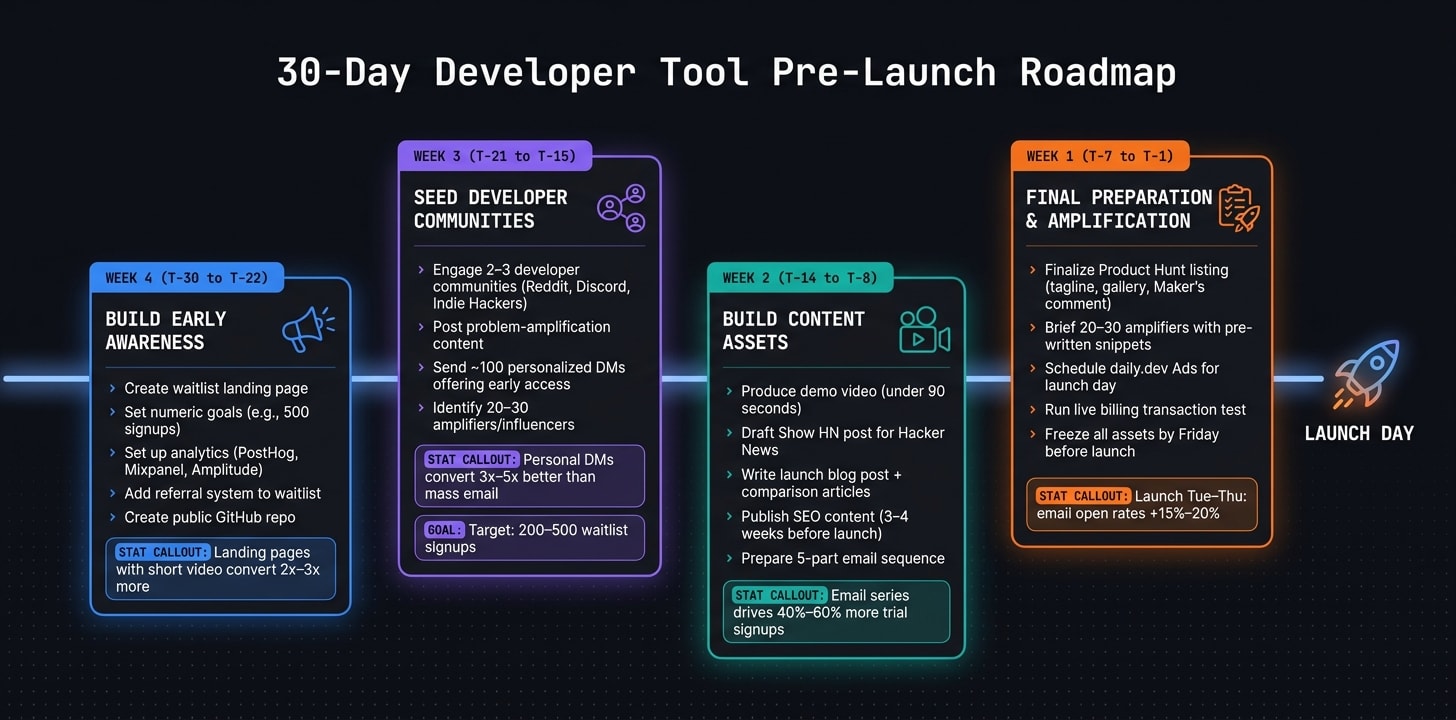
Here’s a snapshot of how to structure your pre-launch efforts week by week. Each phase has a clear focus and specific tasks to keep everything on track.
| Week | Focus | Key Deliverables |
|---|---|---|
| Week 4 (T-30 to T-22) | Build early awareness | Create a waitlist landing page, set numeric goals, and establish analytics tracking |
| Week 3 (T-21 to T-15) | Warm your audience | Develop problem-oriented content, engage in community discussions, and identify 20–30 amplifiers (influencers or supporters) |
| Week 2 (T-14 to T-8) | Build content assets | Produce a concise demo video (under 90 seconds), gather beta tester testimonials, and finalize documentation |
| Week 1 (T-7 to T-1) | Final preparation | Lock in a detailed launch schedule, prepare assets for platforms like Product Hunt and Hacker News, and test the signup flow thoroughly |
This roadmap ensures that each week contributes directly to a strong, well-prepared launch - one that resonates with developers and delivers value.
Also, keep in mind that mid-week launches (Tuesday through Thursday) tend to perform better, with email open rates increasing by 15%–20% . Plan your launch date accordingly and work backward to set deadlines for each week's tasks.
Week-by-Week Pre-Launch Checklists
Use this checklist as the final step in your 30-day pre-launch plan to smoothly transition from creating awareness to amplifying your product's reach.
Week 4 (T-30 to T-22): Creating Early Awareness
This is the groundwork phase. Start by crafting a concise, one-sentence positioning statement and pinpointing your ideal customer. Next, build a landing page designed solely for capturing emails. Landing pages with a short explainer video (under 30 seconds) tend to convert at 2x to 3x the rate of text-only pages .
Before anything else, set up your analytics tools - PostHog, Mixpanel, or Amplitude are good options. These tools will help you track user behavior from day one . Add a referral system to your waitlist immediately, such as offering users the chance to "move up the line by inviting a friend." Delaying this feature could mean missing out on early growth opportunities . For additional visibility, consider creating a public GitHub repo for early visitors to star and follow.
Once early awareness is in place, prepare to engage developer communities in the following week.
Week 3 (T-21 to T-15): Seeding Developer Communities
This week is all about connecting with developers in their own spaces. Choose two or three communities where your target audience is active - examples include subreddits like r/devops or r/webdev, niche Discord servers, or Indie Hackers. Spend at least two weeks contributing meaningful comments before sharing your own content .
Focus on "problem amplification" posts that highlight the challenge your tool addresses, rather than promoting the tool itself. For instance, frame your content as "I built this to solve X, here's what I learned." This approach invites genuine feedback instead of just attention-grabbing upvotes . Complement these efforts with personalized DMs - reach out to about 100 individuals in your ideal customer profile (ICP), offering free early access in exchange for honest feedback. Personal outreach can convert 3x to 5x better than mass email campaigns .
"Be helpful, not promotional. Mention the waitlist once." - LaunchList
By the end of this week, aim to have 200–500 waitlist signups. This number establishes solid social proof for your launch day .
Week 2 (T-14 to T-8): Building Content Assets
Now it’s time to focus on creating assets that showcase your product. A demo video under 90 seconds is essential - highlight how your tool solves a real problem rather than creating a highly polished marketing reel. Pair this with runnable code examples and a "Hello World" sample that gets users up and running within five minutes .
Begin drafting your "Show HN" post for Hacker News, but leave room for later tweaks . Write your launch blog post, comparison articles, and integration documentation. Make sure to publish any SEO-focused content 3–4 weeks before launch so it has time to rank and build authority. Also, prepare a 5-part email sequence for your waitlist. A multi-part email series can drive 40%–60% more trial signups than a single announcement email .
With your content ready, shift your attention to amplification strategies in the final week.
Week 1 (T-7 to T-1): Setting Up Amplification Channels
The last week is for finalizing everything, not creating new assets. Ensure your messaging stays consistent with the themes you developed earlier. Plan to launch on a Tuesday, Wednesday, or Thursday for maximum engagement. Notify your 20–30 chosen amplifiers ahead of time and provide them with pre-written snippets .
Complete your Product Hunt listing with gallery images, a clear tagline, and your "Maker's first comment" ready to post at 12:01 AM PT when the new daily cycle starts . Schedule daily.dev Ads to go live on launch day, targeting developers based on seniority, programming language, and tools they use. Run a live billing transaction to catch any issues that test mode might miss . By the Friday before launch, freeze your signup flow, onboarding sequence, and all content assets to ensure everything is ready to go live without a hitch.
Launch Day Playbook
After the meticulous planning of your pre-launch phase, launch day is all about putting that preparation into action. This is the moment to follow your playbook step by step, ensuring everything runs smoothly.
Launch Day Schedule and Posting Order
Timing is everything. Start your day on Product Hunt at 12:01 AM PT - this ensures you get the full 24-hour window for votes. Next, post your Twitter/X thread at 12:30 AM PT, followed by your "Show HN" submission on Hacker News at 1:00 AM PT. A quick note about Hacker News: don’t ask for upvotes. Let the community engage with your content naturally to avoid breaking their rules.
By 2:00 AM PT, kick off your daily.dev Ads campaign. These ads will target developers based on their seniority, preferred programming languages, and tools. At 3:00 AM PT, send out your waitlist email to notify your early adopters. By 6:00 AM PT, it’s time to post in relevant subreddits to reach niche communities. Then, schedule two major engagement pushes at 8:00 AM PT and 4:00 PM PT to align with U.S.-based audiences coming online. Hosting a midday AMA or live demo at 12:00 PM PT can also give your launch a boost - founders who do this often see a 25% to 40% increase in activation rates among new signups .
| Time (PT) | Platform / Action | Goal |
|---|---|---|
| 12:01 AM | Product Hunt | Begin the 24-hour voting cycle |
| 12:30 AM | Twitter/X Thread | Announce to your social audience |
| 1:00 AM | Hacker News (Show HN) | Engage the technical community |
| 2:00 AM | daily.dev Ads | Amplify reach with paid campaigns targeting developers |
| 3:00 AM | Email Waitlist | Notify your early supporters |
| 6:00 AM | Reddit / Subreddits | Engage with niche communities |
| 8:00 AM | Morning Push | Respond to early comments and feedback |
| 12:00 PM | Midday AMA / Demo | Build momentum with live interaction |
| 4:00 PM | Afternoon Push | Reconnect with U.S. audiences |
| 8:00 PM | Evening Thank You | Show gratitude and share initial results |
Once your schedule is in motion, your job shifts to monitoring progress and keeping the energy alive throughout the day.
Monitoring and Responding in Real Time
Set up a "war room" - this could be a dedicated Slack channel - with at least two people monitoring key metrics like signups, error logs, and payment processing . Check your Product Hunt ranking and social media mentions every two hours to stay on top of feedback and engagement . Since over 60% of launch day traffic typically comes from mobile users, pay close attention to how well your site or app converts on mobile .
Prepare a plain text file with templated responses for common questions about pricing, your tech stack, integrations, and features. However, don’t just copy-paste - read each question carefully and tailor your response to the context before replying .
"The founders who win launch day treat it as a presence event - the founder is online and responsive all day - not as a 'schedule the post and walk away' event." - SuperDupr
Aim to respond to questions and comments within 30 minutes to build trust with your community . If you’re in a time zone far from Pacific Time, make sure someone you trust can handle the midnight-to-6:00 AM PT window to keep the momentum going strong.
Post-Launch Week: Keeping Momentum and Measuring Results
Extending Post-Launch Momentum
Launch day might be over, but the real challenge begins now. The first week after launch is your golden opportunity to turn curious visitors into loyal users and keep the buzz alive while interest is still fresh.
Start by focusing on personalized outreach. Have your Developer Relations team send tailored emails to every new signup within the first three days, including relevant tutorials to help them get started. Then, follow up between days three and seven, especially when users hit key milestones .
Plan for a second wave of content to roll out in weeks two through four. Think about podcast episodes recorded pre-launch, delayed press coverage, or creator posts that may surface after the initial buzz. Don’t let this traffic land on an inactive product page . Publishing a transparent launch retrospective within two weeks can also drive engagement. Sharing real numbers like signups, conversion rates, and traffic sources often performs better than the original launch post on platforms like LinkedIn and Indie Hackers .
"Your launch day is the start of the post-launch sequence. Have a 30-day onboarding plan ready: activation emails, founder calls with the top 50 supporters, case-study capture from week 2 users." - LaunchList
Finally, use this momentum to measure your success and refine your approach by diving into key performance metrics.
Measuring Launch Performance
After the initial excitement, it’s time to evaluate how well your launch delivered. Don’t just look at signups - focus on activation and retention. A signup that doesn’t reach the "aha moment" is just a number that doesn’t translate into long-term value.
| Metric | Target Benchmark |
|---|---|
| Landing page visitor → signup | 20–35% |
| Waitlist → customer (first 14 days) | 8–20% (B2B SaaS) |
| Email open rate | 35–60% |
| Referral share rate | 20–40% |
| daily.dev Ads engagement | Track clicks, saves, and follow-through to signups |
These benchmarks can help you identify where your strategy is working and where it isn’t.
Beyond these metrics, keep an eye on your branded search lift using Google Search Console. If you notice more searches for terms like "[Your Tool] reviews" or "[Your Tool] pricing", it’s a sign that your launch created lasting awareness rather than just a one-day spike . For devtools, track GitHub stars, documentation traffic, and community participation on platforms like Discord or Reddit alongside your conversion data .
"Acquisition metrics are meaningless if users do not activate and retain." - Monolit
Planning Next Steps Based on Launch Data
By the end of the first week, you should have a clear sense of what worked and what didn’t. Zero in on the single acquisition channel that outperformed all others and allocate 70% of your marketing efforts to it for week two . Pause underperforming ad campaigns and double down on creatives that are driving results. Use NPS surveys and direct calls with your first 20–50 users to identify any onboarding issues before they lead to churn .
Turn early user success stories into case studies by week two - these can be powerful tools for sales and marketing . Conduct a formal retrospective to evaluate your goals versus actual results, identify any surprises, and document what went wrong. The most successful founders treat this data as a guide for the future, not just a recap of the past.
"The founders who sustain launch momentum are those who maintain 3 to 5 posts per week on their highest-performing channels through weeks 4 to 12." - Monolit
FAQs
How do I pick the right 'aha moment' for activation?
To pinpoint the right 'aha moment,' zero in on a specific action that clearly showcases your tool's value. This should happen early - ideally within the first few interactions. Examples include a successful API call, establishing a database connection, or completing a deployment. Prioritize actions that reflect real user engagement, make sure they’re straightforward and easy to measure, and monitor completion rates to ensure users quickly experience the main benefit your product offers.
What should I track in analytics before launch day?
Before launch day, it's crucial to keep an eye on the right analytics to gauge engagement and identify potential problems early. Pay close attention to signups and activation metrics, such as the percentage of visitors who sign up and the time it takes users to complete their first key action (like making an API call).
Also, make sure you have error monitoring and uptime tracking in place to maintain stability. Tools like Google Analytics 4 can help you track traffic sources, visitor behavior, and conversion rates from your launch platforms, such as Product Hunt or Reddit. These insights will give you a clearer picture of what's working and where adjustments might be needed.
How do I recruit beta testers who will give real feedback?
Recruiting beta testers works best when you focus on personalized outreach. For example, sending tailored video messages can grab attention and encourage genuine engagement. This approach not only makes participants feel valued but also increases the chances of receiving honest, actionable feedback.
To motivate testers, offer incentives that matter - think lifetime discounts or free access to your product. These rewards can make participation feel worthwhile and build goodwill.
During the beta phase, aim to conduct 15–20 interviews. These conversations are essential for confirming that your product addresses a real problem and meets user needs. Plus, this is a great opportunity to gather testimonials or screenshots that can serve as social proof later on.
Finally, don’t underestimate the power of high-quality demo videos. These can significantly impact your conversions - boosting them by as much as 30%!