

If I had to pick one open social platform for developer marketing in 2026, I’d start with Bluesky. It has a larger active user base, better discovery for small accounts, and an easier way to get posts in front of engineers, founders, and open-source people.
Here’s the short version:
- Bluesky is the best first move for reach, traffic, and early growth
- Mastodon is better for niche technical groups like OSS, security, and privacy circles
- X still has scale, but organic reach is down by about 40% for non-verified accounts
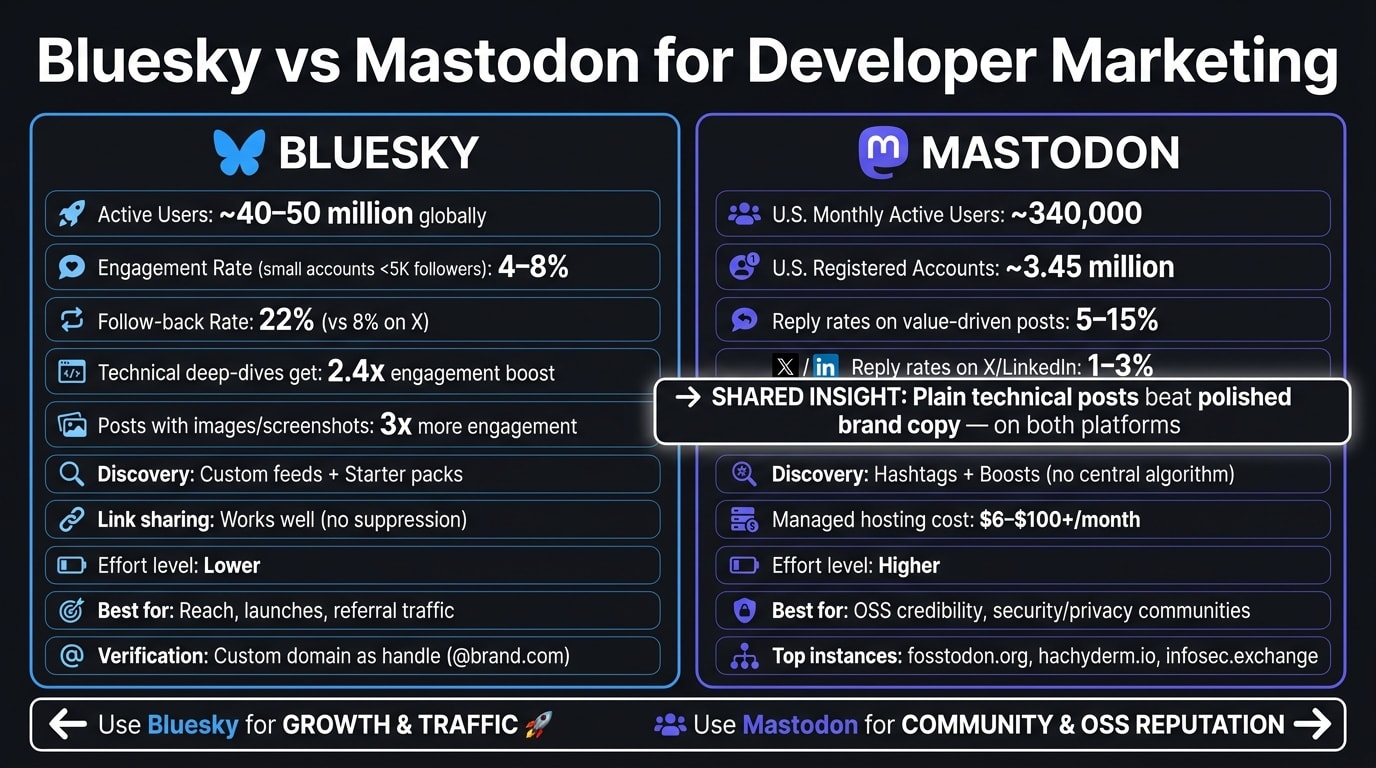
- Bluesky has about 40–50 million active users globally
- Mastodon has about 340,000 monthly active users in the U.S.
- On Bluesky, smaller accounts often see 4%–8% engagement
- On Mastodon, reach depends a lot on instance choice, boosts, and hashtags
- On both platforms, plain technical posts beat polished brand copy
If you want a simple rule: use Bluesky for growth and site traffic; use Mastodon for community ties and OSS reputation. And if your team can’t post, reply, and join conversations each week, skip both.
Quick Comparison
| Factor | Bluesky | Mastodon |
|---|---|---|
| Best use | Reach, launches, traffic | OSS circles, security, community ties |
| Audience size | Larger | Smaller |
| Discovery | Custom feeds, starter packs | Hashtags, boosts, federation |
| Effort level | Lower | Higher |
| Best content | Build notes, screenshots, data, lessons | Release notes, advisories, technical context |
| Link sharing | Works well | Needs more context |
| Setup | Simple | Instance choice matters |
| Brand handle | Custom domain handle supported | Custom domain often needs hosting |
I’d treat the choice like this: Bluesky first, Mastodon second, same-message cross-posting never.
1. Bluesky
Who's Actually There
For developer marketing, the main question isn't just how big Bluesky is. It's who shows up there and stays active.
Right now, the audience leans toward software engineers, technical founders, and open-source advocates. That matters because Bluesky tends to have more people who shape B2B tool decisions .
Accounts with fewer than 5,000 followers often see engagement rates of 4–8%, compared with 0.5–2% on Twitter/X .
How Discovery Works
Bluesky runs on a default chronological feed, plus community-built custom feeds like Web Development or Indie SaaS that surface posts around a topic.
That changes distribution in a big way. A small account can still get solid reach if a relevant custom feed picks up the post .
Starter packs matter too. These are curated lists of accounts that let people follow a related group in one click . If your account lands in an industry-specific starter pack, you can grow a relevant following fast without paid support .
What Content Actually Works
This is a place where technical depth beats polished brand talk.
Build logs, architecture decisions, real data, and honest stories about what went wrong tend to do better than generic product announcements. Technical deep-dives get a 2.4x engagement boost over baseline content, and posts with images or screenshots average 3x more engagement .
The tone matters too. People here usually push back on corporate polish and engagement bait. Plain, technical honesty tends to land better .
One more detail is worth paying attention to: setting your handle to your company's own domain, like @yourcompany.com, can build trust with a technical audience through domain-based verification .
Measuring What Matters
Bluesky doesn't suppress external links, so UTM-tagged URLs work cleanly here. Track referral traffic by post with UTM-tagged links.
Beyond clicks, watch for signals like:
- Reply rate
- Quote posts
- Starter-pack inclusion
Those tend to say more about brand recognition than follower count, which usually lags behind. Technical accounts also see a 22% follow-back rate versus 8% on Twitter/X .
Mastodon needs a different playbook: less reach, tighter norms, and more attention to each instance.
2. Mastodon
Who's Actually There
Mastodon has a lot more registered accounts than active users in the U.S., so raw follower counts can make your reach look bigger than it is. U.S. registered accounts sit at about 3.45 million, but monthly active users are closer to 340,000. The active crowd leans technical, especially open-source contributors and security professionals. If you're marketing dev tools, that's a useful group to reach - but where you set up your account plays a big part in whether they see you.
Choosing the Right Instance
On Mastodon, instance choice has more impact on reach than post quality alone. This isn't a feed-first platform where you can post anywhere and hope the algorithm does the rest. Your instance shapes your handle, your local timeline, and how people size you up from day one.
If you want broad reach with the lowest lift, mastodon.social is the general-purpose pick. But for developer marketing, the better-known options are:
- fosstodon.org for open-source and general tech
- hachyderm.io for developers and tech pros
- infosec.exchange for security-focused communities
Joining one of these drops you into a dense technical crowd right away. That said, each instance has its own moderation rules, so read them before you post.
If you want a custom domain handle - like @yourcompany.com - managed hosting through services like Masto.host costs about $6–$100+/month, based on instance size. That's the cleaner long-term move for brand identity. If your team wants to share content without running a full Mastodon server, the WordPress ActivityPub plugin can push blog posts straight into Mastodon feeds under a handle like @author@yourdomain.com.
How Discovery Works
There isn't a central recommendation algorithm driving distribution here. Reach comes from boosts (Mastodon's version of reposts), hashtags, and cross-instance federation through ActivityPub. Users also follow hashtags to build their feeds, so tags like #OpenSource, #DevOps, or #Rust do a lot of the discovery work.
That changes how you should think about posting. The goal isn't to churn out more updates. The goal is to post something people want to boost.
Posts with clear value - architecture decisions, release notes with honest context, security advisories - can see reply rates between 5% and 15%, versus 1% to 3% on X or LinkedIn. Generic promo posts usually go nowhere, and moderators on some instances may ignore them or flag them.
So yes, volume matters less here. Participation and reading the room matter more.
Content Norms You Can't Skip
Use Content Warnings for long or sensitive threads, and reply to comments yourself; scheduled posts without participation reads as broadcast-only.
Measuring What Matters
Track UTM referral traffic, boosts, and replies. Follower growth is slower here by design. Mastodon asks for more hands-on effort than Bluesky and gives you a smaller, slower-growing audience.
Those trade-offs become a lot easier to see in the next section.
Pros, Cons, and Execution Trade-offs
Bluesky gives you more reach with less hassle. Mastodon gives you tighter technical circles, but it asks more from you. The table below helps you choose where to start. Add the second platform only if your team can keep it active.
| Factor | Bluesky | Mastodon |
|---|---|---|
| Audience size | Larger, fast-growing | Smaller, fragmented |
| Engagement | 5–15% reply rates on value-driven posts; 4–8% for accounts under 5K followers | Reach depends on instance fit and boosts |
| Discovery | Custom feeds + starter packs | Hashtags + boosts |
| Link treatment | Works well for traffic | Needs stronger context |
| Verification | Custom domain as handle, like @brand.com | Instance-dependent; no universal verification system |
| Maintenance load | Low - no instance management | Higher if self-hosted; managed hosting starts around $6/month |
| Culture | Conversational, tech-literate, and personality-friendly | Anti-promotional and etiquette-heavy; content warnings are common |
Here’s the simple version: use Bluesky for dev-tool launches and referral traffic. Use Mastodon for OSS credibility and community-building.
On tooling: Both platforms support open APIs and scheduling. Buffer, Publer, and Fedica work for Mastodon . For Bluesky, cross-post.app and Monolit are solid options .
One thing matters more than most teams expect: don’t post the exact same copy on both platforms. Mastodon, in particular, tends to push back on anything that sounds like a press release. It helps to write with more context, more personality, and less polish. Also, test link cards before you schedule anything. A broken preview can wreck click-throughs on both platforms.
When Not to Invest
Open social isn’t for every developer marketing team. You should skip both platforms if:
- Your audience isn’t technical
- You can’t keep up weekly participation
- You don’t want to deal with public disagreement
If you want steady developer reach without the community-management load, daily.dev for Business gives you a paid option with precise targeting and consistent visibility across a global audience of over 1 million developers.
Conclusion
Bluesky gives you breadth. Mastodon gives you depth.
Choose Bluesky first if you market developer tools, B2B SaaS, or open-source projects and want organic reach without algorithmic gatekeeping. Choose Mastodon first if your audience leans toward core open-source contributors, academics, or privacy-focused engineers who care about control over data and infrastructure.
If your goal is the post-Twitter developer crowd, start with Bluesky. It’s the easier place for new accounts to get moving. Then add a light Mastodon presence later if your team has the time. Think of it as a steady second channel that helps keep your content findable no matter which network leads down the road .
Once you pick a platform, judge it by signal, not size. A small, relevant developer audience can beat a big generic one every day of the week. Watch two things in particular:
- Follower quality: are the people following you actual decision-makers?
- Referral traffic: are your posts sending the right people back to your site?
Those two signals say more than impressions or raw follower counts . For always-on reach beyond open social, pair this with daily.dev for Business.
Use open social for credibility. Use paid channels for scale. And when founders or lead engineers post, they should sound like people - not a logo .
FAQs
How much time does open social take each week?
Open social can take a solid chunk of your week. You’re not just posting. You’re speaking to different groups of people, and each platform has its own style and content habits.
A pace that most teams can keep up with is 3 to 5 posts per week per platform.
So if you’re active on both Twitter and a second platform like Bluesky, you’re usually looking at 6 to 9 posts each week. On top of that, you’ll need time to adjust your tone for each platform and engage with 20 to 30 relevant accounts.
Should founders or brand accounts do the posting?
On Bluesky and Mastodon, brands usually do better when they sound like actual people, not a press release with a logo. These communities care about plain talk, openness, and honest technical discussion. That’s why founder posts often beat polished brand marketing.
If you can’t keep up steady, genuine interaction, founder-led posting is often the better move. And if you do use a brand account, keep the voice personal and skip the corporate jargon.
How do I know if Bluesky or Mastodon is driving real pipeline?
Look past vanity metrics and pay attention to qualitative engagement. On both platforms, real pipeline tends to show up in high-intent signals: detailed replies from your target audience, direct asks for product details, and peer recommendations.
It also helps to track referral traffic from social links and any lift in branded search. On Bluesky, pay close attention to value-first posts that lead to genuine follow-up conversations. On Mastodon, useful participation in technical discussions matters most, because overly promotional posts often get negative responses.