

Selling developer tools to enterprises is challenging because developers use the tools, but executives or procurement teams make the buying decisions. Here’s the key takeaway: to succeed, focus on developers as the starting point, build team-level adoption, and then navigate enterprise procurement requirements.
Key Steps:
- Engage Developers First: Make your tool easy to try with clear documentation and free trials. Developers influence 62% of tech purchases.
- Scale to Teams: Track signs of team adoption (e.g., multiple users from the same company) and offer features like shared workspaces.
- Enterprise-Level Sales: Prepare for strict requirements like SOC 2 compliance, SSO, and ROI-focused conversations. Equip internal champions with resources to advocate for your product.
Quick Stats:
- The software development tools market is projected to grow from $6.41 billion in 2025 to $13.7 billion by 2030.
- Only 5.4% of developers discover tools via cold emails, so focus on organic and product-led growth strategies.
- Enterprise sales cycles now average 6.5 months, often involving over 7 decision-makers.
To succeed, align your product, marketing, and sales teams to respond to user signals at each stage - from individual adoption to enterprise buy-in.
Mapping the Developer-to-Enterprise Buyer Journey
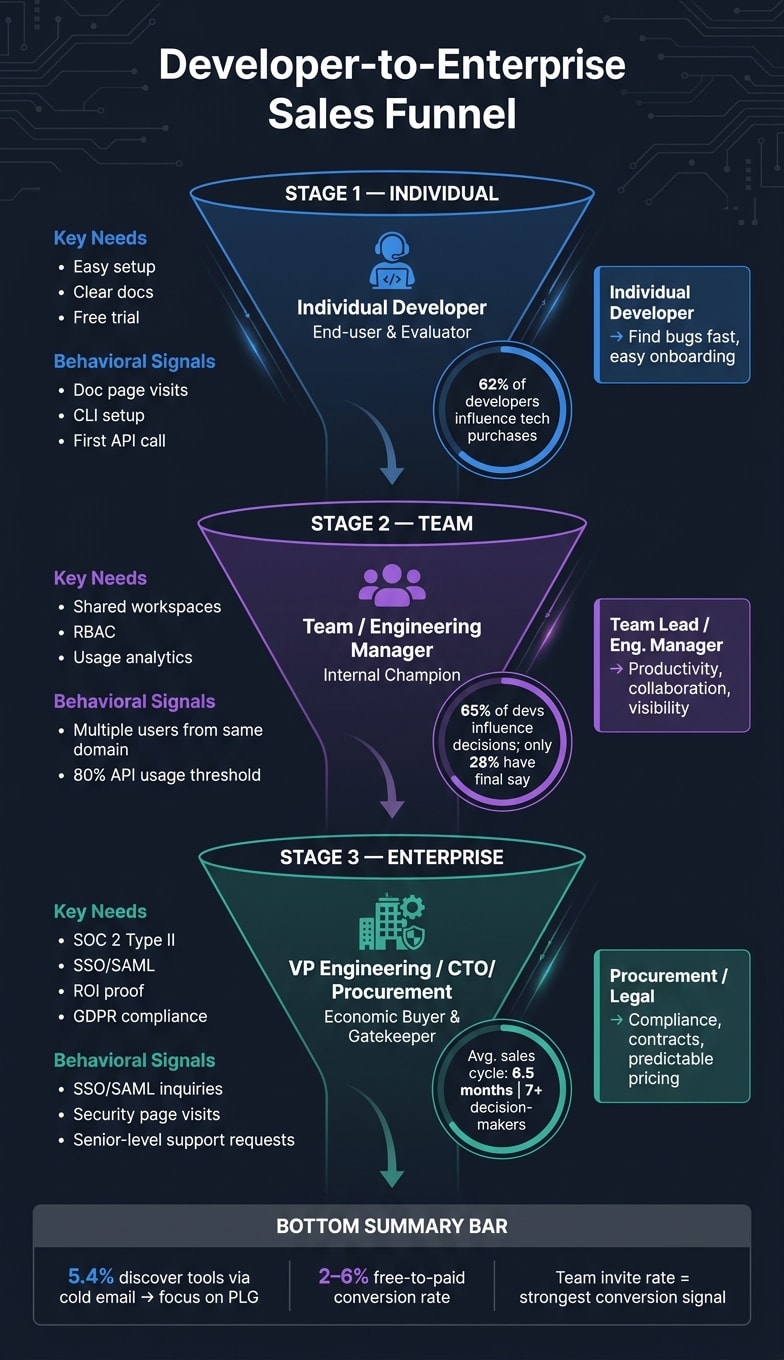
Understanding your buyer and timing is key to navigating the path from a single developer using your tool to securing an enterprise-level contract. This journey typically unfolds in three stages: Individual → Team → Organization . Each step involves stakeholders with distinct roles and motivations, making it essential to tailor messaging and strategies accordingly.
Key Personas and What They Need
Here’s a breakdown of the primary personas involved and their specific needs at each stage:
| Persona | Role in the Journey | What They Need |
|---|---|---|
| Individual Developer | End-user/Evaluator | Easy setup, clear documentation, and a solution to a real technical challenge |
| Team Lead / Engineering Manager | Internal champion/Decision maker | Improved team productivity, collaboration tools, and seamless onboarding |
| VP of Engineering / CTO | Economic buyer | Clear ROI, scalability, strong security, and risk management |
| Procurement / Legal | Gatekeeper | Compliance (e.g., SOC2, GDPR), straightforward contract terms, and predictable pricing |
Source: Industry research
As Kite’s post-mortem insightfully notes:
"Individual developers do not pay for tools."
While developers might not directly sign the checks, they play a crucial role in building momentum for enterprise adoption. This makes it vital to adjust your messaging and sales strategy as you move up the organizational hierarchy.
Stages of the Adoption Funnel
Each stage of the adoption journey comes with unique behavioral signals:
Individual Stage: Activities like visiting documentation pages, completing CLI setups, or making the first successful API call signal that a developer is actively testing your tool.
Team Stage: When multiple developers from the same organization start using your tool, collaborate across teams, or approach 80% of API usage , it’s time to engage with a value-driven offer. This could include presenting an annual contract that highlights cost savings.
Enterprise Stage: Indicators such as visits to security and compliance pages, inquiries about SSO/SAML, or senior-level support requests suggest someone within the company is building a business case for your product.
When these signals emerge, it’s important to shift your focus, translating technical achievements into business terms.
Connecting Developer Value to Business Outcomes
To win over decision-makers, frame technical benefits as tangible business outcomes. Postman offers a great example of this approach. By analyzing organic adoption data, they shifted their narrative from API testing to enterprise governance, showcasing how technical wins lead to cost savings and reduced risks .
As Postman’s CEO Abhinav Asthana puts it:
"When we go to customers, and they're curious about the scale of adoption... we actually use this data to tell them. And it really helps us."
For example, faster debugging can be reframed as reduced downtime, individual usage as organizational standardization and IP retention, and API testing as improved governance and lower integration risks . By presenting these benefits in terms executives care about - like faster shipping, reduced total cost of ownership, and better risk management - the conversation shifts from "Is this worth it?" to "How can we afford not to invest in this?"
Driving Developer Adoption Through Targeted Campaigns
Identifying Developer Pain Points and Workflows
Developers often reveal their frustrations through their actions - like repeatedly copying CLI commands or sifting through documentation - rather than through direct feedback in surveys or sales calls. These subtle cues, which show up in the less visible parts of the funnel, are where real challenges surface .
When assessing these challenges, prioritize them based on how often they occur and their overall impact. For instance, over 60% of infrastructure failures lead to losses exceeding $100,000 . This makes reliability a strong selling point for tools aimed at minimizing downtime.
How you frame your solution matters just as much as the solution itself. Messaging that highlights a transformation - such as "Find bugs in 30 seconds" - resonates more than simply labeling your tool as an "observability platform." Addressing common frustrations directly can make your product stand out. For example, saying, "Stop grep-ing through logs; get the stack trace in one click", speaks directly to the daily struggles developers face .
Building Targeted Advertising Campaigns
Once you've identified developer pain points, craft your messaging to address them head-on. Traditional B2B advertising strategies often fall flat with developers, as more than 60% actively block programmatic ads and ignore generic pitches . To reach this audience, focus on niche channels like developer newsletters, podcasts, and communities on platforms like Reddit or X.
Newsletter sponsorships, for instance, offer a cost-effective way to engage developers. Ads in developer-focused newsletters like Techpresso often generate 400–1,000 clicks at a cost-per-click of $1.70–$3.00 . In fact, these placements have frequently outperformed LinkedIn campaigns, even when the latter had budgets five to ten times larger .
This is where daily.dev Ads come into play. Developers interact with daily.dev as part of their regular technical reading, making it a natural fit for ads that align with their interests instead of disrupting them. Messaging that avoids overused buzzwords like "enterprise-grade" or "seamlessly" tends to perform better with this audience .
"Developers decide to use your tool before they talk to anyone. PLG is the default for devtools; sales-led motion works only for enterprise tier." - Louis Corneloup, Founder, Dupple
Ads should guide developers toward valuable technical resources, as documentation often serves as the highest-converting destination for developer tools. Once developers are drawn in, the next step is to ensure their first experience with your product is smooth and engaging.
Designing Low-Friction First-Run Experiences
To address the pain points uncovered earlier, streamline your onboarding process so developers can quickly realize value. Any friction during the first five minutes - such as lengthy sign-ups, missing API keys, or unclear setup instructions - can lead to lost interest. The goal is to help developers achieve a working "hello world" state within five minutes of their first interaction .
A solid onboarding experience should aim for three key milestones: achieving a working state in 5 minutes, completing a real task in 30 minutes, and hitting a usage milestone within 7 days . Each step builds trust and encourages further engagement.
Onboarding should be treated as a conversion funnel rather than just a support process. Track metrics like time-to-first-successful-API-call and CLI completion rates to identify where users drop off .
"Developer tools often do the opposite [of consumer apps]: they require documentation reading, environment setup, and API keys before the first useful result. That mismatch is one reason developer onboarding should be treated as a conversion funnel." - Marcus Ellison, Senior SEO Content Strategist
One often-overlooked strategy is designing the first-run experience to produce something shareable, like a dashboard screenshot, a code diff, or a before-and-after metric. When developers have something tangible to share in a Slack thread or during a team review, they naturally become advocates for your tool within their organization.
Scaling to Team-Level Adoption
Empowering Internal Champions
Once you've engaged developers, the next step is to turn them into team-wide advocates who can effectively communicate the product's value to management. You can identify these champions by keeping an eye on detailed product-related questions in platforms like Discord, GitHub issues, or Stack Overflow . Another way is to track power users - those who frequently hit free-tier limits or repeatedly explore documentation for premium or enterprise features .
"Find out if your dev prospect is an economic buyer. If they're not, lead with value and work to turn your contact into a product champion who's empowered to make your case to their higher-ups." - Eric Wendt, Content Editor, Common Room
While 65% of developers influence technology purchase decisions, only 28% have the final say in large enterprises . To bridge this gap, equip your contact with the tools they need to advocate for your product. Provide them with clear ROI metrics, architecture diagrams, and a concise business case they can easily share with their managers.
Packaging Value for Teams
Once you've identified your internal champions, the next step is to align your product offering with both developer needs and managerial priorities. Developers focus on solving immediate technical problems, while managers prioritize visibility, standardization, and safeguarding team assets.
A great approach is offering a free plan for exploration and a team plan that includes features like shared workspaces, role-based access control (RBAC), and usage analytics - features that directly address managerial concerns . A strong example of this is Postman. By introducing Enterprise Workspaces, they tackled a major team management issue: lost API collections when developers left. This shift repositioned Postman from being just an "API client" to a "visibility and collaboration platform" .
When marketing team-tier features, focus on answering the key questions managers care about: Who has access to what? What happens to our work if someone leaves? Can we track how the tool is being used by the team?
Triggering Manager-Focused Outreach
Once the value for teams is clearly defined, the next focus should be on engaging management. Timing is everything - don’t reach out when just one developer signs up. Instead, wait until multiple developers from the same organization are actively using your tool. This signals organic adoption, making your outreach efforts much more compelling .
Use product data to identify the right triggers. For example, offer an upgrade when users approach capacity limits, or reach out to the most active user when several team members share the same company domain. A consultative session on setting up a team workspace can be a powerful way to engage .
When reaching out, avoid starting with pricing. Instead, frame the conversation around their goals by asking, "What are you building?" . This approach positions your team as a helpful partner rather than just another vendor, which resonates more with managers evaluating tools for their teams.
Navigating Enterprise Procurement
Once you've secured team-level engagement, the next challenge is meeting the strict requirements set by enterprise procurement processes.
Understanding Enterprise Requirements
When a deal transitions from a team plan to an enterprise contract, the stakes shift dramatically. You're no longer just convincing developers - now you need to satisfy stringent security, legal, and procurement standards before the deal can move forward.
For enterprises in the U.S., SOC 2 Type II compliance is non-negotiable. Without it, your tool likely won't survive the security review stage, let alone reach a pricing discussion. Additionally, SSO via SAML 2.0 or OIDC is a must-have. As Melody Sellers, Principal Engineer at Social Animal, puts it:
"If you don't support SSO, you will not close enterprise deals. Full stop."
Beyond SOC 2 Type II and SSO, enterprises expect SCIM provisioning, immutable audit logs with multi-year retention, and data residency options to address GDPR or regional regulations. Security teams are especially cautious about tools in the software supply chain, demanding assurances around build pipeline integrity and artifact signing - concerns that have grown since incidents like the SolarWinds breach . If your tool incorporates AI, prepare for a specialized AI security questionnaire, which could include 30 to 80 detailed questions about topics like training data sources and defenses against prompt injection attacks .
Preparing Enterprise-Ready Materials
A staggering 73% of startups fail to pass the vendor assessment stage during enterprise sales . The solution? Preparation. Solid enterprise materials can bolster the credibility you've already built with developers and teams.
Start by assembling a "Trust Pack" that includes your SOC 2 Type II report, a summary of your latest penetration test, a sanitized architecture diagram, and a list of sub-processors . Instead of sharing these as email attachments, host them in a secure, self-serve Trust Center using platforms like Vanta or SafeBase. These tools allow buyers to access documents under NDA, cutting down on unnecessary back-and-forth communication.
For procurement questionnaires, stick to industry-standard formats like SIG Lite (about 130 questions) or CAIQ (261 yes/no questions). These formats let you pre-answer most buyer inquiries . Maintaining a "golden response" library ensures your team doesn't have to start from scratch every time a new enterprise sends over a custom spreadsheet.
Additionally, create a Champion Enablement Kit - a resource your internal advocate can present directly to their CISO or CFO. This kit should include an ROI summary, a rollout memo, and a clear business case narrative, making it easier for your champion to push your tool internally. With these materials ready, you can pivot to a consultative sales approach that addresses the unique concerns of each stakeholder.
Running a Consultative Sales Process
Enterprise procurement is a marathon, not a sprint. Sales cycles now average 6.5 months, having lengthened by 38% since 2021 . The buying process often involves at least seven core decision-makers, and complex implementations can require input from over 25 stakeholders . As Jacek Głodek, Managing Partner at Iterators, explains:
"In this coalition, any single person can kill the deal, but no single person can approve it."
To navigate this, map out your "veto coalition" early. Identify potential blockers from security, legal, and infrastructure teams before they derail the deal. Even with full backing from the VP of Engineering, a deal can fall apart during the security review.
Focus on discovery rather than jumping straight into demos. Use the Proof of Concept (PoC) to clearly define the problem, establish measurable success criteria, and agree on a timeline. To weed out low-intent buyers, consider charging a fee for the PoC (e.g., $10,000), ensuring you're only investing time in serious prospects . Once the PoC is successful, structure the first 90 days into three clear phases: a narrow use case (days 0–30), expanding stakeholder involvement (days 31–60), and finalizing the implementation with an internal case study (days 61–90) .
Aligning Product, Marketing, and Sales
To succeed in developer-to-enterprise sales, your product, marketing, and sales teams need to be on the same page. They should know exactly when to act and what to offer, ensuring a seamless experience for users at every stage.
Defining Stage-Specific Triggers and Offers
One common mistake teams make is treating all users the same. But the reality is, different groups have different needs. Individual developers care about features and how well they fit into their workflow. Teams prioritize collaboration and efficiency. Enterprise buyers? They’re focused on governance, security, and risk management .
To align your teams, start by defining Product-Qualified Accounts (PQAs). These accounts combine firmographic data (like company size or industry) with strong product signals - think high usage levels or frequent visits to key pages . These signals help identify when it’s time for sales to step in, ensuring outreach happens at the right moment.
Here’s how triggers and actions align across different stages of the funnel:
| Funnel Stage | Key Trigger | Primary Action |
|---|---|---|
| Individual | Sign-up, doc views, GitHub integration | Free tier, self-serve onboarding, community access |
| Team | Domain clusters, 80% usage threshold | Team plan, shared workspaces, proactive tier-up offer |
| Enterprise | SSO/SAML inquiries, senior role support queries | Consultative sales, security audit, enterprise contract |
Take Postman as an example. They held off on sales outreach until they noticed "API Chaos" - thousands of individual developers in large organizations using disconnected accounts. Their pitch shifted to focus on "Visibility & IP Protection", a message that resonated deeply. By 2024, this strategy helped them reach 98% of the Fortune 500 .
Measuring Success Across the Funnel
Once your triggers and offers are in place, it’s essential to measure progress in real time. Many teams make the mistake of focusing on the wrong metrics. Closed deals and contract renewals are lagging indicators - they reflect past performance. By the time you notice an issue, it’s often too late to fix it .
Instead, focus on leading indicators that show how healthy your adoption is right now. For individuals, track quickstart completions and time-to-value. For teams, monitor domain clustering and how broadly features are being used. At the enterprise level, keep an eye on pilot approval rates and attendance at internal demos.
As Marcus Ellison, Senior SEO Content Strategist, explains:
"Enterprise adoption is not a product launch problem; it is a trust and repetition problem. Design for the first 30 minutes, the first 30 days, and the first executive review."
These milestones create a shared understanding of what progress looks like at each stage, helping your teams stay aligned.
Using daily.dev Ads Across the Funnel
With clear metrics in place, targeted ad campaigns can help drive engagement at every stage of the journey. daily.dev Ads are particularly effective because they reach developers where they already spend their time - engaging with technical content in a trusted environment. At the awareness stage, you can target developers by their seniority, preferred programming languages, or the tools they use. This makes your first impression feel relevant rather than random. Considering that 62% of developers have influence over technology purchases at their organizations , reaching them early can make all the difference.
As accounts move further into evaluation, your ad strategy can shift gears. Instead of focusing on broad awareness, you can deliver more targeted content like ROI summaries, security one-pagers, or architecture diagrams. These materials can go straight to developers already engaged with your product . This approach empowers internal advocates to pitch your solution to decision-makers like the CISO or CFO without waiting for your sales team to step in. The result? A tighter, more efficient feedback loop between marketing efforts and enterprise deal progression.
Conclusion: From Developer Adoption to Enterprise Buy-In
Selling developer tools to enterprises is a step-by-step process that hinges on building trust at every level. First, individual developers need to quickly see tangible value. Then, teams require tools that enhance collaboration and provide visibility. Finally, enterprise buyers demand assurances around security, governance, and return on investment. Each stage calls for a tailored message, offer, and metric for success.
Statistics show that only 5.4% of developers discover new products through cold emails, and free-to-paid conversion rates hover between 2% and 6%. This underscores the importance of genuine product adoption over aggressive outbound efforts. Notably, the team invite rate remains the strongest indicator of a successful conversion to a paid enterprise plan . That’s why empowering internal champions early in the process is so crucial.
Aligning product functionality with strategic marketing and sales efforts ensures that each step - developer adoption, team collaboration, and enterprise buy-in - flows seamlessly into the next. A structured approach, grounded in data, helps track leading indicators like time-to-first-value and integration success rates. These metrics act as early signals, keeping product, marketing, and sales teams aligned. Tools like daily.dev Ads play a pivotal role here, strategically placed to support each stage and ensure a unified strategy.
"Community engagement often signals intent, technical maturity, and implementation readiness." - Marcus Ellison, Senior SEO Content Strategist
Throughout this journey, daily.dev Ads help you connect with developers in the spaces where they naturally explore and evaluate tools. From early awareness campaigns targeting specific programming languages and seniority levels to mid-funnel content like security briefs and ROI summaries for engaged accounts, the platform supports your efforts without disrupting the developer experience. This consistency - delivering the right message at the right time - transforms initial curiosity into lasting organizational commitment.
FAQs
What product signals show it’s time to involve sales?
Key product signals to watch for include high developer engagement, like frequent trial usage or active participation in community discussions. Sales teams should step in when these activities result in interest from decision-makers or when internal advocates within the company are prepared to promote the product internally. These moments signal that it's the right time for more in-depth discussions with procurement teams.
What should be in an enterprise “Trust Pack”?
An enterprise "Trust Pack" should contain key materials that highlight security, reliability, and operational excellence. The essentials include:
- A security overview to outline the measures in place to protect data and systems.
- Compliance documents and certifications to demonstrate adherence to industry standards and regulations.
- Operational metrics showcasing performance benchmarks and system efficiency.
- Concrete evidence of reliability, such as uptime statistics or case studies.
These resources need to be presented in an organized, easy-to-navigate format, making procurement and security reviews straightforward.
How do you help a developer champion sell internally?
Helping a developer champion promote your tool internally means giving them the right support to make a strong case within their organization. Provide them with meaningful insights and resources that highlight the product's benefits in a way that resonates with decision-makers. For example, turn developer activity and usage data into persuasive points that demonstrate the tool’s value. Offer clear, easy-to-understand materials they can use to explain the advantages to managers or procurement teams, making it easier to connect technical success with broader organizational goals.