
Marketing to developers is different. Developers avoid ads, distrust vague claims, and prefer hands-on proof. To win their trust, focus on:
- Clear technical proof: Show benchmarks, documentation, and real-world performance.
- Tailored messaging: Speak to specific developer roles (backend, data engineers, DevOps) and their pain points.
- Hands-on experiences: Offer interactive demos, tutorials, and fast onboarding.
- Trusted channels: Use platforms like GitHub, technical newsletters, and developer communities.
Developers value tools that solve their problems seamlessly and integrate into their workflows. Prioritize transparency, detailed documentation, and measurable results to build credibility and drive adoption.
Understand Developer Needs and Priorities
To connect with developers, you need to understand how they evaluate tools. They don’t rely on flashy overviews or marketing fluff. Instead, they dive into documentation, scrutinize GitHub commits, and run benchmarks. Their approach is methodical, and your marketing strategy should align with that mindset.
Core Technical Requirements
For developers, performance isn’t optional - it’s a dealbreaker. Metrics like p99 latency, throughput, and concurrency are non-negotiable. If a tool fails to meet the required latency, it’s out, no second chances.
Scalability is just as critical, but for a different reason: minimizing risk. Developers know how costly and disruptive "re-platforming" can be - switching databases after an application has scaled is no small task. That’s why they look for concrete proof of features like horizontal scaling, auto-sharding, and how the tool performs under real-world stress. Security and reliability are also top priorities. Developers want transparent SLAs, detailed audit logs, and clear documentation on how the system behaves during failures.
Workflow and Usability Expectations
While technical capabilities grab attention, usability is what keeps developers engaged. Tools must fit seamlessly into their existing workflows. The key questions they’ll ask are: Does this integrate with my current stack? How quickly can I get this running locally?
Mahmudul Haque Qudrati, CEO & ML Engineer at Pristren, sums it up perfectly:
"Poor documentation signals: this tool will be painful to work with, the team does not care about developer experience, and there is probably undocumented behavior that will bite me later."
This highlights the importance of delivering a flawless "Getting Started" guide. Every command, every code snippet - everything must work as promised. If developers encounter broken examples in their first few minutes, trust is shattered, and rebuilding that trust can take months. Additionally, be upfront about your product’s limitations. Developers will eventually discover the edges of your tool in production, so addressing those trade-offs in your documentation shows confidence and builds credibility.
Define Your Target Developer Segments
Trying to market to developers as a single, uniform group? That’s a misstep. Ninad Pathak, Consultant at Pathak Ventures, explains it well:
"'Developer' is not a job title. It is a catch-all term for a fractured ecosystem of dozens of distinct tribes, and incompatible needs."
Before crafting even a single line of ad copy, it’s crucial to identify your Ideal Developer Profile (IDP). This profile is shaped by factors like role, tech stack, company size, and the primary challenges they face. By honing in on these specifics, you can ensure your messaging resonates with the unique needs of each segment.
Key Developer Roles to Target
When marketing database or data infrastructure products, focus on four primary developer roles. Each group evaluates tools with a mix of technical and practical concerns in mind.
- Backend developers and architects: These developers care about how your product integrates with their existing language ecosystem. For instance, what works for a Java-based team may not suit a Node.js environment.
- Data engineers: Often the main buyers of data platforms, they prioritize reliability. A pipeline failure that only surfaces as a CEO complaint is the kind of nightmare they aim to avoid.
- DevOps and infrastructure engineers: Their focus is on uptime, failure mitigation, and ensuring your product aligns with existing CI/CD pipelines.
- Frontend developers: This group is becoming more relevant, especially for tools designed around "frontend-first" environments like Next.js or Vercel.
Beyond roles, organizational context plays a big part in shaping priorities. A solo developer or someone at a small company (fewer than 10 employees) will likely seek fast setup, a generous free tier, and freedom from vendor lock-in. Meanwhile, a team at a 50–200 person scale-up might be more concerned with minimizing downtime or avoiding technical debt. At the enterprise level, buyers (e.g., Fortune 2000 companies) focus on features like SSO/SAML, SOC2, HIPAA compliance, and SLA guarantees. Your product pitch should adapt to these varying needs.
Here’s a quick trick: dive into relevant subreddits (like r/dataengineering) to find unfiltered complaints about the problems your product solves. If developers are venting online, it’s a strong indicator of a real pain point.
Adjusting Strategy by Technology Stack
Once you’ve defined your target segments, it’s time to tailor your strategy to their technical environments. For example, a data engineer using Python, Snowflake, and dbt will have different evaluation criteria than a backend engineer working with Go and a self-hosted Postgres setup. Your messaging, code examples, and integration guides need to reflect their specific setup - not some generic, one-size-fits-all approach.
The best way to start? Focus on a "beachhead" stack - one primary language or cloud environment to target initially. Trying to support every configuration from the get-go is a recipe for diluted messaging.
It’s also helpful to consider developer psychographics:
- Purists: They want transparency - source code, benchmarks, and no hidden complexity.
- Pragmatists: They prefer you handle the heavy lifting, so they can focus on building their products.
- Resume Builders: They’re drawn to trendy technologies like AI integrations or Edge deployments.
Even within the same tech stack, these groups respond to very different messages. Tailoring your approach to these nuances can make all the difference.
Write Messaging That Speaks to Developers
To connect with developers, your messaging needs to address their natural skepticism with solid, technical evidence. Developers are trained to question claims, spot flaws, and focus on practical details. Vague or generic language won’t cut it - they’ll dismiss it immediately if it lacks substance.
Lead With Technical Proof Points
Developers value specifics. If you want their attention, start with a technical claim, back it up with evidence, and provide a clear path to implementation. As Konrad Sopala, author of Developer Led, puts it:
"Infrastructure products, especially databases, are never impulse decisions. They require understanding tradeoffs, deployment models, scaling behavior, [and] operational implications."
For example, your headline might highlight a measurable benefit, like query speed or latency at scale. Then, link directly to benchmarks, architecture diagrams, or hardware specs to prove your point. PlanetScale does this well by reframing cost concerns with the statement, "At PlanetScale we believe cost is a unit of scale." This kind of direct, evidence-based messaging resonates with developers who are accustomed to evaluating trade-offs.
Reliability is another area where specifics matter. Sopala explains:
"There's no dramatic storytelling about resilience. No abstract 'enterprise-grade reliability' phrasing. Instead, you get concrete mechanisms for what happens when things go wrong."
So, skip the buzzwords and focus on the details. Talk about how your system handles failures - such as traffic redirection to read-only replicas, online cluster resizing, or specific SLA credit structures. Developers want to know exactly how your product performs under pressure.
Position Your Product Around Developer Pain Points
Great messaging doesn’t just highlight features - it starts by addressing the real problems developers face. For example, if your product eliminates task queue deadlocks or automates schema changes during deployments, make that the centerpiece of your pitch. Developers need to see how your solution fits seamlessly into their workflow.
Documentation plays a big role here. Developers often evaluate tools based on how well they’re documented. Poor or incomplete documentation signals potential headaches down the road, eroding trust before they even try your product. Treat your documentation as a pre-purchase evaluation tool - it’s your chance to show developers exactly how your product works and how it solves their problems.
Integrate guides and technical documentation directly into the product experience, while keeping clear options to sign up or contact sales. Additionally, publishing "engineering decision" posts that explain why you chose specific architectural approaches - like NVMe drives or a particular replication model - can build credibility. These posts show transparency and a willingness to share the trade-offs behind your decisions, which developers respect.
Choose the Right Developer Advertising Channels
Once your technical messaging is ready, the next step is to get it in front of developers where they naturally spend their time. Crafting the message is only part of the equation; you need to deliver it through the right channels to make an impact. Developers tend to trust specific platforms and communities, so focusing on these spaces ensures your message resonates.
Native Developer Communities
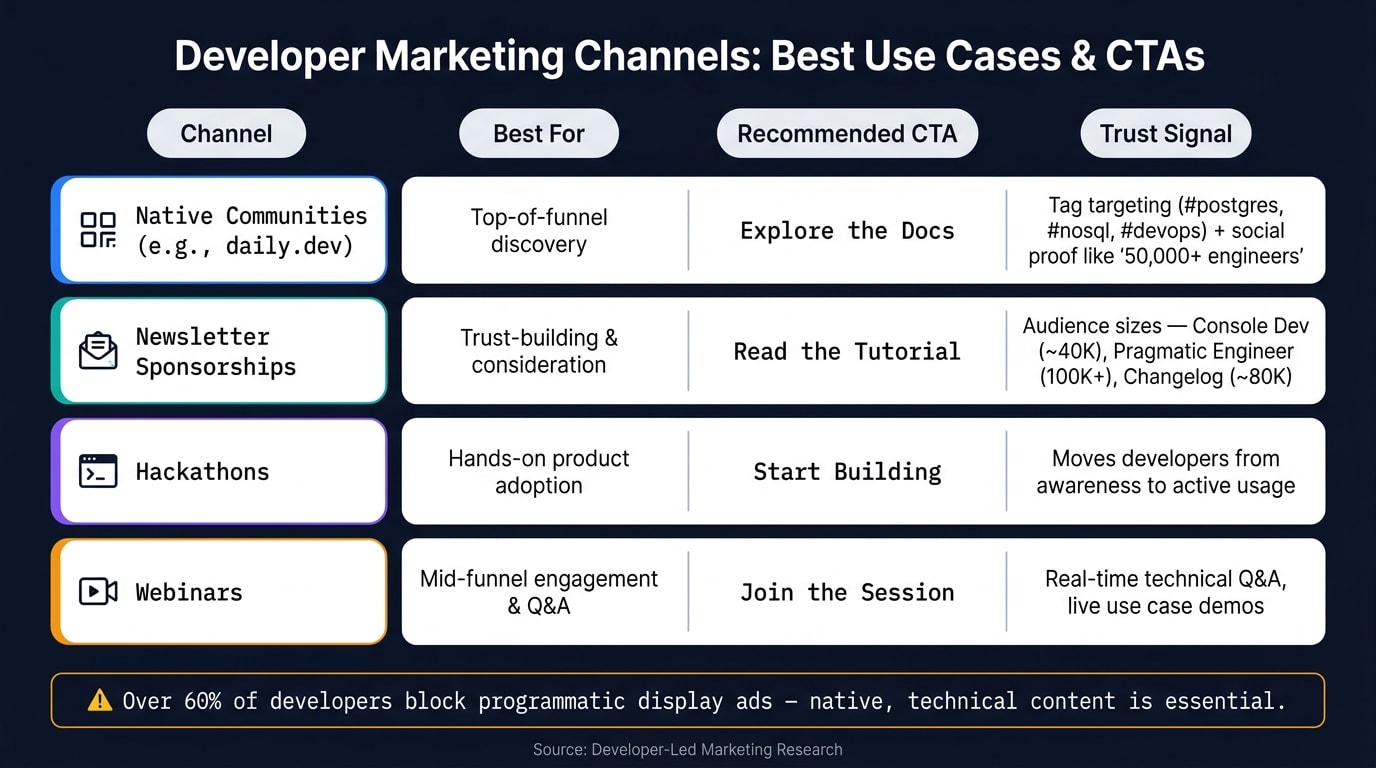
Did you know that over 60% of developers block programmatic display ads ? This means traditional banner ads and generic display networks often fail to reach this audience effectively. Instead, you need to engage developers in the spaces they trust most.
Platforms like daily.dev are built to connect with developers through native, technical content. Developers frequent daily.dev to stay up-to-date with the latest industry trends, making in-feed ads that resemble useful articles far more effective than intrusive formats. You can even target specific tags - like #postgres, #nosql, or #devops - to ensure your message reaches developers already working on related technologies. Adding social proof, such as “Used by 50,000+ engineers” or showcasing GitHub star counts, can instantly boost credibility in these trusted feeds.
When advertising in these communities, keep your call-to-action (CTA) simple and low-pressure. CTAs like "Read the Article" or "Explore the Docs" tend to perform better for initial engagement than more aggressive options like "Start Free Trial." Save those conversion-focused CTAs for later stages in the marketing funnel.
Educational and Technical Content Platforms
Sponsoring technical content is a great way to build trust and credibility. Developers who are actively learning through newsletters or tutorials are often more open to exploring new tools. Consider partnering with respected newsletters like Console Dev (focused on developer tools, ~40,000 subscribers), Pragmatic Engineer (targeting engineering leaders, 100,000+ subscribers), or Changelog Newsletter (reaching ~80,000 open-source developers) .
When sponsoring content, make sure the materials you provide - whether it’s a cheat sheet, architecture guide, or benchmarking report - offer real value on their own. Even if the developer doesn’t immediately purchase your product, they’ll associate your brand with helpful, high-quality resources. For example, sponsoring a deep-dive tutorial or a performance benchmarking post can position your product as a trusted solution.
Events, Hackathons, and Webinars
Developer-focused events like conferences, hackathons, and webinars offer unique opportunities to engage your audience. Hackathons, in particular, are great for driving hands-on adoption. When developers use your API or CLI to build something during a hackathon, they move beyond awareness to actively working with your product.
Webinars, on the other hand, strike a balance between reach and engagement. They allow you to connect with developers mid-funnel by answering technical questions and showcasing use cases in real-time. This makes webinars especially effective for developers who are familiar with your product but need a little more guidance before committing.
| Channel | Best For | Recommended CTA |
|---|---|---|
| Native communities (daily.dev) | Top-of-funnel discovery | "Explore the Docs" |
| Newsletter sponsorships | Trust-building, consideration | "Read the Tutorial" |
| Hackathons | Product adoption, hands-on usage | "Start Building" |
| Webinars | Mid-funnel engagement, Q&A | "Join the Session" |
Build Campaign Assets Developers Will Actually Use
Once you've chosen the right channels, the next step is creating campaign assets that developers will genuinely find useful. Simply getting your message in front of developers isn’t enough; the quality and relevance of your assets - like landing pages, documentation, and demos - determine whether they’ll dive in or move on. Developers are quick to assess tools, so your assets need to stand out based on their technical value.
Technical Landing Pages and Documentation
Great documentation is non-negotiable. It serves as a product evaluation tool, an onboarding guide, and even a conversion driver all in one .
Here are some ways to make your documentation and landing pages more effective:
- Start with code: Place a functional code snippet front and center. Show key API calls or query syntax right away.
- Be specific about performance: Avoid vague promises like "enterprise-grade reliability." Instead, provide measurable data - like latency under load, IOPS, or scalability thresholds.
- Simplify pricing: Offer clear pricing calculators to help developers estimate storage, compute, and throughput costs .
When it comes to design, developers tend to trust straightforward, documentation-like layouts over flashy, animation-heavy pages. Minimalist, markdown-style designs often resonate better because they feel practical and familiar . As one framework puts it, "unapologetically plain" can outperform overly polished designs.
"Marketing through engineering." - Konrad Sopala, Author, Developer Led
Treat your documentation as an extension of your product, not an afterthought. Embedding "Sign Up", "Log In", and "Book a Demo" links directly into the documentation navigation ensures developers stay within your ecosystem. This seamless integration encourages deeper exploration of your product’s capabilities.
Interactive Demos and Tutorials
While strong documentation builds trust, interactive elements turn that trust into action. Developers are far more likely to engage with hands-on experiences than passive reading.
"A working code example beats 500 words of explanation." - Averi
Focus on achieving a "Time to First Result" under five minutes. This means developers should be able to install, connect, and run their first query within that short window . For example, RisingWave’s onboarding guide emphasizes its simplicity by showcasing how a single brew install command gets users started, contrasting it with Apache Flink’s more complex setup process that involves JVM configuration, cluster setup, and JAR packaging . This side-by-side comparison does more to sell the product than any feature list could.
Skip generic "Hello World" examples and instead showcase practical use cases. Highlight scenarios like building a real-time notification system or solving specific challenges, such as Postgres connection pooling in Node.js. Each step should be runnable, and tutorials should link directly to a GitHub repository with the full source code . Neon takes this approach further by including a hands-on challenge where developers add a "delete" feature to a sample app, ensuring they leave the tutorial having built something tangible .
To make adoption easier, stick with standard tools like psql, JDBC drivers, or other familiar clients. The closer your product aligns with developers’ existing workflows, the faster they’ll integrate it into their projects .
Track Campaign Performance and Developer Engagement
Once your campaign assets are in place, the next step is measuring how effectively you're engaging developers. It's not enough to rely on surface-level metrics like click-through rates or form submissions - those won't tell you how deeply developers are interacting with your product. To truly understand their interest, focus on tracking behaviors that show technical engagement, such as exploring documentation, activating trials, or completing integrations.
Metrics That Matter for Developer Campaigns
A key shift in developer marketing is moving from Marketing Qualified Leads (MQLs) to Product Qualified Leads (PQLs). Why? Because MQLs might include someone who simply opened an email, while PQLs represent developers who have taken meaningful steps, like integrating an SDK or hitting a specific API usage milestone. This difference is huge: PQLs convert to paying customers at rates between 15–30%, compared to just 2–5% for MQLs .
Another metric worth prioritizing is Time to First Value (TTFV) - how quickly a developer achieves a meaningful outcome with your product. For example, this could mean running their first query, connecting to a database, or deploying an application. The faster this happens, the better. Aim for TTFV under 15 minutes for freemium products and under 30 minutes for trials . Vercel, for instance, optimized its deployment process so developers could ship an app in under 60 seconds .
Documentation engagement is another powerful indicator of conversion potential. Stripe discovered that developers who visit five or more unique documentation pages in one session are 340% more likely to convert compared to those who view just one page . Tracking metrics like pages viewed per session or the time between a developer’s first documentation visit and their first successful API call can reveal how well your documentation supports adoption.
For database tools, PQL triggers might include actions like completing a schema migration, hitting specific query volumes, or inviting team members. Datadog, for example, defines a PQL as a user who sends at least 100 monitoring events and stays active for over seven days. This approach has helped them achieve a 22% PQL-to-paid conversion rate .
Once you've gathered these insights, use them to refine your campaigns further.
Using Feedback to Improve Future Campaigns
Attribution in developer marketing can be tricky. Research shows that 52% of developers discover tools through "dark social" channels like private Slack groups, Discord servers, or internal wikis - spaces that traditional analytics can't easily track . A simple way to fill in these gaps is by asking new users, "How did you hear about us?" during onboarding. While not perfect, this method can uncover trends that typical attribution tools miss.
In addition to surveys, pay attention to community signals. For example, MongoDB found that developers who answer at least one technical question within their first 90 days are 65% more likely to stay engaged and 40% more likely to expand their usage . Monitoring activity in your community - like a drop in participation or an increase in unanswered questions - can highlight areas where your onboarding process or documentation might need improvement. Regular feedback loops are essential for refining your technical resources and messaging.
"Product Qualified Leads (PQLs) represent the gold standard for developer audience measurement." - Jono Bacon, Author
Tools like PostHog, which offers a free tier for up to 1 million events per month, can help you identify where developers lose momentum after clicking an ad by providing session replays and in-app surveys . Combine these insights with community monitoring on platforms like Reddit or Hacker News to detect sentiment changes early. For example, if you notice multiple developers from the same company asking similar technical questions, it might signal a potential sales opportunity for your team .
Conclusion: Getting Developers to Adopt Your Product
When it comes to marketing to developers, flashy ads and big budgets won’t cut it. Developers tend to be skeptical by nature - they block ads, dismiss cold emails, and can easily spot vague or exaggerated claims. What truly resonates with them is honest, practical content that solves real technical challenges. Building trust with this audience requires showing clear technical value and maintaining transparent communication.
The strategy is simple: focus on what developers need. Provide detailed documentation that highlights your product's capabilities and engage authentically in developer spaces. As mentioned earlier, create something that genuinely solves a problem, be upfront about its limitations, and actively participate in the communities where developers interact.
Documentation is especially critical - it’s often the first point of contact for developers evaluating your product. With tools like Cursor and Claude Code now pulling information from READMEs and SDK documentation, ensuring this content is top-notch is just as important as any paid marketing effort. Joe Karlsson, Developer Advocate at CloudQuery, captures this perfectly:
"Your README, your examples directory, your API reference, and your SDK docs are your LLM marketing."
It’s also crucial to focus on product-qualified metrics rather than vanity metrics. Developer tools with open-source components see enterprise adoption rates increase 45% faster compared to proprietary tools . Additionally, developers who engage deeply with your documentation are up to 340% more likely to convert than those who don’t . The sooner developers experience the value of your product, the more likely they are to adopt it and recommend it to others.
In short, success lies in prioritizing technical clarity, fostering meaningful engagement, and measuring outcomes that reflect real usage and adoption.
FAQs
What proof should I show developers to earn trust fast?
To earn developers' trust quickly, prioritize technical accuracy and transparency. Share concrete data such as performance benchmarks, security certifications, or open-source contributions. Include success stories that showcase measurable outcomes and offer well-documented, detailed examples. Be upfront about any limitations and always back your claims with clear, verifiable metrics. Developers appreciate precision, honesty, and proof that your solution works in practical scenarios.
How do I pick the first developer segment and “beachhead” stack?
To kick things off, dive into behavioral and technographic data to pinpoint a group of developers who are already engaged and whose needs align with what your product offers. Pay attention to specifics like the programming languages they use, the tools they rely on, and their level of seniority.
Next, use this information to craft detailed developer personas. These personas will help you fine-tune your messaging and select the best channels to connect with your audience effectively.
Before going all-in, test your campaign on a smaller subset of this group. Keep a close eye on the results, and use the insights to tweak your targeting. This approach helps you build a solid foundation before expanding your efforts to reach a larger audience.
What are the best PQL and TTFV metrics for database products?
For database products, the most effective Product-Qualified Lead (PQL) metric focuses on tracking meaningful user engagement. This could include actions like sending over 100 monitoring events or maintaining activity for more than 7 days. These behaviors indicate a solid interest and potential for conversion.
Top-performing companies in this space often achieve PQL-to-customer conversion rates between 15% and 30%.
As for Time to First Value (TTFV), it's crucial to keep this metric low to ensure users quickly experience the product's benefits. For freemium models, aim for a TTFV of under 15 minutes. For trial-based products, a TTFV under 30 minutes is ideal. Shorter TTFV not only boosts value perception but also plays a key role in retaining developers.