
DevSecOps teams want security tools that fit into their workflows without slowing them down. To market effectively to them, focus on technical trust, clear messaging, and actionable solutions. Here's what matters most:
- Who they are: Developers, security engineers, and platform engineers who prioritize speed, compatibility, and minimal false positives.
- What they care about: Tools that integrate smoothly into CI/CD pipelines, provide quick results (under 15 minutes), and offer free trials without barriers like credit card requirements.
- How they evaluate: Through hands-on testing, GitHub activity, and documentation - not traditional sales pitches.
- What works in messaging: Highlight specific workflow improvements like "reduce alert triage time" or "cut setup from 3 days to 30 minutes." Avoid fear-based tactics.
- Content strategy: Provide tutorials, technical guides, and compliance resources that solve specific problems. Developers trust detailed documentation and peer reviews over flashy marketing.
- Best channels: Developer events (e.g., DEF CON, BSides), GitHub, Reddit, and targeted platforms like daily.dev Ads.
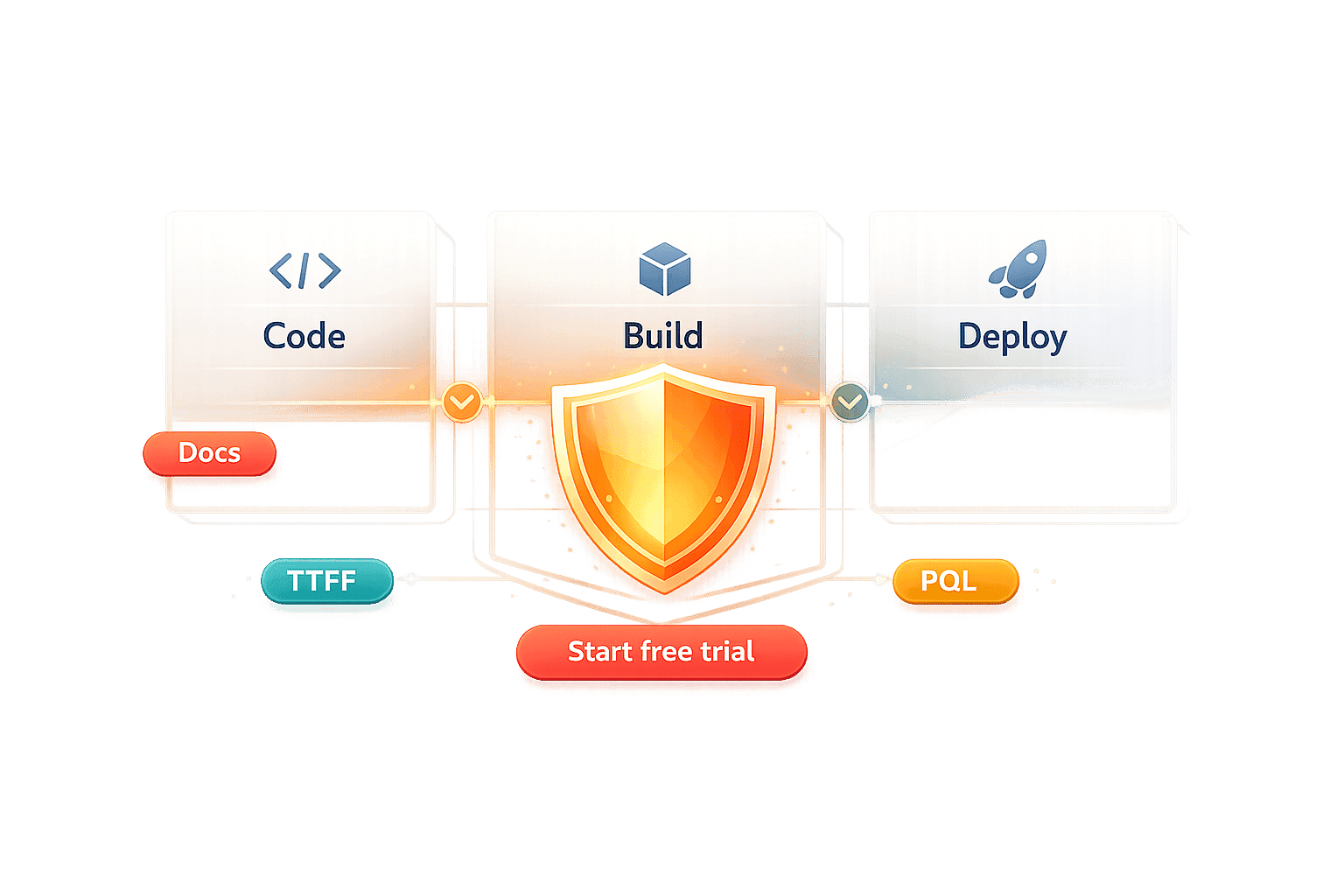
To succeed, focus on product-led growth and track metrics like Time-to-First-Finding (TTFF), pipeline integration rates, and Product Qualified Leads (PQLs). Developers will champion tools that save time and reduce friction, making them key drivers for adoption.
Profiling the DevSecOps Buyer
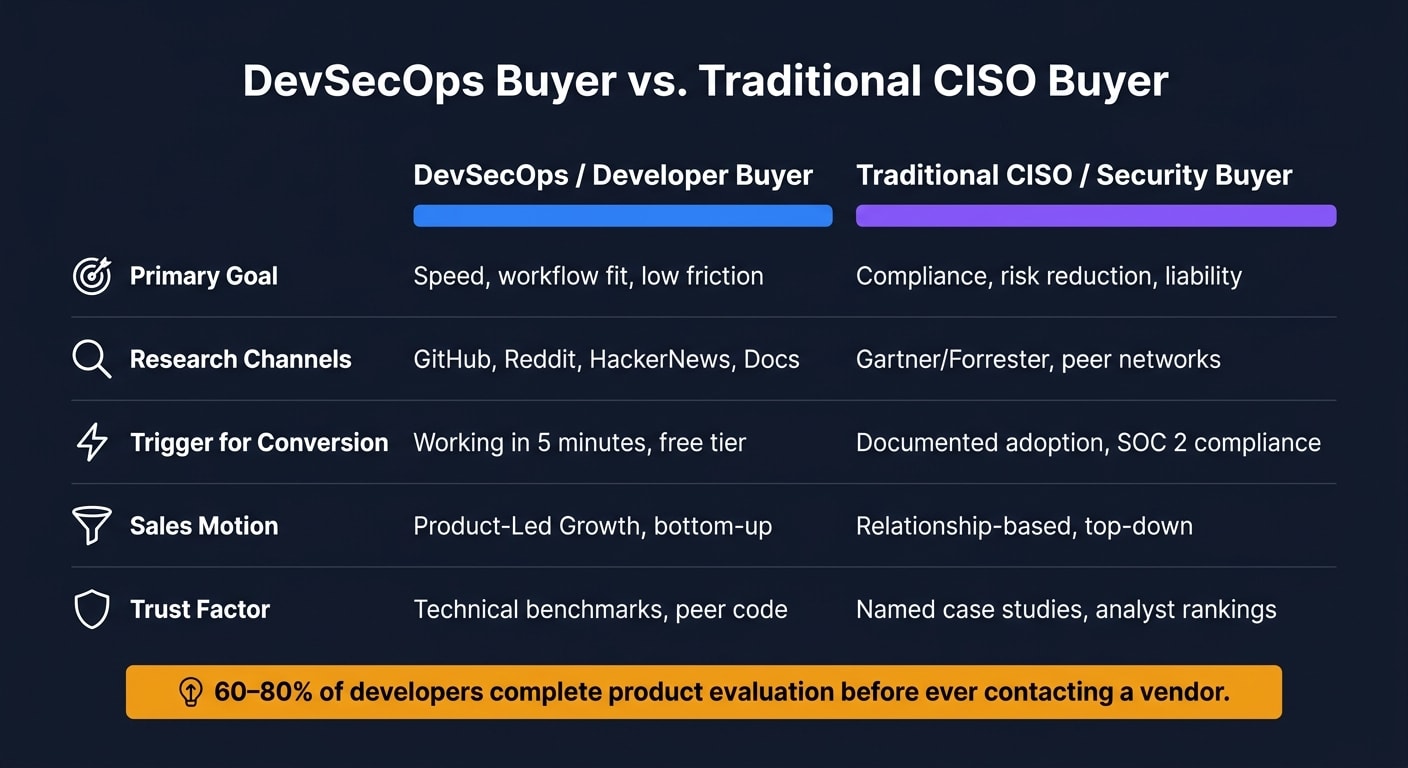
DevSecOps buyers are hands-on and thorough in their evaluation process. Research indicates that developers complete 60–80% of their product evaluation before ever reaching out to a vendor . They’re diving into your documentation, scanning GitHub issues for potential problems, and running their own proof-of-concept tests - all without your sales team even knowing they’re interested.
Key Decision Factors
Once developers complete their independent research, their decisions hinge on specific technical factors. What turns their interest into commitment? It often boils down to CI/CD pipeline compatibility, quick setup, minimal false positives, and a seamless first experience. A tool that takes hours to configure or clogs their pipeline with unnecessary alerts won’t make the cut, no matter how impressive its features are.
Developers also set a high bar for ease of use. They expect to see results within five minutes and access a free tier - no credit card required. If these expectations aren’t met, they’ll move on to the next option. As Sonu Goswami, a B2B SaaS positioning specialist, explains:
"The wedge is not 'we're secure' - it's 'we remove friction'." - Sonu Goswami, B2B SaaS Positioning Specialist
Beyond that initial experience, developers scrutinize factors like API documentation, edge-case handling, and the footprint of any agents. These elements allow them to validate a tool quickly without getting bogged down in extended testing cycles.
How Developer Security Marketing Differs
Given these priorities, marketing to developers requires a completely different approach than targeting CISOs. While CISOs respond to things like analyst rankings, compliance certifications, and risk management narratives, developers focus on benchmarks, code examples, and peer reviews on platforms like GitHub or Reddit.
The table below highlights the key differences that should inform your messaging and channel strategy:
| Factor | DevSecOps / Developer Buyer | Traditional CISO / Security Buyer |
|---|---|---|
| Primary Goal | Speed, workflow fit, low friction | Compliance, risk reduction, liability |
| Research Channels | GitHub, Reddit, HackerNews, docs | Gartner/Forrester, peer networks |
| Trigger for Conversion | Working in 5 minutes, free tier | Documented adoption, SOC 2 compliance |
| Sales Motion | Product-Led Growth, bottom-up | Relationship-based, top-down |
| Trust Factor | Technical benchmarks, peer code | Named case studies, analyst rankings |
One challenge that often trips up security marketers is the user vs. buyer split. The developer who uses your tool daily and the VP of Engineering who approves the purchase have very different concerns . Developers prioritize time savings and seamless integration, while buyers care more about stack consolidation and overall security posture. To succeed, your marketing has to address both - but it starts with winning over the developer.
"The buyer (CTO, VP Engineering, head of platform) will not sign a contract for a tool no one on their team has used." - Abmatic AI
This dynamic is why bottom-up adoption isn’t just a growth strategy - it’s the core sales motion for tools targeting DevSecOps teams. A developer who champions your product internally carries far more weight than any outbound campaign ever could.
Writing Messaging That Works for Developers
Once you understand what DevSecOps buyers need, the next challenge is crafting precise messaging that resonates. One of the biggest mistakes in marketing security tools is using language that doesn't align with developers' priorities. Clear messaging is crucial for positioning your tool as a helpful addition to their workflow, not a roadblock.
Positioning Security as a Workflow Enabler
Developers care deeply about speed and efficiency, especially in CI/CD pipelines. Their focus is on sprint velocity and minimizing the time spent dealing with false positives. To connect with them, your messaging needs to address these pain points directly.
Effective messaging identifies specific problems developers face. Take these two examples:
- Ineffective: "Streamline your security workflow"
- Effective: "Cut CI/CD setup from 3 days to 30 minutes"
The second example works because it’s specific and actionable. Developers can instantly see how it applies to their work. Vague claims, on the other hand, often trigger skepticism. Developers tend to distrust marketing language unless it’s backed by concrete proof.
"Developers distrust bold claims until verified." - Gaurav Tiwari, Developer and Founder
Position your tool as a way to reduce manual tasks, cut down on unnecessary alerts, and speed up remediation. Data shows that developers who engage with five or more unique documentation pages during their first session are 340% more likely to convert compared to those who only visit one page . This highlights the importance of detailed, accessible documentation - it builds trust and encourages adoption.
Steer clear of fear-based tactics. Instead, focus on how your tool enhances workflows and simplifies their daily tasks.
Why Fear-Based Selling Fails with Developers
Fear, uncertainty, and doubt (FUD) strategies no longer work with developers. They’ve grown immune to scare tactics, like breach statistics or ransomware horror stories.
"FUD Fatigue is real... buyers have developed a near-impervious filter against FUD-based marketing. They scroll past it. They delete it." - UpliftGTM
Developers are already inundated with alert fatigue and overwhelming amounts of noise. They need messaging that cuts through the clutter and offers clear, outcome-driven solutions. For example: "Reduce alert triage time and surface the findings that actually matter." This kind of messaging directly addresses their daily frustrations.
While compliance-based claims like "We help you meet SOC 2" might grab initial attention, they rarely foster long-term loyalty. Developers are more likely to stick with tools that genuinely make their work easier and more efficient. Focus on delivering tangible benefits that simplify their workflow.
Building a Content Strategy for DevSecOps Teams
Creating effective content for security tools isn't about flashy marketing or polished brochures. Developers prefer content that tackles real-world issues - the kind they faced just last week. To engage DevSecOps audiences, your strategy must go beyond the surface, diving into the technical depth they value.
Content Formats That Work
The best content for DevSecOps teams has one key feature: it addresses a specific problem before mentioning any product. For example, original threat research or in-depth analyses of vulnerabilities can establish credibility like nothing else. A comprehensive CVE breakdown that explains detection and remediation in a CI/CD pipeline will do far more for your brand than another generic "Top 10 Security Trends" list.
Practical tutorials also resonate strongly. Guides like "How to integrate SCA scanning into a GitHub Actions pipeline" or "Automating SOC 2 evidence collection with your existing toolchain" not only rank well in search engines but also gain trust. This type of content often gets bookmarked or shared in private Slack groups, which accounts for 52% of developer tool discovery .
Compliance-focused content is another must-have. Pages that address specific audit requirements - like SOC 2, HIPAA, or FedRAMP - attract teams actively seeking regulatory solutions . Pair these pages with honest comparison guides that highlight both your tool's strengths and its limitations. As Joe Karlsson, Developer Advocate at CloudQuery, points out:
"I've watched one comparison post stay in the top 10 performers for over a year with zero updates. Good data ages better than good writing."
Don’t overlook your documentation as a content asset. Developers who explore five or more unique documentation pages during their first visit are 340% more likely to convert compared to those who view just one page . Treat your README files, API references, and SDK documentation as integral parts of your content strategy.
Adapting these formats to fit different stages of the developer journey is key to success.
Matching Content to the Buyer Journey
To make the most of your content, align it with the specific stage of the developer's evaluation process. What works best depends on where they are in their journey. At the awareness stage, your goal is to be discoverable when developers search for solutions to their problems - not to push product features. By the evaluation stage, they need detailed technical content to determine if your tool fits their needs. And when they’re ready to commit, peer validation becomes far more valuable than vendor promises.
| Buyer Stage | Content Format | Objective |
|---|---|---|
| Awareness | Original threat research, compliance SEO pages, engineering deep-dives | Build credibility and attract high-intent searches |
| Evaluation | Tutorials, documentation, quickstarts, comparison guides | Help developers assess your tool and shorten time-to-value |
| Adoption | Technical whitepapers, peer case studies, integration guides | Show ROI and confirm architectural compatibility |
| Retention | Changelogs, community forums, troubleshooting FAQs | Minimize friction and promote broader tool usage |
Here’s a practical tip for evaluation-stage content: ensure developers can achieve a working implementation in 15 minutes or less from a cold start. If your "Getting Started" guide takes longer, you risk losing them before they even see the value . Keep your code examples up-to-date and error-free - developers will call out mistakes publicly, and recovering from that kind of damage can be tough.
Channels for Reaching DevSecOps Teams
Creating great content is just the start - it needs to land in front of the right audience. DevSecOps practitioners aren't hanging out on generic B2B platforms. Instead, they gather in niche communities where technical expertise carries more weight than flashy branding.
Developer Communities and Events
Not all security events attract the same crowd. For example, the RSA Conference is perfect for connecting with CISOs and security leaders, making it a good place for brand visibility and executive-level discussions. But if you're targeting developers or security engineers, you'll find better opportunities at Black Hat, DEF CON, and BSides events.
Black Hat is ideal for deep technical engagement, featuring briefings, research sessions, and hands-on labs. DEF CON, on the other hand, has a grassroots vibe that resonates with practitioners, offering an authenticity that's tough to beat. Meanwhile, BSides events are smaller, community-driven gatherings that are perfect for having meaningful conversations with regional experts who influence tool decisions.
Outside of conferences, DevSecOps teams are active in online spaces like r/netsec and r/cybersecurity on Reddit. Open-sourcing a security tool on GitHub is another great way to grab attention, as it directly addresses real-world problems practitioners are trying to solve . Additionally, newsletters like Risky Business and SANS NewsBites deliver high engagement with focused security audiences .
When planning for events, it's crucial to shift your mindset. These aren't just places to scan badges - they're opportunities to schedule pre-booked meetings, host private roundtables, or even run a CTF challenge. These approaches build trust far better than a branded booth ever could.
"The event is the venue, not the strategy." – UpliftGTM
Pair these community efforts with well-placed advertising to reach developers during their discovery phase.
Using daily.dev Ads for Security GTM
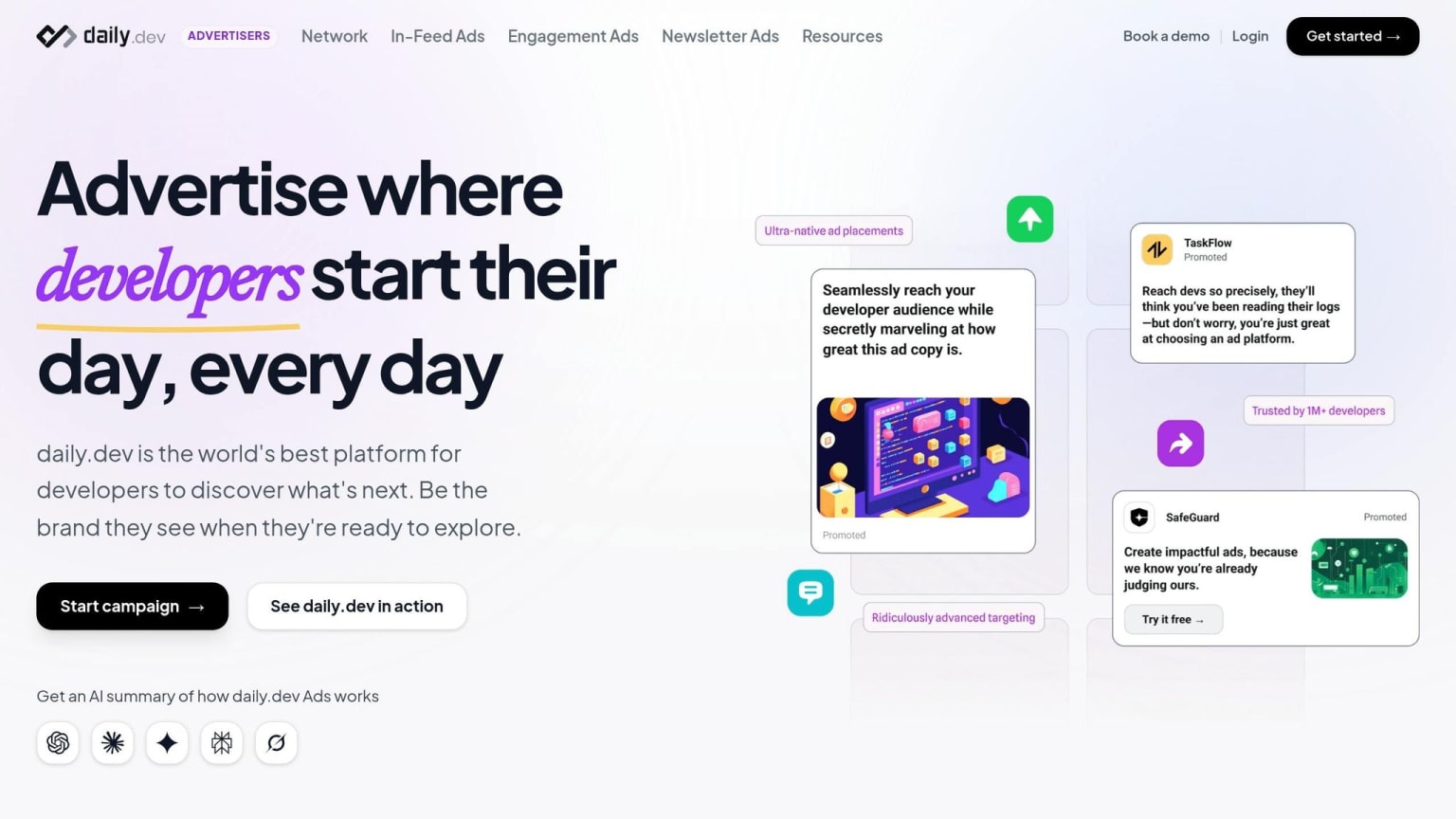
While events and community outreach help build credibility, targeted advertising can extend your reach even further. Standard programmatic ads often fall flat with developers - they rely on outdated profiles and disrupt workflows. daily.dev Ads, however, takes a different approach. It targets developers based on the content they're actively reading, right now, rather than outdated signup information .
This is particularly effective for security go-to-market (GTM) strategies because it connects with developers while they're researching topics like CI/CD pipelines, Kubernetes security, or supply chain vulnerabilities. Consider this: 24% of daily.dev's audience actively reads DevOps and Cloud content, and 30% are senior engineers with more than seven years of experience . These are the decision-makers and champions for DevSecOps tools.
Companies like Snyk, Sonar, Okta, and Datadog are already leveraging daily.dev to reach this audience . Ads appear natively in feeds and personalized digests, blending in as helpful content rather than intrusive interruptions. As the platform itself puts it:
"Developers do not click on ads. They click on solutions to their problems." – daily.dev
To succeed here, your ad creative needs to focus on specific, actionable solutions. Highlight a problem you can solve - like reducing false positives in container scans or speeding up time-to-first-finding in a GitHub Actions pipeline - rather than pushing a generic brand message.
Standing Out in a Crowded Security Market
Reaching DevSecOps teams with focused content is one thing; standing out in a saturated cybersecurity market is another. With over 3,500 cybersecurity vendors globally , vague claims like "AI-powered" no longer carry weight. By 2026, these phrases will be so overused that buyers will ignore them unless backed by clear, verifiable capabilities . The key to success lies in carving out a distinct niche and owning it. Think about how Wiz became synonymous with CSPM or how Snyk positioned itself as the go-to for developer-first security. Neither tried to cater to everyone - they chose a focus and stuck with it.
"Differentiation does not come from claiming you have 'AI-powered' threat detection... It comes from being specific about what you do differently and who you do it for." – UpliftGTM
Workflow Integration and Automation Depth
If your SAST or SCA tool takes too long to configure and deliver results, no amount of clever branding can save it. Buyers value transparency - be upfront about things like your tool's agent footprint, integration time, and ability to function in air-gapped environments. Specifics like these build trust far more effectively than vague ROI promises.
Automation is another area where you can stand out. In a typical SOC, about 90% of alerts are false positives . A tool that significantly reduces these false positives - say, by detecting MITRE ATT&CK T1486 with less than 5% false positives - will quickly earn loyalty. The table below highlights how specific, measurable claims resonate better with technical buyers than generic ones:
| Feature Area | Generic Claim (Avoid) | Specific Differentiator (Use) |
|---|---|---|
| Automation | "AI-driven threat detection" | "Detects MITRE ATT&CK T1486 with <5% false positives" |
| Integration | "Seamless workflow integration" | "Pre-built SOAR playbooks with documented REST API" |
| Performance | "Low impact on systems" | "Minimal agent footprint (<1% CPU) and air-gapped support" |
| Outcome | "Reduces security risk" | "Reduces MTTR by 60% via automated evidence collection" |
These concrete metrics make your tool's value undeniable and help cut through market noise.
Using Technical Proof Points to Build Credibility
Generic buzzwords rarely sway technical buyers - they want specifics. A security architect considering a DAST or CSPM tool will dive into your API documentation, test the tool in a lab, and examine architecture diagrams long before engaging with sales. This makes high-quality documentation a critical marketing asset, not just a support tool.
"For devtools, docs produce more pipeline than the marketing site." – Louis Corneloup, Founder, Dupple
One effective strategy is the "Minute 0–5" rule: a developer should be able to run a scan or see a real finding within the first five minutes of trying your tool . Additionally, publishing content under the names of recognized security researchers adds credibility - not just with your audience but also with search engines . Combining these tactics with a broader developer-focused marketing strategy can make a lasting impact.
Measuring Developer Security Marketing Performance
After launching your developer security marketing campaign, it's crucial to measure success using metrics tailored to the developer audience. Traditional B2B metrics, like Marketing Qualified Leads (MQLs) or simple form submissions, often miss the mark for DevSecOps. Developers tend to skip "request a demo" forms, opting instead for free trials or directly integrating tools into their workflows. This means your measurement framework needs to focus on the technical milestones that matter most.
Core Metrics to Track
The biggest shift in measurement is moving from MQLs to Product Qualified Leads (PQLs). A PQL represents a user who has performed a meaningful technical action, such as running a scan, completing an API integration, or pushing a finding into their CI/CD pipeline. Why does this matter? PQLs for developer tools convert to paying customers at rates between 15% and 30%, compared to just 2% to 5% for standard MQLs . That difference alone should reshape how you define a strong lead.
Another key metric is Time-to-First-Finding (TTFF), which measures how quickly a developer integrates your tool and gets an actionable result. For freemium products, the goal is clear: under 15 minutes. If setup takes more than 30 minutes, abandonment rates climb steeply . For tools like SAST or SCA, a lengthy setup process can hurt your trial-to-conversion rates.
Pipeline integration rate is equally important. This metric tracks the percentage of trial users who move from signing up to successfully completing a scan within their CI/CD pipeline. The target here is a 60%–80% integration rate . If you're falling short, the issue is likely with onboarding rather than demand generation.
While these metrics focus on initial performance, long-term engagement metrics are just as important for evaluating sustained success.
Supporting Metrics for Long-Term Engagement
Initial activation is only part of the picture; continued engagement is vital. One way to measure this is through Monthly Active Developers (MAD). Unlike generic monthly active user metrics, MAD focuses on developers performing authenticated actions, like running scans, committing code, or adjusting configurations, within a 30-day period . This gives a better sense of whether your tool has become part of their daily workflows.
Another strong indicator of success is tracking team invite milestones. When developers start inviting team members, it signals a shift from personal trial to team adoption, which is often a key handoff point for sales .
Retention metrics also play a crucial role. For well-integrated developer tools, Week 1 retention typically falls between 40% and 60%, while Month 6 retention ranges from 15% to 25% . These benchmarks help you understand how well your tool is sticking with users over time.
| Metric | What It Measures | Benchmark |
|---|---|---|
| Time-to-First-Finding | Speed to first actionable security result | <15 min (freemium) |
| PQL-to-Paid Conversion | Trial users completing meaningful technical actions | 15–30% |
| Pipeline Integration Rate | Trial users completing CI/CD integration | 60–80% |
| Week 1 Retention | Developers returning after initial activation | 40–60% |
| Net Dollar Retention (NDR) | Revenue expansion from existing users | 110–130% |
Finally, keep in mind that 52% of developer tool discovery happens through "dark social" channels - private Slack groups, Discord DMs, and word-of-mouth . These channels often bypass standard attribution methods, so adding a simple "How did you hear about us?" survey during onboarding can help capture these insights.
Conclusion: Key Takeaways for Marketing to DevSecOps Teams
Marketing to DevSecOps teams isn’t like traditional B2B security marketing - it’s a whole different ballgame. Developers don’t just take your word for it. They dig deep, examining documentation, checking out GitHub activity, and running hands-on tests before they even think about engaging. That means your marketing needs to deliver technical trust, not just polished messaging.
The real game-changer? Shifting from fear-based tactics to empowerment. As UpliftGTM puts it, "Cybersecurity marketing is broken. Most vendors rely on fear-based messaging that buyers have learned to ignore." Instead, highlight how your SAST, DAST, or SCA tool solves specific workflow headaches, like cutting down false positives, speeding up CI/CD pipelines, or automating compliance tasks. This approach makes your product relevant and developer-friendly.
Technical proof is everything. Did you know that engaging with multiple documentation pages can boost conversion rates by 340% ? That’s why investing in detailed technical content, runnable examples, and robust API references is so important. Developers value depth over flashy campaigns.
Reaching developers where they naturally spend time is just as critical. With over 60% of developers using ad-blockers , traditional ads won’t cut it. Instead, focus on developer-focused platforms. For instance, daily.dev Ads lets you target developers based on the tools and topics they’re actively exploring, like supply chain security or container scanning. This ensures your message hits at the perfect moment.
Finally, track metrics that matter to developers. Forget generic MQLs - focus on Time-to-First-Finding, pipeline integration rates, and PQL-to-paid conversion. These metrics not only show adoption but also help build sustainable, long-term growth. By aligning your strategy with these priorities, you’ll create real impact in the DevSecOps space.
FAQs
What should a DevSecOps trial experience include?
A DevSecOps trial needs to include interactive demos, sandbox environments, clear documentation, and self-service options. These elements allow developers to test the product with ease, understand its capabilities, and dive into its technical features - all without unnecessary hurdles.
How can I prove trust to developers without sales calls?
Building trust with developers starts with providing clear and technical evidence. Share resources like detailed specifications, security certifications, performance benchmarks, and case studies that demonstrate how your product performs in real-world scenarios.
To further empower developers, offer self-service tools. These could include interactive demos, free trials, and thorough documentation. By giving them the chance to explore and test your product on their own terms, you make it easier for them to assess its value without relying on external guidance.
Which metrics best predict security tool adoption in CI/CD?
When evaluating the adoption of security tools in CI/CD pipelines, several metrics stand out as crucial indicators:
- Trial-to-paid conversion rate: This shows how many users transition from trying the tool to becoming paying customers, offering insight into its perceived value.
- Time to first value: This measures how quickly users experience tangible benefits after starting to use the tool, reflecting its ease of use and initial impact.
- Documentation engagement depth: Tracking how extensively users interact with the tool's documentation can reveal how accessible and effective the onboarding process is.
- Product qualified leads (PQLs): These are users who actively engage with the product in meaningful ways, demonstrating its relevance and potential value to their workflows.
Together, these metrics provide a clear picture of how well the tool integrates into developer workflows and the value it delivers.