

AI engineers are a specialized, highly-skilled group working on tasks like building LLMs, developing agents, and managing MLOps. They demand technical rigor and transparency from marketing efforts. Here's what you need to know to connect with them:
- Where they gather: Platforms like Hugging Face, GitHub, and arXiv are their go-to spaces for research and collaboration. They also engage on Hacker News, Reddit, and Discord for discussions. Conferences like NeurIPS and ICML are key for in-person interactions.
- What they value: Engineers prioritize evidence-backed claims. Share detailed benchmarks, reproducible results, and open resources like model cards and weights. Avoid vague marketing language.
- Effective formats: Long-form technical blogs, live evaluation dashboards, and in-depth YouTube system design videos resonate. Podcasts like Latent Space and newsletters like The Pragmatic Engineer are also influential.
- Paid channels: Platforms like daily.dev and podcast sponsorships are effective for targeted outreach. Conference booths and workshops help establish credibility.
- Common mistakes: Avoid generic "AI-powered" claims, cherry-picked data, and gated technical content. Transparency and honesty build trust.
To succeed, focus on creating content that educates and provides actionable insights, backed by solid technical evidence.
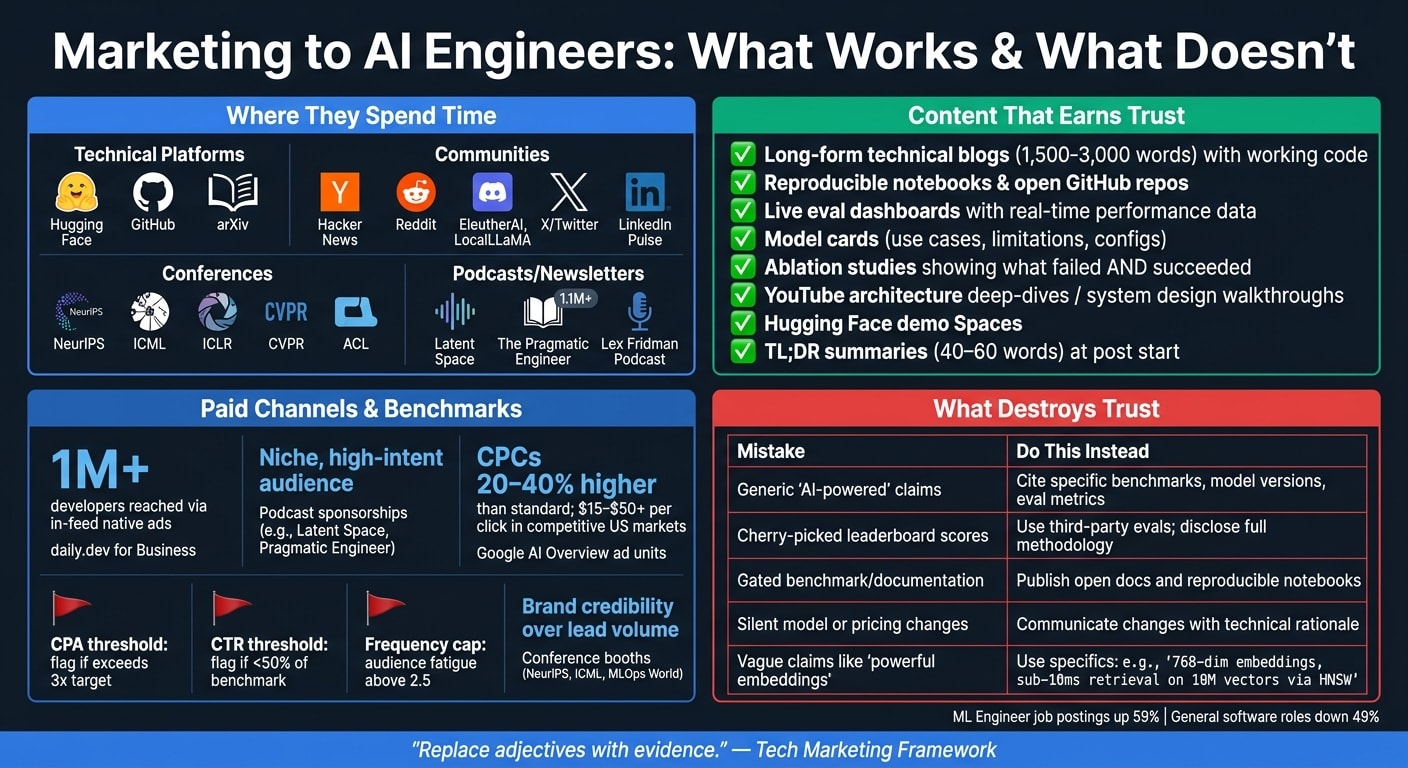
Where AI Engineers Spend Time Online
Key Technical Platforms
AI engineers frequent specific platforms tailored to their specialized needs. Among the top destinations are Hugging Face, GitHub, and arXiv.
Hugging Face serves as a go-to resource for those working with large language models (LLMs). It’s where engineers share model weights, datasets, and even their contribution histories, which act as a public résumé showcasing their applied skills . GitHub remains central to their coding workflow, especially for those contributing to key frameworks like PyTorch, JAX, and Transformers . Meanwhile, arXiv is invaluable for staying on top of the latest machine learning preprints, often providing access to cutting-edge research before it’s formally published .
Beyond these mainstays, AI engineers also dive into more focused online communities to exchange ideas and insights.
Niche Online Communities
Specialized communities offer AI engineers spaces for deeper conversations and real-time updates. Platforms like Hacker News and Reddit are popular for gauging technical sentiment and evaluating new tools within a discerning audience . For more in-depth discussions, Discord servers hosted by groups such as EleutherAI and LocalLLaMA are hotspots for topics like open-weight models, fine-tuning techniques, and optimizing inference.
X (formerly Twitter) plays a unique role in fostering real-time technical discourse. Its "For You" feed amplifies technical content to a broader audience, with 30% to 40% of article views coming from users who don’t follow the author . Meanwhile, LinkedIn Pulse has quietly gained traction as a high-authority platform, becoming the second most-cited domain in AI-generated search results. By 2026, its citation rates had grown four- to fivefold year-over-year .
Podcasts and Curated Feeds for Staying Current
Audio content and curated feeds help AI engineers keep pace with the field’s rapid developments. The Pragmatic Engineer newsletter, which surpassed 1.1 million subscribers in April 2026 , is a trusted resource for detailed insights into the AI engineering stack. Its podcast counterpart offers the same level of depth for those who prefer audio. Other must-listen podcasts include the Lex Fridman Podcast and Latent Space, both of which provide valuable perspectives on the field.
Curated feeds are also becoming an essential tool. Platforms like daily.dev for Business integrate ads directly into the reading experience AI engineers rely on to discover tools and monitor trends. This approach ensures that marketing efforts align with the engineers’ focus, delivering relevant content without disrupting their workflow.
Offline Events Where AI Engineers Show Up
Major AI Conferences
Online communities are great for day-to-day interactions, but nothing beats in-person events for building strong connections. Some of the most prominent gatherings for AI engineers include NeurIPS, ICML, ICLR, CVPR, and ACL - considered the go-to annual events for the global AI research community .
"The major ML conferences - NeurIPS, ICML, ICLR, CVPR, ACL - are where the global AI research community converges annually." - VAMI Editorial
These conferences draw senior, research-focused engineers who play a pivotal role in deciding which tools and technologies to adopt. Events like Google I/O 2026 are also gaining importance, especially for showcasing how AI is transforming enterprise workflows . Participating in or sponsoring these events isn’t just about showing up - it’s about establishing credibility and engaging with the decision-makers who shape the future of AI.
To make an impact, it’s essential to go beyond generic vendor pitches. Engineers at these events value discussions around practical topics like architecture trade-offs, evaluation methods, or inference costs. A polished slide deck alone won’t cut it. These conferences offer a chance to connect on a deeper level, but smaller, local events can take that connection even further.
Local Meetups and Smaller Gatherings
While large conferences are great for visibility, local meetups provide a more intimate setting for meaningful conversations. These smaller gatherings allow engineers to share insights about the tools they use and the challenges they face in production. For marketers, this is a golden opportunity to listen, learn, and build genuine relationships.
The AI talent pool is often described as "narrower, more passive, and more highly networked" compared to general software engineering . This makes focused, one-on-one conversations at meetups far more effective than quick exchanges at crowded conferences. Following up with a personalized, problem-focused message is much more impactful than a generic “great to meet you” email .
Together, these offline interactions complement digital efforts, helping to establish long-term trust and credibility with AI engineers.
Content That Earns Trust With AI Engineers
Once you've pinpointed where AI engineers gather, the next challenge is creating content that earns their trust.
AI engineers are adept at spotting weak claims. They read papers, run evaluations, and test reproducibility. To win them over, your content must be technically precise and backed by evidence.
Technical Depth and Benchmark Transparency
Nothing alienates AI engineers faster than benchmarks presented without context. Cherry-picked leaderboard results often signal a lack of credibility. Instead, share the full evaluation setup. Be clear about the datasets you used, the prompts you ran, and where your model struggled.
"Transparency is a competitive advantage. Replace adjectives with evidence." - j1ngg, Tech Marketing Framework
Reproducible notebooks are a strong trust signal. When engineers can clone your repository, run your evaluation tools, and replicate the numbers you report, it builds confidence. Pair these with a public evaluation dashboard that updates as your model or tool evolves. This creates a resource engineers will not only trust but also share with others.
Transparent evaluation naturally ties into offering detailed resources and thorough documentation.
Open Resources and Model Documentation
Releasing open weights and detailed model cards gives engineers the tools to verify your claims independently. A well-designed model card should include key details like intended use cases, input/output formats, known limitations, and supported configurations. This approach shows you're building solutions for engineers, not just pitching them.
Ablation studies are particularly impactful. Sharing what didn’t work alongside what did provides a research-driven perspective. This level of transparency is especially relevant as teams increasingly explore open-weight alternatives, such as Qwen or Kimi, to sidestep the cost unpredictability of closed API vendors . Additionally, contributions on platforms like Hugging Face and GitHub act as credibility markers, allowing engineers to assess your team’s expertise before any sales discussions .
| Resource Type | Why It Builds Trust |
|---|---|
| Reproducible Notebooks | Engineers can verify results without relying on assumptions |
| Model Cards | Standardize evaluation criteria and openly address limitations |
| Ablation Studies | Offer a complete view by showing both successes and failures |
| Open Weights | Allow local deployment and independent performance testing |
The key is straightforward: teach, don’t sell. Content that helps engineers tackle real challenges - whether it’s reducing inference latency or debugging a RAG pipeline - will always resonate more than content focused solely on product features .
Channels and Formats That Work for Reaching AI Engineers
Finding where AI engineers spend their time is just the start. The real challenge? Delivering content in formats they actually care about. AI engineers approach content differently than general developers - they skim for useful information, avoid anything that feels like a sales pitch, and save content that provides genuine value.
Technical Blog Posts and Eval Dashboards
The best technical blog posts feel like advice from one engineer to another. Long-form tutorials (1,500–3,000 words) that include working code, detailed integration steps, and inline comments tend to perform well. Why? Because clear code annotations are helpful not only for human readers but also for AI tools parsing the content .
To make your posts skimmable, start with a 40–60 word TL;DR. This not only helps readers but also improves visibility in AI-generated search summaries. Additionally, use direct answers at the start of each H2 section. This approach is especially important now that over 60% of US Google searches include AI Overview results .
Eval dashboards are another great way to build trust. By offering live performance data, you show transparency and let engineers see how your model or tool is progressing in real time. Pair this with a demo Space on Hugging Face, where engineers can directly test your model, and you’ve got a winning combination .
While written content is key, don’t overlook the power of dynamic video formats for engaging AI engineers.
YouTube Architecture Deep-Dives
Videos that dive into system design provide a visual complement to written tutorials. These architecture walkthroughs go beyond basic product demos and feel more like conference talks. They explore how a model was trained, the reasoning behind design choices, and the trade-offs made along the way.
"Running several AI agents feels less like 'project management' and more like 'wearing a mech suit.'" - David Heinemeier Hansson, CTO, 37signals
This quote highlights something AI engineers crave: a detailed understanding of how tools work so they can seamlessly integrate them into their workflows. Videos that showcase model architecture, live CLI demos, and agent tool chaining hit the mark. For example, a demonstration of an agent identifying errors, implementing fixes, and submitting pull requests via the CLI is exactly the type of content that gets shared among peers.
Paid Marketing Channels for Reaching AI Engineers
While organic content helps build trust over time, paid channels can speed up your ability to connect with your audience. When paired with transparent, value-driven organic efforts, these paid methods can reinforce your technical credibility. Reaching AI engineers - a highly sought-after and limited audience - often comes with higher acquisition costs, making strategic targeting essential.
In-Feed Ads and Podcast Sponsorships
Platforms like daily.dev for Business allow you to place content directly in the reading flow of AI engineers. With in-feed native ads, you can target developers based on seniority, programming language, and tools, ensuring your message reaches those interested in your LLM infrastructure product - not just generalist developers. This platform connects with over 1 million developers worldwide, and its native ad placements blend seamlessly into the user experience.
Similarly, podcast sponsorships leverage contextual relevance to engage your audience. For example, a mid-roll sponsorship on Latent Space - a podcast centered on LLM architecture, evals, and agent design - reaches listeners deeply engaged in the technical challenges your product addresses. Another strong option is The Pragmatic Engineer, Gergely Orosz's newsletter, which boasts over 1,100,000 subscribers , including senior engineers and decision-makers with purchasing power. Sponsoring such niche platforms carries more weight than generic display ads, as it places your brand in front of a focused, influential audience.
For search marketing, Google now offers ad units beneath AI Overview boxes. These placements come with CPCs that are 20% to 40% higher than traditional top-of-page ads , but they capture engineers right when they’re researching technical solutions. In competitive technical fields within the U.S., you can expect to pay $15 to $50+ per click , making precise targeting critical. These specialized placements can effectively complement your overall paid strategy.
Conference Booths and Sponsorships
Sponsoring events like NeurIPS, ICML, or MLOps World is less about generating a high volume of leads and more about building brand credibility. For instance, if an AI engineer hears about your tool on a Latent Space episode, sees your ad on daily.dev, and then encounters your booth at NeurIPS, they’re far more likely to trust your brand than if they only received a cold email.
While calculating ROI for conference booths can be tricky, the real value lies in the quality of interactions. Conversations with researchers, applied ML leads, and MLOps engineers - people already exploring tools in your category - are invaluable. Think of conference participation as a way to signal trust and foster relationships. To maximize your presence, consider pairing your booth with a technical talk or workshop, as these formats are proven to attract the engineers you want to connect with. Plan your budget accordingly to make the most of these opportunities.
Marketing Mistakes That Push AI Engineers Away
When marketing to AI engineers, it's critical to avoid common pitfalls. These professionals are meticulous - they read research papers, conduct their own tests, and exchange findings with peers. If your messaging can't hold up to their scrutiny, it doesn’t just miss the mark - it can harm your credibility.
Why Generic AI Messaging Fails
Calling a product "AI-powered" without providing specifics is meaningless to an LLM engineer. They need detailed technical information: Which model is being used? What's the context window size? How does it perform on benchmarks? Vague claims like "powerful embeddings" or "accurate results" suggest a lack of technical depth.
For example, instead of saying "powerful embeddings", provide specifics like: "768-dimensional embeddings with sub-10ms retrieval on 10M vectors using HNSW indexing." Instead of generic "accuracy", share benchmark results such as MMLU or HumanEval scores, specifying the model version and prompt template used. As the Tech Marketing Framework by j1ngg advises:
"Transparency is a competitive advantage. Personality is a moat. Replace adjectives with evidence." - j1ngg, Tech Marketing Framework
Another common misstep? Hiding technical details behind lead-generation forms. Engineers evaluating your tool need immediate access to documentation and benchmarks - not a form blocking their way . These mistakes undermine trust, setting the stage for more precise, evidence-based communication.
The Cost of Cherry-Picking Data
Selective presentation of data is another trust-killer. Cherry-picking leaderboard results, for instance, raises red flags. A high MMLU score might prompt questions about the subset used, whether the test set was fine-tuned, and how results compare to third-party evaluations.
A cautionary tale: In April 2026, Anthropic faced backlash for quietly downgrading Claude Code while increasing prices without explanation. Gergely Orosz, author of The Pragmatic Engineer, criticized the move:
"Anthropic's speedrun to destroy trust... Silently nerfing Claude Code, banning companies from Claude, and baffling price rises all add to a sense that Anthropic is in its 'extraction' era." - Gergely Orosz, The Pragmatic Engineer
This isn't just about pricing - it's about transparency. Unexplained changes to model behavior, benchmarks, or pricing come across as manipulative. If your metrics improve due to a new prompt template, say so. If your benchmarks are domain-specific, make that clear. Engineers value honesty over polished but incomplete data .
| Marketing Error | Engineers' Response | What to Do Instead |
|---|---|---|
| Generic "AI-powered" claims | Dismissed as marketing fluff | Cite specific benchmarks, model versions, and evaluation metrics |
| Cherry-picked leaderboard scores | Actively distrusted and cross-referenced | Use third-party evaluations; disclose methodology |
| Gated benchmark data | Creates friction that halts evaluation | Publish open documentation and reproducible evaluation notebooks |
| Silent model or pricing changes | Rapid, lasting trust erosion | Communicate changes transparently with technical rationale |
How to Measure What Is Working
Once you've sidestepped common pitfalls, the next step is figuring out if your campaigns are striking a chord with AI engineers. Traditional marketing metrics like impressions, MQLs, and form fills often fall short in this space. AI engineers tend to assess tools through hands-on testing and integrations, so you need metrics that reflect how deeply they're adopting your product.
Engagement Metrics That Matter
To gauge real adoption, focus on metrics that go beyond surface-level interactions. These include Hugging Face downloads, GitHub stars on integration repositories, and contributions to major ML frameworks like PyTorch or JAX. For example, activity on GitHub can reveal whether engineers are truly embedding your tool into their workflows, rather than just engaging with ads or surface-level content.
Pay attention to onboarding friction as well. Tools like Cursor or Claude Code allow AI-native engineers to ship pull requests at a rate 2.3x higher than those using standard IDEs . If your tool isn't showing up in commit histories quickly, it may signal issues with the developer experience that need addressing.
Some companies are also tracking token leaderboards to measure adoption. By monitoring token spend per engineer, you can identify whether your tool is being actively used. Low visibility in these logs could point to weak adoption rates.
Another emerging indicator is the LLM citation rate. For instance, LinkedIn Pulse became the second most-cited domain in AI-generated responses by 2026, with citation rates increasing 4x to 5x year over year . If your technical content is cited by LLMs on platforms like ChatGPT or Claude, it signals strong topical authority and relevance among engineers.
While these engagement metrics are crucial, financial and usage data also play a key role in validating your campaign's effectiveness.
Tracking Pilot Conversions and ROI
For paid pilots and trial conversions, tracking token spend growth per engineer over time provides a clear ROI signal. For example, developer token spend might grow from $200/month to $3,000/month per engineer within six months . This kind of growth is a tangible sign of successful integration.
On the paid channel side, keep an eye on these three thresholds:
- Cost-per-acquisition (CPA): If your CPA exceeds 3x your target, it’s time for an immediate review.
- Click-through rate (CTR): A CTR that’s less than 50% of your benchmark suggests your creative might need a refresh.
- Frequency: If audience-targeted placements have a frequency above 2.5, it could indicate audience fatigue .
As one Dev Productivity Lead from a SaaS company explained:
"Measure key outcomes and report on spend, monthly. When spend vs results diverge: adjust. More spend should mean better outcomes." - Dev Productivity Lead, SaaS company
If increased spending doesn’t translate into metrics like GitHub stars, download counts, or pilot-to-paid conversions, it’s time to reevaluate your creative, targeting, or even the product itself.
Conclusion: How to Build Credibility With AI Engineers Over Time
Establishing credibility with AI engineers isn’t something you can achieve overnight. It’s a long-term process that hinges on technical honesty and consistency. This audience doesn’t just take claims at face value - they test, validate, and scrutinize. The best advice?
"Replace adjectives with evidence." - Tech Marketing Framework
In other words, ditch vague promises and focus on providing hard proof: reproducible evaluation results, named datasets, and open notebooks that engineers can fork and test themselves. It’s about showing, not telling.
Consistency is just as critical as accuracy. As HubSpot aptly states, "AI is not the threat to fear. Inconsistency is." If your model card says one thing while your benchmark dashboard says another, engineers will catch it - and they won’t hesitate to call it out publicly. Every interaction, whether it’s a GitHub README or a live demo at a conference, should align with the same honest narrative. This level of reliability is the foundation for building trust with AI engineers.
The market is shifting, too. Job postings for ML engineers are up 59%, while general software roles have dropped 49% . This isn’t a broad audience of developers anymore - it’s a focused and discerning group. Tools like daily.dev for Business can help you reach these engineers where they already spend their time, delivering technical content directly into their curated feeds without interrupting their workflow.
At the end of the day, the engineers shaping the future of LLM applications, agent frameworks, and RAG pipelines aren’t just looking for vendors - they’re looking for tools that deliver results. By prioritizing transparency, reproducibility, and education in your content, you’ll earn their trust. And with trust comes adoption.
FAQs
How do I prove my AI product’s claims to engineers?
To support your AI product’s claims, prioritize clarity and technical precision. Use resources like evaluation suites, transparent benchmarks, reproducible notebooks, open weights releases, and ablation studies. Include detailed model cards and evaluation dashboards to enable independent verification of your results. Strengthen your position by referencing peer-reviewed research, reproducible experiments, or open-source models. Engineers appreciate solid, verifiable evidence far more than flashy marketing promises.
What content should I publish to reach LLM and agent devs?
To reach LLM and agent developers, prioritize technical and actionable content that fits seamlessly into their workflows. Some effective approaches include:
- Writing detailed blog posts that include code examples.
- Providing model cards and evaluation dashboards.
- Creating demo Spaces that highlight real-world benchmarks.
Building trust is key. Share resources like open weights, reproducible notebooks, and clear evaluation metrics to demonstrate transparency. To expand your visibility, engage actively on platforms such as GitHub, Hugging Face Spaces, and relevant Discord communities.
What metrics best show AI engineer adoption and ROI?
When evaluating the adoption of AI engineers and the return on investment (ROI) they bring, two important metrics stand out:
Total Compensation: This includes base salary, bonuses, and restricted stock units (RSUs). Tracking these figures helps gauge how competitive companies are in attracting top AI talent.
Volume of AI-Related Job Postings: The number of job listings focused on AI roles provides a clear snapshot of market demand and how aggressively businesses are pursuing AI expertise.
These metrics together offer valuable insights into both the market's appetite for AI engineers and the effectiveness of recruitment strategies.