

GitHub Sponsors is more than a way to fund open-source projects - it's a tool for building trust with developers. By supporting the tools developers rely on, companies can strengthen their reputation and connect with the tech community in meaningful ways. Here's the key takeaway: developers notice when companies invest in open source. This creates credibility that traditional ads can't match.
Why it works:
- Developers trust companies that support the tools they use.
- Sponsorships offer visibility through GitHub profiles, READMEs, and project pages.
- Small, consistent contributions can build goodwill and long-term relationships.
How to get started:
- Identify projects tied to your tech stack using tools like GitHub SBOM API.
- Evaluate project health (recent activity, maintainer distribution, etc.).
- Choose sponsorship tiers based on your goals - visibility, ecosystem alignment, or deeper community connections.
Pro Tip: Combine sponsorships with other developer marketing efforts, like ads or social media, to maximize impact. Sponsorships build trust, while ads expand reach.
Avoid these mistakes:
- Treating sponsorships as transactional or expecting endorsements.
- Supporting projects solely based on popularity without evaluating their relevance or health.
GitHub Sponsors is a long-term investment in trust and credibility, not a quick marketing fix. Companies like Vercel and Sentry have successfully used it to connect with developers and support open-source ecosystems. If you're serious about developer marketing, this is a channel worth exploring.
What Is GitHub Sponsors as a Marketing Channel
GitHub Sponsors is a platform where individuals and organizations can financially support the developers and maintainers of open-source software. It’s not just about funding; it’s about creating a direct connection between those who build essential tools and those who benefit from them. Sponsors choose a tier and set up recurring or one-time payments, ensuring ongoing support for critical projects.
For companies, the value lies in visibility where it matters most. Sponsoring a project means your logo can appear on a maintainer’s GitHub profile, their repository page, and even in the project’s README file. These are some of the most heavily trafficked areas in the developer ecosystem. Imagine a developer who relies on a library daily - seeing your company’s logo tied to that project builds a different kind of trust compared to a typical online ad. This type of sponsorship strengthens your credibility and fosters a deeper connection with the developer community.
"The program gave me a great reason to create content and community around tldraw. I've been very public about who is sponsoring me so it's been a way for my sponsors to grow their communities too." - Steve Ruiz, Founder, tldraw
GitHub Sponsors isn’t designed to be a typical advertising platform. It’s built around sustainability, not promotion. This distinction is crucial. When you support a project, you’re not buying an endorsement - you’re contributing to the ecosystem that powers your tools and services. Developers appreciate this approach, as they tend to reject overtly paid placements. In fact, GitHub explicitly discourages using funding links for pure promotional purposes .
For organizations, GitHub provides practical tools to streamline sponsorships. A dedicated dashboard helps teams manage their contributions, track budgets, and even fund multiple dependencies at once via CSV uploads . For larger teams that prefer paying by invoice, the platform reduces the fee to 3% (compared to 6% for credit card payments). This can add up to meaningful savings, especially when supporting a wide array of projects across your tech stack .
Why Sponsoring Open Source Builds Brand Trust with Developers
Developers might ignore banner ads, but they definitely notice when companies fund the tools they rely on. Seeing your logo in a project’s README as a sponsor tells them one thing: you’re not just a company, you’re a company that cares. It’s a clear message of credibility and support.
Here’s the reality: 86% of critical open source packages are maintained by ten or fewer contributors, and 60% of maintainers don’t receive any financial compensation for their work . When a company steps up to help, it shows a thoughtful engineering culture - one that understands its reliance on open source infrastructure and takes responsibility for keeping it alive.
"We need to make it weird for companies not to support Open Source." - Chad Whitacre, Head of Open Source, Sentry
The numbers back this up. Corporate sponsorship on GitHub grew by 40% year-over-year as of 2026, and GitHub Sponsors has already paid out over $50 million . These companies aren’t just throwing money around - they see it as a long-term investment in building trust with developers. In a space where authenticity matters, this kind of support stands out and strengthens brand recognition in ways traditional advertising can’t.
Even small, consistent contributions can make a huge difference. For example, a $4–$10 monthly sponsorship might be the only financial support some maintainers receive. That kind of gesture creates goodwill that no banner ad could match. And the impact can ripple further: a single tweet about a GitHub Sponsors profile boosts the number of sponsors a project gains by an average of 1.22 . By supporting open source maintainers, you’re not just helping their work - you’re building a loyal base of developer advocates for your brand.
Next, we’ll dive into how to pick the right open source projects that align with your tech stack and target audience.
How to Choose Open Source Projects to Sponsor
When deciding which open source projects to sponsor, focus on those that directly benefit your team and resonate with your target developers. Sponsoring strategically chosen projects, rather than just popular ones, can deliver far greater value for your brand.
Aligning Sponsorships with Your Tech Stack and Target Audience
Start by exporting your internal Software Bill of Materials (SBOM) using the GitHub SBOM API. This will give you a clear picture of all the open source packages your product depends on, including transitive dependencies - those libraries that support your libraries. These transitive dependencies are often the most critical yet the least funded. For example, Frontend Masters allocated $50,000 through thanks.dev in January 2026 to support over 350 dependencies, including key transitive libraries .
"It's unhealthy for the ecosystem when large projects sit on hundreds of thousands in inactive funds while smaller, critical projects go unrecognized." - Marc Grabanski, Founder, Frontend Masters
Consider ecosystem proximity when choosing projects. For instance, if your team works with Vue.js, sponsoring a project like Vuetify places your brand in front of Vue developers, aligning directly with your target audience. The closer a project is to the frameworks or tools your audience uses daily, the more relevant and impactful your sponsorship will feel.
After identifying relevant projects, evaluate their health and influence to ensure your support creates lasting benefits.
Evaluating Project Health and Ecosystem Influence
Before committing funds, check the project's activity level using the updated_at metadata. Projects that have been inactive for three or more months or show a backlog of unresolved issues may present sustainability challenges.
Another key metric is the Development Distribution Score (DDS), which measures how dependent a project is on a single maintainer. A high dependency on one individual is a warning sign - if that person steps away, the project could stagnate. Tools like Ecosyste.ms can help analyze this data on a large scale. For example, Microsoft’s Open Source Programs Office used programmatic metadata analysis during its FOSS Fund round #30 in June 2024 to identify impactful maintainers who had been overlooked by traditional funding methods .
Here’s a quick table of health signals to review before sponsoring a project:
| Metric | Data Source | What It Tells You |
|---|---|---|
| Dependency counts | GitHub SBOM API | How essential the project is to your stack |
| License type | ClearlyDefined.io | Whether it meets your legal requirements |
| Transitive usage | Ecosyste.ms | Potential hidden risks in the infrastructure |
| Recent commit activity | GitHub API (updated_at) |
Whether the project is actively maintained |
Once you’ve confirmed a project meets technical and community standards, check its legal and geographic eligibility.
Legal and Geographic Sponsorship Eligibility
After verifying a project’s technical relevance and health, ensure it meets legal and geographic criteria. GitHub Sponsors supports maintainers in 103 regions worldwide. If a maintainer isn’t in one of these regions, they won’t be able to receive funds yet . Always confirm eligibility before making any public sponsorship announcements.
For corporate accounts, note that GitHub applies up to 6% in fees - a 3% credit card processing fee and a 3% service fee. However, switching to invoiced billing reduces this to 3%, which simplifies accounting and can save significant costs for large-scale sponsorships .
Additionally, ensure the project carries an OSI-approved license by checking with ClearlyDefined.io. Non-standard licenses may require a legal review before your procurement team can approve the sponsorship . If sponsoring multiple projects, you can automate this check using the normalized_licenses field in Ecosyste.ms metadata. Finally, verify the project’s FUNDING.YML file to ensure the correct sponsorable entity is listed and formatted properly before sending any funds .
Sponsorship Tiers and Visibility Options
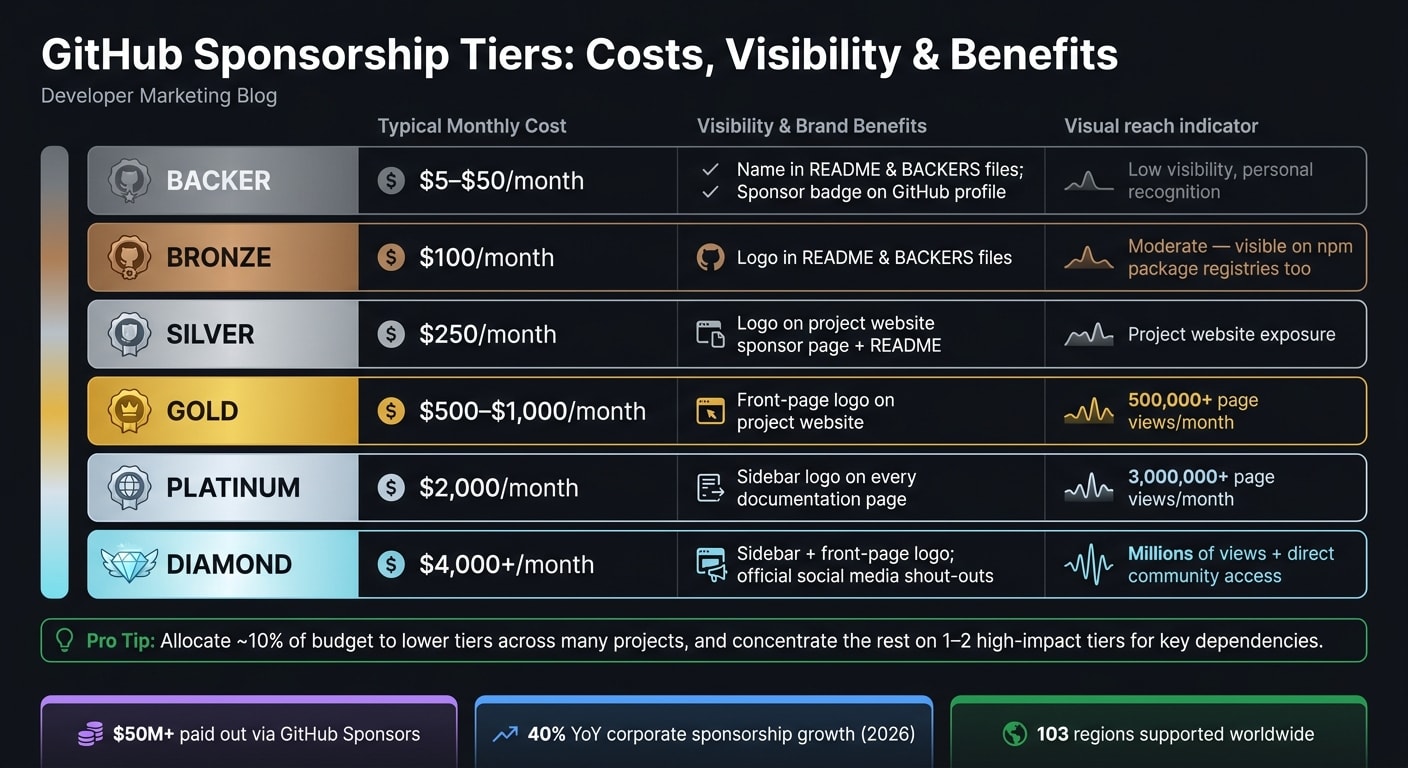
Once you've chosen the projects you want to support, it's important to understand how sponsorship tiers align with your brand awareness goals. Unlike traditional advertising with fixed placements, GitHub Sponsors tiers are entirely defined by the maintainer. They decide the pricing, the tier names, and the benefits offered. This means you’ll need to carefully review each tier's description to determine the visibility and perks that meet your needs.
What Each Sponsorship Tier Offers
Lower tiers, typically ranging from $5 to $50 per month (often labeled "Backer"), include benefits like listing your company’s name in the project’s README and BACKERS files, along with a Sponsor badge on your GitHub profile. While these tiers show support, they are more subtle and don’t offer significant brand visibility.
At the $100 to $250 per month range, visibility starts to increase. Many projects at this level include your company logo in the README file. This might sound minor, but it can have a broader impact. README files often appear on package registries like npm, meaning your logo could be seen wherever developers come across the package - not just on GitHub .
For $500 to $1,000 per month, sponsors often receive a front-page logo placement on the project’s official documentation site. For popular frameworks, this exposure can translate into hundreds of thousands of page views each month.
High-value tiers, ranging from $2,000 to $4,000 or more per month, provide premium visibility. For example, projects like Vue.js offer sidebar logo placements on documentation pages, reaching millions of views. At the "Diamond" level, some projects also include social media shout-outs from their official accounts, giving sponsors direct access to an engaged community of developers.
"Sponsoring Vue gives you great exposure to over 2 million Vue developers around the world through our website and GitHub project READMEs." - Evan You, Creator of Vue.js and Vite
While one-time sponsorships provide visibility for a single month, recurring sponsorships ensure sustained exposure. For long-term brand-building, recurring tiers are usually the better option .
Sponsorship Tier Comparison Table
Here’s a quick overview of typical tier structures for well-maintained open source projects. Keep in mind that perks can vary, so always check the specific tier details before committing.
| Tier | Typical Monthly Cost | Visibility & Brand Benefits |
|---|---|---|
| Backer | $5–$50 | Name in README & BACKERS files; Sponsor badge on GitHub profile |
| Bronze | $100 | Logo in README & BACKERS files |
| Silver | $250 | Logo on project website sponsor page + README |
| Gold | $500–$1,000 | Front-page logo on project website (500k+ page views/month) |
| Platinum | $2,000 | Sidebar logo on every documentation page (3M+ page views/month) |
| Diamond | $4,000+ | Sidebar + front-page logo; official social media shout-outs |
If you're working with a limited budget, consider a breadth-and-depth strategy. Allocate a small portion - about 10% - to lower-cost tiers across multiple projects while focusing the majority of your budget on one or two high-impact tiers for key dependencies. For instance, Sentry followed this approach in October 2023, distributing $500,000 across over 500 maintainers, while reserving larger amounts for critical projects like rrweb, which received $15,000 .
"Even small sponsorships can bring great motivation to individual maintainers. For many of our dependencies, we are likely their first and sole sponsor. That feels great, and helps maintainers stay motivated." - Sentry Blog
Measuring the ROI of GitHub Sponsorships
GitHub sponsorships aren't about generating immediate leads like paid ads. Instead, they focus on building brand presence and trust within the developer community. To gauge their impact, you’ll need to rely on targeted metrics that highlight how your sponsorships enhance visibility and credibility. Here’s how you can measure both direct and indirect returns from your efforts.
Tracking Referral Traffic and Brand Mentions
GitHub offers tools to track referral traffic through the Traffic tab under repository Insights. This feature shows which external sites drive visitors to a project, helping you see if links from your company blog or documentation are bringing users back to your site.
For more detailed tracking, take advantage of GitHub Sponsors' custom metadata URLs. By adding ?metadata_campaign=value to sponsorship links, you can include data in transaction exports. This allows you to compare how different placements perform. For instance, you could analyze metadata_source=readme_top versus metadata_source=docs_footer to determine which generates more sponsorship activity . Keep in mind that metadata fields have character limits.
Social media visibility also plays a role. A single tweet linking to a GitHub Sponsors profile can boost sponsor acquisition by an average of 1.22 . This highlights how even small efforts on social platforms can contribute to sponsorship growth.
Using Developer Surveys to Measure Brand Recall
Quantitative data is crucial, but qualitative insights can also validate your sponsorship strategy. Developer surveys, whether conducted independently or through research panels, can help gauge whether your sponsorships are creating the desired perception. For example, you can ask developers if they recognize your brand as a supporter of open-source projects and whether this influences their choice of tools.
"Developing brand awareness as an organization that values open source" is a primary reason for corporate sponsorship. - GitHub Docs
Since GitHub Sponsors links often generate passive awareness rather than direct clicks, focus survey questions on unaided brand recall. Ask something like, "Which companies do you associate with supporting the open-source tools you use?" While this is a harder metric to shift, it reflects the trust you're building over time.
Direct vs. Indirect ROI Metrics
When evaluating sponsorship ROI, it helps to separate metrics into two categories: direct and indirect. Direct metrics are easier to track and quantify, while indirect metrics take longer to develop but often have a lasting impact.
| Metric Type | Examples | How to Track |
|---|---|---|
| Direct ROI | Referral traffic, sponsor count, Revenue Per Visitor | Metadata URLs, GitHub Sponsors Dashboard, CSV/JSON exports |
| Indirect ROI | Brand trust, GitHub Stars, developer sentiment | Developer surveys, social mentions, star history tools |
| Discovery & Reach | Unique visitors, referring sites, page views | GitHub Repository Insights - Traffic tab |
| Social Impact | Brand mentions, retweets, replies | Social monitoring on Twitter/X, Bluesky |
One particularly useful indirect metric is the rate of new stars gained by a sponsored project. If you notice a spike in stars following a sponsorship announcement, it could signal that your support is resonating with the community .
Combining GitHub Sponsors with Broader Developer Marketing
Once you've measured your ROI, integrating GitHub Sponsors with other marketing efforts can significantly boost your impact in the developer community. While GitHub Sponsors may not generate immediate leads, it builds long-term trust and credibility, making developers more open to your ads, blog posts, and product updates.
The most effective developer marketing strategies in 2026 follow a clear formula: contribute and publish on GitHub, then promote that activity across other platforms. Contributions on GitHub act as social proof, reinforcing the messages you share elsewhere. GitHub Sponsors, in particular, lays the groundwork for credibility over time, while targeted paid channels offer instant, scalable visibility. For example, daily.dev Ads allows you to run campaigns directly in a feed that reaches over 1 million developers who are actively exploring new tools, frameworks, and industry trends. By targeting specific attributes like seniority, programming language, and tech stack, you can ensure your ads reach developers who are likely already familiar with the open-source projects you support. This creates a scenario where a developer who has seen your logo in a README is far more receptive to your ad than someone encountering your brand for the first time. Together, this approach forms a comprehensive developer marketing strategy - balancing credibility with broad exposure.
It’s important to see these channels as complementary, not interchangeable. Use GitHub Sponsors to build a strong, lasting presence in the ecosystems that are relevant to your product. Then, leverage paid advertising to expand your reach to a larger, qualified audience when timing is critical. When these approaches work together, the presence of your logo in a README reinforces the ads developers encounter, and those ads, in turn, strengthen the trust built through your sponsorships.
When combined with other targeted marketing channels, GitHub Sponsors becomes a key part of a well-rounded developer marketing strategy.
| Channel | Primary Role | Time Horizon |
|---|---|---|
| GitHub Sponsors | Trust & ecosystem credibility | Long-term (months to years) |
| daily.dev Ads | Scalable reach & immediate visibility | Short-term (days to weeks) |
| X / Bluesky | Real-time launch amplification | Immediate (hours to days) |
| B2B pipeline & executive reach | Medium-term (weeks to months) |
The ultimate goal is to establish a full-funnel presence in the developer ecosystem. Sponsorships create enduring trust, while targeted advertising ensures your message reaches the right audience at the perfect moment.
Sponsorship Risks and Anti-Patterns to Avoid
GitHub Sponsors can be a powerful way to enhance your developer brand - if done with sincerity. But there are pitfalls that can undermine trust, often stemming from one root issue: developers can sense when a company's intentions aren't genuine.
Avoiding Transactional Sponsorships
Nothing damages your reputation faster than treating sponsorships like business transactions. Linking financial support to feature requests, pressuring maintainers for deliverables, or expecting public endorsements sends the wrong message. Developers value what Sentry’s team refers to as a "moral economy", where contributions feel like voluntary support rather than a quid pro quo arrangement.
"We need to make it weird for companies not to support Open Source." - Sentry Blog
GitHub explicitly prohibits using funding links for advertising purposes . Sponsorships are designed to directly support open-source work - not act as a backdoor for paid promotions. Crossing this line doesn’t just harm your reputation in the community; it can also lead to compliance issues with platform policies.
To avoid these pitfalls, focus on sponsoring projects that align with your values and technical needs.
Making Sure Sponsored Projects Fit Your Goals
Sponsoring a project simply because it’s popular can backfire. Effective sponsorships aim to sustain open-source work, not chase visibility for your brand. For instance, GitHub stars are a poor measure of a project’s health. A 2024 investigation uncovered around 6 million suspected fake stars across nearly 19,000 repositories . A project with 50,000 stars but only one active contributor and unresolved issues from years ago is likely a risky bet for sustainability.
Instead, evaluate projects based on meaningful metrics like contributor retention, fork rates, and how promptly maintainers address issues. Focus on sponsoring the projects your team relies on - the ones in your dependency graph. This approach not only makes your sponsorship logical to the community but also ensures it supports the stability of your own product.
Respecting Maintainers and Community Expectations
It’s important to remember that most maintainers are volunteers. A 2025 Tidelift survey found that 60% of open-source maintainers receive no financial compensation for their work . Approaching them with demands, tight deadlines, or expectations for promotional content in exchange for funding is a quick way to alienate them.
Timing matters, too. Launching a sponsorship program as a reaction to slowed growth or because a competitor embraced open source can come across as insincere.
"If it looks like you're open sourcing because growth slowed or a competitor went OSS-first, developers notice. Authenticity is not optional in this community." - Meghan Murphy, Vermilion Cliffs Ventures
Sponsorships should be treated as a long-term commitment rather than a short-term marketing tactic. Regular contributions, even smaller ones, can make a bigger impact than a one-time payout. Sentry discovered that sponsorships of $4–$10 per month provided meaningful motivation for individual maintainers . Consistency builds trust and strengthens relationships - key elements for success in developer marketing.
Case Studies: Corporate Sponsorship Done Right
Let’s dive into how companies like Vercel and Sentry have strategically used sponsorships to forge meaningful connections in the open-source community. These examples show how thoughtful investments can drive collaboration and innovation.
Vercel and the Next.js Ecosystem
Vercel’s approach to supporting open source goes beyond simply writing checks. Guillermo Rauch, Vercel’s founder, describes their philosophy as treating dependencies like strategic partners:
"It's almost like our dependencies are suppliers to our project... Open Collective is our API to getting support from and building relationships with the maintainers of our dependencies." - Guillermo Rauch, Founder, Vercel
This mindset has led Vercel to sponsor maintainers not just for problem-solving but to cultivate trusted technical relationships. For example, sponsoring Tobias Koppers, the creator of Webpack, isn’t about asking him to fix bugs - it’s about having a reliable expert to collaborate with when needed .
Vercel also runs a structured Open Source Program that supports projects in quarterly cohorts. In May 2025, the Spring 2025 cohort consisted of 22 projects, including Fumadocs (a documentation framework now used for Vercel’s Flags SDK and Turborepo docs) and nuqs (a type-safe search params manager with over 300,000 weekly npm downloads). Each project received $3,600 in Vercel credits and access to a dedicated Slack space for collaboration and peer learning . By combining infrastructure support, community resources, and visibility, Vercel provides value that goes far beyond financial contributions.
This focused approach to sponsorship strengthens technical relationships and sets the groundwork for broader initiatives, such as Sentry’s strategy.
Sentry and the Python Ecosystem
Sentry takes a broader approach, balancing both reach and depth in its open-source sponsorship strategy. To maximize its impact, Sentry provides small monthly payments - typically $4 to $10 - to as many key GitHub dependencies as possible. By 2023, the company achieved 95% coverage of its fundable dependencies, a milestone it claims as a first in the industry .
Beyond smaller contributions, Sentry also commits substantial funding to major foundations. In January 2026, for the fifth year in a row, Sentry allocated $750,000 from its annual open-source budget to organizations like the Django Software Foundation, the Python Software Foundation, and NumFOCUS . This amount represents a 50% increase from 2023 and translates to approximately $5,813 per developer on staff .
What sets Sentry apart is its emphasis on consistency and accountability. The company co-founded the Open Source Pledge, an initiative where member organizations promise to contribute at least $2,000 per year per developer on staff to open-source maintainers. By early 2026, members of the Pledge had collectively paid $4.5 million to maintainers and foundations .
These case studies highlight how companies can build trust and create lasting value in the open-source ecosystem through thoughtful and deliberate sponsorship strategies.
Conclusion: Building a Trust-First Developer Marketing Strategy
GitHub Sponsors isn't designed to generate leads or close deals directly. Instead, it serves as a powerful way to establish credibility - something no ad campaign can replicate. Developers form opinions by examining code and observing how companies engage with the communities they care about. Supporting the tools they rely on sends a clear message: you're not just a vendor vying for attention, but a genuine contributor to the ecosystem.
Companies like Vercel and Sentry demonstrate how well-executed sponsorships can create lasting goodwill among developers. These efforts aren't about scoring PR points; they're deliberate, long-term commitments to building trust.
The takeaway here is clear: developer trust takes time to grow. Early efforts may seem to go unnoticed, but consistent and authentic support over one to two years can establish a reputation that sets you apart. As Disha Agarwal, Head of Marketing at Reo.Dev, explains:
"Developer marketing is no longer just about traffic. It's about trust, distribution, and sustained visibility across both humans and machines."
GitHub Sponsors works best as part of a larger strategy. Pair it with well-crafted technical documentation, clear changelogs, and outreach efforts that introduce your brand to new developers. With over 60% of developers blocking traditional display ads , channels that attract rather than interrupt - like GitHub Sponsors - carry more weight. When used thoughtfully, this approach helps position your brand as a reliable, long-term partner in the developer community.
FAQs
How much should my company spend on GitHub Sponsors?
There's no one-size-fits-all answer to how much your company should allocate to GitHub Sponsors. It all hinges on your specific goals and overall strategy. For instance, companies like Sentry invest hundreds of thousands of dollars each year, whereas individual sponsors typically contribute monthly amounts ranging from $5 to over $100. The key is to set a budget that reflects the value you want to bring to both your brand and the open-source community.
How do I choose which open-source projects to sponsor?
When choosing open-source projects to support, focus on those that complement your tech stack and have active, engaged communities. Look for projects that clearly showcase their value and have transparent funding models. It's also wise to pick projects with recent contributions and updates, as this indicates ongoing development and relevance.
Additionally, consider supporting projects maintained by independent developers rather than those backed exclusively by large organizations. This approach ensures your sponsorship has a more meaningful impact while also boosting your visibility and goodwill within the community.
How can I prove GitHub Sponsors ROI to leadership?
To convince leadership of the value of GitHub Sponsors, focus on tracking specific, measurable metrics that align with your organization's objectives. Here's how you can demonstrate the impact:
- Monitor sponsorship growth: Keep an eye on the increase in sponsorships tied to mentions on your GitHub profile. This directly shows how your activity drives funding support.
- Analyze traffic and conversions: Use attribution data to understand where your sponsorship traffic is coming from and how effectively it converts. This can help pinpoint which efforts are yielding the best results.
- Highlight long-term benefits: Emphasize how sponsorships contribute to broader goals, like improving brand visibility within the developer community and fostering goodwill. These outcomes can strengthen your reputation and relationships in the long run.
By focusing on metrics that resonate with your leadership's priorities, you'll be able to make a data-driven case for the value of GitHub Sponsors.