

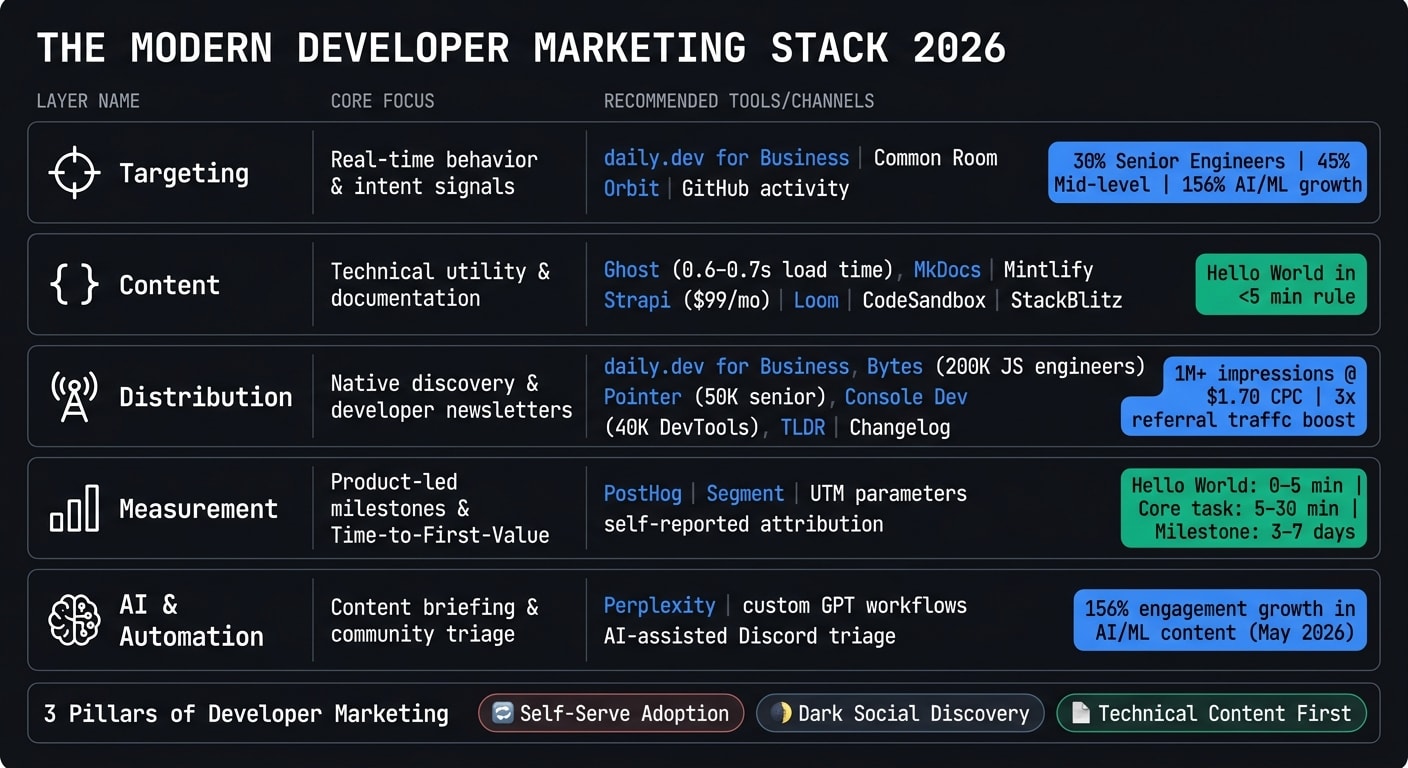
Developers are tough to market to. Traditional B2B tactics like gated PDFs and LinkedIn ads don’t work - they block ads, avoid sales pitches, and prefer proof over promises. By 2026, successful developer marketing relies on three pillars:
- Self-serve adoption: Developers try tools themselves before engaging sales.
- Dark social: Key discovery happens in untrackable spaces like Reddit, Discord, and newsletters.
- Technical content: Documentation and tutorials outperform traditional marketing materials.
Key Tools and Strategies:
- Targeting: Platforms like daily.dev for Business and tools like Common Room capture real-time developer behavior and community insights.
- Content: Tools like Ghost, MkDocs, and Mintlify help create fast-loading blogs, polished docs, and runnable code examples.
- Distribution: SEO, developer newsletters (e.g., Bytes, Techpresso), and native content platforms like daily.dev are more effective than ads.
- Measurement: Focus on product analytics (e.g., PostHog) and track Time-to-First-Value instead of traditional attribution.
- AI: Use AI for content research and community engagement, but always validate technical accuracy manually.
The developer marketing stack is all about providing actionable solutions where developers already are. Success depends on aligning tools, content, and distribution with developer habits.
Audience and Intent Layer: Tools for Targeting Developers
A solid audience layer is essential for any developer marketing strategy. Unlike other audiences, developers often leave fewer traditional digital footprints. This means static data - like outdated job titles or cookie-based retargeting - often misses the mark. The real focus should be on what developers are engaging with right now.
Contextual and Behavioral Targeting
Platforms like daily.dev for Business excel at targeting developers through real-time behavioral signals. These include tracking articles read, tools upvoted, and topics bookmarked. This approach captures developers while they’re in "Discovery Mode", actively seeking new tools and solutions.
The platform offers detailed filtering options, allowing you to target by programming language, specific tools, and even seniority levels - ranging from junior developers to Staff Engineers. Here’s a quick breakdown of their audience: 30% are Senior Engineers, 45% are mid-level, and the AI/ML segment alone has seen a 156% growth by 2026 .
"Campaigns perform better when the audience and context match the message. daily.dev reaches developers while they actively discover tools and ideas." - daily.dev
When creating campaigns, focus on desktop placements. Developers often evaluate complex tools on workstations, making this the ideal environment for engagement. These behavioral insights are a great starting point for understanding your developer audience.
Community Intelligence and Developer Graph Data
Real-time behavioral data is just one piece of the puzzle. To get a deeper understanding of engaged developers, community intelligence tools like Common Room and Orbit come into play. These platforms map how developers interact with your project, providing a complementary layer of insight.
Both tools gather signals from platforms like GitHub and Discord to build a "developer graph." Common Room takes this a step further by consolidating these signals into unified contact records, delivering actionable insights for your DevRel team. Meanwhile, Orbit focuses on monitoring community health over time using its "Orbit Level" framework, which scores members based on their engagement depth.
While these tools require API integrations and regular data updates, the payoff is significant: a prioritized list of developers who are highly engaged and ready for more personalized outreach.
Integrating these insights into your strategy creates a precise targeting workflow. Here’s how it all fits together.
Tradeoffs and Recommended Usage
The table below outlines the strengths and ideal use cases for each tool:
| Tool | Primary Use Case | Data Source | Setup Complexity | Best For |
|---|---|---|---|---|
| daily.dev for Business | Top-of-funnel discovery and reach | Real-time platform behavior | Low | Reaching new developers outside your community |
| Common Room | Community intelligence and contact unification | GitHub and Discord | High | Identifying and activating high-intent members |
| Orbit | Community health tracking over time | GitHub and Discord | Medium | Measuring DevRel impact and engagement trends |
For example, you could use Common Room or Orbit to spot trending topics or challenges within your community. Then, tailor your creative and targeting strategy on daily.dev for Business to address those insights. If your Discord community shows a surge in Kubernetes cost optimization questions, that’s your cue to launch a native in-feed campaign with content tackling that exact issue.
However, keep in mind the limitations of these tools. Community intelligence platforms rely on the quality and quantity of your signals - if your GitHub repository has minimal activity or your Discord is quiet, the data may not be actionable. Similarly, daily.dev for Business is most effective when paired with strong technical content. A native ad that leads to a poorly designed landing page won’t resonate with developers, who tend to have high standards for content quality.
Content Production Layer: Building Technical Content for Developers
When crafting content for developers, it’s essential to focus on clarity and utility. Developers don’t have time for fluff - they’re looking for actionable resources like code samples, tutorials, and documentation that solve their problems quickly. To achieve this, the tools you choose for content creation play a critical role.
Developer-Friendly CMS and Documentation Tools
For technical blogs, Ghost is an excellent option for small to mid-sized devtool teams. It’s known for its speed, offering load times of 0.6–0.7 seconds and a Time to First Byte of just 240–280ms . If your team requires more flexibility in how content is structured, Strapi is a strong alternative. It’s open-source, free to self-host, and supports TypeScript and CI/CD workflows. For those preferring a cloud-hosted solution, Strapi’s plans start at $99/month .
When it comes to documentation, developer teams already familiar with Markdown and Git often turn to MkDocs. This approach treats documentation like code, allowing it to be versioned, reviewed, and deployed alongside your software . On the other hand, platforms like Mintlify and Fern cater to non-technical contributors, making it easy to create polished documentation sites. These platforms often include features like runnable examples, robust error handling, and coverage of edge cases . While Git-based tools prioritize portability, hosted platforms are designed for rapid deployment and ease of use.
Interactive content can take your documentation to the next level, engaging developers in ways static text cannot.
Video and Interactive Code Embeds
For asynchronous communication, Loom is a go-to tool. It’s perfect for creating quick API demos, workflow walkthroughs, or internal handoffs. Videos can simplify complex processes, while interactive embeds add a hands-on element to your content. Tools like CodeSandbox and StackBlitz allow you to embed live, runnable code environments directly into your blog posts or documentation. This aligns with the “Hello World” activation rule: if a developer can’t get something working in under five minutes, they’re likely to move on .
Tradeoffs in Content Tools
One of the biggest challenges in this layer isn’t tool selection but maintenance. Outdated documentation can damage trust faster than having no documentation at all . Git-based workflows help mitigate this by tying documentation updates to code changes, ensuring everything stays in sync. Hosted platforms, while quicker to set up, can slow down urgent fixes when non-technical contributors are involved.
| Tool | Type | Starting Cost | Best Fit |
|---|---|---|---|
| Ghost | Blog CMS | Free (self-hosted) | Ideal for small teams |
| Strapi Cloud | Headless CMS | $99/month | Teams needing custom content models |
| MkDocs | Docs (Git-based) | Free | Engineering-led doc workflows |
| Mintlify | Hosted Docs | Free tier available | Fast doc setup, polished output |
| Loom | Video | Free tier available | Async walkthroughs, internal demos |
Managing multi-language content is another layer of complexity. If your product supports multiple programming languages, such as Python, Go, and TypeScript, you’ll need a well-thought-out content model from the beginning. Retrofitting this later can be a logistical nightmare, so plan ahead to keep everything organized and maintainable.
Distribution and Developer Discovery Channels
To connect with developers effectively, you need to meet them where they are. Developers don’t engage with traditional PPC or display ads - ad blockers are common in this audience. Instead, the key is to focus on platforms and channels they already trust and use regularly.
SEO and Programmatic Content Strategies
Targeting developers through SEO means focusing on their specific search habits. For example, a developer searching for "TypeError: Cannot read properties of undefined Next.js" is actively looking for a solution, making them a high-value lead compared to someone searching for "JavaScript framework."
As Louis Corneloup, Founder at Dupple, explains:
"For devtools, docs produce more pipeline than the marketing site."
This means your SEO efforts should prioritize detailed, actionable documentation over a polished homepage. Developers value resources like runnable code samples, thorough edge case explanations, and ready-to-use snippets. Shorebird, for instance, collaborated with Draft.dev to ramp up their technical content production, achieving a 3x boost in referral traffic and organic keyword rankings within the first month. Their visitor-to-signup conversion rates stayed strong at 10–15% .
In addition to organic search, another powerful way to reach developers is through trusted newsletters.
Developer Newsletters and Content Syndication
Sponsoring developer newsletters is a highly effective paid strategy. For example, in April 2026, DigitalOcean ran 4 Primary and 4 Spotlight Ads in Techpresso, a newsletter reaching 550,000 tech professionals (165,000 of whom were engineers). This campaign generated over 1,000,000 impressions at a $1.70 CPC .
When choosing newsletters, it’s crucial to tailor your sponsorships to specific developer audiences. Options like Bytes (200,000 JavaScript engineers), Pointer (50,000 senior engineers), and Console Dev (40,000 readers focused on DevTools) are more effective for devtool campaigns than a generic tech newsletter. A budget of $5,000–$10,000 per month typically covers 2–3 placements and ongoing community engagement .
For content syndication, adapt your messaging to fit the platform and audience. Create 5–10 variations of your headlines and depth levels. What resonates with a senior engineer reading Pragmatic Engineer might not perform as well on platforms like Dev.to.
Using daily.dev for Business for Content Distribution
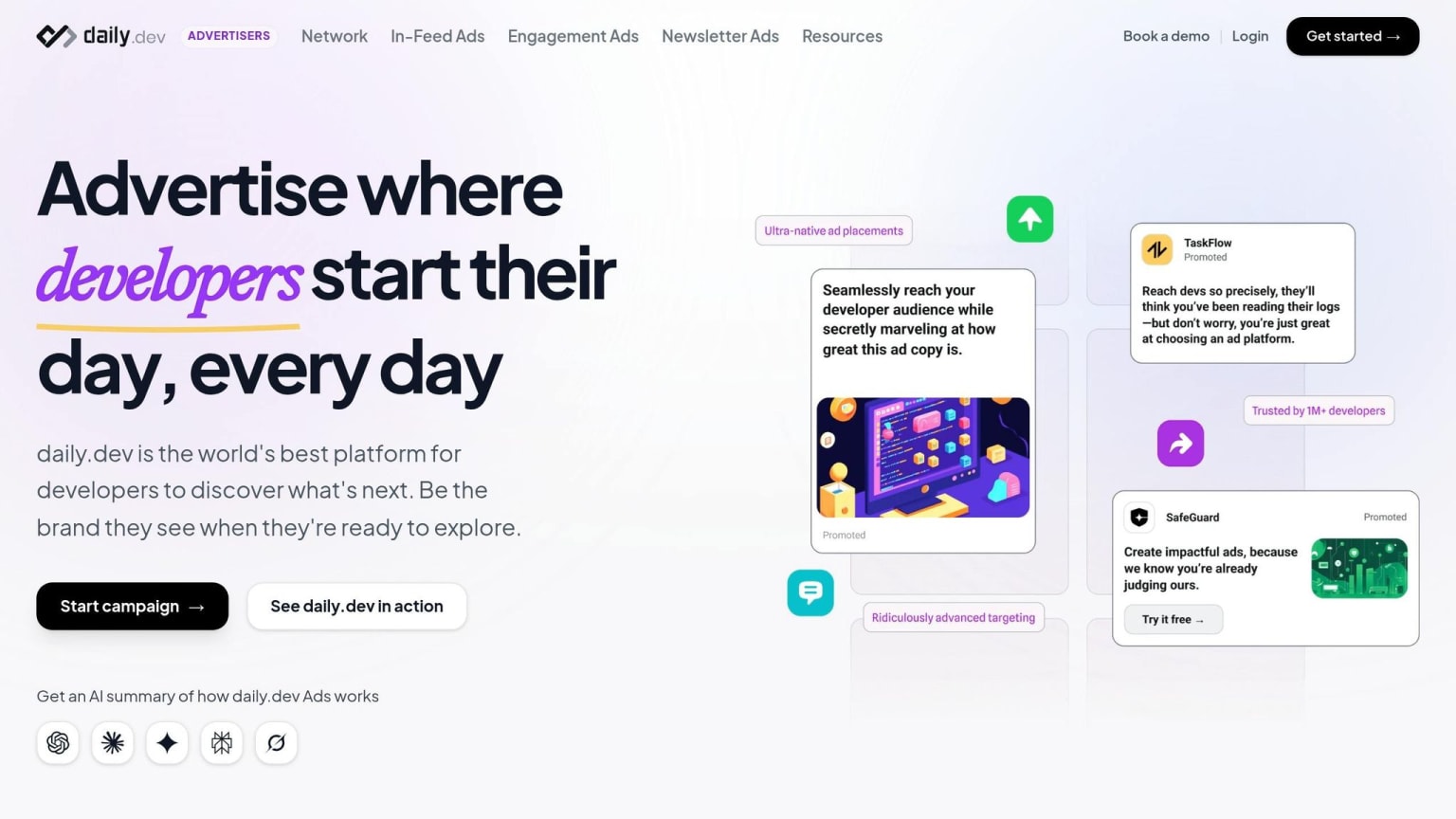
daily.dev for Business is a great complement to SEO and newsletters, offering native content placement tailored to developers' discovery habits. With over 1 million developers in its network - 30% senior engineers (7+ years) and 45% mid-level engineers (3–7 years) - it’s a platform that aligns with how developers naturally explore tools . Notably, engagement from the AI/ML engineering segment grew by 156% in 2026, making it particularly effective for tools in that space .
As daily.dev puts it:
"Developers do not click on ads. They click on solutions to their problems."
The platform integrates your content directly into developers’ feeds, avoiding interruptive advertising. Features like Branded Tags, Keyword Spotlights, and Tag Page Takeovers allow you to align your brand with specific technology categories. This approach turns casual interest into meaningful engagement. Since daily.dev is desktop-first, it naturally fits into how developers evaluate tools - at their workstation, not on mobile devices.
Measurement and Attribution: Tracking the Developer Funnel
Measuring developer marketing comes with unique challenges, especially since much of the discovery happens through "dark social" channels. These are spaces like Slack, Discord, or private forums where tracking pixels can't reach. As a result, traditional last-click attribution models often fail to capture the full picture, underestimating what’s truly driving engagement.
First-Party and Product Analytics
To get a clearer understanding of user behavior, tools like PostHog are invaluable. PostHog tracks a developer’s journey from sign-up through key activation milestones, directly tying this data to your marketing efforts. A crucial metric to focus on is Time-to-First-Value - how quickly developers can achieve meaningful outcomes. Aim for:
- A working "Hello World" in 0–5 minutes.
- Completing a core task with their own data in 5–30 minutes.
- Reaching a key usage milestone within 3–7 days .
By integrating these metrics into a single dashboard, you can ensure full visibility across the developer funnel.
Building a Source-of-Truth Dashboard
Relying solely on marketing metrics won’t give you the full story. A comprehensive dashboard should pull data from multiple layers to provide a complete view of your funnel:
| Layer | Data Sources | Key Metrics |
|---|---|---|
| Marketing | Newsletters, daily.dev, SEO | CPC, CTR, referral traffic |
| Community | Discord, Reddit, GitHub Discussions | Engagement rate, sentiment, branded mentions |
| Product | PostHog, Segment | Time-to-First-Value, activation rate, usage milestones |
| Sales | CRM (Salesforce/HubSpot) | Qualified pipeline, PLG-to-enterprise conversion |
For example, you can connect newsletter click-throughs (via UTM parameters) to developers hitting activation milestones. This bridges the gap between casual engagement and sales-ready leads.
Developer-Specific Attribution Strategies
Traditional attribution models often falter in developer marketing. A developer might hear about your product in a Hacker News thread, read your documentation days later, and finally sign up after seeing a Slack link shared by a colleague. In this multi-touch, fragmented journey, UTM parameters alone won’t cut it.
One effective workaround is self-reported attribution. Simply include a sign-up question like "How did you hear about us?" to uncover channels that analytics tools might miss. This is especially helpful for tracking traffic from dark social. Additionally, use dedicated landing pages for key channels - such as newsletter sponsorships, community posts, or conference talks - to better measure entry points.
As Dawn Parzych from Shorebird shared about their content strategy:
"Our first pieces were published within weeks and ranked within the first month... surprisingly [the conversion rate] stayed consistent at 10-15%."
This kind of steady conversion rate becomes clear only when you follow the full journey - from initial content engagement to sign-up - rather than focusing solely on top-of-funnel metrics.
AI and Automation in Developer Marketing
AI for Content Briefing and Generation
AI tools can make the research-heavy parts of content creation much easier by pulling insights directly from active developer communities. Tools like Perplexity and custom GPT workflows can scan platforms like Reddit, Hacker News, and Discord to identify the pressing questions developers are asking. This information feeds into content briefs, cutting down on hours of manual research.
The numbers back this up: engagement with AI/ML content on developer platforms jumped 156% as of May 2026 . If your content strategy isn’t keeping up with this trend, you risk losing relevance. AI-driven briefing tools allow you to stay on top of community discussions, offering content that’s timely and technically rich by using real-time signals instead of outdated keyword data.
That said, AI should only handle the early stages of content creation. Human engineers need to validate the technical details. As Louis Corneloup, Founder of Dupple, aptly said:
"For devtools, docs produce more pipeline than the marketing site."
This highlights the importance of combining AI’s efficiency with human expertise to ensure every code sample and technical detail is accurate before publication.
Automating Community Engagement
AI-generated insights can also enhance community engagement by automating some of the repetitive tasks in DevRel operations. For instance, AI-assisted triage has become a go-to for teams managing active Discord servers or GitHub Discussions. Here’s how it works: an AI system categorizes incoming questions by topic and urgency, drafts an initial response, and flags it for human review before posting. This process allows for faster response times while maintaining accuracy and depth.
However, the human review step is non-negotiable. Developers are quick to spot errors like incorrect API responses or code that doesn’t work, and they won’t hesitate to call them out. To maintain trust, always ensure AI-generated responses are reviewed and refined by your team .
Risks and Limits of AI in Developer Marketing
The primary risk with AI isn’t blatant errors; it’s the tendency to churn out generic marketing language at scale. Developers are particularly sensitive to buzzwords like "seamless", "plug-and-play", or "enterprise-grade" . Without clear guidance, AI can default to these overused terms, alienating your audience.
Another big challenge is code hallucinations. If an AI-generated tutorial includes broken imports or outdated methods, it won’t just fail to engage - it could harm your reputation. The fix? Treat AI-generated code as a starting point and have it thoroughly tested by a human before publishing.
| Risk Factor | Impact | Mitigation Strategy |
|---|---|---|
| Code hallucinations | Damaged credibility from broken examples | Human/DevRel review of all technical snippets |
| Generic marketing language | Developers disengage due to buzzwords | Use strict prompts; avoid terms like "seamless", "plug-and-play", etc. |
| Low-Intent Outreach | Poor engagement rates on platforms like LinkedIn | Focus on discovery-driven platforms like daily.dev or Discord |
Ultimately, AI is a tool, not a replacement. It helps with repetitive and research-heavy tasks, but the final content needs to reflect human expertise. When used thoughtfully, AI can free up DevRel teams to focus on what really matters: creating in-depth tutorials, answering complex questions in forums, and maintaining the authentic technical tone developers expect.
Conclusion: Putting Your Developer Marketing Stack Together
For a developer marketing stack to work effectively, every layer needs to connect seamlessly. Behavioral targeting ensures you're reaching the right developers at the perfect time. Technical content - like documentation, runnable code samples, and straightforward tutorials - provides developers with a reason to engage, offering solutions they’re actively searching for. Meanwhile, measurement shifts the focus from traditional lead counts to tracking how quickly developers achieve their first successful integration.
Here’s how these layers align with tools and priorities in 2026:
| Layer | 2026 Core Focus | Recommended Tools/Channels |
|---|---|---|
| Targeting | Real-time behavior & intent | daily.dev for Business, GitHub activity, community signals |
| Content | Technical utility & docs | Interactive code embeds, "Hello World" samples |
| Distribution | Native discovery & newsletters | daily.dev for Business, TLDR, Bytes, Changelog |
| Measurement | Product-led milestones | First-party analytics, Time-to-First-Value |
| AI | Briefing & personalization | AI-driven content summaries, ML-based targeting |
This structure connects every layer of your marketing stack to targeted strategies, combining technical content, discovery, and measurement into a unified approach.
For example, daily.dev for Business enhances the discovery layer with precise and active targeting, ensuring your content reaches developers who are eager to learn. Each layer - from real-time targeting to AI-powered automation - works together to form a cohesive marketing strategy. Tools like Common Room or Orbit complement this by offering community insights, while a paid reach channel like daily.dev ensures you’re not stuck relying on outdated profile data.
Whether you’re crafting a changelog post, sponsoring a newsletter, or launching a targeted campaign, the key question remains: does this help a developer solve a real problem? Nail that, and choosing the right tools becomes much simpler.
FAQs
What should I track if dark social attribution is unreliable?
When dark social attribution proves unreliable, it's smarter to shift your focus to tracking measurable developer campaign KPIs. Metrics like API call growth, SDK installs, documentation engagement, and community participation offer tangible insights into how well your campaigns are performing and how engaged developers are with your tools and resources.
How do I reduce Time-to-First-Value for my devtool?
To speed up Time-to-First-Value (TTFV), simplify onboarding with tools like clear, runnable examples and one-click demos. Include copy-paste code snippets that showcase immediate value. Strengthen engagement by using personalized communication - think follow-up emails packed with tutorials or milestone updates.
Leverage in-product metrics and provide contextual guidance aligned with user goals to keep users on track. Additionally, interacting on platforms like Discord or Reddit can offer quick learning opportunities and troubleshooting, helping users reach meaningful outcomes faster.
When should I use community intelligence vs paid reach?
Community intelligence is all about connecting with developer communities, such as those on Reddit or GitHub Discussions. The goal? To build trust, gather insights, and establish meaningful relationships. This approach shines when you're aiming for early-stage awareness and credibility.
On the other hand, paid reach - like targeted ads or newsletter sponsorships - offers a scalable way to run measurable campaigns. Whether you're focused on discovery or driving conversions, paid reach is ideal for performance-oriented objectives.
The sweet spot often lies in combining the two. Use community intelligence to build trust and credibility, while leveraging paid reach to meet specific performance goals. Together, they can deliver powerful results.