
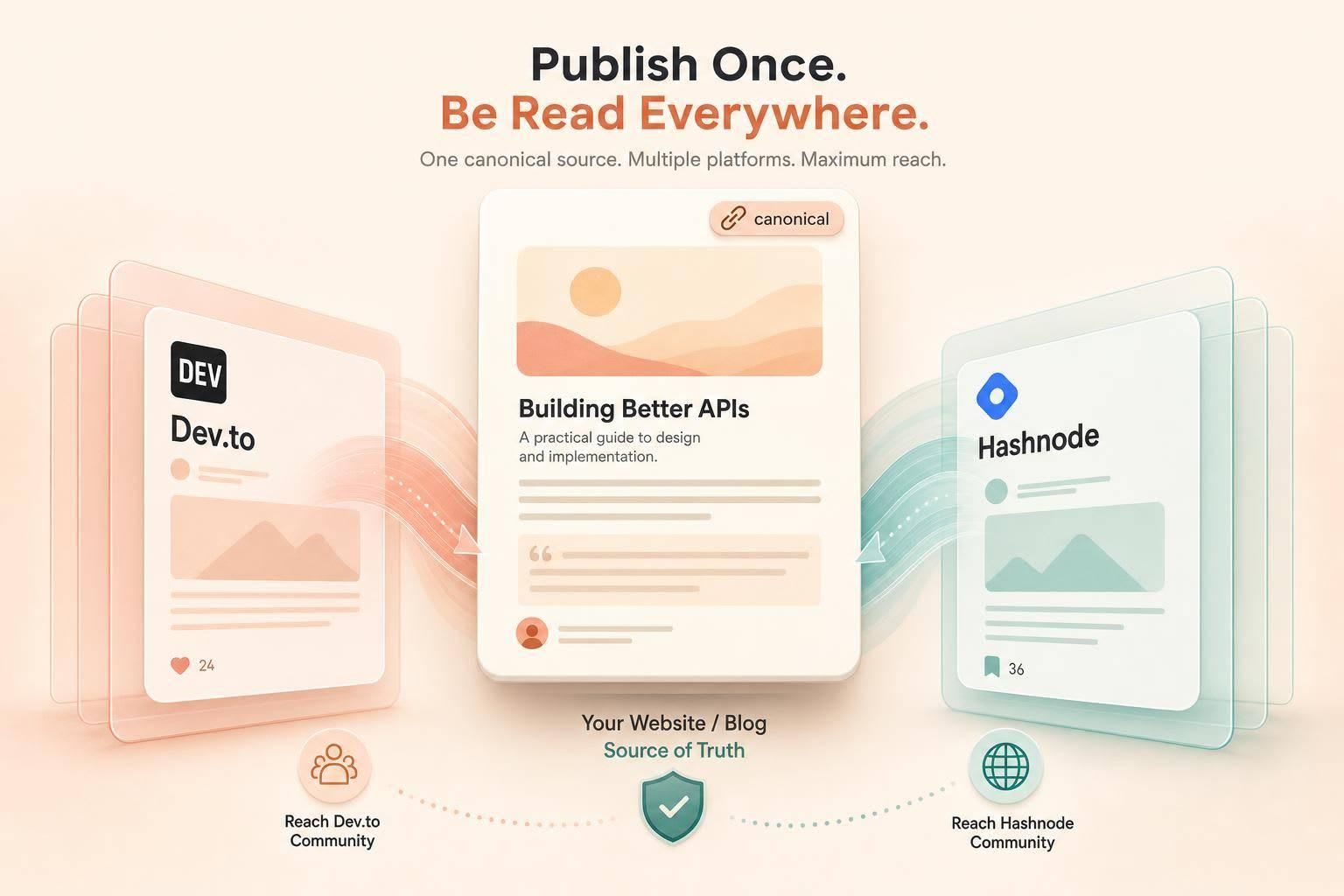
If you want more developers to read your posts in 2026, publish on your own site first, then syndicate to dev.to and Hashnode with the right canonical URL. That is the short version.
Here’s the full takeaway in plain English:
- dev.to is better for short, code-led posts, tool comparisons, and build write-ups
- Hashnode is a better fit for long posts, series, and search-led traffic
- Publish on your site first if you want SEO value to stay on your domain
- Wait for indexing, then cross-post to each platform
- Use platform-native canonicals so the copy on dev.to or Hashnode does not outrank your main post
- Early comments, tags, and timing shape how far a post travels
- Track signups, referrals, and search impressions, not just pageviews
A few numbers make the case. dev.to gets 10+ million monthly visitors, Hashnode gets 3+ million, and syndicated posts can see about 85% more engagement than posts published in only one place. On top of that, dev.to and Hashnode have strong domain authority, which can help your posts show up in search and AI answers.
If I had to boil the whole article down to one rule, it would be this: use dev.to and Hashnode for distribution, not as a replacement for your main blog.
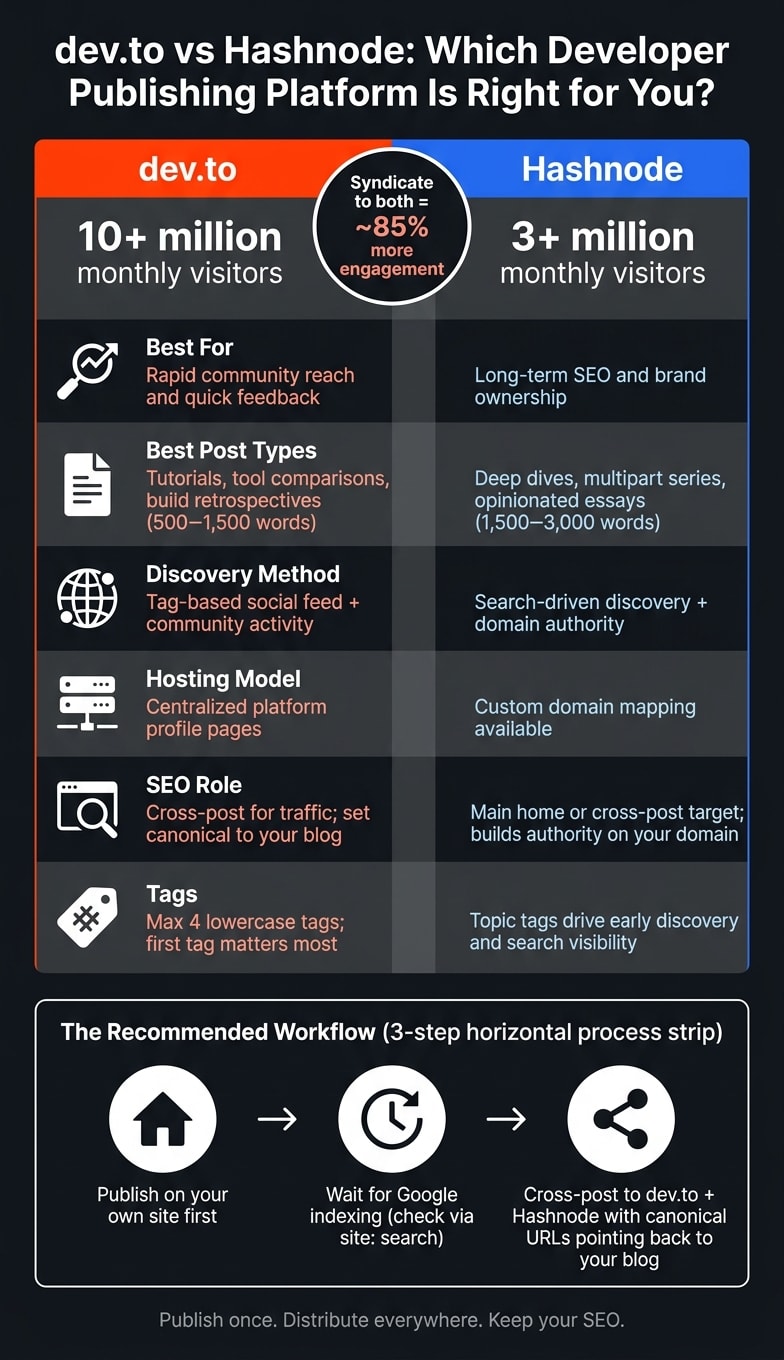
Quick comparison
| Platform | Best use | Best post type | Main discovery path | Best publishing role |
|---|---|---|---|---|
| dev.to | Fast reach and feedback | Tutorials, comparisons, build posts | Tag feeds and community activity | Cross-post for traffic |
| Hashnode | Search traffic and domain ownership | Deep dives, series, opinion pieces | Search and domain authority | Main home or cross-post target |
So the playbook is simple: pick the right format, set canonicals the right way, publish in the right order, and push early discussion once the post is live.
Pick the right post format for each platform
The same topic needs different packaging on each platform. Start with the problem, then show the fix. Once you syndicate, that packaging plays a big part in whether the platform recommends the post.
What works on dev.to: code-first tutorials, comparisons, and build retrospectives
dev.to tends to reward posts that deliver something useful in the first screen. The best fit is usually code-first tutorials, tool comparisons, and "how I built X" retrospectives. That goes double when the post includes runnable snippets or a repo link.
A title like "How I cut my Postgres query from 2s to 80ms" is far stronger than "Optimizing my database". Why? Because it tells the reader the result right away.
Two formatting details matter here:
- Start with the code or outcome, then explain the context.
- dev.to allows a maximum of four lowercase tags with no special characters , so make each one precise and relevant. Use the first tag for the post's main topic.
What works on Hashnode: deep dives, series, and opinionated technical essays
Hashnode works a bit differently. Discovery there leans more on search and domain authority, so long-form posts are often a better fit. Architecture deep dives, multipart series, and opinionated technical essays tend to do well.
Hashnode's built-in series feature links related posts together, which can lead readers from one piece to the next and support stronger SEO clustering. The custom domain option also means each post builds authority on your brand's domain, not Hashnode's subdomain.
Table: dev.to vs Hashnode by use case, content type, discoverability, and hosting model
| dev.to | Hashnode | |
|---|---|---|
| Best for | Rapid community reach and quick feedback | Long-term SEO and brand ownership |
| Best post types | How-tos, tool comparisons, build retrospectives | Deep dives, multipart series, opinionated essays |
| Discovery | Tag-based social feed | Search-driven discovery and domain authority |
| Hosting | Centralized platform profile pages | Custom domain mapping available |
Don't force one version to do the same job on both platforms. Keep the core technical content the same, but tweak the title, intro, and tags so each post fits the platform it's on.
Next, lock in canonical URLs and cross-posting rules before you publish to both platforms.
Set up cross-posting and SEO correctly
Your company blog should be the source of truth. dev.to and Hashnode are best used as distribution channels.
When to use rel=canonical versus publishing a unique version
A canonical URL is a tag that tells search engines which URL should rank as the original. If you skip it, the platform copy can outrank your original post.
If the post is identical or almost identical to what’s on your company blog, set the canonical URL to your blog. On dev.to, use canonical_url in YAML frontmatter. On Hashnode, use originalArticleURL in article settings. These are built-in fields, not hacks.
If you want to rewrite for the platform, change the headline, intro, and summary only. Keep the technical core the same. That kind of platform-specific framing can help with engagement.
A dev.to-only publish works when speed-to-market or fast community reach matters more than owned SEO. In that case, leave the canonical unset and let the dev.to version serve as the main search result.
If your post uses MDX or custom components, remove those custom elements and swap them for links back to the original interactive version.
Once the canonical is set, the next call is publish order.
Cross-post workflows for company blog, dev.to, and Hashnode
The safest route is the POSSE method: publish on your own site, then syndicate elsewhere. In plain English, that means:
- Publish on your company blog first.
- Wait until the original is indexed before syndicating. You can check with a quick
site:yourdomain.com/your-post-urlsearch. - Cross-post to dev.to and Hashnode with canonical URLs pointing back to your blog.
If your main home is a Hashnode custom domain, the flow changes a bit. Publish there first, wait for indexing, then cross-post to dev.to with the canonical pointing to your Hashnode URL. In early 2026, the OpenClaw team used this setup and saw dev.to cross-posts bring in 200–400 views per post from native feeds, while their Hashnode posts ranked for mid-level technical searches within 48 hours.
After the post is live, the next job is to create early signal without forcing engagement.
Table: canonical settings by publishing scenario
| Publishing Scenario | Canonical Target | SEO Tradeoff | Content Approach |
|---|---|---|---|
| Company blog first, then syndicate | Company blog URL | SEO authority stays on your domain; platforms drive reach | Verbatim body; adapt intro and title per platform |
| Hashnode custom domain first | Hashnode custom domain URL | SEO authority accrues to your domain via Hashnode's custom domain mapping | Verbatim; cross-post to dev.to after indexing |
| Dev.to only (no owned blog) | Leave unset | dev.to can rank in search; no SEO benefit to your domain | Adapt for platform; use when speed matters more than ownership |
| MDX or interactive post | Company blog URL | Blog ranks for the full experience; platform version acts as a lead | Strip custom components; replace interactive blocks with "see original" links |
Use the table to choose your path, then stick with one workflow.
Increase reach after publishing
After you hit publish, reach often comes down to what happens next. Early reactions, comments, and tag signals shape how far the post goes. Once syndication is live, those first few hours can decide whether the post keeps getting seen.
Algorithm signals that affect visibility on dev.to and Hashnode
On dev.to, early reactions can push a post into the Relevant and Top feeds. dev.to also limits you to 4 tags, and the first tag matters most for broad discovery, so pick that one with care. Fast replies to comments help too because they show activity to the platform.
On Hashnode, topic tags play a big role in early discovery and can help the post appear in search.
Newer accounts can still get traction on both platforms if they fit what people expect there: clean Markdown, solid technical depth, and active participation on other authors' posts before publishing their own.
How to seed early discussion
Right after the post goes live, share it in internal Slack or Teams channels. Then ask teammates to leave specific technical questions in the comments. That helps start a real discussion instead of a pile of forced compliments.
Timing matters too. Publish between 8:00 and 10:00 a.m. ET to line up with the recommended high-traffic window and give the post a better shot at early reactions.
On dev.to, the #discuss tag can help opinion-based or question-led posts invite more participation. That can keep comments coming in after the first few hours.
Those early reactions are useful feedback. If one angle starts getting attention, that's usually the version worth sharing again in outside channels.
Where to share each post next: GitHub, Reddit, and newsletters
After the first wave of traffic on the platform, targeted sharing can bring in a second wave.
- GitHub Discussions can work well when the post solves a repeat problem in a repository.
- Newsletters tend to work better when the link is framed around what the reader will learn, not what the company built.
- Reddit usually responds better when you match the title and framing to the subreddit. Communities like
r/webdev,r/programming, andr/rustoften respond better to technical story angles than launch-style wording.
If you want paid amplification, daily.dev for Business can put the post in front of a targeted developer audience based on seniority, language, and tooling.
Developer publishing platforms aren't the finish line. They're the first layer of distribution. Track which channel brings clicks, signups, and comments. Keep each traffic source separate so you can see which ones keep paying off over time.
Measure results, set cadence, and avoid common failure modes
What to measure: referral traffic, signups, search visibility, and AI citation signals
Once the post is live, the next step is simple: check whether it keeps working over time.
Pageviews alone don't tell you much. A post can pull in traffic and still do almost nothing for the business. Track referral traffic with UTMs, source-attributed signups, assisted conversions in analytics, and branded search lift . Use Hashnode's referrer and newsletter-signup analytics . Read ratio and time on page can also help you spot low-intent clicks, where people land on the page and bounce without much interest .
Traffic is only part of the picture. In Search Console, confirm that the original URL is earning impressions . That helps you see whether search engines are picking up the right page. It's also worth tracking whether your posts appear as cited sources in AI assistants like ChatGPT or Perplexity. High-ranking technical articles on these platforms can become primary sources for AI assistants and featured snippets .
Set a 90-day lift target, then compare results against your pre-syndication baseline . That gives you a clean way to judge whether the post is building momentum or just making a brief splash.
Table: 1 deep post per month vs weekly short posts
Cadence matters because volume shapes what happens next. Some posts build over time. Others sink fast.
| Factor | 1 Deep Post / Month | Weekly Short Posts |
|---|---|---|
| Production effort | High (1,500–3,000 words, code-tested) | Low to medium (500–800 words) |
| Expected reach | High; likely to surface in Top feeds and newsletters | Low; often buried or flagged as thin content |
| Repurposing potential | High; can be split into threads, newsletters, and videos | Low; limited depth for further distribution |
| Campaign fit | Thought leadership and technical deep dives | Quick updates or building-in-public notes |
| Long-term value | High; ranks for long-tail queries for years | Low; fades quickly in chronological feeds |
A deep post usually asks for more work up front. But it has more room to travel. You can turn one strong piece into a thread, a newsletter section, or a short video without forcing it . Weekly short posts can still help for quick updates or building-in-public notes, but they often vanish fast in feed-based platforms .
What gets buried or backfires on both platforms
When results flatten out, the problem often sits in the post itself.
Three failure modes show up again and again:
- Thin content with no usable technical detail gets buried.
- Posts that read like product pages - titles like Introducing X or We just launched Y - get ignored by developer communities that want problem-solving content, not announcements .
- Unedited AI drafts are easy to spot: uniform sentence length, corporate tone, and phrases like in today's rapidly evolving landscape signal low effort to both readers and algorithms .
Weak performance is useful feedback. If a post isn't landing, change the format, topic, or cadence.
FAQs
How long should I wait before cross-posting?
Use the POSSE method: publish on your own site first, then syndicate it elsewhere.
Then give Google a little breathing room. Wait at least 24 hours before you cross-post, and 1 to 3 days is even better. That gives Google more time to crawl and index the original version on your site.
You can also request indexing right away in Google Search Console.
When you do cross-post the piece, set the canonical URL to your original post.
Should I rewrite the post or syndicate it as-is?
Syndicate it as-is, not rewritten. The standard approach is POSSE: publish on your own site first, then syndicate elsewhere.
To protect SEO authority, treat your blog as the source of truth and set the platform’s canonical field to your original post. This signals that your site is the authoritative source and avoids unnecessary message drift.
How do I know if syndication is actually working?
Track the clearest signs of impact: referral traffic, signups by source, brand search lift, and whether your content is being indexed by AI assistants like ChatGPT or Perplexity.
It also helps to watch platform engagement. That includes views, reactions, comments, and community signals like repo stars. These numbers won't tell the whole story on their own, but they can show whether people are noticing and responding.
To make sure SEO is doing its job, use Google Search Console to confirm that canonical URLs point to your primary domain.