
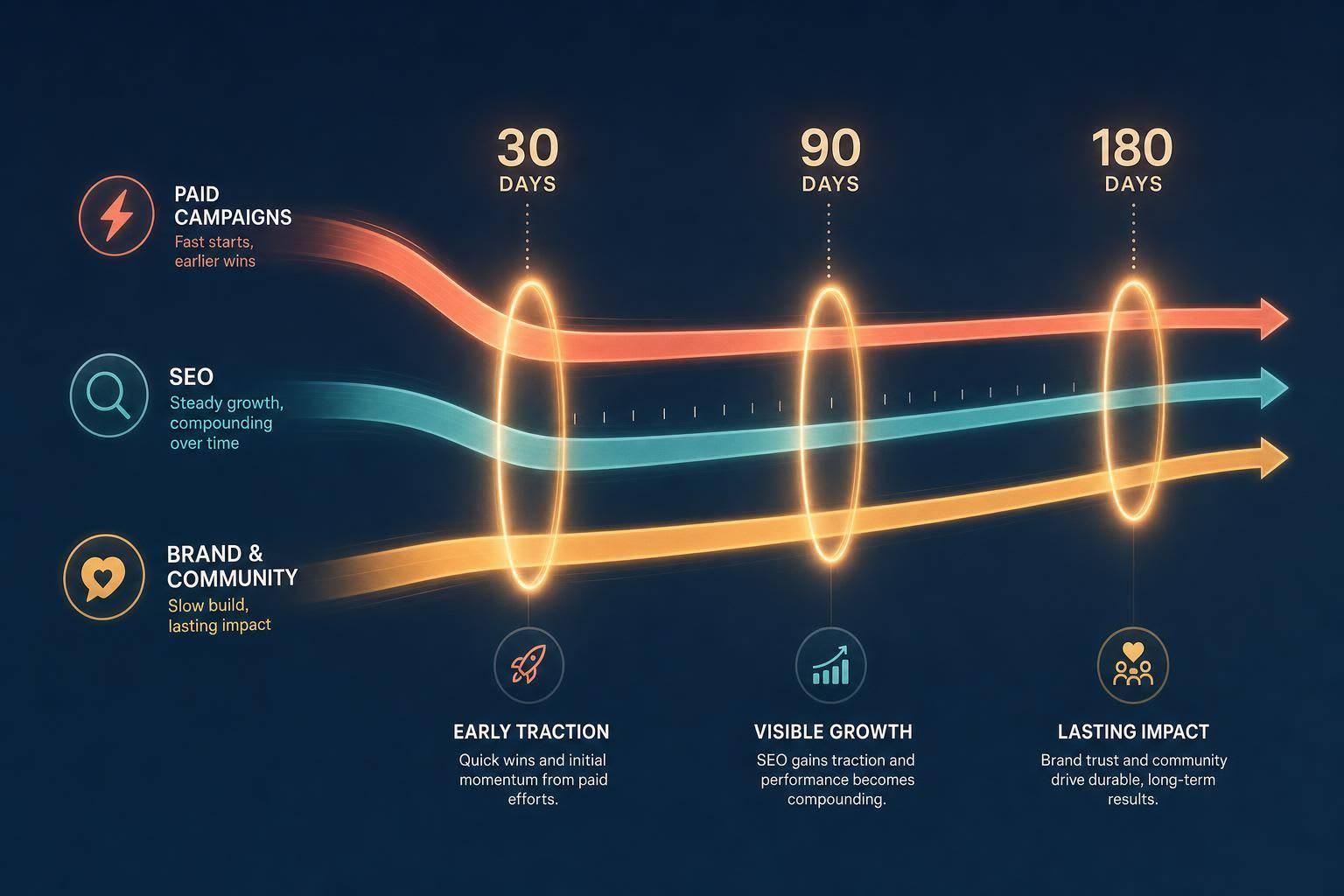
Developer marketing usually takes longer than leaders expect. From what I see in the article, paid campaigns can show early signals in 1–3 weeks, SEO often needs 3–6 months to show pipeline impact, and community or brand programs may need 2–4 quarters before they show clear sales impact.
Here’s the short version:
- Paid gives early feedback fast, but revenue takes much longer.
- SEO and content start slow, then build over time.
- Community and brand work on trust, so they need repeat exposure across months.
- 30 days is for reach, engagement, and tracking checks.
- 90 days is for lead quality, meetings, and pipeline signs.
- 180 days is when I’d start judging cost, revenue, and deal movement.
- If your attribution window is shorter than your sales cycle, you’ll undercount impact.
A few numbers stand out:
- One benchmark puts first impression to closed-won at 281 days
- 82% of SEO experts expect meaningful traffic growth in about 6 months
- Only 5.7% of new pages reach Google’s top 10 within 1 year
- Average B2B sales cycles grew to about 6.5 months in 2025
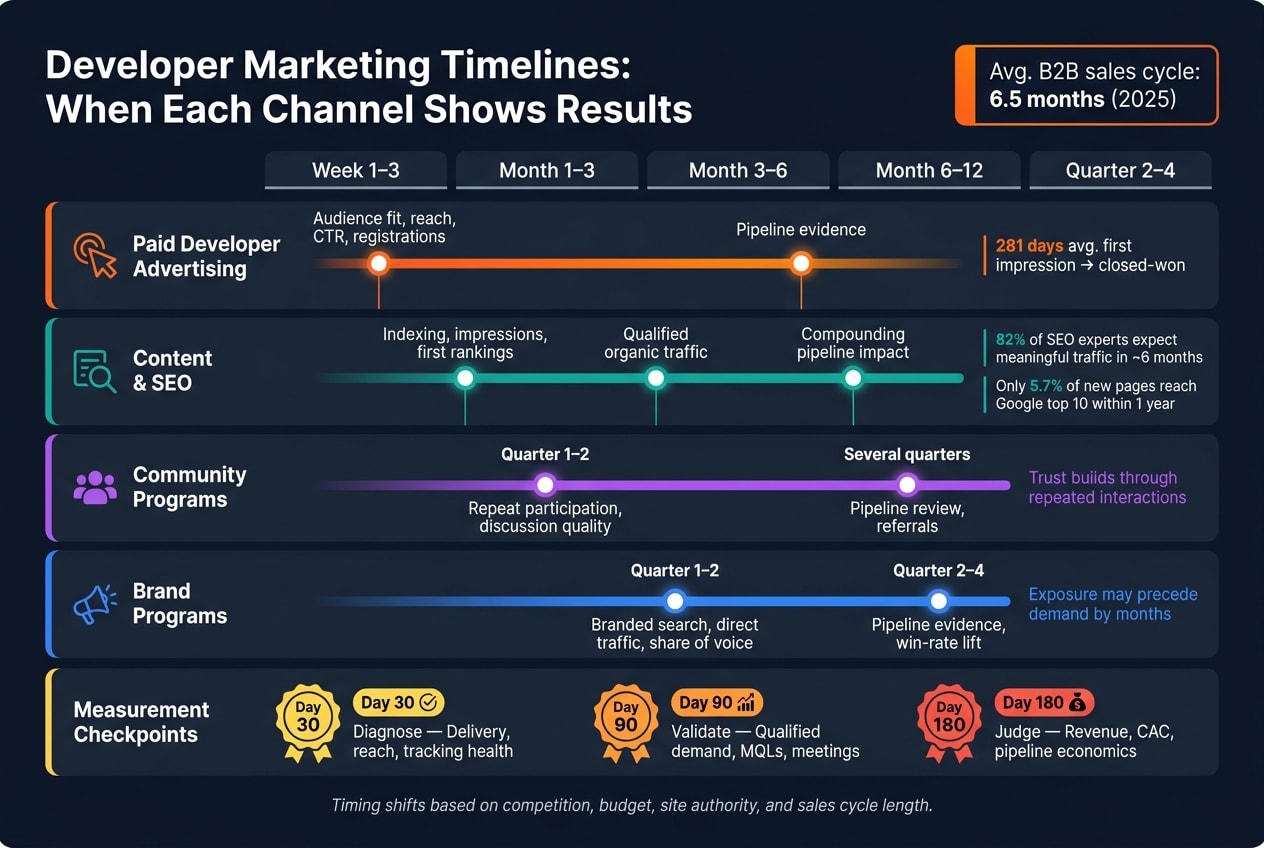
Quick comparison
| Motion | First useful signal | When pipeline may show up | Main thing to watch early |
|---|---|---|---|
| Paid advertising | 1–3 weeks | 3–6+ months | Audience fit |
| Content and SEO | 1–3 months | 3–6 months | Indexing and ranking movement |
| Community | First few quarters | Several quarters | Repeat participation |
| Brand | First few quarters | 2–4 quarters | Branded search and direct traffic |
My main takeaway is simple: don’t ask every channel to prove the same thing on the same timeline. Paid, SEO, community, and brand each work on a different clock, so the only fair way to judge them is by the first result each one can reasonably produce.
What timeline should you expect from each developer marketing motion?
Use the table below as a planning guide, not a promise. Timing shifts based on competition, site authority, budget, execution quality, sales cycle length, and audience fit.
Developer buyers come back to the same technical questions again and again. So the best way to judge each motion is simple: what is the first question this channel can answer? Use these ranges to set checkpoints, then measure each motion by the earliest signal it can reasonably produce.
| Motion | Checkpoint | Primary metrics | Why results take time |
|---|---|---|---|
| Paid developer advertising | 1–3 weeks: delivery, reach, clicks, registrations; 1–3 months: lead quality; 3–6+ months: pipeline | Qualified CTR, conversion rate, cost per qualified registration, target-account engagement, opportunities, pipeline | Campaigns need time to exit the learning phase, accumulate enough conversions, and connect early interactions to longer sales cycles |
| Content and SEO | 1–3 months: indexing, impressions, first rankings; 3–6 months: pipeline evidence; 6–12 months: compounding impact | Qualified organic sessions, non-branded rankings, assisted conversions, influenced pipeline, revenue | Search engines need time to crawl, assess, and rank pages; authority and topic coverage compound gradually |
| Community programs | First few quarters: repeat participation, attendance, discussion quality; several quarters: pipeline review | Repeat participation, active members, event attendance, referrals, influenced opportunities | Trust develops through repeated interactions, and influence is often poorly captured by last-touch attribution |
| Brand programs | First few quarters: branded search, direct traffic, mentions and backlinks; 2–4 quarters: pipeline evidence | Branded search, direct traffic, share of voice, target-account engagement, influenced pipeline | Exposure may precede demand by months, and buyers often act later through channels that obscure the original influence |
Start with paid, since it produces the first usable signal.
How quickly can paid developer advertising show results?
Paid is the fastest motion for getting feedback. But fast feedback is not the same as proven ROI.
In the first 1–3 weeks, you can usually assess delivery, reach inside the intended developer audience, click-through rate, qualified clicks, landing page engagement, registrations, and audience-fit signals like job seniority, programming language, tools, company size, or account list match. Those metrics answer one core question: Are we reaching the right developers? At this stage, paid should prove audience fit first, not revenue.
Pipeline proof takes more time. A registration that shows up in week two still has to qualify, get sales follow-up, and move through your conversion cycle before it becomes an opportunity. One paid B2B SaaS benchmark estimates about 281 days from first impression to closed-won revenue. That's why short reporting windows can make paid look weaker than it is. For developer campaigns, a 30–90-day attribution window makes more sense than same-session or 7-day reporting.
Use real-time tracking to improve delivery. Judge ROI on downstream pipeline.
When do content and SEO start contributing to pipeline?
Technical content has to be crawled, indexed, and ranked before it can shape a buying decision. That's the trade-off with SEO: it takes longer to start, but gains can build over time.
Even with strong execution, this process is slow. Google's SEO guidance says changes can take from a few hours to several months to show up, and it recommends waiting several weeks before judging impact.
Early movement, like impressions, indexed pages, and first ranking shifts, can show up within about 90 days. But 82% of SEO experts surveyed expect it to take around six months before traffic grows in a meaningful way, with fuller results often showing up at 12–24 months. Ahrefs data adds another reality check: only about 5.7% of newly published pages reach the top 10 within one year.
That doesn't mean you should wait to invest. It means you should use the right checkpoint at the right time.
- At 90 days, check indexing, impressions, ranking movement, and whether the pages are bringing in the right developer audience.
- At 6 months, look for qualified organic visits and assisted conversions.
- At 12 months, check backlinks, returning visitors, and pipeline influence.
Once search starts earning visibility, the next hurdle is trust. That's where community and brand take longer.
Why do community and brand programs take quarters to show results?
Community and brand programs move more slowly because they rely on trust built through repetition, not one-off clicks or form fills.
Developers usually don't convert the first time they see you. They might spot your brand at an event, run into it again in a technical discussion, and only later bring it into a buying conversation. That kind of influence is real, but it often doesn't show up cleanly in last-touch reports.
Early signals to watch include repeat event attendance, the quality of technical discussion, branded search growth, direct traffic, and share of voice. These signals tell you the program is starting to stick.
Commercial outcomes, like influenced opportunities, win-rate lift, and pipeline from brand-aware accounts, usually appear after several quarters. You often need cohort-level or account-level analysis to see them clearly. Plan for 2–4 quarters before expecting clear pipeline evidence.
Why do these timelines differ, and what can delay results?
The gap comes down to how fast each motion produces a signal you can actually measure. Different motions create demand in different ways, so the first sign of traction and the first sign of revenue show up on different timelines.
Why does paid move faster while SEO, community, and brand take longer?
Paid buys distribution right away. You can turn on a campaign and start getting clicks the same day. But a click isn't revenue. That person still has to become a qualified lead, then an opportunity, then closed revenue.
Gartner describes enterprise B2B buying as a multi-stage process that includes problem identification, solution exploration, requirements, evaluation, validation, and internal consensus. In plain English, the ad may get someone in the door, but the buying process decides when money shows up.
The same thing happens with owned and relationship-driven motions. SEO and content take longer because pages need to be crawled, ranked, and revisited before they shape a buying decision. Community and brand take longer because they depend on trust, and trust usually builds through repeated exposure.
A developer might run into the same technical question several times before doing anything about it. That's why these motions need to show up across repeated touchpoints. The issue isn't whether the channel works. It's how fast the signal appears.
What usually slows developer marketing down?
Sometimes the motion isn't the problem. The execution is.
Common slowdowns include:
- Weak positioning
- Broken message-to-page flow
- Poor tracking
- Slow lead follow-up
- Unclear lead definitions
Poor instrumentation trips up a lot of teams. Missing campaign parameters, inconsistent CRM stages, and self-reported attribution can make a channel look weak even when it's doing its job.
Some delays come from measurement problems. Others come from long buying cycles. A campaign may be bringing in qualified interest while opportunities sit in procurement, legal review, or budget approval. When that happens, the lag often reflects a multi-stakeholder buying process, not a weak campaign.
What must be in place before the timeline starts?
Don’t start the clock until measurement is set up. Paid, content, community, and brand can look slow or fast based on the rules you set before launch. If those rules aren’t in place, a 90- to 180-day test can turn into noise instead of learning.
Which setup decisions make results interpretable?
Start by defining one audience: role, seniority, and stack. “Developers” is too broad if you want clean readouts. That audience definition should stay the same for the full test period.
Then choose one primary conversion event. Set it before launch and stick with it. If you change the definition halfway through, your results stop being comparable over time.
Every traffic-driving link should also be tagged with UTMs.
| UTM Parameter | Purpose | Example Value |
|---|---|---|
utm_source |
Platform | daily.dev, github |
utm_medium |
Channel type | paid_social, newsletter |
utm_campaign |
Specific initiative | q2_api_launch |
utm_term |
Keywords/audience | python_developers |
utm_content |
Creative variant | sidebar_banner |
You’ll also want to record trial-to-paid conversion and time to first value before launch. Without those baselines, there’s no clean reference point for judging whether a campaign changed anything.
Which sales and attribution rules should be agreed on before launch?
Marketing and sales should agree in writing on a few things before anything goes live:
- What a qualified lead looks like
- What counts as a marketing-influenced opportunity
- The sales follow-up SLA
Those rules decide how pipeline gets credited in reporting.
You should also match the attribution window to the buying cycle before launch.
Once those rules are locked in, 30-, 90-, and 180-day results become much easier to read.
What should leadership measure at 30, 90, and 180 days?
Once setup is fixed, use the right timeline: 30 days for delivery, 90 days for demand, and 180 days for economics. That timing should match how the motion actually plays out, not how the sales team likes to report.
| Checkpoint | What to measure | What the data can answer | What not to conclude |
|---|---|---|---|
| Day 30: Diagnose | Delivery, developer-audience reach, click-through rate, qualified engagement, landing-page conversion rate, cost per desired action, creative variation, tracking accuracy, sales follow-up completion | Are campaigns reaching the intended developers? Is the message generating meaningful engagement? Are conversion events and handoffs recorded correctly? | Do not declare the program a revenue success or failure. One month is usually too short to judge a B2B motion whose sales cycle may extend beyond the reporting window. |
| Day 90: Validate demand | MQLs or your equivalent qualified lead event, sales-accepted leads, meetings, opportunities created, qualified pipeline value, funnel conversion rates, assisted conversions, performance by segment and channel | Is qualified demand developing? Which segments deserve refinement, expansion, or a pause? | Do not treat pipeline as booked revenue or assume an early winning segment will hold the same economics at scale. |
| Day 180: Judge economics | Closed-won revenue, marketing-sourced and marketing-influenced pipeline, cost per opportunity, acquisition cost efficiency, opportunity velocity, win rate, cohort performance | Is the motion making a financially meaningful contribution? Are acquisition costs and revenue outcomes improving across cohorts? | Do not attribute all revenue to one channel, ignore sales-cycle length, or label a motion ineffective when target accounts have not yet had enough time to mature. |
What should you learn by day 30?
Day 30 is about audience fit and tracking health, not revenue. At this stage, you’re checking two things: are the campaigns reaching the right developers, and is your measurement stack recording that activity correctly?
Some early patterns can tell you a lot. If conversion rate is low but qualified engagement is strong, the issue usually sits with the landing page or the offer, not with audience demand. If click-through rate is high but technical engagement is weak, that often points to curiosity clicks, loose targeting, or messaging that promises more than the experience delivers. That’s why this checkpoint matters. It helps you spot what needs fixing without pretending the data says more than it does.
Before you optimize anything, check the basics:
- UTM consistency
- CRM mapping
- Event parity
- Sales disposition logging
If tracking was only fixed recently, the first 30 days of data may still be too messy to trust. In that case, don’t optimize off shaky numbers.
If tracking is clean, the next step is simple: see whether attention turns into qualified demand.
What should you know by day 90?
By day 90, the focus moves from delivery to qualified demand. This is where volume alone stops being enough.
Report MQL-to-SAL rate, SAL-to-meeting rate, meeting-to-opportunity rate, and qualified pipeline value in U.S. dollars alongside raw counts. Counts tell you how much came in. Rates tell you where the funnel is leaking.
This is also the point to make tighter calls. Refine pieces that show promising engagement but weak conversion. Expand segments that generate strong opportunity creation and believable sales follow-up. Pause channels that keep sending low-quality traffic or come with tracking issues you can’t sort out. If the sample is still small, or if opportunities remain active, keep gathering evidence instead of forcing a verdict.
In plain English: by 90 days, leadership should know whether demand is starting to form, and where it looks strongest or weakest.
If that demand is real, the next issue is whether it becomes revenue in a cost-efficient way.
What should count by day 180?
Day 180 is the main checkpoint for financial contribution, but it still has to be read in the context of actual sales-cycle length and cohort maturity. In a 2025 B2B benchmark, average sales cycles had expanded to about 6.5 months, up from 4.9 months in 2019. That means some enterprise deals opened at launch may still be working their way through the pipeline at this point.
At this stage, report:
- Closed-won revenue
- Marketing-sourced and marketing-influenced pipeline
- Cost per opportunity
- Acquisition cost efficiency
- Opportunity velocity
- Win rate
- Cohort performance
Use the ROI benchmarks post for CAC and LTV:CAC context, and the reporting-to-CMO post for attribution and cadence.
The big job here is separating too early from underperforming. Those are not the same thing.
Too early applies when opportunities are still active, the cohort is too small, the normal sales cycle has not passed, or tracking was only fixed not long ago.
Underperforming applies when a mature enough cohort shows poor qualified engagement, low sales acceptance, weak opportunity creation or progression, poor acquisition costs, or no progress after documented optimization.
That’s why every conclusion at 180 days should include cohort age, sample size, and sales-cycle benchmarks. Without that context, it’s easy to call something broken when it just hasn’t had enough time yet.
FAQs
How do I know if results are slow or just early?
Pay attention to leading indicators, not just end results. Early on, look at things like documentation visits, code snippet copies, and API key creation.
If people are doing those things, your marketing is probably doing its job. You're just at an early stage of a longer buying cycle.
If those signals aren't there, something may be getting in the way. The friction could be in your onboarding, your messaging, or both. And because developer sales cycles often run longer than 90 days, short-term conversion data can make performance look slower than it actually is.
What if my sales cycle is longer than 180 days?
If your sales cycle runs past 180 days, a 30-day attribution window will probably shortchange your top-of-funnel work. In that case, extend the window to 60–90 days or more so you can see more of the buyer journey instead of giving all the credit to late-stage touches.
A U-shaped attribution model tends to work well here. It gives weight to both the first touch and the lead conversion point, which helps when early technical interest starts the path to revenue.
It also helps to track proxy metrics such as:
- API key creation
- Documentation depth
- Time to First Value (TTFV)
And don’t stop at marketing platform data. Sync CRM deal outcomes back to your marketing touchpoints so you can tie early technical activity to closed revenue.
Which metrics matter most for each channel?
Prioritize actionable engagement signals over vanity metrics like impressions or click-through rates.
A lot of top-line numbers look good in a report but tell you almost nothing about buyer intent. If someone saw your brand, that’s fine. If they copied a code snippet, created an API key, and got to value fast, that’s a much stronger sign.
Here’s a cleaner way to think about it:
- Awareness: branded search volume, GitHub repository views, forum mentions
- Engagement: documentation depth, code snippet copy events, API key creation, Time to First Value (TTFV)
- Pipeline/revenue: Product Qualified Leads (PQLs), trial signups, activation rates, ARR influenced, Customer Acquisition Cost (CAC), Net Dollar Retention (NDR)
This shift matters because it ties marketing to product use and revenue, not just traffic. A spike in impressions can look nice on a dashboard. But API key creation or a lower TTFV tells you people are moving from interest to use. That’s the difference between surface-level attention and signals you can act on.