
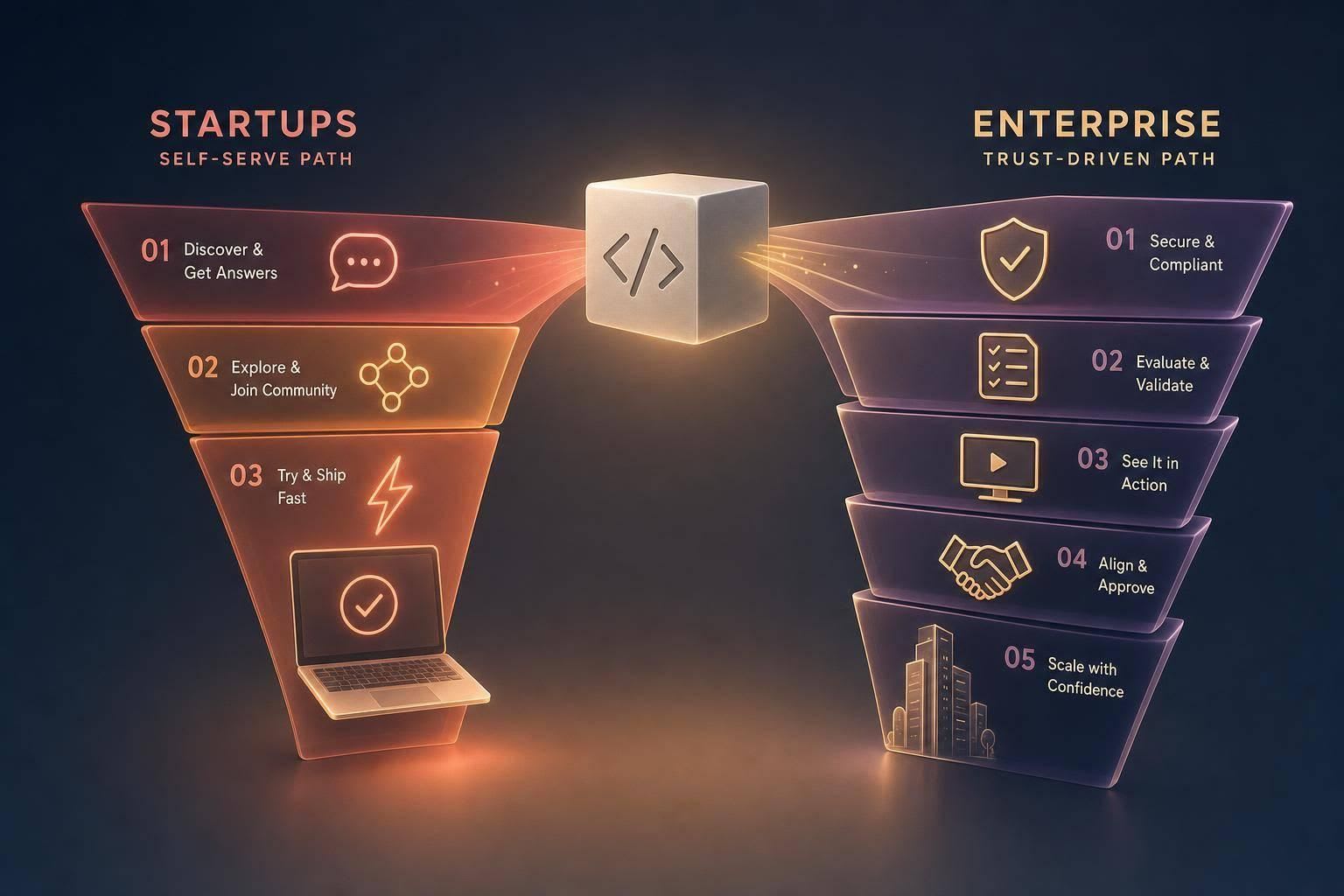
The short answer: I’d market the same dev tool in two different ways. Startups buy with speed, simple pricing, and peer proof. Enterprises buy through committees, security review, legal review, and longer sales cycles.
If I were planning this motion, I’d treat the split like this:
- Startups often buy in 14 to 30 days
- Enterprise deals often take 90 to 180+ days, and many $100,000+ ACV deals stretch to 6 to 12 months
- Startup buyers are often 1 to 3 people
- Enterprise deals can involve 5 to 10+ stakeholders, and some deals reach about 11 people
- Startups want self-serve signup, fast time to value, and plain pricing
- Enterprises want demos, pilots, case studies, security docs, and procurement support
- Startup proof comes from GitHub, communities, and peer comments
- Enterprise proof comes from ROI stories, named customers, and reference calls
In other words: the product may stay the same, but the path to “yes” changes a lot.
Quick Comparison
| Area | Enterprise | Startup |
|---|---|---|
| Buyers | Committee across engineering, security, finance, legal, procurement | Founder, CTO, or engineering lead |
| Deal size | Often larger; many motions built around $100,000+ ACV | Often lower; many buys under $15,000 ACV |
| Sales cycle | 90 to 180+ days; sometimes 6 to 12 months | 14 to 30 days |
| Purchase flow | Demo, pilot, review, legal, PO | Signup, trial, card checkout |
| Security needs | SOC 2, DPA, SSO/SAML, audit logs, vendor review | Basic security checks in most cases |
| Proof | Case studies, ROI, references | GitHub stars, changelog, word of mouth |
| Best channels | Outbound, ABM, webinars, events, retargeting | Product-led growth, search, community, marketplaces |
| Main CTA | Book demo / start pilot | Start free / try now |
What I take from this is simple: if I send startup buyers into a long sales flow, I lose them. If I send enterprise buyers to a bare self-serve page, I also lose them. The channel, CTA, proof, and follow-up all need to match how that segment buys.
That’s the frame for the rest of the piece.
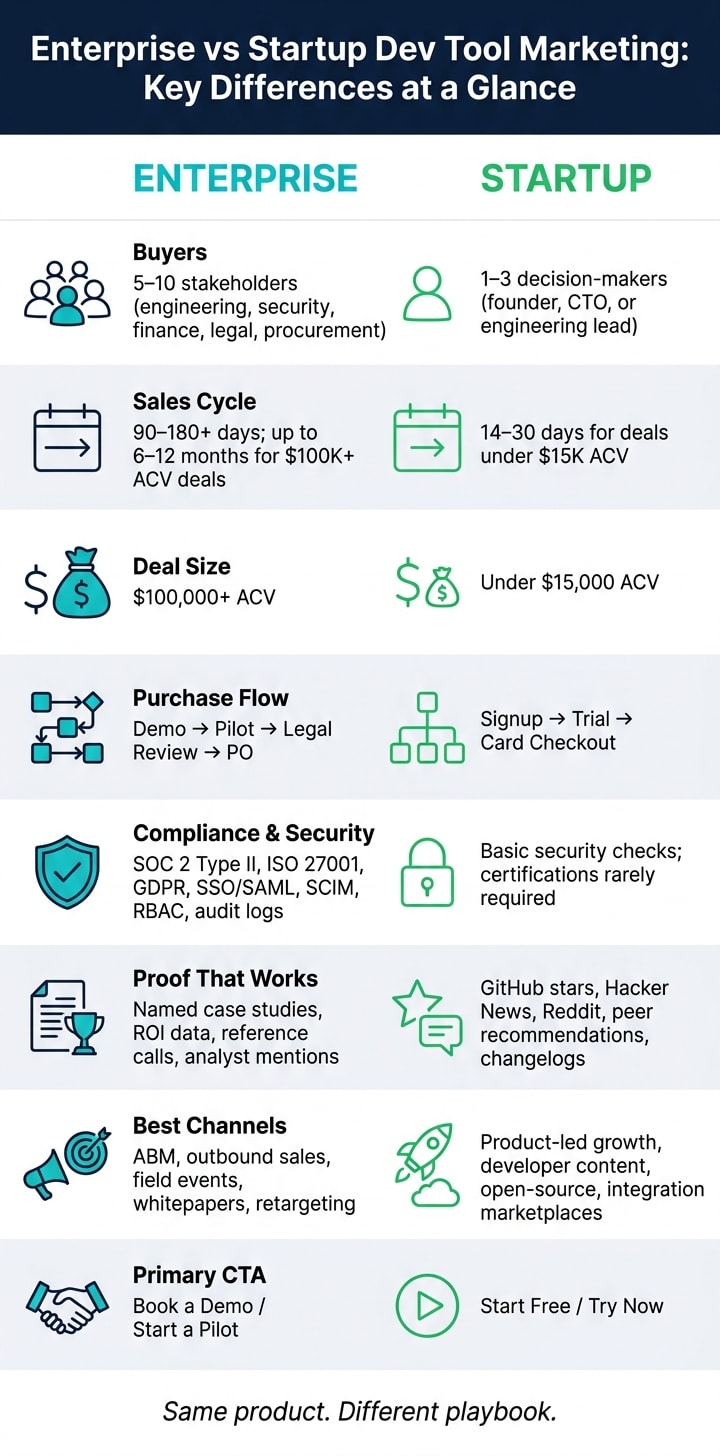
Enterprise vs startup at a glance
Here’s the comparison in one view. Think of it as the operating map for the rest of the article.
The variables that change the playbook
| Dimension | Enterprise | Startup |
|---|---|---|
| Buyer count | 5–10 stakeholders across engineering, security, procurement, and finance | 1–3 decision-makers, usually the founder, CTO, or engineering lead |
| Budget control | Owned by engineering/IT, with finance and procurement approvals tied to annual budget cycles | Owned directly by the founder, CTO, or engineering lead; flexible and discretionary |
| Procurement | Formal: MSAs, DPAs, SLAs, vendor risk assessments, and approved vendor lists | Lightweight: standard terms, card checkout, immediate purchase |
| Compliance | SOC 2 Type II, ISO 27001, GDPR, SSO/SAML, SCIM, RBAC, and audit logs are often required before adoption | Basic security assurances; formal certifications are rarely required unless the company is in fintech, healthtech, or another regulated sector |
| Proof expectations | Named case studies, quantified outcomes, formal POCs, and reference calls | Community proof, GitHub stars, peer recommendations, and quick-start demos |
| Channel mix | ABM, outbound sales, field events, whitepapers, and partner programs | Product-led growth, developer content, open-source ecosystems, and integration marketplaces |
| Sales cycle | 90–180+ days; often 6–12 months for deals above $100K ACV | 14–30 days for deals under $15K ACV |
That gap doesn’t just affect deal speed. It changes how you staff sales, how you sequence content, and what your pipeline targets should look like.
The next section breaks down how those differences shape the decision path.
These segments sit on a spectrum, not in two neat boxes. A 200-person SaaS company might review vendors with more formality than a seed-stage startup, but still move much faster than a Fortune 500 enterprise. The smart move is to map target accounts by compliance and procurement rigor before you pick the playbook.
Buyer and process: committee sale vs swipe-a-card purchase
The number of people involved in a purchase changes the funnel itself, not just the message.
Enterprise buying committee and approval flow
Enterprise deals often pull in multiple approvers from engineering, security, finance, procurement, and legal. In most cases, those people fall into four roles:
- Technical evaluator: integration, performance, security, DX
- Economic buyer: ROI and strategic fit
- Procurement/legal: contract terms and compliance
- End users: usability and time saved
That matters because one pitch almost never works for everyone. The engineering team cares about how the product fits into the stack. Finance wants to know if the spend makes sense. Legal and procurement look at risk, terms, and compliance. End users care about whether the tool makes their day easier.
So enterprise teams need role-specific assets that help each group get to “yes.” If the buying group can’t line up, deals slow down or stop. Enterprise marketing isn’t just about getting attention. It’s about helping people inside the account agree with each other.
Startup decision path and faster conversion
Startup buying looks very different. It’s usually faster, lighter, and far less formal.
A founder, CTO, or engineering lead can try a tool and pay by card or from budget without going through a full procurement process. That means startups buy for immediate utility. If your product takes weeks to show value, you’ve probably lost them.
In plain English: the funnel has to get users to first value in minutes, not weeks. That pace also changes the kind of proof buyers trust. A startup buyer is often less interested in a long approval story and more interested in seeing the product work right away.
Trust signals: procurement, proof, channels, and time
When the buying motion shifts, the trust signals shift with it.
Procurement and compliance requirements
Enterprise procurement is a structured approval process. Buyers at this end of the market often ask for SOC 2 Type II, ISO 27001, penetration test summaries, DPAs, security questionnaires covering access control, encryption, and incident response, plus MSAs, SLAs, and liability caps. Some benchmarks suggest that 62% of enterprises now require SOC 2 and GDPR documentation upfront, no matter the deal size.
Startups usually need far less review.
That’s why it helps to bundle your SOC 2 report, architecture diagram, MSA, DPA, and standard security answers into one shareable trust kit. The goal is simple: give your internal champion something they can forward to security, legal, and procurement without having to ping your sales team for every file. Less back-and-forth means fewer delays when the deal hits committee review.
Proof expectations: case studies vs community proof
Proof doesn’t look the same across segments.
Enterprise buyers want formal evidence of business impact. That usually means case studies with hard numbers, customer logos people know, and reference calls with peers at similar companies. Third-party validation helps too, like analyst mentions, security certifications, and quotes from advisory board members. A polished PDF case study with a clear problem-solution-outcome flow, tied to both engineering and business metrics, is often the format that travels best inside a buying committee. Enterprise proof has to hold up in a room full of reviewers, not just win over one person.
Startup buyers tend to trust peer and community signals more. GitHub stars, Hacker News threads, Reddit discussions, and endorsements from respected engineers often carry more weight than a polished case study. Visible use by well-known open-source projects, active changelogs, and fast issue response times all signal that the product is alive and maintained. Short, honest how we use this posts from actual practitioners - not polished marketing copy - are often what gets a fast-moving buyer to act.
Run separate proof tracks for each segment. Those assets shape which channels are most likely to convert.
Channel mix and timeline differences
Enterprise dev-tool evaluations commonly run 90 to 180+ days. Security and legal reviews can tack on several more weeks beyond the technical evaluation. Startup adoption can happen in hours or days: one developer tries the tool, it works, and the team is on a paid plan by the end of the week.
That timing changes the channel mix.
For enterprise demand generation, you need channels that can hold attention over a long cycle. Educational webinars, technical whitepapers, retargeting campaigns, and sales-assisted follow-up help keep the product top-of-mind while internal reviews crawl forward.
For startups, speed matters more. Fast-discovery channels do most of the work:
- Community sponsorships
- Self-serve product-led funnels
- Direct-response offers that get someone into a free trial with as little friction as possible
On technical channels, run separate enterprise and startup campaigns with different creative, offers, and CTAs.
Conclusion: segment first, then build the playbook
The product stays the same. The playbook changes.
At its core, this comes down to two sales motions. Enterprise buyers need proof they can take to a committee, plus security docs, legal review, and enough time to get everyone aligned. Startup buyers want fast access, simple pricing, and signals from peers that say, "yes, this is worth trying."
That’s why a mismatched motion does damage. When the motion doesn’t line up with how people buy, you burn demand and lose deals before product fit even gets a chance to matter.
The rule here is simple: let the segment’s buying behavior shape every decision that comes next - channels, funnel, proof, and CTA. A startup campaign should push people to self-serve. An enterprise campaign should move them toward a demo, pilot, and trust kit. Same product, different playbook.
Segment first. Then build the motion around how that segment buys.
FAQs
How do I decide if an account is a startup or enterprise?
Use a mix of firmographic data and product usage signals.
Startups usually have 11 to 200 employees. Enterprises are often 1,000+.
For enterprise intent, watch for signs like these:
- Multiple users from the same domain
- Questions about SSO, SAML, RBAC, or audit logs
- Visits to security or compliance pages
- Movement from basic docs to API integrations, production deployments, or enterprise security setup
One signal on its own may not mean much. But when a few of these show up together, the pattern starts to look a lot more like an enterprise buyer than a small team kicking the tires.
What should go in a trust kit for enterprise buyers?
Include clear proof of security, compliance, and reliability in one place: a SOC 2 Type II report, penetration test summary, architecture diagram, sub-processor list, DPA, and pre-filled security questionnaires.
That handles the risk review side. But buyers also need to see the business case.
Show business value and day-to-day readiness with SLA terms, uptime stats, ROI case studies, and a champion kit that includes an ROI summary, rollout memo, and business case.
Host everything in a secure, self-serve Trust Center so teams can get what they need without back-and-forth emails.
Can one dev tool website serve both segments well?
Yes. One dev tool website can serve both groups well if it shifts based on who’s visiting and where they are in the buying process.
For developers, the site should make the technical value obvious right away. They want to see how the tool works, how fast they can get started, and whether it solves a problem they have today.
Managers and procurement teams need something different. They’re looking at ROI, security, scale, and whether the tool fits the company’s needs without creating headaches later.
As signals start to show up - like team-wide adoption, SSO questions, or spikes in usage - the site can move from self-serve content toward a more consultative enterprise message. That way, a solo developer gets what they need fast, while a buying team gets the depth they need when the stakes get higher.