

If you want fewer sponsorship surprises, lock down the deliverable, the reporting source, the dates, and the shortfall fix before you sign. That is the main point.
When I read this piece, the takeaway is simple: a rate card is just the starting price sheet. What matters is the insertion order. That is where I need to define whether I am buying a placement, a read guarantee, or another measured result. I also need clear make-good terms, such as an extension, a replacement placement, or a pro-rated credit/refund if delivery misses the mark.
Here’s the article in plain English:
- I should treat developer sponsorships like a media buy, not a loose partnership.
- I need to pin down the exact unit sold: placement, impressions, viewable impressions, clicks, or reads.
- If the deal says “estimated” or “subject to availability,” I should treat that as open for negotiation.
- I should separate terms into:
- standard terms,
- flexible terms,
- and terms that need something in return.
- I should define exclusivity by category, scope, and time window.
- I should keep frequency and renewal on separate contract lines.
- I should not rely on impression estimates alone if the campaign goal is content consumption.
- If the IO guarantees 50,000 reads and I get 46,000, the shortfall is 4,000 reads. That math should already be written into the contract.
- I should set a dispute window, often 5 to 10 business days, and a remedy path in advance.
- A common remedy order is:
- extension,
- substitute placement,
- pro-rated credit or refund.
One example in the article stands out: daily.dev’s sponsored content uses a guaranteed read floor. Campaigns usually run for about 30 days. If the read floor is not met, distribution can be extended for up to 30 more days. If there is still a gap after that, the buyer can get a pro-rata credit or refund for the unmet share.
Quick comparison
| Deal point | Weak version | Strong version |
|---|---|---|
| Deliverable | “Homepage placement” | “Linked unit in desktop homepage hero from October 5, 2026 to October 19, 2026” |
| Metric | Mixed metrics | One named metric, such as 20,000 qualifying reads |
| Reporting | “We’ll send results” | Named source, final report due within 10 business days |
| Shortfall | Not stated | Extension, replacement, then pro-rated credit/refund |
| Exclusivity | “No similar products” | Named competitors, channels, and dates |
| Renewal | Mentioned loosely | Full terms for notice, timing, and response deadlines |
So if I were negotiating this kind of sponsorship, I would focus on one thing first: what exactly am I buying, how is it counted, and what happens if it falls short? Everything else comes after that.
Read the rate card as a starting point, not the final deal
A rate card is the publisher's standard package-and-price sheet. Think of it as the baseline, not the final deal. Your job is to turn each line item into something you can check in the insertion order.
Before you negotiate, clean up the comparison. A $10,000 flat-fee placement and a $10,000 guaranteed-read package may cost the same, but they are not selling the same thing. One buys a position. The other buys a defined outcome. If you compare them without separating the delivery unit, the whole negotiation gets skewed.
| Field | What to pin down |
|---|---|
| Price | Total price in U.S. dollars; pricing basis; taxes; production fees; agency fees; minimum spends; cancellation terms; payment schedule |
| Delivery unit | Served impression, viewable impression, click, read, or placement day |
| Placement | Exact location, fixed or rotating, device environments covered |
| Dates | Start date, end date, time zone, blackout dates, flighting rules |
| Audience | Geography, job role, interest filters, and exclusions |
| Reporting | Reporting source, cadence, metrics, and evidence |
| Services | Copywriting, design, editing, distribution, tracking, screenshots, wrap report |
| Shortfall remedy | What qualifies as under-delivery, and what's the fix? |
Use this table to turn rate-card language into contract language.
If any field on the rate card says "estimated", "typical", or "subject to availability", treat it as a negotiation point, not a promised deliverable.
Verify exactly what is being sold
Get the placement, dates, audience, reporting source, and shortfall remedy confirmed in writing. "Homepage placement" sounds nice, but it is not enforceable. "Logo and linked unit in the desktop homepage hero position from October 5–19, 2026" is. Apply that same level of detail to approval deadlines. Don’t settle for a phrase like "in advance of launch." State the exact date, time, and time zone. Submit final assets five business days before launch, and require publisher feedback within two business days.
You also want to split included services from add-ons. A rate card may mention newsletter distribution, editorial review, or a wrap report. That does not mean those items are automatically part of the order. If they are not listed clearly, they can turn into surprise charges or slowdowns that affect delivery.
How to read daily.dev's read-floor commitment: a worked example
daily.dev's sponsored-content product uses a guaranteed read floor as its main delivery commitment. A "read" means a user opened and consumed the sponsored post, not just saw it served in-feed.
The guaranteed number of reads is written into the insertion order. It is not left as an estimate. Campaigns typically run about 30 days, with a launch burst followed by sustained pacing. If the floor is not met by the campaign end date, the publisher first extends distribution for up to 30 additional days. If there is still a shortfall after that extension, the buyer gets a pro-rata credit or refund for the unmet portion. The final wrap report, delivered within 10 business days of campaign end, includes both impressions and reads so the buyer can match delivery against the contracted floor.
When you review a read-floor package, ask a few direct questions:
- How is consumption verified at the technical level?
- Which internal system is the billing record?
- What is the maximum extension window before a credit is triggered?
Once the rate card is clear, separate the fixed terms from the negotiable ones.
Split proposal terms into what is fixed and what is negotiable
Once the rate card is clear, sort each term by how fixed it is.
Standard terms are the vendor’s usual operating conditions, like approved creative specs, invoicing timing, and payment deadlines. Commercially flexible terms are the items a vendor can often move, such as campaign dates or reporting cadence. Terms that require a trade are the asks that cut into inventory or add risk for the vendor, including exclusivity, guaranteed placements, and extended make-goods.
From the buyer’s side, the job is simple: don’t trade flexibility until the core deliverable is protected. Lock that in first, whether it’s a read-floor commitment, a named placement, or a guaranteed number of sponsored issues. After that, trade scope, timing, or commitment length to get concessions. This matters because terms that are precise now are much easier to enforce later if delivery comes up short.
A simple matrix helps keep those tradeoffs in plain view before the call.
Build a spreadsheet with one row per term and three columns:
- Standard
- Flexible
- Requires a trade
Before the first call, mark your non-negotiables:
- Minimum guaranteed delivery
- Required audience or channel
- Budget ceiling
- Reporting requirements
Exclusivity and renewal both shape how long the vendor’s commitment lasts, so handle them apart from placement details. Of the two, exclusivity is the term most likely to move from standard to negotiable.
Define exclusivity by category, scope, and time window
Exclusivity is not one single term. It can apply to a product category, a named list of competitors, a specific channel, or a set time window. Each of those choices changes the price and affects how easy the term is to enforce.
A vague phrase like no similar products is asking for trouble. It sounds fine in a meeting, then turns into an argument later. When you draft exclusivity language, spell out the restricted category, the named competitors, the inventory covered, the exact start and end dates, and the concession you’re giving in return.
If you want exclusivity without paying more than you should, offer something the vendor cares about. That might be a longer campaign term, earlier creative approval, or a larger upfront commitment.
Negotiate frequency and renewal as separate contract terms
Frequency should sit on its own line item, apart from exclusivity. Regular exposure is not a contract term. It’s too loose. Replace it with a schedule that names the number of placements, the exact dates or flight windows, the channel and format, and what happens if a specific issue is unavailable.
Six newsletter inclusions delivered once per week in the Tuesday edition can be audited. Weekly exposure can’t.
Renewal also needs its own negotiation. Don’t let it get folded into a frequency discussion. The common structures each mean something different for the buyer:
| Renewal structure | What it means for the buyer | Key negotiation point |
|---|---|---|
| Full renegotiation | No preferential access; price and inventory reopen | Ask for a 60-day advance planning window before expiry |
| Right of first negotiation | Vendor negotiates with you first, but can approach others after | Define the negotiation period and response deadline |
| Right of first refusal | You can match a competing third-party offer | Require enough information and time to evaluate |
| Option to renew | You can extend under stated terms | Lock in the renewal price and notice deadline |
| Automatic renewal with opt-out | Agreement continues unless notice is given | Set a clear notice period and fee-adjustment formula |
A practical clause might give you a 30-day first-negotiation period starting 90 days before expiry, followed by a right to match a third-party offer for the same property. Whatever structure you choose, the contract should state the notice method, the response deadline, and what happens if either side misses it.
Once the terms are fixed, convert them into guaranteed delivery and make-good language.
Replace impression promises with guaranteed delivery terms
Treat impression promises as estimates unless the insertion order clearly guarantees delivery, measurement, and a fix if delivery falls short.
Once the rate card and fixed terms are locked in, turn the delivery promise into contract language you can enforce. A solid guarantee clause should spell out:
| Guarantee element | What to specify |
|---|---|
| Guaranteed unit | One exact metric: qualified reads, delivered impressions, or viewable impressions - not a blend |
| Source of record | Publisher's first-party system, a named ad server, or a reconciliation process if discrepancy exceeds 10% |
| Reporting period | Campaign start and end dates, time zone (for example, 12:00 a.m. ET on October 1 through 11:59 p.m. ET on October 31), final report due within 10 business days |
| Counting method | Unique vs. total events; deduplication rules; minimum dwell time or completion criteria |
| Exclusions | Invalid traffic, bots, internal/test activity, duplicate events, traffic outside agreed geographies |
| Shortfall threshold | What shortfall triggers a remedy, or whether any gap does |
| Remedy deadline | When the seller must notify you, propose a cure, and issue a credit or refund |
Why defined exposure commitments are easier to enforce than impression estimates
Impressions and viewability tell you something was delivered. They do not tell you someone actually consumed it.
That’s why a read-floor commitment works better for sponsored editorial. daily.dev defines a read as a developer who opened the post and actually consumed the content - not an impression served in the feed. That difference matters. It ties the contract to what the audience did, not just what the system served. Under daily.dev's advertising terms, the read floor listed in the insertion order is the guaranteed metric for Sponsored Content; impressions are reported separately and are not guaranteed unless the order expressly says otherwise.
Draft the clause like this: The guaranteed deliverable is 20,000 qualifying reads from October 1 through October 31, 2026. Served impressions, clicks, and click-through rate will be reported for context only and do not constitute guaranteed delivery. That’s the language that sets up a make-good if delivery comes in short.
Use impression totals as diagnostic data, not as the payment trigger or the basis for make-goods. The guaranteed metric should decide the shortfall - not the impression count.
Define make-goods in the contract before the campaign starts
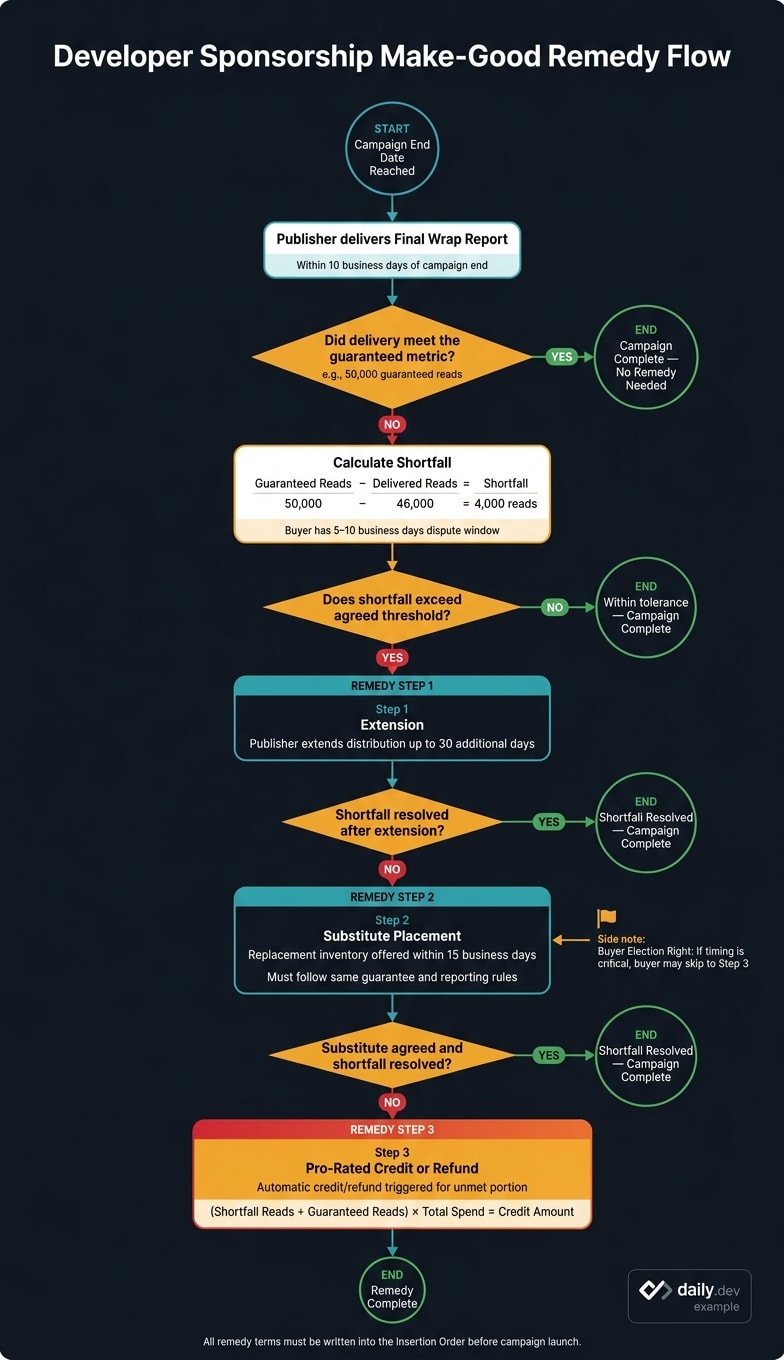
Once the delivery guarantee is set, put the fix directly into the IO. Spell out five things before the campaign goes live: shortfall calculation, final-report timing, dispute window, replacement timing, replacement match, and what happens if the replacement misses too.
Start with shortfall calculation. It should use the same guaranteed metric you already agreed to. If the IO guarantees 50,000 reads and the campaign delivers 46,000, the shortfall is 4,000 reads. Simple. Put the discrepancy threshold in the IO as well. And make sure you have a written dispute window - usually 5 to 10 business days after you get the wrap report - before that report becomes final.
Next, set the remedy order. A clean setup is:
- Extension first
- Then a substitute placement
- Then a pro-rated credit if no substitute is agreed within 15 business days
Also add buyer election rights. If the campaign is tied to timing, a substitute placement may not help much. In that case, the buyer should be able to choose a pro-rated credit or refund instead of replacement inventory when the replacement does not fit the campaign goal.
Then lock in the backstop. Any replacement inventory should follow the same guarantee and reporting rules as the first placement. If there is still a shortfall after the make-good deadline, the contract should trigger an automatic credit or refund.
FAQs
What should I negotiate first in a sponsorship deal?
First, verify the audience. Treat it as a pass/fail gate before you get into pricing, targeting, or formats.
Ask how the audience is measured, how bot and invalid traffic are filtered, and whether they can show proof of actual reach. If the audience is a fit, move on to quality guarantees like read-floor commitments and written make-good terms.
When should I ask for a make-good or refund?
Ask only after a guaranteed deliverable comes in short and the extra flight time still doesn’t hit the agreed amount. In most cases, publishers first extend the flight by up to 30 days.
If there’s still a gap after that, you can ask for a make-good flight, a substitute placement, or - if no deal is reached within 15 business days - a credit. For sponsored content read floors, any remaining shortfall leads to a pro-rata credit or refund. Non-guaranteed deliverables don’t qualify.
How do I tell if a rate card term is actually flexible?
Look for specific, written guarantees instead of fuzzy promises. You want exact thresholds for viewability, invalid traffic tolerance, and clear make-good terms if delivery falls short.
Make-good credits, redelivery terms, and performance guarantees should appear as separate items in the IO, not hidden in loose wording. Skip estimates when you can, and put guaranteed-delivery terms ahead of simple impression promises.