

My short answer: bid on competitor keywords only in tight cases. If your comparison page is strong, your CAC can handle higher CPCs, and the search intent is close to “alternatives” or “vs”, it can work. If not, it often turns into higher costs, weaker conversion rates, and annoyed developers.
Here’s the core idea in plain English:
- Competitor keyword ads usually cost more than normal search clicks.
- Click-through rates and conversion rates often drop because the searcher started with another brand in mind.
- Broad branded terms are the riskiest because they can trigger bidding wars.
- Comparison pages beat generic landing pages for this traffic.
- Organic comparison content is the better long game because it can keep driving visits after paid spend stops.
- Trademark mistakes can create legal and platform risk.
- Developer audiences are less forgiving of ads that feel sneaky, vague, or too aggressive.
For context, general dev tool CPCs often fall around $2 to $15 per click. Competitor terms can go above that, which means even a small drop in conversion rate can wreck your payback model.
Quick comparison
| Option | Cost pattern | Trust with developers | Best use case | Main risk |
|---|---|---|---|---|
| Bidding on competitor keywords | Higher CPCs; cost can climb fast | Lower if the ad or page feels pushy | Mature categories with strong comparison pages and CAC room | CPC wars, weak conversions, trademark issues |
Comparison content (/alternatives/) |
Upfront content cost, no pay-per-click after | Higher when the page is direct and technical | “vs” and alternative searches during evaluation | Slower payoff than paid traffic |
| Native developer feed promotion | Paid distribution without search auction pressure | Better fit when the page is useful first | Reaching developers before they search | Page still needs to do the selling |
If I had to reduce the full article to one rule, it would be this: build the comparison asset first, then test paid conquesting only when the math is still in bounds.
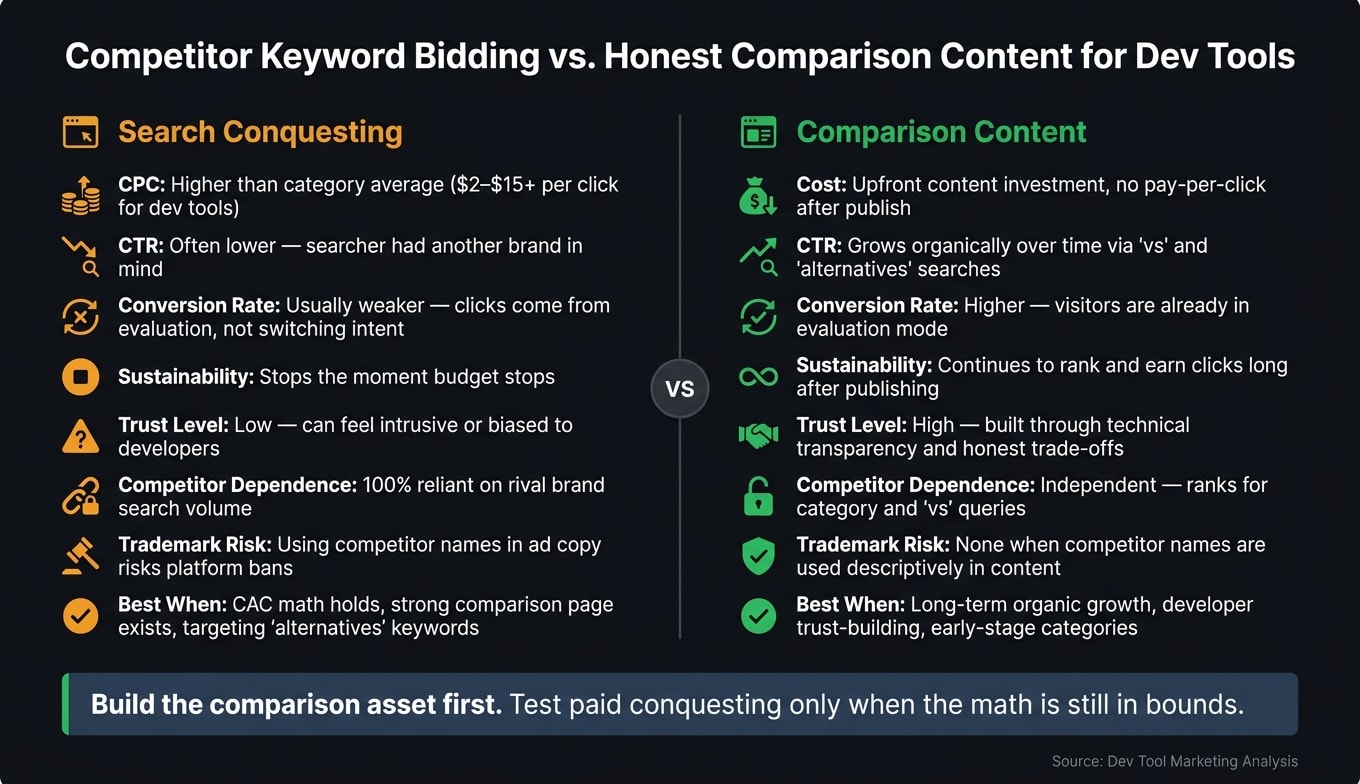
How search conquesting works and why the economics get complicated
Search conquesting means bidding on a competitor's brand or product name, then sending that traffic to a page built for a direct comparison. The setup sounds simple, but the math can get messy fast.
To keep spend tight, use exact or phrase match so you show up for narrow queries instead of broad, expensive traffic. And don't send those clicks to a generic landing page. Send every competitor click to a page that answers the comparison right away. If someone searches a rival by name, they don't want fluff. They want the difference, fast.
The bigger issue is what happens when auction pressure starts climbing. A setup that looks fine at first can get expensive in a hurry.
What typically happens to CPC, CTR, and conversion rates
Competitor campaigns usually cost more and convert worse than standard search. General dev tool search CPCs often land around $2 to $15 , and competitor terms push higher. That tends to show up in three places at once: CPC goes up, CTR softens, and conversion rates drop.
| Metric | Typical pattern | Why it happens |
|---|---|---|
| CPC | Higher than category average | Lower intent match and more auction pressure |
| CTR | Often lower | Searchers started with a different brand in mind |
| Conversion rate | Usually weaker | Clicks come from evaluation, not active switching |
Why does this happen? Because the person searching didn't start with you. They started with another brand in mind. You're stepping into the middle of their decision process, not meeting them at the start with a clean slate.
That's why conquesting can look efficient in one account and brutal in another. A small shift in click cost or conversion rate can change the whole picture.
Why mature categories make conquesting more tempting
Conquesting only works when competitor-brand search volume is deep enough to absorb higher CPCs. That's why it shows up more often in mature dev tool categories, where buyers already search for terms like competitor-vs-your-tool or competitor alternatives. In early-stage categories, there usually isn't enough volume to make the trade-off worth it.
The appeal is easy to see. If a competitor has already built the brand awareness and you haven't, their search volume can look like a pool of high-intent buyers you couldn't reach on your own. But that only holds up until CPCs start rising.
If click costs stay inside your CAC model, conquesting can work. If they don't, it turns into bidding theater. Then you're not buying efficient demand. You're just paying for noise.
When bidding on competitor keywords is smart versus when it backfires
The line between a smart conquesting test and a money pit usually comes down to five things: where the click lands, whether your CAC can handle the cost, how developers respond, trademark risk, and how well the page converts.
| Factor | Smart Use (Rational Test) | Scorched Earth (Backfire) |
|---|---|---|
| CPC Pressure | High-intent "alternatives" keywords with manageable CAC | Bidding on broad brand names that trigger CPC wars |
| Landing Page | Technical docs, code snippets, honest trade-offs | Generic marketing page with a "Request a Demo" form |
| Developer Sentiment | Helpful, transparent, and objective | Manipulative or feels like it's mimicking the rival's brand |
| Trademark and Brand Risk | Clear differentiation; trademarks respected | Using trademarked names in ad copy (risks platform bans) |
| Conversion Efficiency | High for dedicated comparison pages | Low; high bounce rates from lack of technical depth |
Smart use: a strong comparison page, clear differentiation, and CAC headroom
Conquesting can work when your CAC model has room for higher CPCs. That part matters because competitor terms often cost more, and those clicks get expensive fast.
But cost is only half the story. Developers can smell fluff a mile away. If they click an ad and land on a glossy page with vague claims, they're gone. A page with code snippets, architecture diagrams, and plain-spoken trade-offs has a much better shot. It meets the visitor where they are.
Going after narrower, high-intent "alternatives" keywords also helps. The search intent is tighter, and CPC pressure is usually lower than bidding on the rival's main brand term. In plain English: you're reaching people who are already comparing options, not people who were just trying to find the other company. The ad works only if the landing page explains the switch at a glance.
Scorched earth: CPC wars, poor fit, and developer backlash
This tends to go sideways when teams start bidding on broad brand-name terms. That's where CPC wars kick off, and costs can spiral before you know it.
The bigger issue, though, is developer sentiment. Developers want direct technical answers. They don't like brand games, and they don't respond well to pages that feel sneaky or try too hard to look like the rival. That's the heart of it: conquesting in this space wins or loses based on trust.
A safer play is to bid on the keyword without leaning on the competitor's identity. Once you start putting a competitor's trademarked name in the ad copy, you add legal risk and open the door to platform bans.
If conquesting can't clear the CAC hurdle, you're often better off earning that traffic with comparison content than paying for every click.
The better long game: honest comparison content that earns the click
When conquesting starts to cost too much, move the battle off the auction and onto the page. Search conquesting is a tactic. Honest comparison content is an asset. One stops the moment the budget dries up. The other can keep bringing in traffic long after it goes live.
Comparison content works because it reaches developers while they’re still weighing options. It can rank for "vs" and alternatives searches without leaning on competitor-brand search volume .
| Factor | Search Conquesting | Honest Comparison Content |
|---|---|---|
| Sustainability | Stops when budget stops | Continues to rank and earn clicks organically |
| Trust | Low; often feels intrusive or biased | High; built through technical transparency and trade-offs |
| Competitor Brand Dependence | 100% dependent on rival brand search volume | Independent; ranks for category and "vs" queries |
That’s the big split. Conquesting is reactive by design. Comparison content can shape how developers size up their options during the evaluation phase, before they’ve settled on a choice .
That’s why the landing page matters more than the bid.
What a good alternatives page needs to include
Once someone lands on the page, the comparison needs to be clear right away. A solid alternatives page should read like a technical brief: name both tools, explain who each one is for, and lay out the trade-offs side by side. It also helps to group these pages under an /alternatives/ hub. That gives the pages a stronger connection to each other and gives search engines one clear place to send people .
How daily.dev Ads can amplify comparison content without forcing the click
Display ads miss a lot of developers because ad blockers are common. daily.dev Ads solves for that by placing native in-feed promotions inside the developer feed, where developers are already in discovery mode. Promote a comparison page there, and you can reach people who are actively sizing up options based on seniority, programming language, or even the tools they already use. The message feels useful, not hostile .
Native in-feed promotion can put comparison content in front of developers before they even search, which gives the page room to do the persuading.
Conclusion: A balanced verdict for dev tool marketers
The takeaway is pretty simple: competitor bidding is a narrow tactic, not a full strategy.
In mature categories, it can work if your CAC math holds up and your landing page does its job. It tends to fall apart when click costs climb faster than conversions, or when visitors land on a weak, generic page.
The path that lasts longer is honest comparison content under an /alternatives/ hub. That gives you a way to earn clicks through organic search instead of paying for every visit.
To put that content in front of the right people sooner, daily.dev Ads can place it natively inside the developer feed. That means reaching engineers while they're still in discovery mode, before they’ve even run a search .
Use conquesting only when the economics make sense. Build comparison content first. Then distribute it through developer-native channels.
FAQs
How do I know if competitor bidding is profitable?
Judge profit by long-term pipeline and activation, not just lead volume. In developer marketing, buying cycles often stretch from 90 to 180 days. So if you give all the credit to the last click, you’ll miss a big part of what’s going on.
Use position-based attribution instead. It gives credit across the journey, not just at the finish line.
Watch metrics that tie spend to business results:
- Pipeline-to-spend ratio
- Activation milestones
- Unit economics
- Conversion quality
For targets, aim for an LTV:CAC ratio of 3:1 to 5:1. And if a keyword is spending more than 3x your target cost per conversion without producing results, pause it. That kind of spend can drain budget fast without moving deals forward.
What should a dev tool comparison page include?
A high-converting dev tool comparison page should start with a clear verdict. Don’t make people hunt for the answer. If one tool is the better fit for a given use case, say that up front.
From there, lean on technical substance, not salesy copy. Developers want proof. They want to see how the tools differ in practice, where each one fits, and what they’ll give up with either choice.
Use data-backed tables to compare key areas like features, pricing, integrations, and support. That makes the page easy to scan without watering down the details.
You should also include materials that help people evaluate the product in a hands-on way, such as:
- Code snippets
- Architecture diagrams
- UI screenshots
Back up your claims with third-party data people can trust. And don’t dodge trade-offs. If a tool is easier to set up but has fewer integrations, say so. If pricing looks lower at first but climbs with usage, spell that out. That kind of honesty helps the page do its job.
Keep the page tight. Strip back extra navigation, cut distractions, and stick to one clear call to action so the next step feels obvious.
When is organic comparison content the better bet?
Organic comparison content is the better long-term play for earning developer trust and stacking organic signups over time. It tends to work best with people who are deep into a 30-day evaluation window and actively searching for alternatives.
This approach makes the most sense when you can share transparent, data-backed insight, such as benchmarks, performance metrics, or nuanced use-case breakdowns, instead of one-sided marketing claims. If you show where your tool shines - and where it falls short - you give switch-minded developers the kind of honesty that helps them make a decision.