
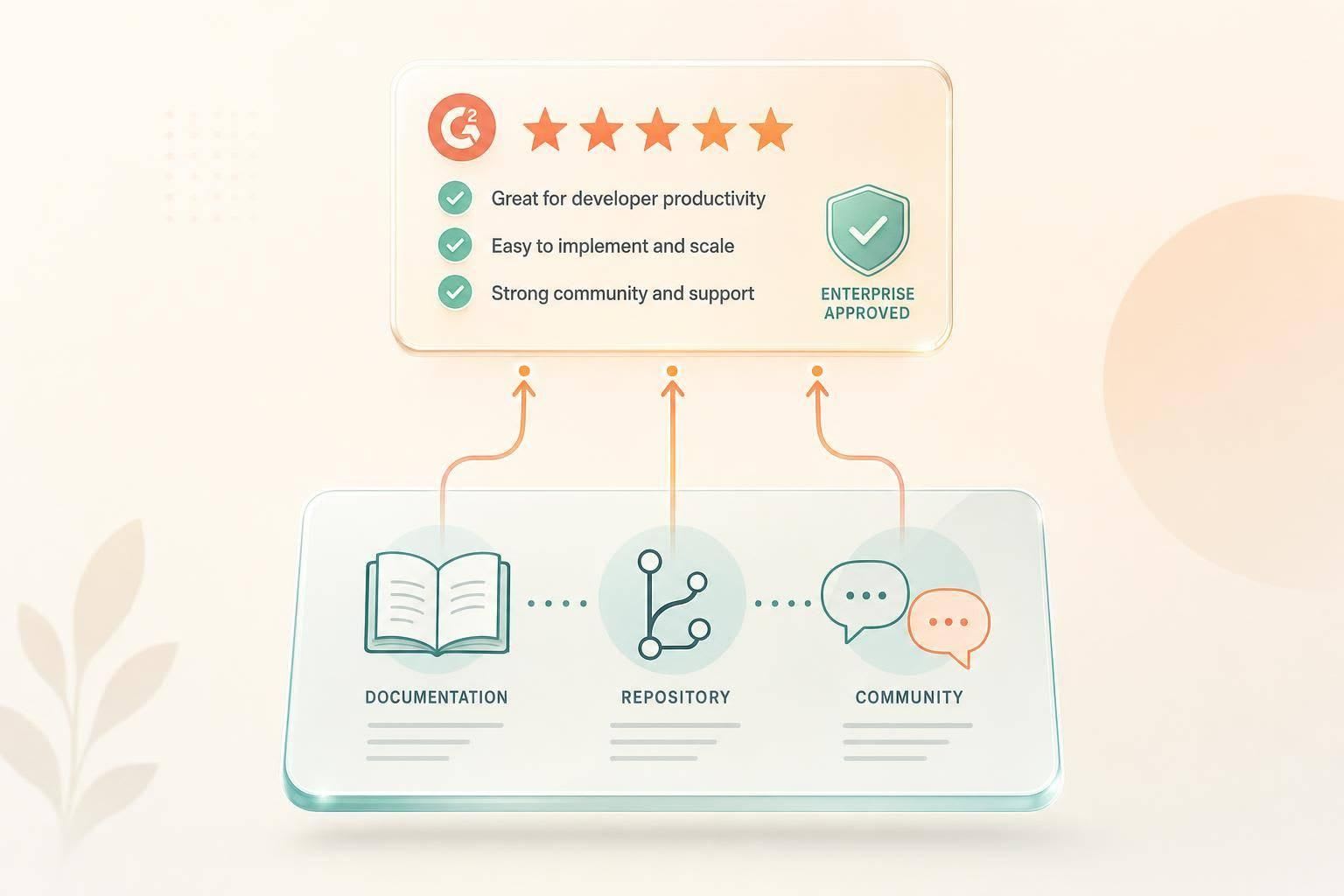
Short answer: yes - but mostly later in the buying process.
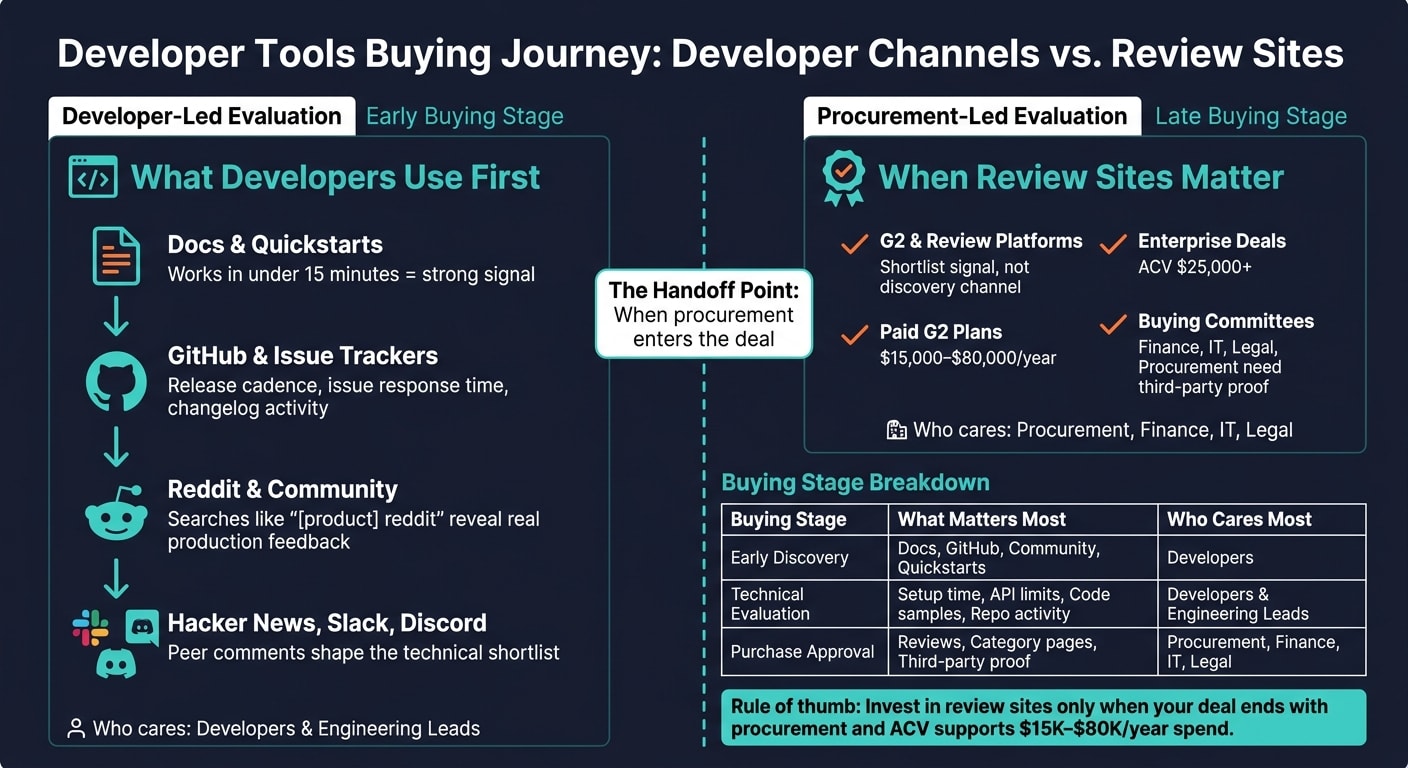
If I market a developer tool, I should treat review sites like G2 as procurement support, not a main growth channel. Developers usually pick tools based on docs, quickstarts, GitHub activity, release pace, and peer comments. By contrast, review sites tend to matter when finance, IT, legal, or procurement step in.
Here’s the simple version:
- Developers rarely start with review sites
- Docs and product experience matter more early on
- GitHub, issue response time, and changelogs help build confidence
- Reddit, Hacker News, Slack groups, and Discord often shape the shortlist
- G2 matters more in enterprise deals, especially when ACV is $25,000+
- Paid review-site plans can cost $15,000–$80,000 per year, so the spend has to fit the deal size
- If I’m selling self-serve, open-source, or low-friction tools, review sites are often low priority
- If I skip G2, I should put that budget into better docs, working code samples, and a faster time-to-first-value path
Bottom line: developer channels first, review sites later. For most devtools, review platforms help with vendor checks and shortlist support, not with hands-on product evaluation.
| Buying stage | What matters most | Who cares most |
|---|---|---|
| Early discovery | Docs, GitHub, community talk, quickstarts | Developers |
| Technical evaluation | Setup time, API limits, code samples, repo activity | Developers and engineering leads |
| Purchase approval | Reviews, category pages, third-party proof | Procurement, finance, IT, legal |
If I want to decide whether G2 is worth the work, the key question is simple: does my deal usually end with procurement?
How developers evaluate tools before procurement
Docs, quickstarts, and trial experience carry the most weight
Docs often tell developers what landing pages don't: rate limits, tier gates, and API constraints. And in practice, a quickstart that works in under 15 minutes means more than a giant logo wall .
That first hands-on moment sets the tone. If setup feels messy, code samples fail, or the feature you need sits behind an enterprise plan, a lot of developers just move on. Sales usually doesn't even get a shot.
GitHub, issue trackers, and release cadence act as live trust signals
Once docs look solid, many developers head straight to GitHub. They're checking update cadence, issue responses, and changelog activity . Regular releases suggest the product is still being maintained. Long quiet stretches suggest the opposite .
And this part can make or break a deal fast. If reliability issues have been sitting open for months, or maintainers answer with canned replies instead of direct help, trust drops fast. That can sink the deal before procurement or finance ever enters the picture.
Reddit threads, peer recommendations, and community sentiment shape perception
A common search during evaluation is "[product name] reddit" . Developers want the stuff polished marketing pages tend to skip: production failures, API quirks, support problems, and blunt stories from engineers who've used the tool in live systems.
Community threads often carry more weight because they feel less polished and less driven by incentives . For day-to-day evaluation, places like r/devops, r/programming, and r/webdev often matter more than a G2 profile.
The same pattern shows up elsewhere too. Hacker News threads, internal Slack groups, and niche Discord communities all shape opinion. One candid comment from a working engineer in the right subreddit can matter more than a stack of formal reviews on a review platform.
These signals often shape the technical shortlist long before review sites come into play.
When G2 and review sites matter for developer tools
Procurement and enterprise deals are the strongest use case
Things change once a buying decision moves past engineering. At that point, review sites start to matter more - but mostly for procurement, not for deep technical evaluation.
They tend to matter most when the buyer is finance, procurement, IT, or legal, not the developer. They can also shape AI-generated recommendations during the purchase stage, acting more like a shortlist signal than a discovery channel.
The person using the tool and the person approving the spend are often not the same. Developers usually turn to GitHub, docs, and Reddit. Approvers look at review sites to check risk and see whether a vendor looks legitimate.
That only matters when the buying process includes approvals, budget review, and extra layers of sign-off.
Review sites help buying committees more than individual developers
The earlier section shows how developers narrow options on their own terms. Review sites serve a different purpose. They give procurement, finance, security, and legal teams enough confidence to put a vendor on the shortlist .
They don't solve implementation questions. They do something simpler: they signal that the vendor is real, shows up in a consistent way, and has enough proof points to support the spend.
The main question is whether your sales motion gets that far.
When to invest in review sites and when to skip them
Once procurement shows up, review-site spend shifts from a discovery play to a budget line. At that point, review sites tend to help buying committees more than individual developers. So the rule is pretty simple: invest when the deal needs non-technical proof, and skip them when developers can test, adopt, and move forward on their own.
Invest when enterprise motion and stakeholder complexity are high
Put money into review sites when you sell to mid-market or enterprise buyers with $25,000+ ACV and review-site proof helps move committee-led deals forward. If your sales cycle includes procurement, finance, or other approvers, a solid presence on sites like G2 can make it easier for those groups to sign off.
That price tag matters. Paid G2 tiers run from $15,000 to $80,000 per year . So this spend tends to make sense only when contract size supports it. If you're closing high-ACV deals and formal procurement is part of the process, review sites can earn their keep.
Deprioritize when adoption is self-serve, early-stage, or open-source-led
Skip review sites when developers can adopt the tool without outside approval and the deal doesn't hinge on procurement.
In that kind of motion, review sites usually don't change much. Developers want to test the product, read the docs, run the API call, and decide for themselves. If that's how adoption happens, review-site spend is often hard to justify.
What to build first if review sites are not the priority
If review sites aren't the top priority, put that budget into developer trust signals instead.
Start with the basics that help someone get to value fast:
- A clear quickstart
- A working API example
- A setup path that gets users to a working API call in 5–10 minutes
- A frequent changelog
- Copy-pasteable code samples
- An active GitHub repo
- Technical case studies with measurable outcomes
Those assets usually do more for trust than vague ROI claims .
Developer marketing channel strategy and key takeaways
Use developer-focused channels earlier in the buying journey
Review sites show up late in the funnel. Developers usually find and size up tools in places they already spend time.
They start with docs, GitHub, and community spaces. So your channel plan should begin there, not on review sites. Put your message in places developers already read during discovery, like technical newsletters and community feeds. For awareness and evaluation, those channels tend to do more work than review sites .
Use developer channels for awareness and evaluation. Use review sites for procurement.
That’s the big call: developer channels first, review sites later.
Conclusion: Reviews matter, but usually later than marketers expect
The core issue is timing. Review sites aren’t irrelevant for developer tools. They just tend to matter later than many marketing teams think.
Start by building strong trust signals for developers. Then add review-site programs when formal procurement begins, buying committees step in, and non-technical stakeholders want third-party validation before they sign off .
The math still needs to make sense: invest in review sites only when your sales motion and deal size can support it.
FAQs
is G2 worth it for devtools?
G2 is worth it for developer tools mostly as a basic inclusion gate for AI search visibility.
Here’s the catch: many developers don’t put much trust in surface-level reviews or incentive-driven feedback. If a page feels polished but thin, they can smell it a mile away. Still, AI engines often cite G2 when making recommendations, so being absent there can hurt visibility.
The practical move is simple: claim a free listing and get 10 to 20 legitimate reviews. After that, put most of your effort into the places developers use to judge tools for real:
- GitHub
- Hacker News
- Stack Overflow
Those channels tend to matter more for technical evaluation and day-to-day credibility.
where do developers check reviews?
For developer tools, most developers look for real-world feedback in places like:
- GitHub
- Hacker News
- Reddit, especially programming, devops, and data subreddits
- Stack Overflow
These sources show how tools hold up in practice. You can see bug reports, workarounds, setup pain, edge cases, and the kind of trade-offs that matter once a tool is in actual use.
By contrast, G2-style review sites usually matter less when someone is doing a technical check. They can still show up later, especially during procurement or when a team is narrowing down a shortlist.