

Most developer demand starts where your analytics can’t see it. If a link gets shared in Slack, Discord, email, or a DM, it often shows up as direct traffic later. That means your reports may give credit to branded search or a last visit, even though the first push came from a private chat.
Here’s the short version:
- Dark social is private link sharing that strips or hides referral data.
- For developer tools, this often happens in Slack, Discord, DMs, and email threads.
- Last-click attribution fails because it credits the final tracked visit, not the earlier peer recommendation.
- You can’t fully track dark social, but you can measure it with proxies.
- The best signals are:
- Branded search lift
- Direct traffic to deep docs pages
- Self-reported attribution
- Assisted conversions and longer paths
- SparkToro found that 100% of visits from Slack, Discord, WhatsApp, TikTok, and Mastodon were marked as direct traffic in its test.
If I were reporting on this, I’d keep it simple: don’t treat dark social as missing data you can recover. Treat it as hidden influence you can estimate from patterns. That gives you a better read on budget, CAC, and channel performance without pretending the data says more than it does.
This article explains where dark social happens, why attribution breaks for developer audiences, which signals to watch, and how to report results with plain limits and clear confidence levels.
Why last-click attribution fails with developer audiences
Last-click attribution gives all the credit to the final measurable touch. On paper, that sounds neat. In developer buying, it breaks fast.
That’s because developers often start with a trusted peer, not a paid click. The first nudge might happen in a Slack thread, a Discord chat, or a private email. None of that shows up cleanly in analytics. So the last measurable touch can look like the main reason for the conversion, even when it wasn’t.
Private shares often show up as direct or unknown traffic
Links shared in Slack, Discord, or email often lose referrer data. When that happens, analytics tools log the visit as direct or unknown traffic. SparkToro's research found that 100% of visits from Slack, Discord, WhatsApp, TikTok, and Mastodon were marked as direct traffic, with no referral information passed through .
Here’s where it gets messy: a developer might click a shared link, leave, come back days later on another device, and then convert through a branded search. Analytics gives the credit to the search, not the original share. Once that first share drops out of view, the rest of the path gets mislabeled too.
Developer buying journeys are peer-led and non-linear
In dashboards, the path can look clean. In real life, it usually isn’t.
A common journey looks more like this:
- Peer recommendation in Slack
- Docs review
- Internal validation
- Later branded search and signup
Last-click attribution gives credit to the final Google search, even though the decision was already in motion .
And because these channels often don’t pass referrer data or UTMs, standard attribution models tend to overcredit branded search and direct traffic.
Where dark social happens for developer brands
If last-click hides the influence, this is where that influence often begins. Dark social shows up in the private tools developers already use every day.
Slack, Discord, and private technical communities
A lot of developer tool discovery happens inside team workspaces and niche community servers, not on public feeds. Someone runs into a problem, posts in #infra or #devops, and a teammate drops in a link to a doc or repo. No UTM. No referrer. No clear trail.
That’s why these channels matter. The recommendation lands right in the moment the problem shows up. Developers ask questions, compare options, and swap links in the same thread. It’s casual, fast, and tied to the work in front of them. Private channels drive a large share of link sharing in buying journeys.
DMs, email forwards, and private professional messages
It happens one-to-one too. A developer sends a LinkedIn DM to a former colleague and asks what they’re using for feature flags now. A staff engineer forwards a migration guide to eng-architecture@company.com. A tech lead texts a link to a teammate before a planning meeting.
These shares often happen at decision points: shortlist, evaluation, or internal buy-in. Later, they tend to surface as direct traffic, docs visits, or clustered sign-ups from one company. You can’t see the original share, but you can watch for the pattern. That’s where indirect measurement starts to matter.
How to measure dark social without pretending it is fully trackable
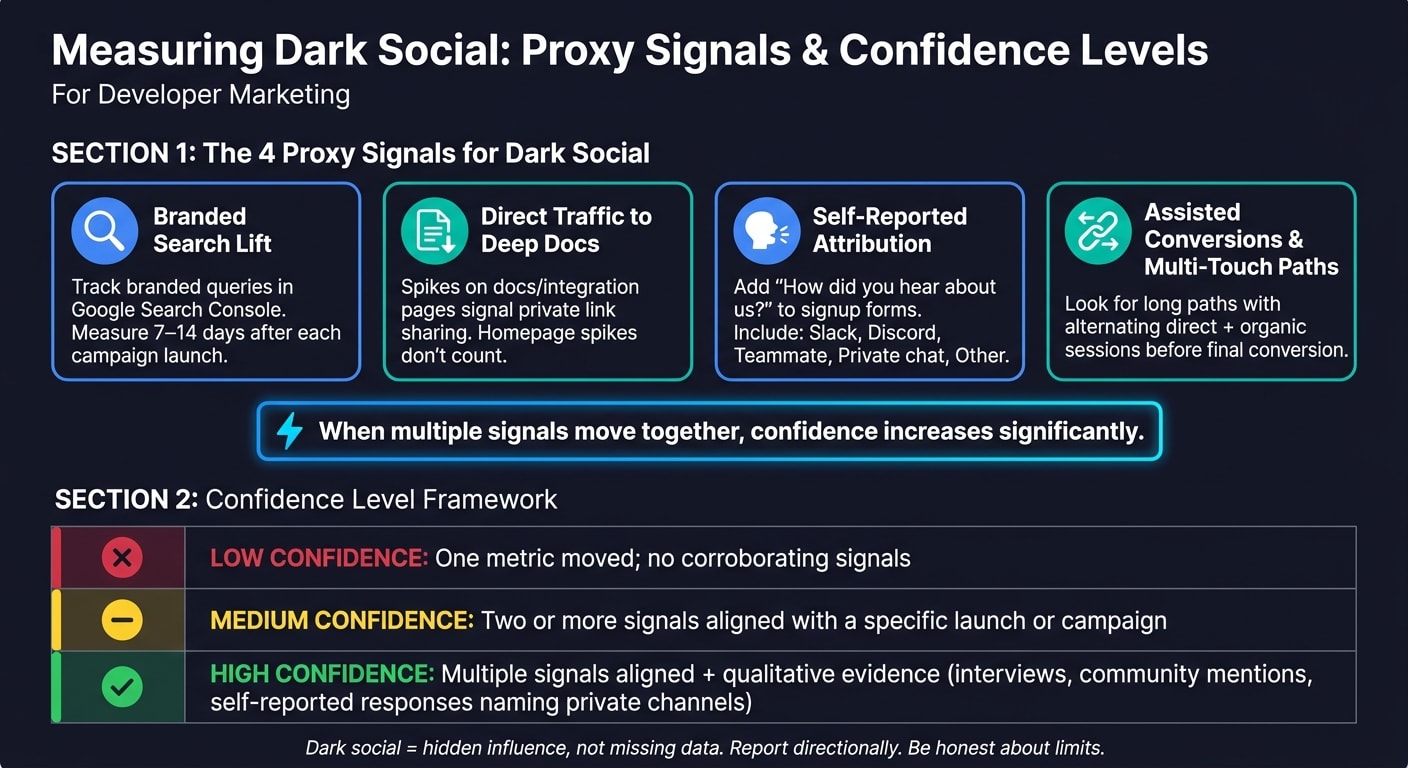
Once a private share slips past analytics, you’re left with proxy signals. That’s not a flaw in your setup. It’s just how dark social works. You won’t recover every private share, so the smarter move is to measure the traces it leaves behind.
Use proxy signals: branded search lift, direct-traffic patterns, and self-reported attribution
Start with branded search lift. This shows how often people search for your product or company name before, during, and after a campaign. If branded queries climb after a community push, there’s a good chance peer conversations are driving demand. Use Google Search Console to set a baseline across several quiet weeks, then check the change 7–14 days after each campaign.
Next is direct-traffic patterns. This signal only helps if you segment it the right way. A spike in direct traffic to deep docs pages or integration guides says a lot more than a jump in homepage visits. Why? Because people rarely type a long docs URL from memory. Those visits often come from links shared in private chats, team threads, or closed groups.
Then there’s self-reported source. Add a “How did you hear about us?” field to signup or demo forms. Be specific with the choices so people don’t have to guess. Options like these work well:
- Slack community
- Discord server
- Teammate
- Private team chat
Add an “Other” field as a backup. Then group free-text responses into the same categories each month so you can spot patterns over time.
When these proxies move together, the signal gets stronger. One metric on its own can be noisy. A few metrics pointing in the same direction? That starts to tell a much clearer story.
Add campaign codes and custom URLs
Give each community or campaign its own URL or code, then compare signups and activations by source.
Use those identifiers as comparison tools, not as perfect attribution. That distinction matters.
Codes won’t catch every share. People strip parameters, copy links into chats, or send screenshots instead. But even with those gaps, custom URLs and campaign codes make it much easier to compare channels side by side.
Read dark social through assisted conversions and multi-touch paths
Codes can hint at source. Path data helps you see what happened after that first click.
Assisted-conversion reports and time-lag data show the parts that last-click reporting misses. Watch for paths where direct deep-link sessions or branded searches show up more than once before the final conversion. Long, multi-touch journeys with alternating direct and organic sessions are a strong pattern for peer-led developer buying.
What you’re doing here is building a case from several angles: branded search is up, deep-link direct traffic is up, self-reported mentions are up, and assisted conversions show longer paths. Put together, those signals can give you a solid directional read on what’s working.
Report the results as directional evidence, and be plain about what the data can and can’t prove.
What dark social can and cannot prove, and how to report it
Be clear about limits and confidence levels
Once you have proxy signals, the next step is to report them with clear confidence levels. Dark social can only be measured through proxies, so treat the data as directional evidence, not proof.
No proxy method can tell you who shared a link, which Slack workspace received it, or what the message said. You also can’t tie exact revenue to a Discord server or prove that one private thread caused a deal. If you claim more than the data can support, technical stakeholders will spot the gap fast. And once that trust slips, it’s hard to win back.
What helps? Signals that line up from different angles. A lift in branded search, more direct landings on deep docs, and self-reported Slack or Discord mentions are each incomplete on their own. But when they move together, the case gets stronger.
A simple confidence framework makes this much easier to explain:
| Confidence Level | What It Requires |
|---|---|
| Low | One metric moved; no corroborating signals |
| Medium | Two or more signals aligned with a specific launch or campaign |
| High | Multiple signals aligned and qualitative evidence confirms the pattern |
Here’s the plain-English version:
- Low confidence: one noisy metric moved, and nothing else backs it up.
- Medium confidence: two or more signals lined up around a launch or campaign.
- High confidence: several signals lined up, and qualitative evidence supports the pattern, such as developer interviews, community mentions, or “How did you hear about us?” responses that keep naming private channels.
Use that language directly in your reports. For example, you might say you have medium confidence that dark social contributed in a major way to post-launch CLI adoption, based on sustained branded search lift and more direct visits to the CLI docs.
Conclusion: treat dark social as hidden influence, not missing data you can fully recover
The goal is not perfect attribution. The goal is honest reporting of hidden influence.
Developer recommendations move through private spaces, and last-click attribution only sees the tracked visit, not the private recommendation that triggered it. Much B2B sharing happens in private channels - private messages, email threads, and closed communities - so peer-led influence stays invisible to standard analytics.
That’s why the smart move is to measure the traces, report the patterns plainly, and make budget decisions from directional trends instead of waiting for precision that will never come. Put together, the signals above can form a steady, honest picture that stands up when a skeptical engineering leader asks how you know what you think you know.
FAQs
How is dark social different from direct traffic?
Dark social is the sharing and discovery that happens in private places like Slack, Discord, DMs, and plain old word of mouth. It spreads person to person, but most analytics tools can’t trace where it came from.
Direct traffic is a dashboard label you can actually see. But here’s the catch: dark social often ends up lumped into direct traffic or even organic search. That mix-up makes its impact easy to overlook.
Which proxy signals are most useful for developer marketing?
When dark social makes tracking fuzzy, self-reported attribution is your clearest stand-in for word-of-mouth. A simple prompt during onboarding - like "How did you hear about us?" - can tell you a lot that analytics tools miss.
You can also watch a handful of other signals to spot momentum:
- Branded search volume
- GitHub stars
- API key creation
- PQLs
- Time to First Value (TTFV)
- Time to First Hello World
- Engagement with documentation or code samples
None of these gives you the whole picture on its own. But together, they can show whether people are hearing about your product, trying it, and getting to that first small win.
How should I report dark social without overstating it?
Don’t rely on last-click attribution alone. It often assigns dark social influence to direct traffic or organic search, which can give you the wrong read on what’s driving results.
A better approach is to pair a self-reported "How did you hear about us?" question with proxy metrics like documentation traffic, API key generation, and community signals such as GitHub stars or Discord activity.
That gives you a more realistic view of what’s happening without overstating impact.