
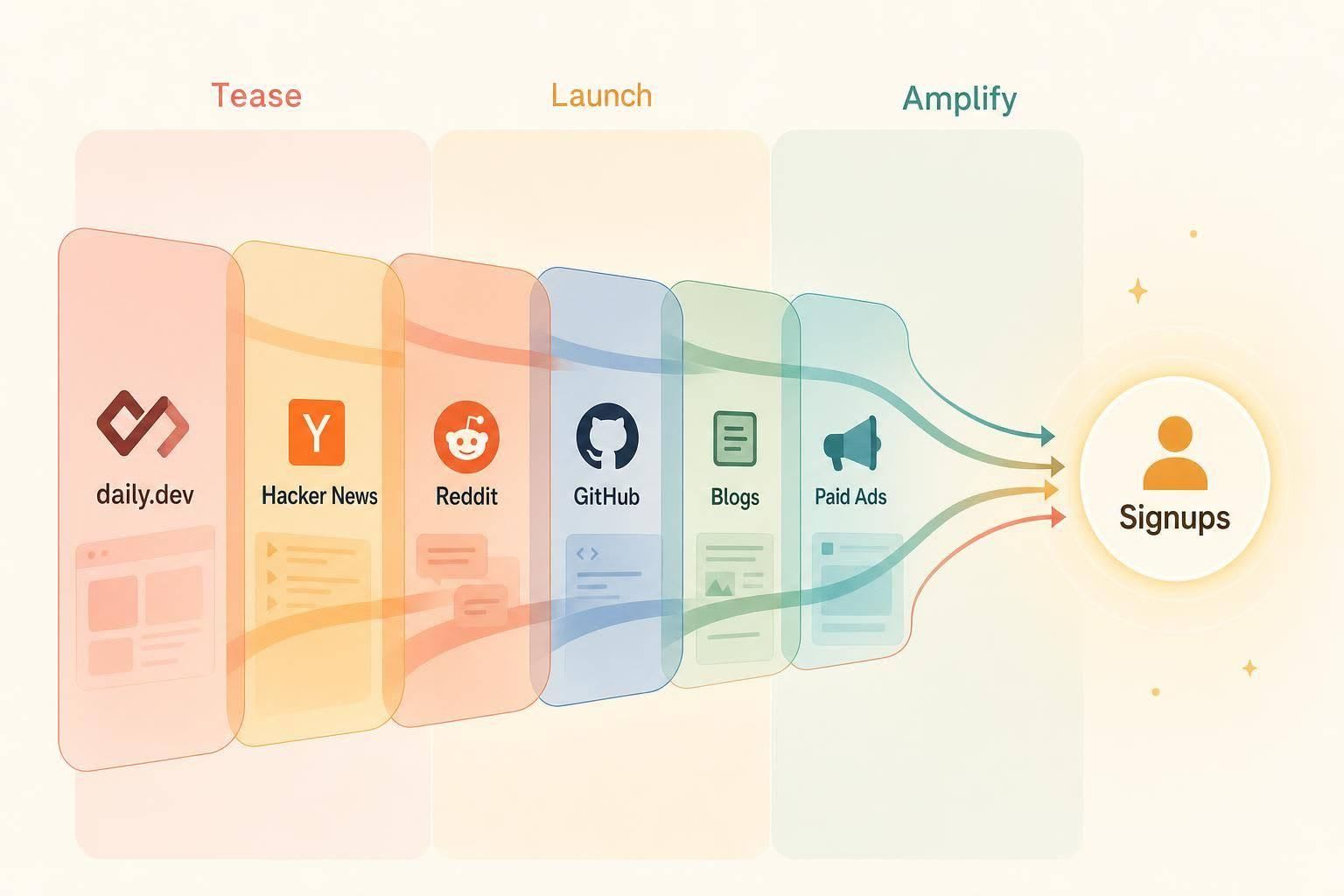
The short answer: don’t bet on one channel. If I were launching a developer tool, I’d use a mix of places for discovery, feedback, trust, and signups.
Here’s the simple breakdown:
- daily.dev works well for reaching developers in-feed, with targeting by stack and seniority. One 2026 example cited 12.8x more qualified signups.
- Hacker News is good for blunt early feedback, but the spike is short: often 2 to 6 hours.
- Reddit helps when I match the post to the right niche subreddit instead of posting a broad promo.
- GitHub helps with long-tail discovery through topics and Awesome Lists.
- Dev.to and Hashnode give me space to explain the tool with tutorials and walkthroughs.
- Paid channels work best after I know which message gets clicks and signups. The article cites $3 to $12 CPM for native developer ads, $500 to $5,000 for newsletter sponsorships, and $6,000 to $12,000 per quarter for sponsored coding challenges.
Before I launch anywhere, I’d lock in one main goal:
- signups
- waitlist joins
- GitHub stars
- installs
- demo requests
- docs visits
I’d also make sure these are ready first:
- landing page
- docs
- screenshots or demo GIFs
- GitHub examples
- someone ready to answer comments during launch week
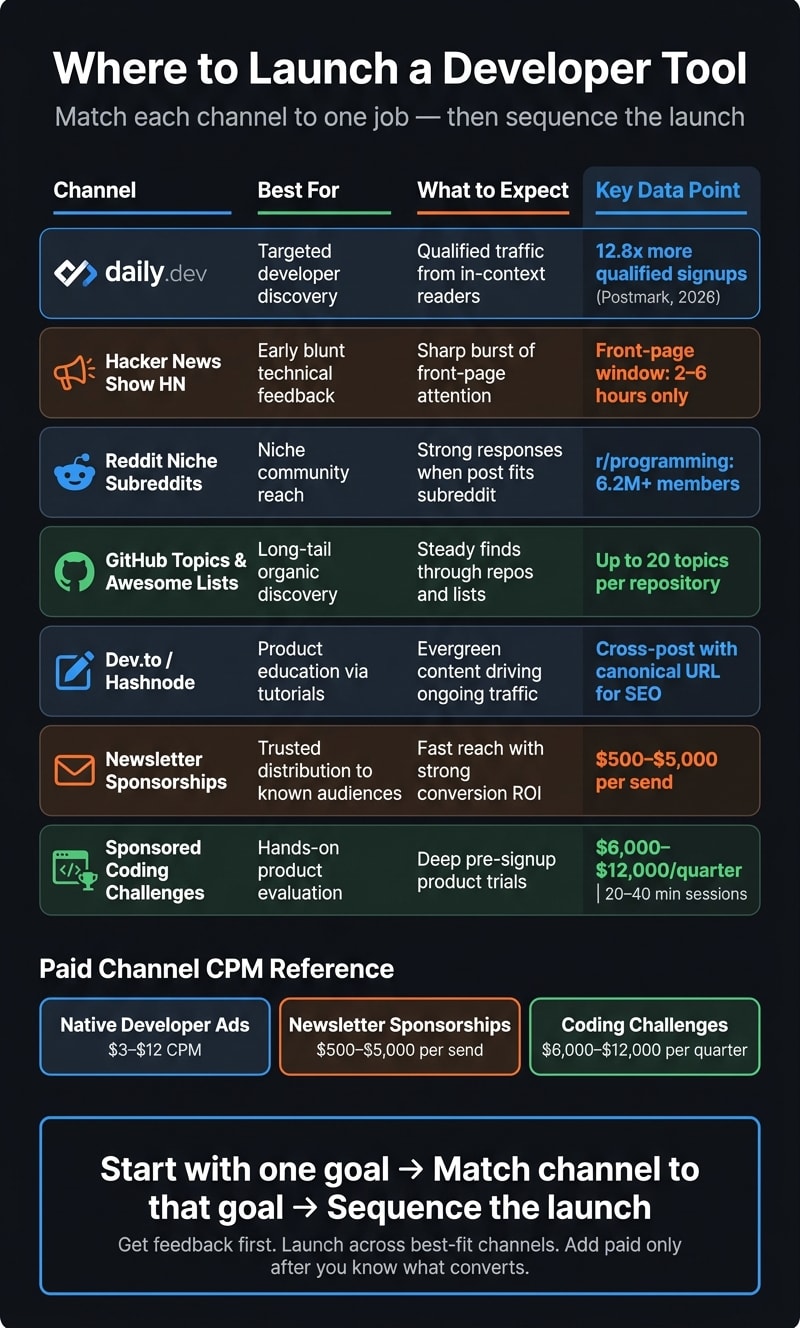
Quick Comparison
| Channel | Best for | What I’d expect |
|---|---|---|
| daily.dev | Targeted discovery | Qualified traffic from developers already reading in context |
| Hacker News | Early feedback | Sharp burst of comments and short-lived attention |
| Niche reach | Good responses if the post fits the subreddit | |
| GitHub | Long-tail discovery | Steady finds through topics, repos, and lists |
| Dev.to / Hashnode | Product education | More room to show use cases and setup |
| Newsletters | Distribution to known audiences | Fast reach if the audience matches the tool |
| Coding challenges | Hands-on product trials | Deeper product evaluation before signup or use |
My takeaway is simple: start with the goal, match each channel to one job, then sequence the launch. I’d get feedback first, post across best-fit channels on launch day, and only add paid push once I see which asset converts.
What to decide before choosing a launch channel
Start by getting clear on who the product is for. Look at the user’s role, tech stack, use case, and seniority level. That profile tells you two things fast: who to target first and where the product is most likely to click.
Then decide what success looks like. Pick one primary conversion event and stick with it. That could be GitHub stars, sign-ups, demo requests, installs, or docs visits. Just choose one. If you track too many conversions at once, it gets messy, and it becomes hard to tell what’s doing the work.
You should still watch both early signals and later conversions. In week one, pay attention to things like unique visitors and upvotes. Those are leading indicators. Over the first month, shift your focus to qualified sign-ups or demo requests. That’s where you start to see whether early interest turns into actual traction.
Before you commit to any channel, make sure your launch assets are ready. At a minimum, that means:
- A clear landing page
- Documentation
- Demo screenshots
- GitHub examples
- Someone ready to reply to comments and questions during launch week
If those pieces are weak, trust drops fast. And that hurts every channel, not just paid or performance-driven ones. Good assets give each channel a fair shot.
From there, match the channel to the job. Some channels are best for a short burst of blunt feedback. Others work better for steady discovery over time. Knowing that upfront helps you stagger the launch instead of dumping everything out at once. It also shapes how each channel supports the others during launch week.
1. Native developer platforms
Native placements work best when you want to meet developers where they already spend time, inside a feed that feels normal to them. That matters. If you want input from people who are already in discovery mode, this type of placement tends to land better than ads that interrupt them somewhere else.
daily.dev
daily.dev is a personalized feed that reaches developers during their day-to-day workflow. It’s a strong fit for tools that are easier to explain through technical content, product walkthroughs, or implementation stories. In 2026, Postmark ran in-feed placements targeted by stack and seniority and saw 12.8x more qualified signups.
Use this channel when your launch needs developers who already have the right technical context, instead of a broad top-of-funnel audience that may not care yet.
2. Community discussion hubs
Community hubs are a good fit when you want direct feedback, trust, and access to a niche group. The big upside is simple: you're meeting developers where they're already talking, comparing options, and picking tools. But there's a catch. These communities don't have much patience for obvious self-promotion, so how you show up matters just as much as where you post.
Each hub does a different job: HN for feedback, Reddit for niche reach, and GitHub for long-tail discovery.
Hacker News (Show HN)
Show HN is best for direct technical feedback and a short burst of front-page attention. That feedback can be very useful for early-stage tools. Just don't expect it to last long. The front-page window is usually only about 2–6 hours .Reddit (niche subreddits)
Reddit works best when you post in the right community. Subreddits like r/programming, which has over 6.2 million members , can put your tool in front of a huge developer audience. More focused communities, like r/mlops, can be even better if your product serves a specific use case. The best move here is to lead with helpful answers, not a product pitch.GitHub (Topics and Awesome Lists)
If you want discovery that lasts longer than a discussion thread, GitHub can help. It's not just a code host; it's also a place where developers find tools. Adding up to 20 lowercase, hyphenated topics to your repository helps your project appear on GitHub topic pages . Getting featured on a relevant Awesome List can also help your tool look more legit.
3. Content-led launch surfaces
If community hubs borrow attention, content-led surfaces earn it.
That’s the big difference. These channels give you room to show how the tool works, not just announce that it exists. They also help you build launch assets that can keep bringing in traffic long after launch week is over.
Technical blogging platforms (Dev.to / Hashnode)
Dev.to and Hashnode are built for engineers. That means they tend to reward technical writing for developers: tutorials, “building in public” posts, and honest breakdowns of how your tool works.
A simple move here: publish on your own domain first, then cross-post with a canonical URL.
daily.dev (educational content distribution)
Use daily.dev to put technical launch content in front of developers while they’re already reading and learning in context.
Once a post starts converting, push the strongest one into the next channel.
4. Performance amplification channels
Once organic traction kicks in, paid channels can help you get more mileage out of it, especially in places where developers already spend time.
One problem: ad blockers cut into reach. That’s why native placements tend to do better than standard display ads.
Use native placements for focused reach, newsletters for trusted distribution, and coding challenges when you want developers to try the product in a hands-on way.
Developer-first ad networks: Platforms like daily.dev offer native in-feed placements that blend into the reading experience. You can target by stack, seniority, or language, which helps keep spend tight. Typical CPM is $3–$12 .
Vetted newsletter sponsorships: Publications like TLDR and JavaScript Weekly reach developers when they’re already in reading mode. These sponsorships can deliver much stronger conversion ROI , and one send can cost anywhere from $500 to $5,000 depending on list size . The big thing is fit: the newsletter’s technical focus should line up with your tool’s use case.
Sponsored coding challenges: This is the strongest format for hands-on evaluation . You give developers a real problem to solve with your tool’s API, dataset, or workflow - usually a 20–40 minute session . Plan on roughly $6,000–$12,000 per quarter . Send paid traffic to docs, a sandbox, or a free tier, then track which asset converts best.
Native placements help more people find you. Newsletter sponsorships let you borrow trust. Coding challenges push people from interest into evaluation. These channels tend to work best once you already know which message and asset convert. That way, paid becomes part of a launch sequence, not a standalone bet.
How to combine channels into a stronger launch
Once you know the channel types, the next move is timing them well. Developer launches tend to fall flat when each channel runs on its own. The upside comes from lining them up so one channel pushes people into the next.
Start with your foundation. Lock in your docs, sandbox, landing page, and README. Add a demo GIF and make the install steps easy to follow. In many cases, the repository is the main place where people decide to try the product, not a signup form. When that base is ready, you can stop tinkering with setup and focus on distribution.
Two weeks before launch, do a small soft launch in the community to get feedback. At the same time, build a prelaunch waitlist so you already have people ready for launch day.
On launch day, post across your best-fit channels in one coordinated push. Start with email, then follow with community posts.
After the first spike fades, move into content and paid amplification. Publish a tutorial, then use daily.dev native placements to stretch the reach of the message that’s already converting.
That’s the core sequencing logic: build organic credibility first, then add paid amplification once you know which message and asset convert.
Conclusion
The right channel comes down to the result you want.
The best approach is usually a mixed sequence: start with discovery, back it up with proof, then support both with content and selective amplification. Choose one main goal first. Then match the channel to that goal and build the rest of the sequence around it.
FAQs
Which launch channel should I test first?
Start by auditing your documentation. In many cases, it’s the highest-converting surface because every other channel sends developers there when they’re sizing up your product.
Once that’s in good shape, run a multi-channel launch. Coordinate with developer-heavy communities like DevHunt and Hacker News, and add daily.dev Ads to put your product in front of an engaged audience during the first 24 hours.
How do I know if my launch assets are ready?
Focus on technical accuracy and clear value. Skip the hype.
Your landing page should match your ad copy. If the ad mentions a feature, API, or framework, visitors should see it right away. No hunting around. A working code snippet or live sandbox helps a lot here because it lets developers test the product on the spot.
Your documentation needs to be clear and easy to follow. The path to a first win should feel simple, not like a maze. If someone can get from landing page to first successful test without friction, you're in good shape.
It also helps to check the basics that developers notice fast:
- Is the site mobile-optimized?
- Does it load fast?
- Can people find the setup steps right away?
Load time matters more than many teams think. A slow site can hurt trust and cut conversions before a visitor even reads the docs.
When should I add paid promotion?
Add paid promotion only after you already have a working funnel. Paid ads should speed up conversions, not create them from scratch.
If your docs or website already turns organic visitors into signups or customers on a steady basis, begin with a small test budget, like $500, before you scale up to $5,000 or more. First, make sure your landing page is optimized and technically sound.