

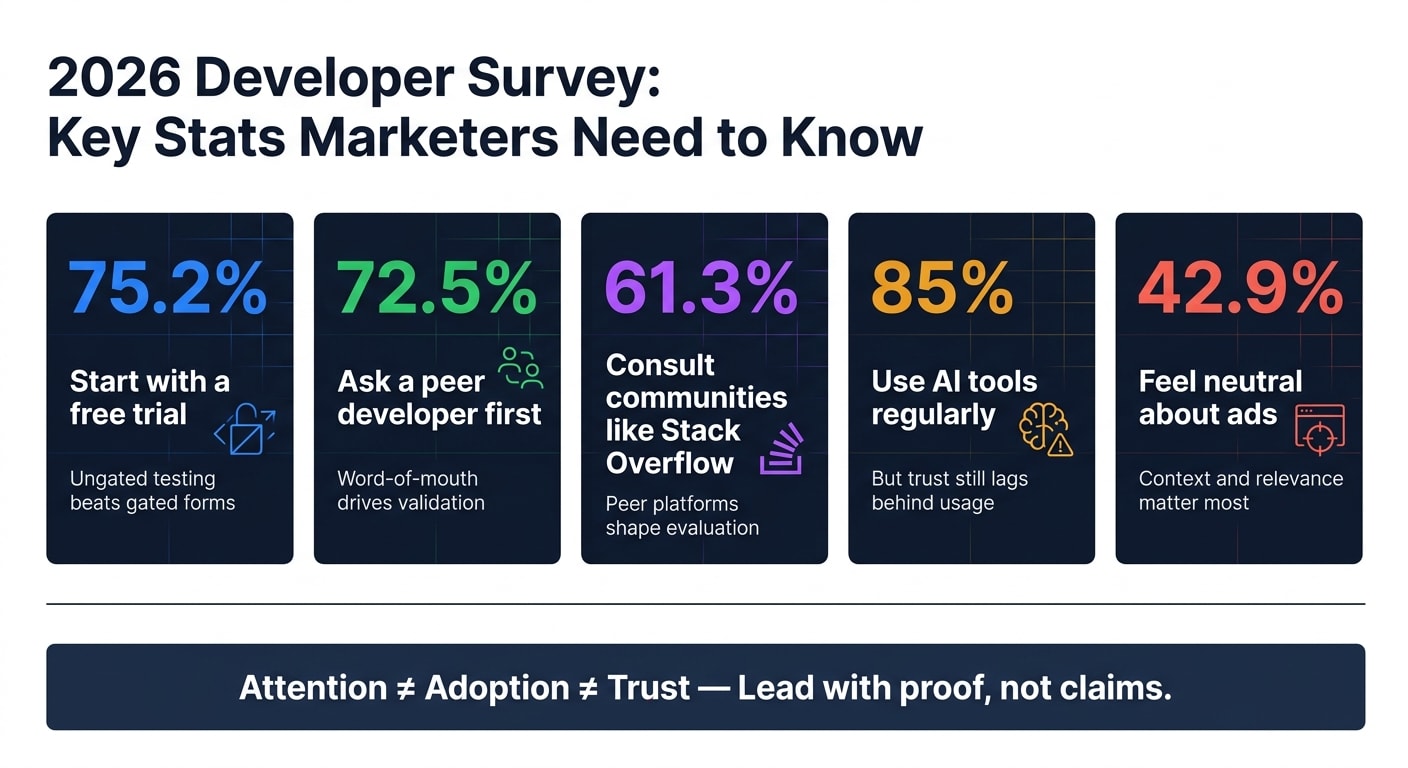
Here’s the short version: developers don’t want more hype. They want docs, trials, peer input, and proof. The survey data points in the same direction: 61.3% check community sources during evaluation, 75.2% start with a free trial, 72.5% ask another developer, 85% use AI tools often, and 42.9% feel neutral about ads.
If I were turning this into a marketing plan, I’d keep it simple:
- Put more budget into docs, search, product demos, and community-heavy channels
- Send traffic to ungated trials, code samples, and sandboxes
- Target by stack, language, and seniority instead of broad job titles
- Use messaging built on proof, limits, control, and human review
- Treat AI as a use-high, trust-lower category
The big lesson is simple: attention, adoption, and trust are not the same thing. A tool can get used a lot and still face doubt. That’s why the best path is not louder claims. It’s clearer proof.
Quick Comparison
| Signal | What the surveys show | What I’d do |
|---|---|---|
| Attention | Developers spend time in docs, community Q&A, search, and video | Show up where they already research |
| Evaluation | 75.2% start with trials; 72.5% ask peers | Make testing easy and ungated |
| Trust | Peer input and product proof matter more than vendor claims | Lead with code, benchmarks, and clear limits |
| AI | 85% use AI often, but trust still lags | Focus on review, control, and verification |
| Ads | 42.9% feel neutral about ads | Match the ad to the context and task |
Below, I’ll break down what these survey patterns mean for channel choice, messaging, and proof.
Where developer attention is right now
Developers tend to size up tools on their own before they ever speak with sales. They search, read docs, watch demos, and check with peers. So the first place to work on is discovery.
Community, search, video, and documentation drive discovery
Technical documentation is one of the strongest conversion surfaces in the developer funnel . Community platforms like Stack Overflow still sit at the center of how developers troubleshoot and sanity-check tools, and 61.3% consult communities like Stack Overflow during evaluation . Long-form technical channels also keep developer attention .
AI-powered search is reshaping discovery. AI Overview coverage for B2B technology queries climbed from 36% to 82% in one year . That puts more weight on authoritative technical content that can show up in synthesized answers.
How developers evaluate new products before adopting them
Discovery moves into validation. 75.2% of developers begin with a free trial, and 72.5% ask another developer they know when sizing up a new tool .
Don’t gate tutorials or code samples behind email forms. Developers will just go find an ungated option . At this point, proof beats reach.
Attention surfaces and what they mean for ad placement
Look at these surfaces by job to be done, not just by traffic.
| Surface | Primary Role in Discovery | Survey Evidence | Placement Implication |
|---|---|---|---|
| Stack Overflow | Troubleshooting and peer validation | 61.3% consult communities during evaluation | Use contextually relevant placements |
| YouTube | Visual learning and product demos | Long-form technical channels keep developer attention | Sponsor walkthroughs and technical demos |
| Technical documentation | Conversion and activation | Highest-converting surface in the developer funnel | Invest in runnable code samples and fast quickstarts |
What adoption data says about positioning
Languages and ecosystems with the largest consistently visible audiences
Once you know where developers pay attention, adoption data shows which ecosystems deserve the most budget. Attention tells you where people look. Adoption tells you which categories they may actually move toward.
The best signal for audience size is repeat visibility across surveys. If the same language or ecosystem keeps showing up near the top in Stack Overflow, JetBrains, and State of JS/CSS, that overlap matters more than any one stat on its own. It gives you a stronger starting point for audience targeting.
Use that consistency to shape your creative, landing pages, and budget around the workflows your product supports.
High-usage tools are not always high-trust tools
High adoption does not mean high trust. A tool can be used by a lot of people and still be low-preference.
That’s why generic claims usually fall flat. Technical proof wins. Lead with proof, because the evaluator is often the buyer. And that gap between use and trust? That’s where positioning can go wrong.
Usage versus satisfaction by tool category
Read usage and satisfaction together. If a category has broad usage but weaker enthusiasm, that gap is a positioning signal, not just a rank on a chart.
When satisfaction trails usage, lead with:
- implementation detail
- migration path
- proof
The gap between adoption and trust that marketers cannot ignore
AI use is broad, but confidence stays limited
Developers use AI a lot, but confidence still trails behind. 85% use AI tools on a regular basis, and 62% rely on at least one coding assistant .
That matters because heavy use does not mean blind trust.
Developers will test new tools. They’ll even work them into their day-to-day flow. But before they depend on the output, they want to check it for themselves. That gap changes both the message and the channel. Lead with what the product can do, where it falls short, and how human review fits in. Don’t push an “automate everything” pitch.
What developers treat as trust signals
You see the same pattern outside AI too: getting someone to try a product is one thing; earning trust is another.
As developers move from discovery to verification, they tend to judge tools on their own. Self-serve evaluation comes first. Vendor claims come last, if they matter at all. That tells marketers where to show up and what kind of proof to bring.
Documentation does a lot of the heavy lifting here. Developers use it to check whether a tool will save time before they even think about signing up. That means the docs need to do more than explain features. They need to prove them with:
- Runnable code
- Clear limits
- Benchmarks
Adoption level versus trust level by category
| Category | Adoption Level | Trust Level | Main Concern | Messaging Focus |
|---|---|---|---|---|
| AI Coding Tools | High (62% rely on one) | Limited | Need for verification | Verification, control, human review |
| Documentation | High (primary eval surface) | High, if accurate | Stale or generic content | Technical precision, copy-pasteable code |
| Community Q&A | High (61.3%) | High, peer-led | Vendor astroturfing | Authentic peer proof, community presence |
The AI row is the one to pay attention to.
High adoption with limited trust means developers are using these tools, but with one hand on the wheel. That trust gap should shape the whole positioning brief: proof, control, and human review need to come first. It should also guide targeting, creative, and the proof you show in the places developers already trust.
What marketers should do with this data in 2026
Those patterns point to three execution choices: who to target, what to say, and where to show up.
Use survey signals to shape targeting, creative, and proof
Treat docs, sandboxes, and free trials as the funnel .
Target based on ecosystem fit: programming language, stack, and seniority. That’s usually a better filter than broad job-title targeting because developers tend to judge tools in the context of their day-to-day work.
Your creative should say, fast and plainly, what the product does and what it does not do. No fluff. No mystery. If you have proof points, put them front and center: GitHub stars, npm downloads, and “used by X teams” can help reduce doubt .
Send ad traffic to docs or a live sandbox instead of a gated form . That matches how developers check products for themselves. They want to see the tool, test the tool, and decide on their own terms.
If the message needs to prove value, the placement also needs to match how developers evaluate tools.
Apply these findings in developer-native channels
Where you appear matters just as much as what you say. Developer-native environments like docs, search, newsletters, and in-IDE placements line up with how developers already research and compare tools.
daily.dev Ads can place campaigns in-feed with targeting by programming language, tools, and seniority .
In-IDE placements reach developers during workflow pauses .
Key signals from the 2026 survey landscape
Taken together, the survey signals boil down to three planning rules:
- Attention concentrates on self-serve evaluation surfaces.
- Adoption follows workflow fit, not novelty.
- Trust still trails usage, especially in AI - lead with verification, control, and limits.
FAQs
How should marketers measure trust vs. adoption?
Measure trust by looking at what people do, not just what they say. The clearest sign of confidence is behavior: time-to-first-successful-run should land in under 15 minutes if the experience is working. You can also watch how people move from docs to sign-up to steady API usage, then track retention and usage over time. Peer-trust signals matter too, especially recommendations and advocacy.
Measure adoption on its own. Focus on depth of integration: active users, feature usage, integration activity, and early signs like API key generation or a first API call. Impressions and clicks, on their own, are vanity signals when you're trying to measure trust.
What should a developer-focused trial or sandbox include?
An effective developer-focused trial or sandbox should make it easy to test things out and get technical feedback right away.
That means giving people test data, code samples in popular languages, an ungated environment, and clear error messages with solid debugging tools. When those pieces are in place, developers can judge the product by using it, not by reading sales copy.
How can AI messaging build confidence with developers?
Use technical precision and transparency. Skip hype and buzzwords. Describe what the system does, how it works, and how it performs with specific, accurate language.
Be clear about AI’s role, and keep human review in the loop to check accuracy. Back up claims with concrete proof, such as tested code snippets, live demos, or benchmark results.