

I’d start with facts buyers can check - not tricks to get AI mentions. To help ChatGPT, Claude, and Cursor recommend your developer tool for the right tasks, explain who it serves, publish accessible docs, and support your claims with outside reviews.
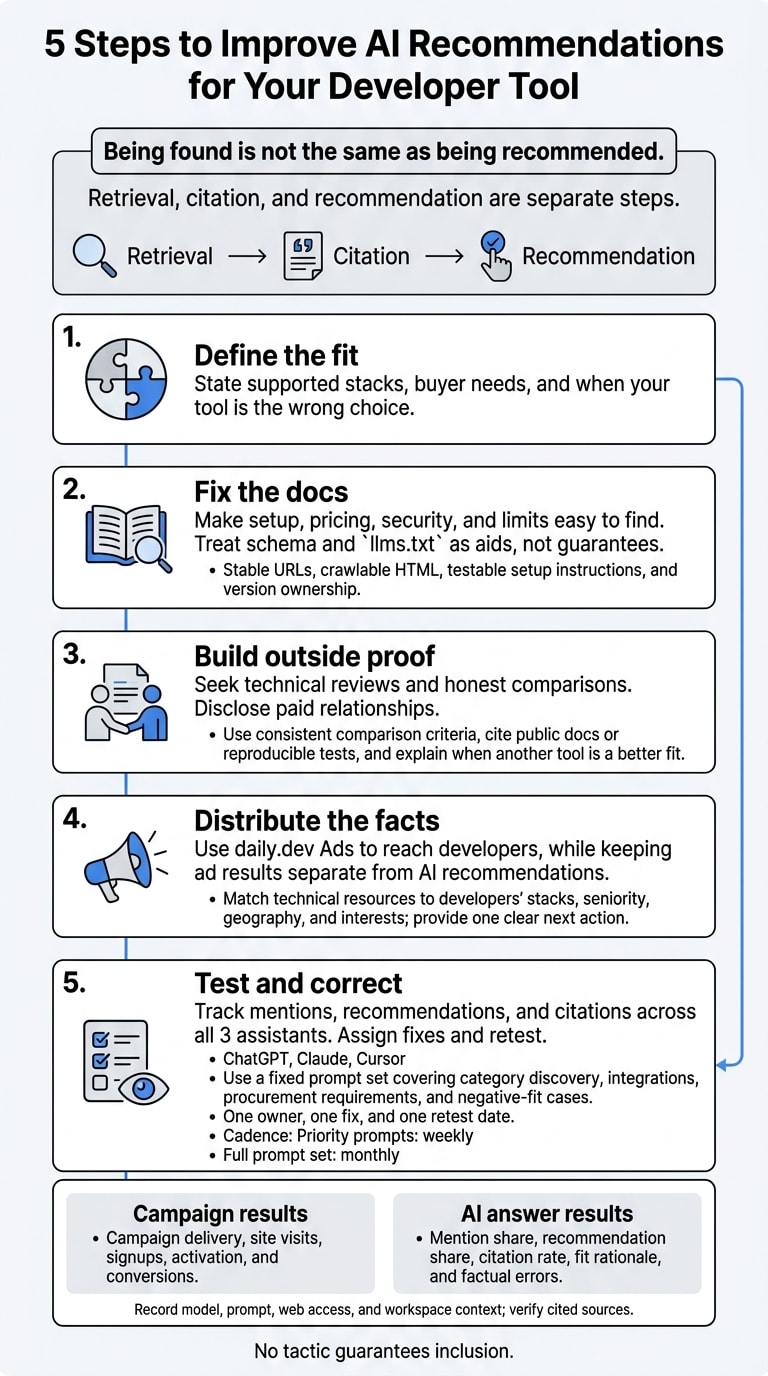
My approach covers 5 steps:
- Define the fit: State supported stacks, buyer needs, and when your tool is the wrong choice.
- Fix the docs: Make setup, pricing, security, and limits easy to find. Treat schema and
llms.txtas aids, not guarantees. - Build outside proof: Seek technical reviews and honest comparisons. Disclose paid relationships.
- Distribute the facts: Use daily.dev Ads to reach developers, while keeping ad results separate from AI recommendations.
- Test and correct: Track mentions, recommendations, and citations across all 3 assistants. Assign fixes and retest.
The rule I’d keep in mind: being found is not the same as being recommended. This is answer engine optimization (AEO) - and no tactic guarantees inclusion.
2. Keep documentation accessible and accurate
Once you’ve written the answers, make them easy for assistants to find and check. Retrieval, citation, and recommendation are separate steps: an assistant may find your documentation without citing it or recommending your tool. For every test, record web access, model version, prompt, and workspace context.
Document setup, integrations, and limitations
Publish docs at stable URLs, with core instructions in crawlable HTML. Check that assistants can reach them: test key pages while logged out, then review redirects, canonicals, robots.txt, and noindex for anything that blocks access.
Make setup instructions testable. Include required dependency versions, permissions, environment variables, commands, expected output, and cleanup steps. Clearly separate demo assumptions from production requirements, and flag likely authentication and quota failures.
Give each document an owner, test instructions before release, and record the version tested. Keep docs for older versions online, with links to migration steps and current behavior.
Use structured data and llms.txt with clear limits
Use Google’s SoftwareApplication schema only for visible, verified product facts. Match the markup to the page text and check it with the Rich Results Test. Structured data helps search systems interpret software information, but it does not guarantee indexing, citations, or recommendations.
Treat llms.txt as an optional navigation aid, not a recommendation signal in 2026. Place a concise Markdown file at /llms.txt with links to canonical setup, API, integration, security, limitations, migration, and changelog pages. Include short descriptions, and leave out tracking parameters and pages that require login. It does not replace robots.txt, and the proposal does not establish universal assistant adoption.
3. Earn independent coverage and publish comparisons
Once your docs are clear, give buyers and assistants outside sources they can check. Your site establishes product facts; independent coverage shows how those facts hold up in practice. This helps ChatGPT, Claude, and Cursor check claims beyond a single source. Third-party proof helps, but it doesn’t guarantee inclusion.
Earn tutorials, reviews, and community mentions
Focus on implementation tutorials, technical reviews, listicles, YouTube walkthroughs, dev.to posts, and Reddit threads. Choose outlets and creators with technical expertise and an audience that fits your product.
Give them a sample project, current docs, and a technical contact. Ask them to report the version tested, results, and any limits. Then let them draw their own conclusions.
Disclose payment, free access, affiliate ties, and employee involvement near the recommendation. Never frame sponsored coverage as an independent endorsement. On Reddit, follow community rules, state your affiliation, and answer technical questions. Don’t script praise or coordinate recommendations.
Compare developer tools honestly
Address the evaluation questions buyers ask in AI chats and procurement reviews. Build each comparison around one buying decision: supported stacks, managed versus self-hosted deployment, integration effort, or operational requirements.
Use the same criteria for every tool. Cite public docs or reproducible tests, distinguish measurements from opinion, and explain when another tool is a better fit.
Record the actual review date and name an owner to recheck claims after releases or pricing changes. Include known limitations and current public pricing pages instead of unsupported “best” or “fastest” claims. Paid distribution is just distribution - not proof of technical superiority or independent approval.
4. Distribute technical content with daily.dev Ads
Once third-party coverage is in place, use daily.dev Ads to put the same technical facts in front of the right developers. Track campaign engagement and AI recommendation share of voice separately. Paid reach doesn’t guarantee recommendations or inclusion in AI answers.
Choose an ad format for your content goal
Match the format to what developers need to learn and what you want them to do next. Link to a focused technical resource - not a homepage that leaves readers hunting for setup instructions.
| Content objective | daily.dev Ads format | Suitable asset | Primary metric |
|---|---|---|---|
| Drive qualified visits to a technical resource | In-Feed Native Ads | Integration guide or setup tutorial | Qualified clicks, engaged sessions, assisted conversions |
| Distribute an in-depth technical article | Sponsored Post | Technical article under your byline, with canonical republishing | Guaranteed feed impressions, read-floor commitment, reads, downstream conversions |
| Build association with a category or workflow | Engagement Ads: Branded Tags, Keyword Spotlights, Custom Upvotes, Tag Page Takeovers, Stack Placements | Category education or workflow explainer | Relevant surface exposure, interaction, branded search, direct traffic |
| Reach readers interested in a specific topic | Digest newsletter sponsorships by topic track | Short educational message linking to a hands-on guide | Delivered placements, clicks, engaged sessions, conversions |
Sponsored Post’s canonical republishing keeps the original article on your domain. Engagement Ads place your brand in context: Branded Tags connect a tool with a category, Keyword Spotlights focus on a workflow term, and Custom Upvotes add branded interaction. Tag Page Takeovers offer sustained visibility, while Stack Placements work when your tool fits a particular stack.
Target developers who fit your tool
Target developers by tech stack, seniority, geography, and interests. Send each segment to a guide that covers prerequisites, setup steps, supported technologies, limitations, and one clear next action.
Use consistent campaign parameters, then track visits, signups, and activation separately once the campaign goes live. Use the developer advertising planning hub to plan distribution and the AI-answer share-of-voice guide to keep recommendation reporting separate.
5. Measure recommendations and plan next steps
Track recommendation share of voice
After distribution, check whether assistants surface the right facts for the right prompts. Set a 2026 baseline across ChatGPT, Claude, and Cursor using a fixed prompt set. Cover category discovery, integrations, procurement requirements, and negative-fit cases. Ask when your tool should not be recommended, too.
Use share-of-voice tooling to work at scale, then manually review high-value answers. Log the exact prompt, assistant, model and mode, date, time, region, language, account state, personalization, and web search or browsing setting. Track mentions, recommendations, fit rationale, citations, and factual errors separately. Open cited URLs to check that they support the claims.
Before reporting share of voice, define what counts as a mention, recommendation, and citation. Measure mention share, recommendation share, and citation rate separately, then compare results by assistant and prompt intent. Keep campaign delivery, site conversions, and AI answer results in separate reports. Follow the guide to measuring brand share of voice in AI answers for the reporting workflow.
Assign fixes and retest recommendations
Use the results to send each fix to the right team. Product marketing handles unclear category or buyer fit. Documentation owners address missing technical facts. Developer marketing handles gaps in independent coverage. Give each issue one owner, one fix, and one retest date, along with a source URL.
Check priority prompts weekly and review the full set monthly, keeping evaluation rules unchanged. Record page updates and coverage publication dates alongside the results. Don't credit a campaign for changes without evidence of causality. When your technical content is accurate and ready to reach developers, you can discuss a daily.dev Ads campaign.
FAQs
Which AEO improvements should I prioritize first?
Make your product easy to identify on your homepage and in your documentation. Keep product details, pricing, and features clear and up to date so AI assistants can crawl and retrieve that information.
Once your site is structured for machine readability, work on getting third-party mentions on developer-focused platforms like dev.to, Reddit, and YouTube. These external signals help AI assistants connect your tool to specific technical questions.
How long should I wait to evaluate AEO results?
Compare AEO results with your established baseline over time, tracking AI visibility, favorability, and accuracy. Re-run your prompts across ChatGPT, Gemini, Perplexity, and Claude to check how citations of your brand change. Treat a change as statistically significant only when it meets a 95% confidence threshold.
For active campaigns, use share-of-voice tools to track your brand’s presence as AI models update their knowledge bases.
How can I separate daily.dev Ads results from AEO gains?
Measure each track separately. daily.dev Ads track traffic and conversions from native placements. Agent Ads rerun target prompts across major AI models, measuring changes in brand visibility, favorability, and accuracy against a baseline.
To isolate the ad’s effects, we compare the same daily.dev page with and without your ad block. We also provide logs showing which agents read which pages, so you can cross-check the results with your AEO tooling.