
Yes - but only when I match the event, the goal, and the follow-up.
If I want brand awareness, student and community hackathons can work. If I want product use, I need professional, conference, or API-first events plus hands-on activations like workshops, mentoring, judging, or sponsor challenges. Plain logo placement is usually the weakest option.
A few numbers make the tradeoff clear:
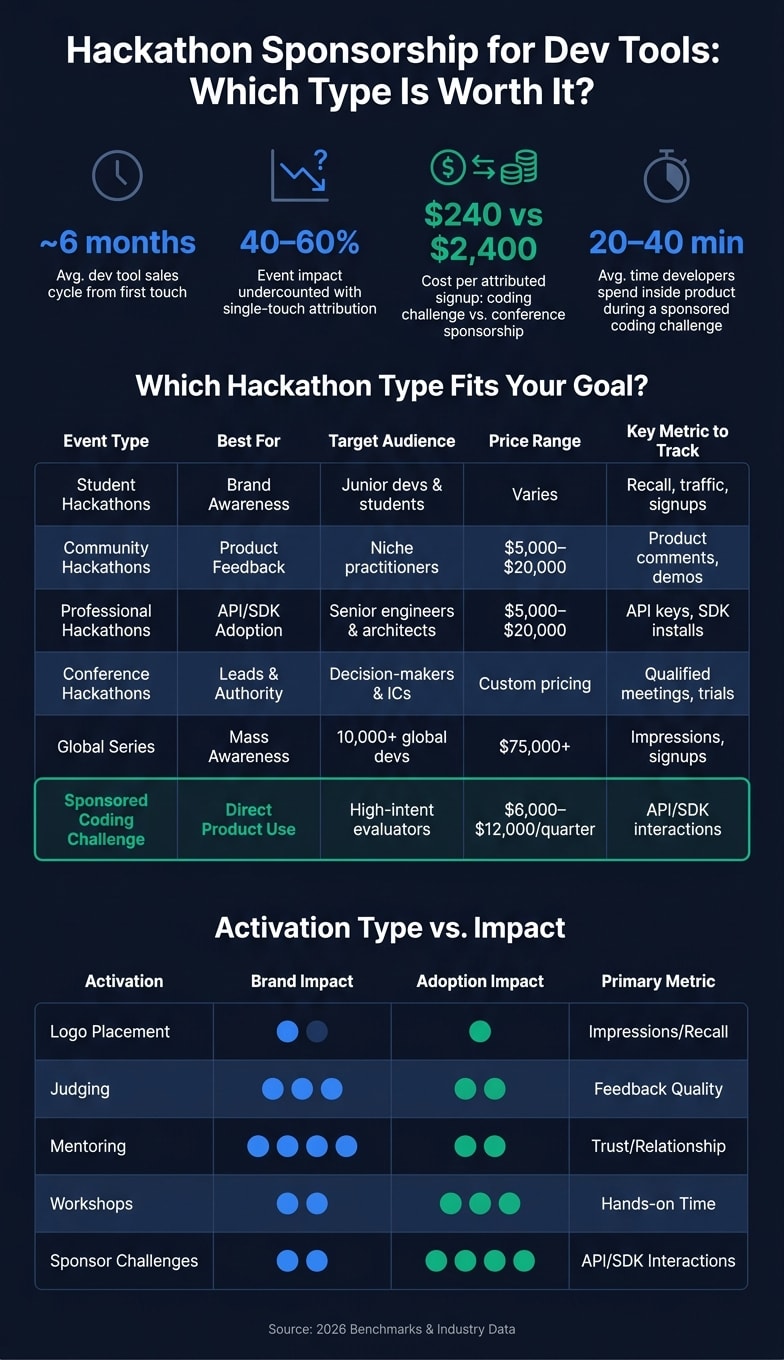
- Developer tool sales often take around 6 months from first touch to signed deal.
- Event impact is often undercounted by 40% to 60% when teams look at only one touchpoint.
- Niche/community hackathons often cost $5,000 to $20,000.
- Global series can start at $75,000+.
- Sponsored coding challenges often land around $6,000 to $12,000 per quarter.
- One 2026 benchmark cited about $240 per attributed signup for a coding challenge vs. about $2,400 for a standard conference sponsorship package.
Here’s the short version:
- Student hackathons = better for name recognition
- Community hackathons = better for product feedback
- Professional hackathons = better for API/SDK trials
- Conference hackathons = better for leads and market signal
- Logo placement alone = low action
- Mentoring, workshops, and product-based challenges = more usage and better feedback
| Option | Best For | Main Risk | What I’d Track |
|---|---|---|---|
| Student hackathons | Awareness | Hard to tie to usage | Recall, traffic, signups |
| Community hackathons | Feedback | Small reach | Product comments, demos |
| Professional hackathons | Adoption | Higher staff load | API keys, SDK installs |
| Conference hackathons | Leads | Higher cost | Qualified meetings, trials |
| Logo placement only | Visibility | Low action | Impressions |
| Workshops/challenges | Product use | Needs prep | Hands-on time, completions |
Bottom line: if I can’t support the event before, during, and after it, I’d skip the sponsorship. If I can tie it to product use and track actions like API key creation, SDK downloads, or challenge completions, it can be worth the spend.
Where hackathon sponsorship falls short for dev tools
Most hackathon sponsorships buy visibility, not product use. Your logo on a banner or your name on an opening slide tends to fade into the background. For most developers, logo placement is just noise unless it points to something they can try right now. On its own, visibility rarely turns into usage.
That matters because visibility is easy to count and hard to turn into something useful. This is where many sponsors get stuck. They leave with badge scans and impression estimates, but no clear sign that anyone actually tested the product. Single-touch attribution often undercounts event impact by 40% to 60% . Without shared behavior-based metrics, like API key generation or SDK downloads, ROI stays blurry.
Student and professional hackathons produce different results
Student events usually lean more toward awareness. Professional and conference events are more likely to lead to technical feedback and actual usage. So the playbook should shift with the audience. The activation plan, the people you send, and the metrics you watch all need to match who's in the room.
That difference is why sponsorship only works when the event lines up with the goal. If the fit is off, sponsorship becomes waste. If the fit is right, it can turn into leverage.
When hackathon sponsorship is actually worth the investment
If logo placement rarely drives usage, the next step is simple: figure out which kind of hackathon fits your goal.
That’s the part many teams miss.
A hackathon can help with brand reach, product trials, or hands-on feedback. But those outcomes usually come from different event types, different activations, and different ways of measuring success. If you want awareness, one format works better. If you want developers to try your API or SDK, another tends to do the job.
Brand goals: student and community events are a better fit
If your goal is long-term familiarity with early-career developers, student hackathons are a strong match. They put your company in front of junior developers while they’re still forming opinions about the tools and brands they’ll remember later.
Community hackathons work well when you want to reach a more specific group. These events often bring in niche practitioners who can give direct technical feedback and share how your product lands with a focused audience.
Adoption goals: professional, API-focused, and conference hackathons are a better fit
When the goal is product adoption, professional, API-focused, and conference hackathons tend to be the better bet. These events usually attract senior engineers, architects, and decision-makers who can judge whether your API or SDK is worth using in actual work.
That changes the value of the sponsorship. Instead of broad exposure, you’re getting people who can test integration, ask hard questions, and point out friction you may not catch on your own. In some cases, they can also become qualified leads.
| Event Type | Primary Goal | Target Audience | Key Outcome |
|---|---|---|---|
| Student Hackathons | Brand Awareness | Junior devs / students | Long-term familiarity & goodwill |
| Community Hackathons | Technical Insight | Niche practitioners | Technical feedback & user insights |
| Professional Hackathons | Product Adoption | Senior engineers / architects | API/SDK integration & qualified leads |
| Conference Hackathons | Adoption & Authority | Decision-makers & ICs | High-value leads & ecosystem signal |
Once the event type is clear, the next question is cost.
How daily.dev Ads can extend hackathon impact beyond the event
Most sponsors put all their attention on the event itself and miss what happens before and after. That’s a mistake. A lot of the momentum comes from the surrounding weeks, not just the hours people spend building.
Use daily.dev Ads to promote workshops, API challenges, or follow-up content to a relevant developer audience before and after the event. That can help more people show up prepared, keep your message in front of them after the hackathon ends, and give the sponsorship a longer shelf life.
That matters most when you want the event to keep working after the sponsorship ends.
Hackathon sponsorship costs: what public pricing actually shows
Hackathon sponsorship usually comes in tiers. Pay more, and you generally get more access, more exclusivity, and more ways to show up at the event. But the sticker price only tells part of the story. What matters is whether the event gets you the outcome you want.
Student hackathon pricing: tiered packages, but costs vary widely
Student and collegiate hackathons often sell sponsorship packages that bundle logo placement, booth space, workshops, and mentor access. That sounds neat on paper, but pricing can swing a lot depending on the event, the school, and the market.
Global series have some public price anchors; major conference hackathons require custom quotes
Public pricing for global hackathon series is pretty limited. One of the clearer reference points comes from AngelHack, which has cited packages starting at $75,000 and up, with keynote slots and naming rights included.
At the other end of the market, niche and community hackathons aimed at senior or specialized developers often fall in the $5,000 to $20,000 range . Sponsored coding challenges built to drive direct product use are often priced at $6,000–$12,000 per quarter .
For major conference hackathons, public rates usually aren't posted. Pricing tends to be custom and depends on things like exclusivity, audience access, and the scope of the activation.
Use these numbers as a rough map, not a quote sheet.
| Event Type | Typical Audience | Published Price Range |
|---|---|---|
| Student/Collegiate | Junior devs, students | Varies by event and market |
| Niche/Community | Senior or specialized devs | $5,000–$20,000 |
| Global Series | 10,000+ global devs | $75,000 and up (e.g., AngelHack) |
| Sponsored Coding Challenge | High-intent evaluators | $6,000–$12,000/quarter |
The next question is whether those costs buy meaningful engagement or just logo placement.
Better alternatives to buying logo placement
If you're already putting money into sponsorships, the next step is simple: where does that spend lead to actual developer action? Logo placement is the easiest box to check. But most of the time, it doesn't get people to click, test, build, or ship. If your goal is product use, put your budget into participation instead of passive visibility.
Judging and mentoring build trust and generate better feedback
Judging and mentoring place your team next to people who are actively building. That's where you learn the stuff that matters: where your product fits, where it breaks, and what developers wish it did instead. That kind of contact is hard to get from a banner or a logo on a slide.
Mentoring also tends to stick in people's minds. Developers usually remember the person who helped them get unstuck, not the company logo they saw in the corner of a room. And from a budget angle, both judging and mentoring are often low-cost add-ons to a sponsorship package, which gives them a lot of leverage for the price.
If you need deeper product use, it helps to move past casual access and into something more structured, like workshops or product-based challenges.
Workshops, API challenges, and prize design drive deeper product use
Workshops and sponsored coding challenges push developers past awareness and into actual use. That's a big jump. It's one thing for someone to know your name. It's another for them to open your docs, call your API, and spend time inside the product.
Sponsored coding challenges can keep developers in the product for 20–40 minutes . That's usually enough time for someone to figure out whether the tool is useful, frustrating, or worth a second look.
The cost gap can be hard to ignore too. In one 2026 benchmark for data infrastructure tools, a sponsored coding challenge cost about $240 per attributed signup, compared with about $2,400 for a standard conference sponsorship package .
Not all activations work the same way, so compare them by outcome, not by logo space.
| Activation Type | Likely Brand Impact | Likely Adoption Impact | Primary Metric |
|---|---|---|---|
| Logo Placement | Low/Medium | Low | Impressions/Recall |
| Judging | High | Medium | Feedback Quality |
| Mentoring | Very High | Medium | Trust/Relationship |
| Workshops | Medium | High | Hands-on Time |
| Sponsor Challenges | Medium | Very High | API/SDK Interactions |
If you run a challenge, make it product-dependent. The best challenge setups require teams to use the product in a real way, not just mention it to qualify for a prize.
Conclusion: a simple yes-or-no framework for hackathon sponsorship
Hackathon sponsorship is worth it only when the activation matches the goal. Use logo placement for reach. Use judging, mentoring, workshops, or sponsor challenges for feedback, trust, and adoption.
FAQs
how much does hackathon sponsorship cost?
Hackathon sponsorship costs can be all over the map. It mostly comes down to the package, the amount of visibility you want, and how much space you want at the event.
Here’s the usual range:
- Entry-level packages: $2,500 to $5,000
- Mid-tier packages: $9,000 to $15,000
- Gold sponsorships: around $25,000
- Platinum or title sponsorships: usually start at $50,000+
Some event-wide sponsorship programs fall between $20,000 and $100,000.
You may also need to budget for add-ons. For example, a workshop can cost an extra $4,000, while a bug challenge may add $5,000.
Which hackathon type fits my goal?
It depends on what you want from the event.
If your goal is product adoption and deeper use of your product, put your money into hackathons with hands-on participation. Think sponsored coding challenges or technical workshops where developers actually build with your API or SDK. That kind of setting puts your product in people’s hands, which is often where interest turns into usage.
If you’re after brand awareness, a lower-tier sponsorship can do the job. But if you want to shape enterprise buying decisions, aim for events that draw architects and engineering leaders. In that case, look for sponsorship tiers that include speaking slots and attendee data for lead generation.
How do I measure hackathon ROI?
Measure hackathon ROI with behavioral data and long-term financial impact, not just headcount.
A simple way to do this is to calculate CPL by dividing your total investment, including sponsorship, travel, and staff time, by actions that show real interest, such as:
- API tests
- SDK downloads
- Account signups
For revenue tracking, use a multi-touch attribution model that gives 60% of the credit to last-touch and 40% to first-touch. That split gives you a clearer picture of what pushed someone to act first and what finally got them over the line.
It also helps to add NPS surveys. Numbers tell you what people did. NPS helps you understand how they felt about your brand and whether developers are likely to stick around and keep using what you built.