

If I were planning developer marketing in 2026, I would not treat geography as a minor setting. I would use it to decide where to spend, where to test first, and where English-only messaging will fall short.
Here’s the short version:
- North America and Western Europe are still key for enterprise pipeline
- India, Latin America, and Southeast Asia are where developer growth is strongest
- SlashData helps me estimate market size
- GitHub Octoverse helps me spot country-level growth
- India can often support English-first campaigns
- Brazil, Mexico, Indonesia, and Vietnam usually need more local language support
- Timing, language, and buyer intent should change by region
A few numbers make the point fast:
- Global developer population: about 47 million
- India GitHub growth: 28% YoY
- Brazil GitHub growth: 27% YoY
- South Asia developer population: 4 million to 7.5 million from 2022 to 2025
- Latin America developer population: 1.7 million to 3.4 million from 2022 to 2025
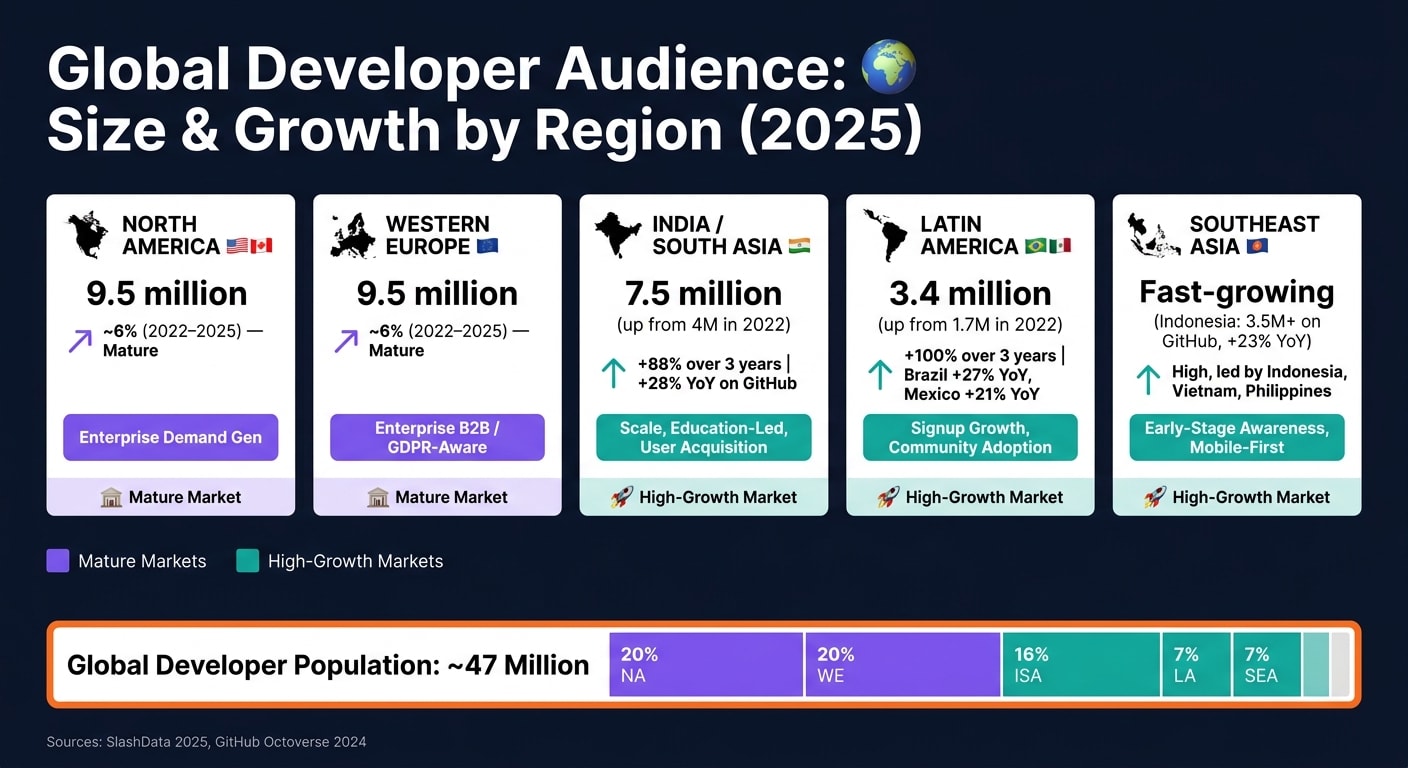
Quick comparison
| Region | Main role in a media plan | What I would do first |
|---|---|---|
| North America | Enterprise demand gen | Focus on security, ROI, and product depth |
| Western Europe | Enterprise B2B | Keep privacy and compliance in view |
| India / South Asia | Scale and education-led growth | Start in English, then localize as reach expands |
| Latin America | Signup growth and community | Split Brazil from Spanish-speaking markets |
| Southeast Asia | Early market building | Localize onboarding and learning content |
Put simply: size tells me where the audience is, and growth tells me where momentum is. That is the core idea behind this map.
The global developer map: population size and growth by region
SlashData shows where developers are clustered. GitHub Octoverse shows where activity is picking up speed.
Regional developer population shares from SlashData

SlashData's survey-based estimates give one of the clearest public snapshots of where developer populations are concentrated by region. Its regional view groups developers into North America, Western Europe and Israel, South Asia, Greater China, East Asia, Latin America, and Middle East and Africa.
These are population share estimates, not exact headcounts. So don't treat them like a precise audience total. They're better used to shape budget splits at the start. In other words, this data helps set a baseline for budget allocation before you fine-tune by country.
Regional growth signals from GitHub Octoverse

GitHub Octoverse adds a different layer: growth momentum. The strongest regional growth signals are coming from South Asia, Latin America, and Southeast Asia.
That matters because growth often points to where earlier moves can pay off. Use GitHub growth as a cue for earlier entry and heavier investment. In many high-growth regions, tighter geo segments, simpler English copy, and lower-cost testing tend to work well before a broader push.
In practice, share data sets the budget frame, while growth data shows where to test next. India, Latin America, and Southeast Asia pair growth with strong targeting upside. At the same time, mature regions still matter for enterprise reach. From there, the next step is deciding which regions need localization and which can scale with English-first creative.
Regional priorities for developer marketers: India, Latin America, Southeast Asia, and mature markets
Geography should shape where you localize, where you run early tests, and where you push for enterprise pipeline. The table below turns those market signals into campaign priorities.
| Region | Developer Population | Growth Signal | Primary Campaign Fit |
|---|---|---|---|
| North America | ~9.5 million | Mature, about 6% growth from 2022 to 2025 | Enterprise pipeline |
| Western Europe | ~9.5 million | Mature, about 6% growth from 2022 to 2025 | Enterprise B2B, GDPR-aware campaigns |
| India / South Asia | 7.5 million | Grew from about 4 million in 2022 to 7.5 million in 2025 | Scale, user acquisition, education-led |
| Latin America | 3.4 million | Grew from about 1.7 million in 2022 to 3.4 million in 2025 | Cross-border collaboration |
| Southeast Asia | Fast-growing, led by Indonesia | Requires localization | Early-stage, community building |
India and South Asia: scale, growth, and English-first outreach
Start with India and South Asia. According to SlashData, South Asia's developer population grew from about 4 million in 2022 to 7.5 million in 2025. That's roughly 88% growth in three years. GitHub Octoverse 2024 adds another signal: India alone has more than 17 million developers on GitHub, up 28% year over year.
For campaign planning, this matters a lot. English-first creative can work well in India and much of South Asia because English is common in higher education, software engineering, and day-to-day work communication. That means you can often launch in English first, then localize with care into Hindi or other regional languages when you want broader reach across the ecosystem or stronger traction with early-career developers.
Timing matters too. India Standard Time is UTC+5:30, so U.S.-based teams should schedule ad delivery and email sends for late morning through early evening IST. On messaging, themes like career growth, remote work access, certifications, and productivity tools tend to line up well with what this audience is looking for.
Latin America and Southeast Asia: fast-growth regions with localization needs
Then there are the fast-growth markets where localization can't be treated like a box to check. Latin America's developer base doubled from 1.7 million to 3.4 million between 2022 and 2025. GitHub Octoverse 2024 shows the country-level picture in more detail:
- Brazil has more than 5.4 million GitHub developers, growing 27% year over year.
- Mexico has more than 1.9 million, growing 21%.
- Colombia has more than 1 million, growing 25%.
- Argentina has more than 1.1 million, growing 22%.
Southeast Asia shows similar momentum, with Indonesia leading the way at more than 3.5 million GitHub developers and 23% year-over-year growth in 2024.
The big takeaway is simple: these regions need real localization, not plain translation. In Latin America, Portuguese is a must for Brazil, and Spanish should match the country. Mexican Spanish and Argentine Spanish don't sound the same, and that shows up in tone, phrasing, and word choice. In Southeast Asia, Bahasa Indonesia and Vietnamese matter most for learning content and onboarding flows.
There's also a practical edge for U.S.-based teams working in Latin America. Many major cities are only 1–3 hours away from U.S. time zones. That makes live webinars, office hours, and product demos much easier to run than similar programs across APAC.
North America and Western Europe: mature markets for enterprise-focused campaigns
When the goal is enterprise pipeline, the map looks different. SlashData estimates about 9.5 million developers in North America and 9.5 million in Western Europe, which makes them the two biggest established developer communities in the world. Growth is slower here, but enterprise concentration is high. In the Q1 2024 Developer Nation survey, Western Europe and Israel accounted for 33% of enterprise developers, compared with 31% in North America.
That makes these regions a strong fit for B2B campaigns tied to multi-stakeholder buying cycles, high-ticket products, and more specialized roles such as DevOps, platform engineering, and security. Put plainly, if you're selling into larger companies with bigger budgets and longer sales cycles, North America and Western Europe are usually where enterprise-focused campaigns have the best fit.
Turning the audience map into a media plan with daily.dev Ads

Build regional segments and layer on developer attributes
Geography tells you where to show up. Attributes tell you who to reach.
Once you've picked your priority regions, the next step is to turn that map into actual audience segments, budget buckets, and delivery rules. With daily.dev Ads, you can pair regional targeting with developer-specific attributes like programming interests, tools, seniority, and language preferences. That gives you segments based on both location and role.
For example, if you're running a cloud infrastructure campaign in India and Southeast Asia, you'll usually get better results by layering in DevOps or Kubernetes interest instead of going after every developer in those markets. That tighter setup cuts waste and makes the ad feel more relevant.
A simple rule works well here: start broad at the regional level, then narrow the audience with attributes that line up with your product use case and buyer profile. And when volume supports it, split countries out instead of lumping whole regions together. Brazil and Mexico shouldn't always sit in the same bucket. The same goes for Indonesia and Vietnam.
Allocate budget by market maturity, growth, and campaign goal
There isn't one budget split that works for every campaign. The better move is to use market growth and maturity to decide where each dollar goes.
| Region | Growth | Suggested Budget Weight | Campaign Objective Fit |
|---|---|---|---|
| North America | Mature, slower growth | 25–35% | Enterprise demand gen |
| Western Europe | Mature, slower growth | 25–30% | Enterprise B2B, product evaluation |
| India / South Asia | High growth, +88% from 2022 to 2025 | 20–25% | Scale, awareness, developer education |
| Latin America | High growth | 10–15% | Signup generation, community adoption |
| Southeast Asia | High growth, led by Indonesia, Vietnam, the Philippines, and Singapore | 5–10% | Early-stage awareness, mobile-first reach |
Think of it this way: mature markets like North America and Western Europe are often better suited for enterprise demand gen and product evaluation. High-growth regions like India / South Asia, Latin America, and Southeast Asia are often better for scale, awareness, education, and signup growth.
Match delivery timing, messaging, and creative to local conditions
After budget allocation, fine-tune delivery around how people in each market actually behave.
A single UTC-based schedule sounds neat on paper, but in practice it misses peak engagement windows across most regions. Run separate schedules by region instead. If the campaign spans multiple markets, split dayparting rules for APAC and AMER so ads show up at the right times.
Messaging also needs to match market conditions. In mature markets, buyers tend to care more about enterprise outcomes like security, scalability, integration depth, and ROI. In high-growth markets, practical value tends to land better: ease of adoption, developer productivity, and fast time to value.
Localization matters too, but this doesn't always mean rewriting everything from scratch. In many cases, a localized headline, proof point, and CTA will do more than a full translation with generic wording. English-first creative can work in parts of India and Southeast Asia. Latin America is different. There, ads, landing pages, and email follow-up should be in Spanish or Portuguese.
Conclusion: a geography framework for developer campaigns
Geography changes who you reach, not just how many people you reach. That’s why SlashData and GitHub Octoverse serve two different jobs in planning. SlashData helps size regions. GitHub Octoverse shows activity and growth. Put them together, and the split becomes pretty clear: use mature markets for revenue, and use fast-growth regions for expansion.
Keep mature markets focused on enterprise revenue. Then move growth spend toward India, Latin America, and Southeast Asia. North America and Western Europe still account for about 20% each of the global developer population and 27% to 30% of enterprise developers, while South Asia and Latin America have nearly doubled in recent years.
After you pick the market, localization becomes the next filter. English-first creative can work in India and much of South Asia. But Latin America and Southeast Asia need local language, examples, and context. Not a huge rewrite. Just enough regional fit to match tone, vocabulary, and local working hours.
That turns into a pretty direct campaign setup on daily.dev Ads:
- Build regional segments
- Layer in developer attributes
- Weight spend based on market maturity and growth
- Match timing and messaging to local working hours
Let the data decide where the budget goes.
FAQs
How should I prioritize countries within each region?
Prioritize the biggest, fastest-growing developer markets first, then expand into other high-potential countries based on performance.
Start with the United States, China, and India. From there, move into Europe, Southeast Asia, and Latin America to add growth and market mix.
Within each region, begin with broad targeting, then narrow down by country based on what the data shows. Focus more budget and effort on countries where CTR is above 2% and conversion rates are above 5%.
When should I localize instead of using English-first messaging?
Prioritize localization if you want to build long-term trust, improve conversion, and connect better with people in specific regions.
An English-first approach can still work in markets with strong English proficiency or when budgets are tight. But in places like Japan or Brazil, localization often matters a lot more. Developers in those markets often expect technical content in their native language.
A simple tiered approach can work well here: localize pricing and onboarding first, then use machine translation for documentation.
How do I split budget between mature and high-growth markets?
Prioritize audience concentration, not just cheaper ads.
In mature markets like North America and Western Europe, CPCs often land between $2.00 and $5.00. In high-growth regions like APAC and LATAM, they often fall between $0.50 and $2.00.
A common starting budget split looks like this:
- 40% to APAC
- 30% to EMEA
- 20% to LATAM
- 10% to smaller markets
Start with geo-fenced tests. Then move more budget to the regions that perform best.