




To win developer-tool clients in 2026, I’d start with a tested product review, a clear activation goal, and a small first project. Your pitch should show how you’ll help developers use the product - not just click an ad.
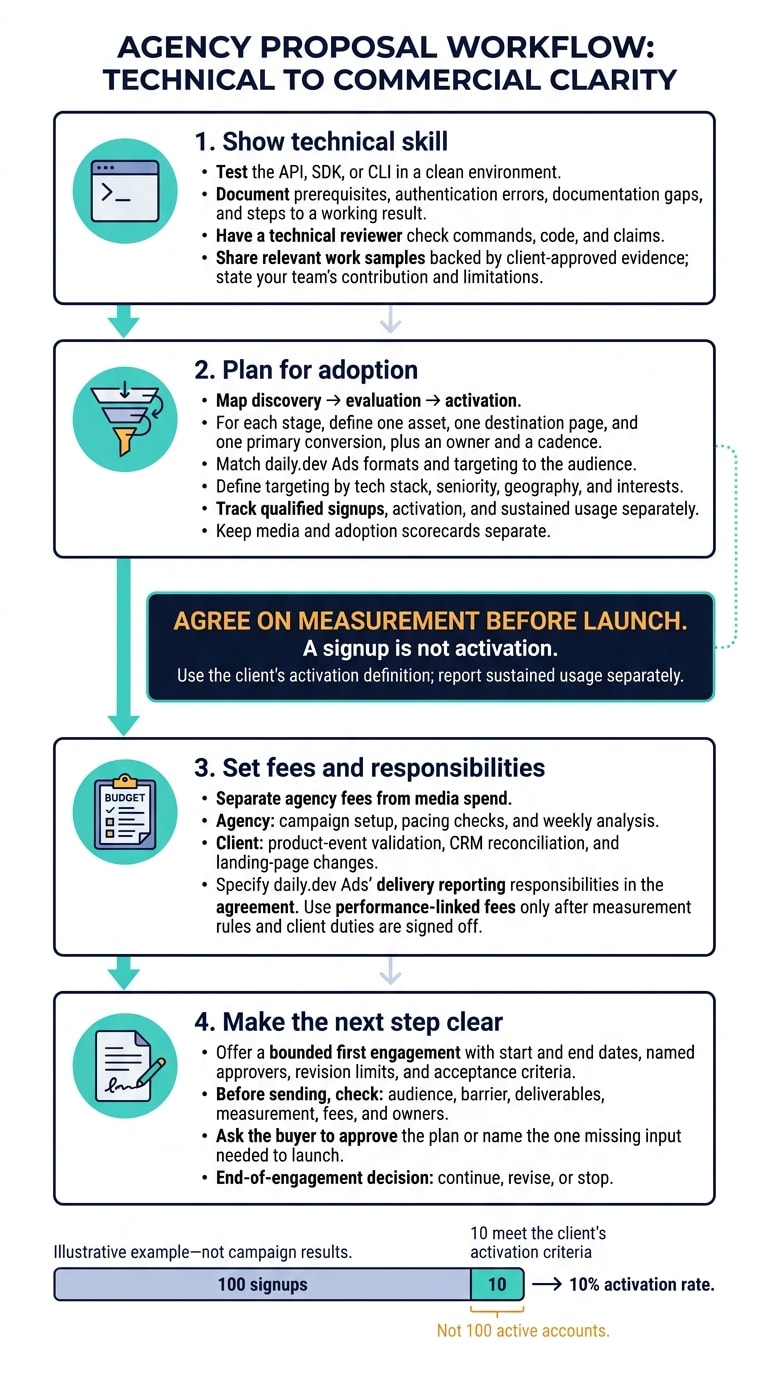
I’d build the proposal around four steps:
- Show technical skill: Test the API, SDK, or CLI, and share work samples backed by developer marketing case studies and client-approved results.
- Plan for adoption: Match daily.dev Ads formats and targeting to the audience. Track signups, activation, and repeat usage separately.
- Set fees and responsibilities: Separate agency fees from media spend. Name who handles delivery, tracking, technical checks, and approvals.
- Make the next step clear: Offer a bounded first engagement with deadlines, acceptance criteria, and a decision to continue, revise, or stop.
My rule: agree on measurement before launch. If a campaign brings in 100 signups but only 10 meet the client’s activation criteria, that’s a 10% activation rate - not 100 active accounts.
1. Show technical knowledge and proven results
Review the product, audience and adoption path
Start with a technical review, not a generic pitch. Test the API, SDK, or CLI in a clean environment. Document prerequisites, authentication errors, gaps in the docs, and the steps needed to get a working result.
Before delivery, have a technical reviewer check commands, code, and claims. This shows the buyer you understand the developer’s experience - and gives you material for the case studies below.
Build case studies around qualified adoption
Build each case study around the product, audience, adoption barrier, your agency’s contribution, measurement period, results, and limitations. Back it up with client-approved evidence and technical artifacts, such as a tested tutorial or integration walkthrough.
Report engagement, signups, activation, and pipeline separately. A signup is not activation. Use the client’s definition of activation, and report sustained usage as a separate measure. Explain attribution limits rather than treating every campaign conversion as agency-generated.
Show relevant work and technical expertise
Pick work samples that match the prospect’s technical category and adoption barrier. Include the deliverable, your team’s exact contribution, the reviewer’s relevant expertise, and any client-approved outcome.
If you don’t have direct experience, share a tested product review or sample instead. Be clear about what it demonstrates; don’t imply a client track record you don’t have.
2. Build a measurable campaign plan
Once you’ve mapped the product and audience, use that knowledge to choose channels and assign reporting roles.
Build a campaign plan the agency can explain and defend to the client. For each stage - discovery, evaluation, and activation - define one asset, one destination page, and one primary conversion, plus an owner and a cadence. daily.dev Ads sends traffic to those pages; product-event reporting shows what happens after the click.
Match ad formats to campaign goals
| Campaign job | Format to consider | Deliverable and measurement |
|---|---|---|
| Introduce a product or technical use case | In-Feed Native Ads | Deliver concise ad copy and visuals linked to a relevant landing page. Track clicks and qualified signups separately. |
| Support technical evaluation | Sponsored Post | Deliver a technical article or tutorial with guaranteed feed impressions, a read-floor commitment, and canonical republishing. Measure delivery, reads, and product actions separately. |
| Build launch or topic visibility | Engagement Ads | Deliver launch- or topic-focused ad copy and visuals. Track delivery and format-specific engagement against the awareness goal. |
| Reach a topic-focused inbox audience | Digest newsletter sponsorships by topic track | Deliver a relevant educational or evaluation resource. Track clicks, qualified visits, and downstream conversions. |
For Engagement Ads, choose Branded Tags, Keyword Spotlights, Custom Upvotes, Tag Page Takeovers, or Stack Placements based on the visibility goal. Confirm implementation details before committing to scope.
With the format selected, settle the audience, conversion event, and reporting responsibilities before launch.
Set targeting, conversion events and reporting roles
Define targeting by tech stack, seniority, geography, and interests. Start with the people most likely to use the product. Agree on one primary conversion and what counts as a qualified signup. Use consistent tracking parameters across formats, audiences, ad versions, and landing pages.
Give the agency ownership of campaign setup, pacing checks, and weekly analysis. The client should own product-event validation, CRM reconciliation, and landing-page changes. Specify daily.dev Ads’ delivery reporting responsibilities in the agreement.
Review the daily.dev Ads pixel with engineering and privacy reviewers to address consent, data handling, and regional requirements. Document attribution windows, click-through versus view-through reporting, and tracking gaps.
Keep media and adoption scorecards separate. Report impressions, reads where applicable, clicks, and CTR alongside qualified signups, activation, and cost per activated account. Review results weekly: weak clicks call for tests of ad copy, visuals, or audiences; weak signups call for landing-page fixes; and weak activation calls for an onboarding review. Change one primary variable at a time.
3. Define agency fees and delivery roles
Once measurement is set, list agency fees and media spend separately. The media line should cover approved daily.dev Ads spend so buyers can see exactly what they’re paying for. Define delivery roles apart from the media budget.
Choose an agency fee model
Choose a model based on how fixed the scope is, how mature the measurement setup is, and how much client coordination the work needs.
| Fee model | When to use | Best fit |
|---|---|---|
| Fixed-scope project | Deliverables are clear and measurement is straightforward | Early-stage teams testing a channel |
| Monthly retainer | Recurring work needs regular support and coordination | Established teams with recurring needs |
| Performance-linked fee | The funnel is stable and outcomes can be reliably attributed | Established companies with reliable tracking and sales operations |
| Media-management fee | Spend and execution needs are defined | Teams with an approved media budget needing specialist execution |
| Hybrid engagement | Fixed deliverables and outcome-linked work have defined measurement rules | Teams seeking delivery certainty and outcome alignment |
Use performance-linked fees only after measurement rules and client duties are signed off. That includes the conversion event, attribution window, and payment trigger. Spell out what happens if tracking fails, onboarding changes, or sales follow-up stalls. Use a hybrid model only when measurement rules are already defined.
With pricing agreed, keep the first engagement narrow.
Assign responsibilities and scope the first engagement
The first engagement should prove fit before a larger commitment. Set it out in a bounded statement of work with start and end dates, named approvers, revision limits, and acceptance criteria.
Specify what the client will receive: the brief, design and copy assets, technical review, launch checklist, weekly or biweekly status updates, final recap, and next-step recommendations. Record the approver, deadline, and dependencies for each deliverable. Confirm which execution tasks the daily.dev Ads team handles so the agency charges for separate work.
Require client technical approval for code examples, SDK names, compatibility claims, security language, and documentation links. Name the client owners responsible for legal and privacy approval, customer-logo permissions, and data-use decisions. Keep an approval history. Require written change orders for new deliverables, major revisions, or budget changes.
Set escalation rules that state who responds, by when, and what pauses work. Schedule an end-of-engagement review covering scope, budget, delivery metrics, business outcomes, and client follow-through. Use that review to decide whether to continue, revise, or stop.
4. End with a clear proposal and next step
With the plan, metrics, and roles set, close with a proposal the buyer can approve without delay. Start with one sentence covering the developer audience, adoption barrier, campaign approach, and outcome. Show how the campaign will move developers from their first visit to activation.
Before sending, check six details: audience, barrier, deliverables, measurement, fees, and owners.
If compatibility blocks adoption, tie the integration guide to documentation visits and the agreed activation event.
Then ask the buyer to approve the plan or name the one missing input needed to launch.
Book a conversation with daily.dev Ads to confirm audience fit, format, timing, and scope before launch.
FAQs
How can my agency prove expertise without devtool clients?
Lead with how you work and what you know technically. Share content written or reviewed by engineers, include runnable code, and show that you understand the channels developers use to find and share information. Focus on product metrics like activation and SDK installs, not vanity metrics like impressions.
Don’t have devtool clients yet? Use case studies from other complex technical sectors. Or audit a prospect’s documentation and content, then offer an engineer-backed critique with clear steps they can take.
Which activation event should we track for a developer tool?
In 2026, track signups, trials, and activations attributed to the placement. Put time to first API call, SDK installs, and docs engagement ahead of impressions or click-through rates.
For daily.dev Ads, install the conversion pixel before your first impression to track outcomes, including view-through attribution. Use incrementality holdouts to check whether the ads drove additional results - not just conversions reported by the platform.
When should we scale a daily.dev Ads pilot?
Scale a daily.dev Ads pilot when pixel-based attribution sets a clear conversion benchmark, your messaging connects with a specific developer audience, and signups or activations stay consistent and repeatable - not just impressions or clicks.
Before increasing your budget or reach, check that your conversion pixel tracks full-funnel performance, your targeting delivers reliable results, and your ad content connects with that audience. Agencies may also qualify for partner-program bonus credits and free slots to help protect margins.