

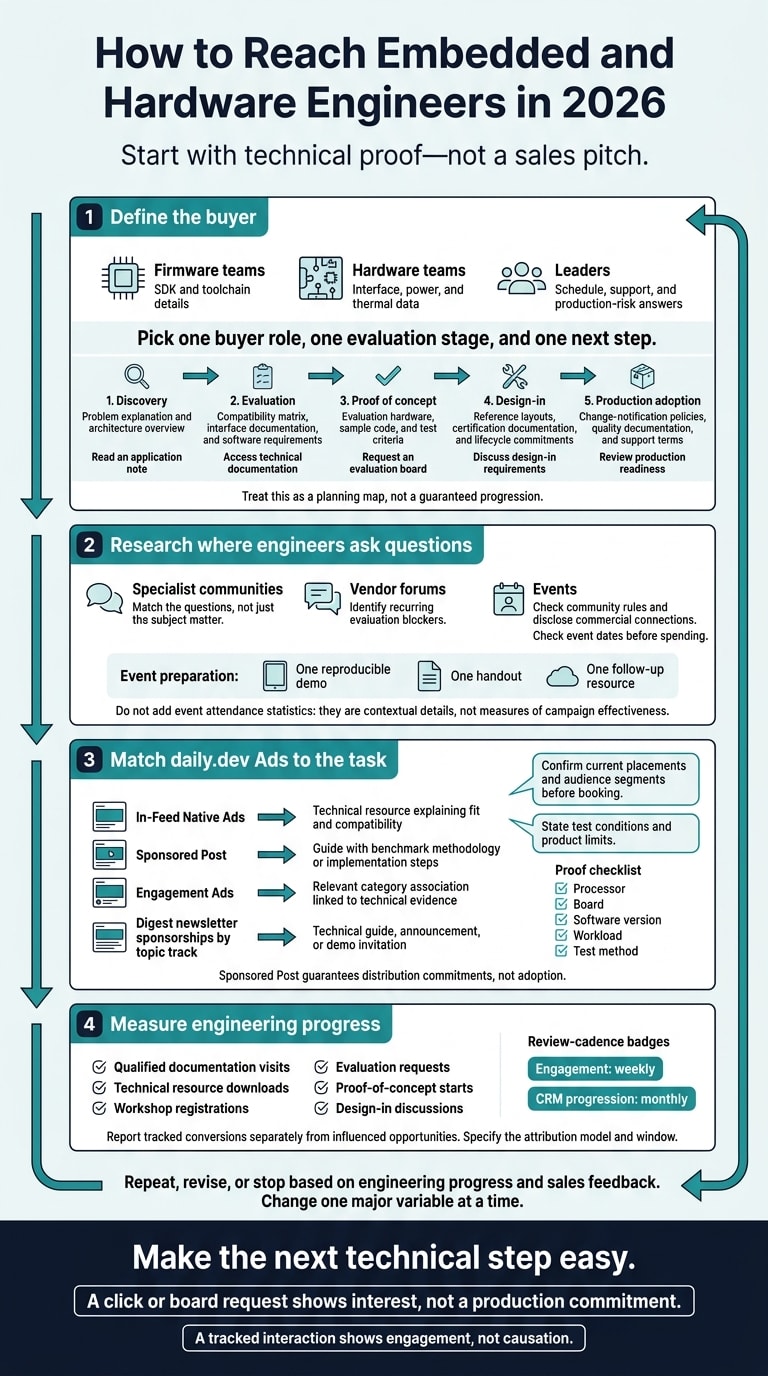
To reach embedded and hardware engineers in 2026, I’d start with technical proof - not a sales pitch. Pick one buyer role, one evaluation stage, and one next step, such as reading documentation or requesting an evaluation board.
Here’s how I’d build the plan:
- Define the buyer. Firmware teams need SDK and toolchain details; hardware teams need interface, power, and thermal data; leaders need schedule, support, and production-risk answers.
- Research where engineers ask questions. Use specialist communities, vendor forums, and events to learn what blocks evaluation. Check event dates before spending.
- Match daily.dev Ads to the task. Choose a format and audience that fit your technical guide, benchmark, reference design, or demo. State test conditions and product limits.
- Measure engineering progress. Track documentation visits, evaluation requests, proof-of-concept starts, and design-in discussions separately. Review engagement weekly and CRM progress monthly.
My rule: make the next technical step easy. A click or board request shows interest, not a production commitment.
1. Define your audience and evaluation stage
Use your audience and their evaluation stage to guide every channel choice that follows.
Separate firmware, hardware, and leadership roles
Each role needs different proof. Firmware developers review SDKs, APIs, drivers, debugging tools, memory use, and integration effort. Electrical and hardware engineers check schematics, interfaces, thermal behavior, and manufacturability. Systems architects examine dependencies and how failures are contained.
Engineering managers weigh staffing, schedules, support, and production risk. A staff engineer may decide whether a product fits, even if someone else approves the spending. These differences shape the proof each campaign should present.
Include the application area in each profile: industrial controls, robotics, automotive, or edge AI. Each calls for different evidence.
Identify the evidence engineers need
Build an evidence checklist covering architecture compatibility, interfaces, software support, certification status, component availability, and supply continuity. Label anything missing or unverified. Distinguish completed certifications from pending ones. For every performance claim, state the processor, board, software version, workload, and test method.
| Stage | Evidence | Next action |
|---|---|---|
| Discovery | Problem explanation and architecture overview | Read an application note |
| Evaluation | Compatibility matrix, interface documentation, and software requirements | Access technical documentation |
| Proof of concept | Evaluation hardware, sample code, and test criteria | Request an evaluation board |
| Design-in | Reference layouts, certification documentation, and lifecycle commitments | Discuss design-in requirements |
| Production adoption | Change-notification policies, quality documentation, and support terms | Review production readiness |
Before offering a proof of concept, confirm the target architecture, required interfaces, engineering owner, success criteria, and validation timeline. Spell out what your team provides and what the buyer must supply. An evaluation-board request shows hands-on interest - not a production commitment.
Record each segment’s role, application, stage, evidence gap, next action, and follow-up owner. Have a technical subject-matter expert review the profile before launch. Then use it to choose channels where these buyers already spend time and communities that can validate the proof they need. For more on reaching these technical audiences, explore our developer marketing resources.
2. Research technical communities and events
Study specialist media and vendor forums
Review Hackaday, Embedded.fm, EEVblog, and Adafruit to see which communities focus on experimentation, tradeoffs, measurement, or project documentation. Connect each source to discovery, evaluation, or proof-of-concept questions. Read comments and questions to learn whether readers want project ideas or help putting them into practice.
Match the questions, not just the subject matter. Record each source’s recurring problems, contributor roles, geography, technical depth, and content format. Check vendor forums and documentation hubs for repeated questions about drivers, power budgets, or integration. Let those patterns guide your channel choices - but don’t assume you can reach forum members through paid targeting.
Check community rules before joining a discussion. Answer an actual question with reproducible steps, relevant documentation, and a clear disclosure of your commercial connection. Skip the product link if your answer works without it. Before paying for a placement, confirm current availability, audience details, and reporting. Clicks alone don’t tell you whether someone started an evaluation.
Use these findings to select the technical channels and proof points in the next section.
Plan events around technical demonstrations
Check the calendar before committing budget. As of October 14, 2026, embedded world had already ended. Its March 10–12 event in Nuremberg, Germany, reported approximately 36,000 visitors and 1,262 exhibitors from 43 countries. Those numbers provide market context, not proof of buyer fit. Hackaday Supercon was scheduled for November 6–8 in Pasadena, California, with a hands-on hardware focus. Before planning any activity, verify registration, submission deadlines, sponsorship availability, and lead capture terms directly.
Use events to gather the exact technical questions buyers ask before moving to evaluation. Prepare one reproducible demo, one handout, and one follow-up resource. Show the setup, measurement method, units, and limits. Record interest by technical topic and assign someone to handle follow-up.
Send the promised documentation after the event. Then track qualified conversations and proof-of-concept starts over an agreed attribution window - not just badge scans or immediate sales.
Carry the same topics and approach to proof into your advertisement campaign for developers on daily.dev.
3. Plan a daily.dev Ads campaign for technical buyers
Once you’ve defined the buyer stage, choose a format that delivers the proof buyers need at that point.
Choose a format for your asset and goal
Before choosing a daily.dev Ads format, select one evaluation stage and one action from your earlier stage map. For a 2026 campaign, confirm current placements and audience segments before booking.
| Stage and goal | Format | Asset and proof | Next action and success signal |
|---|---|---|---|
| Discovery: introduce a tool or design | In-Feed Native Ads | Technical resource explaining fit and compatibility | Access documentation; track qualified downloads or signups |
| Evaluation: explain an architecture or migration | Sponsored Post | Guide with benchmark methodology or implementation steps | Review implementation details; track reads, read-floor commitment, and evaluation actions |
| Discovery: build category recognition | Engagement Ads | Relevant category association linked to technical evidence | Explore the resource; track assisted documentation visits |
| Discovery or evaluation: reach a topic audience | Digest newsletter sponsorships by topic track | Technical guide, announcement, or demo invitation | Access the guide or register for a demo; track clicks and registrations |
With the format set, build the asset around the evidence engineers need now - not the pitch you want to make later.
Sponsored Post guarantees distribution commitments, not adoption. It includes guaranteed feed impressions, a read-floor commitment, and canonical republishing. Before booking, confirm the read-floor definition, canonical URL, and delivery window.
Engagement Ads include Branded Tags, Keyword Spotlights, Custom Upvotes, Tag Page Takeovers, and Stack Placements. Check placement and category availability before building ad content. For Digest newsletter sponsorships by topic track, check that your topic fits the available tracks.
Write copy with datasheet-grade honesty
Make compatibility explicit. List supported architectures, operating systems, interfaces, toolchains, and versions only when documentation backs them up. State operating limits, including board-specific dependencies, unsupported peripherals, or certification status.
Keep measured results separate from projections. Performance claims need the hardware revision, firmware version, test setup, and a reproducible method. Keep the ad short and link directly to the evidence.
Match targeting and follow-up to evaluation needs
Match the target segment to both the asset and the evaluation stage. Send discovery traffic to technical education. Direct evaluators to migration guides, demos, reference designs, or documentation.
Follow up with the next useful technical asset, and save sales handoffs for evaluation signals.
Keep named-account outreach separate from daily.dev Ads targeting. Use the campaign planning resources to tighten the brief before launch.
4. Measure engineering progress and plan your next campaign
Track engagement against engineering milestones
Define progress before launch, then measure the live campaign against the engineering milestones you set. Track qualified documentation visits, technical resource downloads, workshop registrations, evaluation requests, proof-of-concept starts, and design-in discussions separately. For later CRM stages, require evidence: a completed lab test, a stated integration requirement, or a documented purchasing timeline.
Use consistent campaign parameters across landing pages and forms. Keep those parameters in CRM records where consent allows. Report tracked conversions separately from influenced opportunities, and specify your attribution model and window. A tracked interaction shows engagement, not causation.
Review engagement weekly and CRM progression monthly. For long sales cycles, continue reviews beyond the initial window. Ask sales and solutions engineers which compatibility questions, integration requirements, or missing test results are holding things up. Use their answers to decide whether to keep, adjust, or stop the campaign.
Review your launch checklist
Confirm five decisions: segment, stage, asset, format, and measurement plan. Assign someone to own CRM updates and set review dates.
If qualified documentation visits aren't leading to evaluation requests, improve the technical asset or make the next technical step clearer before spending more. If the wrong engineers engage, refine the audience by tech stack, seniority, geography, or interests. Change one major variable at a time.
Decide whether to repeat, revise, or stop the next campaign based on whether the right engineers reached the next stage and what sales feedback tells you. For help checking the plan, discuss campaign fit.
FAQs
How can I validate audience fit before launching daily.dev Ads?
Run one discovery test for a clearly defined audience segment, using tech stack, seniority, geography, and interests to set your targeting. Keep the test focused on one landing page for 4–6 weeks.
Measure activation with the daily.dev conversion pixel, configured for your actual KPI - whether that’s a first signup, API call, or deploy.
Use In-Feed Native Ads to reach developers while they’re actively researching. Relevant context and targeting can help bring in higher-quality responses.
When should I involve sales in an engineering evaluation?
Bring sales in when engineers show active intent, not just passive interest. Look for actions like visiting technical documentation, accessing sandbox environments, or generating API keys.
These signals suggest the evaluation is moving toward a decision. Track them to shift from awareness campaigns to conversion-focused outreach as engineers build internal support and decision-makers get ready to discuss implementation and procurement.
How do I measure ROI across long design-in cycles?
Measure ROI beyond clicks. Use pixel and view-through attribution to track downstream actions: technical documentation visits, sandbox usage, signups, first API calls, and paid accounts.
Split your budget between awareness and conversions. Use holdout groups or geographic splits to test incrementality - whether your campaigns drive results that wouldn’t happen otherwise.
Review delivery metrics weekly, then reconcile pipeline and conversions at the end of the quarter. Keep audiences and measurement windows consistent so you can compare pilots on the same terms.