

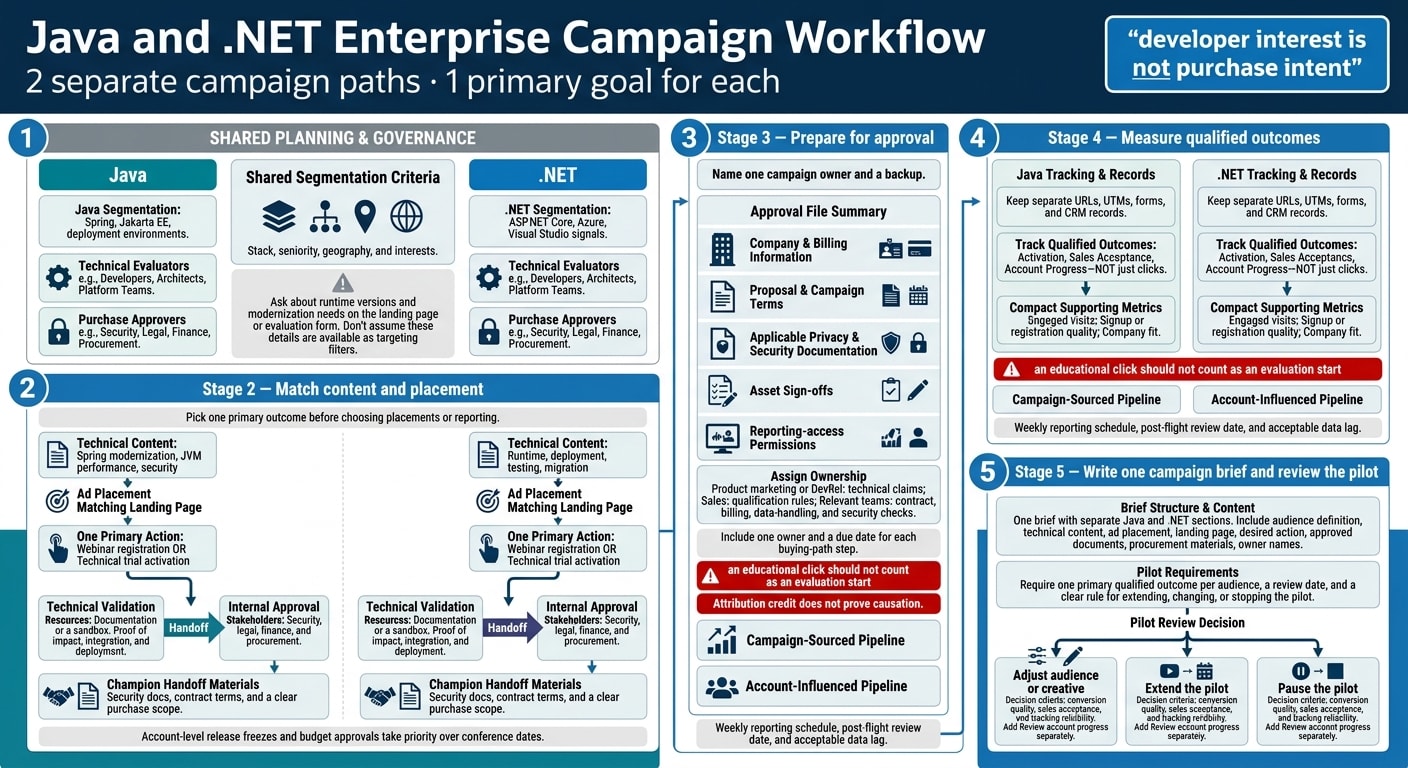
I’d build 2 separate campaign paths for Java and .NET developers, with 1 primary goal for each. Match the technical content, ad, and landing page to each stack - and give developers a clear next step toward evaluation.
Here’s how I’d plan it:
- Define the audience: Use stack, seniority, geography, and interests. Separate technical evaluators from purchase approvers.
- Match content and placement: Choose daily.dev Ads formats that fit your goal, from technical reading to trials or events. Plan around team evaluation windows and approval deadlines.
- Prepare for approval: Assign owners and gather security, legal, billing, and procurement documents before launch.
- Measure qualified outcomes: Track Java and .NET separately. Review activation, sales acceptance, and account progress - not just clicks.
- Write one campaign brief: Include both audience paths, a review date, and rules for changing, extending, or stopping the pilot.
My starting rule: developer interest is not purchase intent. Help readers validate the product first, then give their internal champions the materials needed for approval. Keep those two steps separate.
1. Define your audience and campaign goal
Pick one primary outcome before choosing placements or reporting. Let that outcome guide your asset, conversion, and measurement. In enterprise campaigns, the same product needs separate paths for technical validation and internal approval.
| Primary goal | Offer or destination | Measure |
|---|---|---|
| Awareness | Relevant technical content | Reach and engagement |
| Education | Implementation guide or technical report | Guide views and docs visits |
| Trials | Stack-specific trial page | Signups and activation |
| Events | Technical webinar registration page | Registrations and attendance |
| Account-based demand | Evaluation content for target accounts | Qualified evaluators and account movement |
With the goal set, divide your audience by stack and buying role.
Segment Java and .NET audiences by stack
For Java, distinguish Spring audiences from Jakarta EE audiences and note their deployment environments. For .NET, map ASP.NET Core, Azure, and Visual Studio signals. Pair those signals with seniority, geography, and interests instead of relying on job titles alone.
Ask about runtime versions and modernization needs on the landing page or evaluation form. Don't assume these details are available as targeting filters. Public-profile signals may suggest a fit, but they don't confirm an employer's stack. Use the stack segments to shape your message, landing page, and next step.
Identify evaluators and buying stakeholders
Next, map who evaluates the product and who approves the purchase.
Give developers documentation or a sandbox for technical validation. Engineering managers, architects, and platform teams need proof of impact, integration, and deployment. Define what counts as a qualified lead before launch; not every signup represents enterprise demand.
Security, legal, finance, and procurement need a separate approval path. Prepare security docs, contract terms, and a clear purchase scope that your technical champion can share. For account-based demand generation, track the difference between reaching an evaluator and moving an account toward a purchase. Developer interest is an entry point - not proof of budget or buying authority.
2. Plan content and daily.dev Ads placements
Match content and timing to each ecosystem
Use the stack and role segments from section 1 to pick your sources, content angles, and timing.
For Java, turn to InfoQ for architecture, Baeldung for implementation, and Foojay for JVM topics. Use Devoxx sessions to identify current technical questions. Focus on release adoption, Spring modernization, performance, or security - whichever helps readers make their next evaluation decision.
As of October 14, 2026, Microsoft Learn, the .NET Blog, and Microsoft community resources list .NET Conf 2026 for November 10–13 and describe it as the launch event for .NET 11. Check dates, sessions, and release-support details before launch. Schedule educational content before evaluation windows and implementation content afterward. Account-level release freezes and budget approvals take priority over conference dates.
With the message set, choose a placement that supports the next step.
Choose a daily.dev Ads format for your goal
Choose a daily.dev Ads format based on your asset and the action you want readers to take. Target by tech stack, seniority, geography, and interests. Before launch, confirm topic tracks, placement fit, and ad requirements.
| Objective | Recommended format | Required asset | Primary measurement |
|---|---|---|---|
| Drive qualified technical traffic | In-Feed Native Ads | Stack-specific ad copy and visuals, plus a matching landing page | Engaged visits and qualified conversions |
| Distribute technical content | Sponsored Post with guaranteed feed impressions, a read-floor commitment, and canonical republishing | Technical article, canonical source, and next step | Feed-impression delivery, read-floor fulfillment, and assisted conversions |
| Build association with a technical topic | Engagement Ads: Branded Tags, Keyword Spotlights, Custom Upvotes, Tag Page Takeovers, and Stack Placements | Approved terms, tags, stack references, and ad copy and visuals | Placement engagement and qualified traffic |
| Reach readers by subject area | Digest newsletter sponsorships by topic track | Concise sponsor copy and a focused destination | Clicks and qualified conversions |
Build separate Java and .NET conversion paths
Give each format one next step in the buyer journey, and keep the ad promise consistent through evaluation. For Java, move from a modernization or JVM problem to implementation guidance, architecture explanations, technical validation, and evaluation materials. Follow the same stages for .NET, but use its own runtime, deployment, testing, and migration language. Link each asset to the next useful resource instead of sending every visitor straight to a sales form.
Keep URLs, ad copy and visuals, tracking parameters, CRM campaign names, and conversion events separate for each track. Set one primary action per destination, such as webinar registration or technical trial activation. Treat documentation visits and guide completions as secondary signals: an educational click should not count as an evaluation start. After technical validation, send champions to security, legal, and procurement materials that help them secure internal approval.
3. Prepare approvals, launch and reporting
Once you’ve built separate Java and .NET paths, confirm approvals and reporting before launch.
Prepare procurement and approval documents
Get the daily.dev Ads pilot ready for approval. Document the objective, audience, primary conversion, flight dates, budget owner, approved assets, landing page, reporting requirements, and review date. Name one campaign owner and a backup. Product marketing or DevRel should approve technical claims, sales should own qualification rules, and the relevant teams should handle contract, billing, data-handling, and security checks.
Keep everything in one approval file: company and billing information, the current proposal and campaign terms, applicable privacy and security documentation, asset sign-offs, and reporting-access permissions. For inventory from verified partner publishers, include placement context, audience fit, delivery expectations, and reporting responsibility without naming the publishers.
Map the buying path from stakeholder alignment through performance review. Give each step one owner and a due date.
Track conversion quality and account progress
Before launch, define qualified traffic, engaged visits, signups, event registrations, and account progress for each stack. Choose one primary outcome and use the other measures to spot drop-offs. Set a weekly reporting schedule, a post-flight review date, and an acceptable data lag so incomplete data doesn’t drive budget decisions.
Test that campaign parameters stay intact through forms and signup, and that the campaign, audience, creative, and conversion timestamp reach the CRM. Keep Java and .NET separate in URLs, UTMs, forms, and CRM records. Check the full handoff before launch, then review both stacks using the same qualification rules.
Treat CTR as an engagement signal - not a standalone measure of success. Review click quality alongside engagement, signup or registration quality, company fit, sales acceptance, and account movement.
State the attribution model, eligible channels, and lookback window. Attribution credit does not prove causation. Keep campaign-sourced pipeline separate from account-influenced pipeline, and label influenced pipeline clearly.
At the scheduled review, decide whether to adjust the audience or creative, extend the pilot, or pause it. Base that decision on conversion quality, sales acceptance, and tracking reliability. Review account progress separately.
4. Complete your campaign brief
Once approvals and reporting are set, write one brief with separate Java and .NET sections. For each audience, connect the technical content, ad placement, landing page, and developer marketing insights for each action. Make the audience definition a fixed part of the brief.
Work backward from evaluation milestones and approval deadlines. Match educational content to research, implementation guidance to validation, and demo or trial pages to active evaluation. Choose the daily.dev Ads format that supports each goal, and explain why it fits.
Attach the approved documents, procurement materials, and owner names. Then specify one primary qualified outcome per audience, a review date, and a clear rule for extending, changing, or stopping the pilot. Someone outside the campaign team should be able to read the brief and understand both the test and its pass-fail rule.
For a final check on audience fit, format, and timing, discuss campaign planning before launch.
FAQs
How should I split my budget between Java and .NET campaigns?
Prioritize the language that matches your main enterprise pipeline stage, while keeping baseline support for the other. Run always-on or monthly In-Feed Native Ads for Java and .NET, targeting each separately by tech stack and seniority.
Add Digest newsletter sponsorships by topic track around Spring and Microsoft ecosystem milestones, when intent is highest. Compare performance during the campaign, then shift spending based on live reporting recommendations.
What signals show a developer is ready for sales outreach?
A developer is ready for sales outreach when they move from passive research to actively evaluating your tooling. Look for frequent interactions with your category keywords, follows of your branded tags, and engagement with your technical content across the daily.dev feed and digests.
daily.dev targeting uses real-time reading behavior, not outdated profile data, to identify developers looking into your stack, CI/CD pipelines, or observability tools.
How long should an enterprise campaign pilot run?
For enterprise campaigns on daily.dev Ads, plan for a full-month pilot. That gives developers time to connect your brand with your category and gives you a reliable view of performance before you decide whether to scale.
Start with a focused in-feed test to see what resonates. Successful enterprise brands often move from pilots to quarterly commitments, then to regular monthly spend.